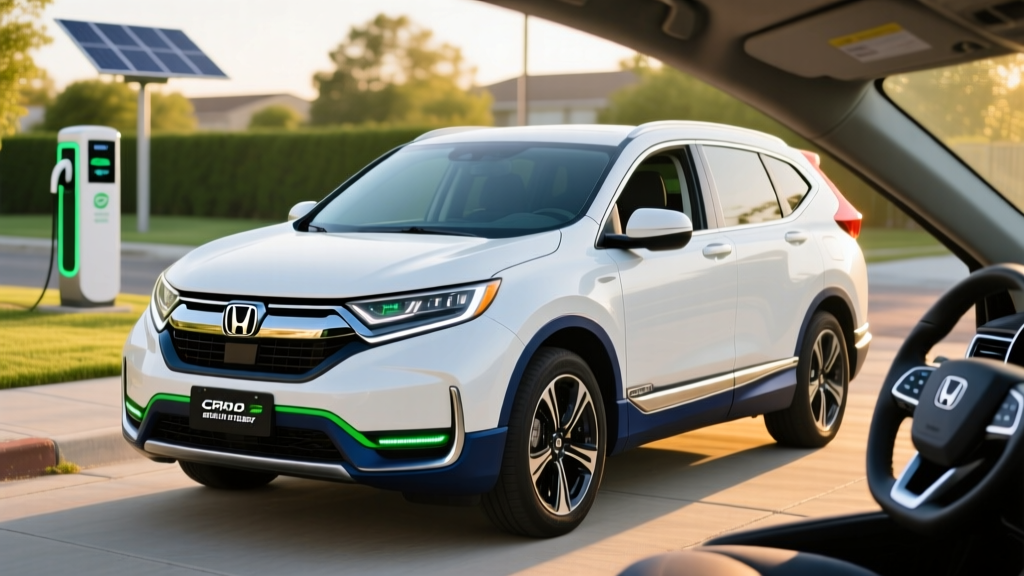
The Honda CR-V has long been one of America's best-selling compact SUVs, and its hybrid variant has become the default choice for buyers who want excellent fuel economy without the range limitations or charging demands of a full electric vehicle. For 2025, Honda has refined the CR-V Hybrid into a compelling package that balances efficiency, practicality, and value. This guide covers every major 2025 Honda CR-V Hybrid feature — from its two-motor powertrain and EPA-rated MPG to battery longevity, trim pricing, and how it stacks up against plug-in hybrids and battery-electric SUVs.
HEV vs PHEV: What the CR-V Hybrid Actually Is
Before examining specs, it's critical to understand what the 2025 CR-V Hybrid is — and what it isn't. Honda offers the CR-V exclusively as a conventional hybrid (HEV) in the United States. There is no plug-in hybrid (PHEV) variant for the North American market. The competing Toyota RAV4, by contrast, offers both a standard hybrid and a RAV4 Prime PHEV with 42 miles of electric-only range.
HEV (CR-V Hybrid) vs PHEV (e.g., RAV4 Prime) vs BEV (e.g., Ioniq 5)
| Attribute | HEV (CR-V Hybrid) | PHEV (RAV4 Prime) | BEV (Ioniq 5) |
|---|---|---|---|
| Plug-in Required? | No — self-charging | Yes — 120V or 240V | Yes — Level 2 or DC fast |
| Electric-Only Range | ~1 mile (low-speed) | 42 miles EPA | 303 miles EPA |
| Fuel/Charging Infra | Gas stations only | Gas + home outlet | Home charger + public DC |
| Federal Tax Credit | Not eligible (§30D) | Not eligible (§30D) | Up to $7,500 (if eligible) |
| Best For | No home charging access | Short commutes + gas flexibility | Home charging + low running costs |
The HEV designation means the CR-V Hybrid charges its own small battery through regenerative braking and the gasoline engine. You never plug it in. You simply fill up at a gas station and drive. This makes it ideal for apartment dwellers, street parkers, or anyone without reliable access to a home charger.
Powertrain Specs: Two-Motor Hybrid System
The 2025 CR-V Hybrid uses Honda's fourth-generation two-motor hybrid system, pairing a 2.0-liter Atkinson-cycle four-cylinder engine with two electric motors. Here are the exact figures:
| Specification | 2025 Honda CR-V Hybrid |
|---|---|
| Engine | 2.0L DOHC Atkinson-cycle 4-cylinder |
| Engine Horsepower | 145 hp @ 6,100 rpm |
| Combined System Output | 204 hp |
| Combined Torque | 247 lb-ft (electric motor) |
| Transmission | e-CVT (direct-drive, no traditional gears) |
| Drivetrain (FWD trims) | Front-wheel drive |
| Drivetrain (AWD trims) | Real Time AWD with torque vectoring |
| 0–60 mph (est.) | ~7.6 seconds (AWD) |
| Towing Capacity | 1,000 lbs |
| Battery Type | Lithium-ion (approx. 1.1 kWh usable) |
The system operates primarily in electric-drive mode at low and moderate speeds, with the gas engine acting as a generator to feed the drive motor. At highway speeds, a lock-up clutch connects the engine directly to the wheels for efficiency. This seamless handoff is virtually imperceptible from the driver's seat — a hallmark of Honda's hybrid engineering.
Fuel Economy: EPA Ratings and Real-World MPG
Fuel economy is the headline feature of any hybrid, and the 2025 CR-V Hybrid delivers strong numbers across all trims. According to fueleconomy.gov, here is the official EPA breakdown:
| Drivetrain | City MPG | Highway MPG | Combined MPG |
|---|---|---|---|
| FWD (Sport, Sport Touring) | 43 | 36 | 40 |
| AWD (Sport, Sport Touring) | 40 | 34 | 37 |
Real-World MPG: What to Actually Expect
EPA ratings are a starting point, not a guarantee. In real-world driving, the CR-V Hybrid's behavior follows a pattern common to all series-parallel hybrids: city MPG often exceeds the EPA estimate, while highway MPG can fall slightly below it.
Here's why. In stop-and-go city traffic, the electric motor handles most of the propulsion, and regenerative braking recaptures energy at every stop. Owners frequently report 42–45 MPG in urban driving on FWD trims. On the highway, however, the aerodynamic drag of a compact SUV and the reduced benefit of regen braking mean sustained 70–75 mph cruising typically yields 32–35 MPG for AWD models.
Cold-weather impact: Expect a 5–10% reduction in fuel economy during winter months (below 30°F). The engine runs more frequently to provide cabin heat, and battery efficiency drops in cold temperatures. This is far less severe than the 20–30% range loss a battery-electric vehicle experiences in the same conditions, but it's worth factoring in if you live in northern climates.
- City (mild weather): 42–45 MPG (FWD), 39–42 MPG (AWD)
- Highway (70 mph): 33–36 MPG (FWD), 31–34 MPG (AWD)
- Winter combined: ~34–37 MPG (AWD)
- Total driving range: ~540 miles (FWD, 14.0-gal tank)
2025 CR-V Hybrid Trims, Pricing, and Tax Credit Eligibility
For 2025, Honda offers the CR-V Hybrid in two dedicated hybrid trims: the Sport and the Sport Touring. Both are available with FWD or AWD. Pricing below includes Honda's $1,395 destination charge:
| Trim | Drivetrain | MSRP (incl. destination) |
|---|---|---|
| Sport Hybrid | FWD | $36,395 |
| Sport Hybrid | AWD | $37,895 |
| Sport Touring Hybrid | AWD (standard) | $41,895 |
Does the CR-V Hybrid Qualify for a Federal Tax Credit?
No. The 2025 Honda CR-V Hybrid does not qualify for the federal §30D Clean Vehicle Credit. Under current IRS rules, only battery-electric vehicles (BEVs) and qualifying plug-in hybrid electric vehicles (PHEVs) with at least 7 kWh of battery capacity are eligible for the up-to-$7,500 credit. Conventional hybrids like the CR-V do not meet this threshold.
However, some states and local utilities offer rebates for hybrid purchases. Check your state energy office or utility provider for current programs. Additionally, the CR-V Hybrid's lower fuel costs — roughly $600–$800/year less than the gas-only CR-V at 15,000 miles/year — provide ongoing savings that partially offset the lack of an upfront incentive.
Battery Longevity, Warranty, and Replacement Cost
Battery lifespan is consistently the top concern among first-time hybrid buyers. Here's what the data shows for the 2025 CR-V Hybrid:
Honda Hybrid Battery Warranty
- Hybrid battery: 8 years / 100,000 miles (10 years / 150,000 miles in CARB states including CA, NY, MA, and others)
- Hybrid system components: 8 years / 100,000 miles
- Powertrain warranty: 5 years / 60,000 miles
- Capacity retention threshold: Honda covers the battery if it fails or degrades below functional levels — not a specific percentage like BEV warranties
How Long Will the CR-V Hybrid Battery Last?
Honda's lithium-ion hybrid battery is small (~1.1 kWh usable) and operates within a narrow state-of-charge window — typically between 40% and 80%. This shallow cycling dramatically reduces stress on the cells compared to a BEV battery that regularly charges to 100% and discharges to near zero.
Based on historical data from Honda's hybrid lineup (Insight, Accord Hybrid, previous-gen CR-V Hybrid), these batteries routinely last 150,000–200,000+ miles before any significant degradation. Many first-generation Insight and Civic Hybrid owners reported original batteries exceeding 200,000 miles.
Battery Replacement Cost
If the hybrid battery does eventually need replacement out of warranty, expect to pay between $2,000 and $4,000 for a new OEM battery pack including labor. Refurbished or aftermarket options may be available for $1,000–$2,000. This is substantially less than BEV battery replacements, which can exceed $10,000–$20,000, because the CR-V Hybrid's battery is small and accessible.
Key 2025 CR-V Hybrid Features by Trim
Beyond the powertrain, the 2025 CR-V Hybrid trims carry distinct feature sets. Here's what differentiates them:
Sport Hybrid (base hybrid trim)
- 7-inch touchscreen with wireless Apple CarPlay and Android Auto
- Honda Sensing suite (adaptive cruise, lane-keeping, collision mitigation, road departure mitigation)
- LED headlights and taillights
- 18-inch alloy wheels
- Dual-zone automatic climate control
- Push-button start with smart entry
- Blind-spot information with rear cross-traffic monitor
Sport Touring Hybrid (top trim)
- 9-inch touchscreen with wireless Apple CarPlay and Android Auto
- Built-in navigation
- Wireless phone charging pad
- 12-speaker Bose premium audio system
- Heated front seats and heated steering wheel
- Power-adjustable front seats with driver memory
- Hands-free power tailgate with walk-away close
- Low-speed braking control and front/rear parking sensors
- Rain-sensing wipers
- AWD standard (not available as FWD)
The Sport Touring adds approximately $5,500 to the AWD Sport's price, primarily through premium audio, the larger infotainment screen, and comfort features. For most buyers, the Sport AWD at $37,895 offers the best value proposition in the lineup.
CR-V Hybrid vs Full EV vs Gas: Which Should You Choose?
The 2025 CR-V Hybrid occupies a specific niche. Here's a decision framework to determine whether it's the right choice for your situation:
Choose the CR-V Hybrid if:
- You don't have access to home or workplace charging (apartment, street parking, condo without EV infrastructure)
- You want 37–40 MPG without changing your fueling habits at all
- You regularly drive long distances where charging stops would add unwanted time
- You want lower upfront cost than a BEV ($36K–$42K vs $45K–$55K for comparable electric SUVs)
- You live in a region with extreme cold where BEV range loss is a concern
Choose a PHEV (like the RAV4 Prime) if:
- You have home charging and a commute under 40 miles round-trip
- You want to drive mostly on electricity weekdays but need gas flexibility for weekend trips
- You want to reduce gasoline consumption by 60–80% without full BEV commitment
Choose a Full EV (like the Ioniq 5 or EV6) if:
- You have reliable Level 2 home charging
- Your daily driving is under 250 miles and you're comfortable planning DC fast-charge stops on road trips
- You want the lowest per-mile fuel cost (~$0.04/mi on home electricity vs ~$0.12/mi for the CR-V Hybrid on gas)
- You want to take advantage of the up-to-$7,500 federal tax credit and potential state incentives
Pros and Cons at a Glance
Pros
- 40 MPG combined (FWD) — among the best in the compact SUV segment
- No plug-in charging required — works with existing gas-station infrastructure
- Smooth, quiet electric-drive feel at city speeds
- Spacious interior with 36.3 cu ft cargo behind rear seats (76.5 cu ft folded)
- Standard Honda Sensing ADAS on all trims
- Strong reliability track record for Honda's hybrid system
- 8-year/100,000-mile hybrid battery warranty (10 yr/150K in CARB states)
- AWD available across both hybrid trims
Cons
- No federal tax credit eligibility (unlike qualifying BEVs and PHEVs)
- No plug-in / electric-only driving mode for zero-emission commutes
- Engine drone under hard acceleration (e-CVT characteristic)
- 1,000-lb towing capacity — less than some turbo-gas competitors
- Sport Touring at $41,895 approaches PHEV and BEV territory
- 7-inch base screen feels dated for the price point
- Real-world highway MPG drops to low-to-mid 30s at sustained speeds
Frequently Asked Questions
How many MPG does the 2025 Honda CR-V Hybrid get?
The FWD CR-V Hybrid is EPA-rated at 43 city / 36 highway / 40 combined MPG. The AWD version rates 40 city / 34 highway / 37 combined. In real-world city driving, many owners report exceeding the EPA city estimate by 2–5 MPG thanks to frequent regenerative braking. Highway fuel economy tends to match or fall slightly below the EPA figure at sustained speeds above 70 mph.
Can the CR-V Hybrid drive on electric power alone?
Only for very short distances (roughly 1 mile) at low speeds, such as creeping through a parking lot. The battery is too small (~1.1 kWh) for meaningful electric-only driving. Unlike a PHEV, the CR-V Hybrid is not designed to operate as an electric car — it uses its electric motors to assist the gas engine and optimize overall efficiency.
Does the 2025 CR-V Hybrid qualify for any tax credit?
It does not qualify for the federal §30D Clean Vehicle Credit, which is reserved for plug-in vehicles (BEVs and PHEVs) meeting battery capacity, sourcing, MSRP, and buyer income requirements. Some state or utility-level incentives may apply — check your local programs. The competing Toyota RAV4 Prime PHEV may qualify for partial credits depending on current sourcing rules.
Is the CR-V Hybrid reliable, and what does a battery replacement cost?
Honda's hybrid system has an excellent reliability record spanning two decades. The hybrid battery is warrantied for 8 years/100,000 miles (10 years/150,000 miles in CARB states). Real-world data suggests these batteries routinely last 150,000–200,000+ miles. Out-of-warranty replacement costs approximately $2,000–$4,000 for a new OEM pack — far less than a BEV battery replacement.
Is the CR-V Hybrid better than the gas-only CR-V?
For most buyers, yes. The hybrid costs approximately $1,500–$2,000 more than a comparably equipped gas CR-V but saves $600–$800 per year in fuel at 15,000 miles/year (assuming $3.50/gallon). Payback typically occurs within 2–3 years. The hybrid also delivers smoother low-speed acceleration and quieter city driving. The gas-only CR-V's main advantage is a slightly higher towing capacity (1,500 lbs vs 1,000 lbs).
Does the CR-V Hybrid require premium fuel?
No. The 2025 CR-V Hybrid runs on regular 87-octane unleaded gasoline, keeping operating costs low.
The 2025 Honda CR-V Hybrid is a pragmatic, well-executed compact SUV that delivers exactly what it promises: class-leading fuel economy with zero lifestyle compromise. It won't qualify for federal tax credits, and it won't drive 40 miles on electricity alone. But for the millions of buyers who lack home charging access or simply want a fill-up-and-go vehicle that sips fuel, the CR-V Hybrid remains one of the strongest choices in the segment — backed by Honda's proven hybrid reliability and a battery warranty that should outlast most ownership periods.