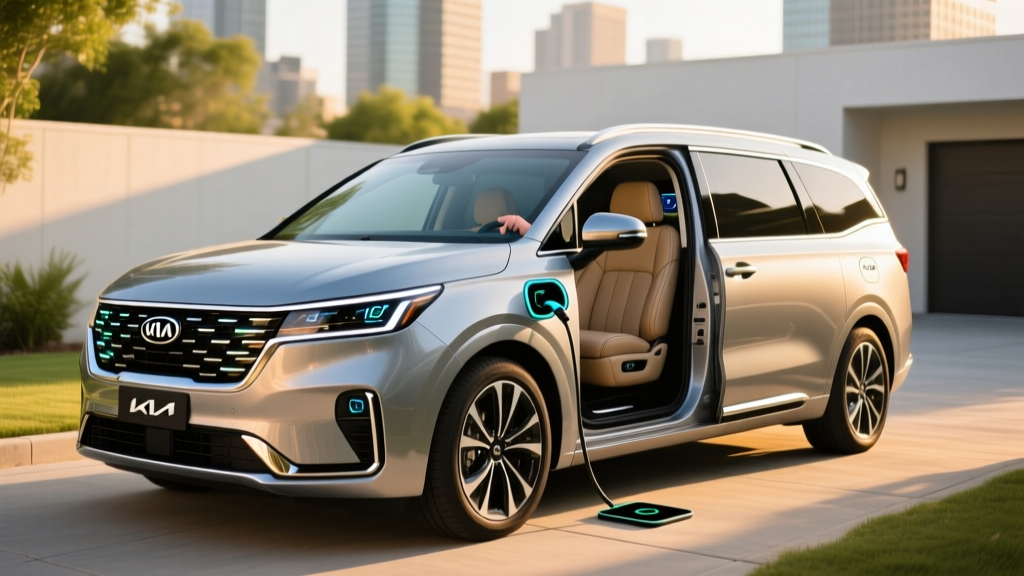
The minivan segment just got more efficient. Kia introduced the 2025 Kia Carnival Hybrid minivan as the first electrified variant of its popular people-hauler, pairing a 1.6-liter turbocharged four-cylinder with an electric motor to deliver a combined 245 horsepower and an EPA-estimated 34 MPG combined. For families who need three rows, serious cargo space, and lower fuel bills — but aren't ready to commit to a full battery-electric vehicle — this is a compelling proposition.
At AutoEdgeView, we've spent time analyzing the Carnival Hybrid's powertrain specs, real-world efficiency data, and ownership economics. Here's everything you need to know before visiting a dealer.
2025 Kia Carnival Hybrid: Key Specifications at a Glance
| Specification | 2025 Kia Carnival Hybrid |
|---|---|
| Powertrain | 1.6L Turbo I4 + Electric Motor (HEV) |
| Combined Horsepower | 245 hp |
| Combined Torque | 271 lb-ft |
| Transmission | 6-speed automatic |
| EPA Fuel Economy (City/Hwy/Combined) | 34 / 31 / 34 MPG |
| Fuel Tank Capacity | 15.9 gallons |
| Total Driving Range | ~540 miles |
| Drivetrain | Front-wheel drive |
| Seating | 7 or 8 passengers |
| Cargo Volume (behind 3rd row) | 41.1 cu ft |
| Max Cargo Volume | 145.1 cu ft |
| Towing Capacity | 3,500 lbs |
| Starting MSRP | $40,900 (LX trim) |
| Hybrid Battery Warranty | 10 years / 100,000 miles |
How Many MPG Does the Carnival Hybrid Actually Get?
The EPA rates the 2025 Kia Carnival Hybrid at 34 MPG city, 31 MPG highway, and 34 MPG combined, according to fueleconomy.gov. That's a meaningful improvement over the gasoline-only Carnival, which returns 19 city / 26 highway / 22 combined.
| Metric | Carnival Hybrid (HEV) | Carnival Gas (V6) | Difference |
|---|---|---|---|
| City MPG | 34 | 19 | +79% |
| Highway MPG | 31 | 26 | +19% |
| Combined MPG | 34 | 22 | +55% |
| Annual Fuel Cost* | ~$1,650 | ~$2,550 | Save ~$900/yr |
*Based on 15,000 miles/year, 55% city driving, and $3.50/gallon regular unleaded. Your costs will vary with local fuel prices and driving patterns.
Real-World MPG vs. EPA Estimates
Hybrids like the Carnival tend to meet or exceed their EPA city estimates in real-world stop-and-go driving, where regenerative braking recaptures energy that a gas-only vehicle wastes as heat. On suburban errand runs and school-dropoff routes, owners of similar Hyundai/Kia turbo-hybrid powertrains (like the Tucson Hybrid and Sorento Hybrid) frequently report 33–36 MPG in mixed city driving.
Highway driving is where hybrids lose their advantage. At sustained 70-80 MPH speeds, the electric motor contributes less and aerodynamic drag dominates the Carnival's boxy minivan profile. Expect 28–31 MPG on the highway in real-world conditions, roughly in line with the EPA highway figure. Cold weather will knock 2–4 MPG off both city and highway figures due to increased engine idle time for cabin heating and reduced battery efficiency.
HEV vs. PHEV: Why the Carnival Hybrid Is a Conventional Hybrid
This is where buyer confusion often sets in. The 2025 Kia Carnival Hybrid is a conventional hybrid electric vehicle (HEV), not a plug-in hybrid (PHEV). That distinction matters for your daily routine and your wallet.
| Feature | Carnival Hybrid (HEV) | Plug-in Hybrid (PHEV) Example |
|---|---|---|
| Needs to be plugged in? | No — self-charging via engine + regen | Yes — plug in for electric-only range |
| Electric-only range | None (motor assists engine at low speeds) | Typically 20–40 miles |
| Battery size | ~1.5 kWh (small, buffer-style) | 12–25 kWh |
| Home charger required? | No | Recommended (Level 2 for faster charging) |
| Federal tax credit eligible? | No | Up to $7,500 (if battery sourcing/income rules met) |
| Best for | No home charging access; wants simplicity | Home charging + short daily commute |
The Carnival Hybrid's small battery charges entirely through regenerative braking and the gasoline engine. You never plug it in. You simply fill up at a gas station and drive — exactly like a conventional minivan, but with significantly better fuel economy. If you want plug-in electric range in a Kia minivan, you'll need to look elsewhere; Kia does not currently offer a Carnival PHEV in the U.S. market.
Powertrain Deep Dive: 245 HP Turbo Hybrid System
Kia's hybrid system in the Carnival pairs a 1.6-liter turbocharged GDI four-cylinder engine (producing roughly 178 hp on its own) with a 47.7 kW (64 hp) electric motor integrated into the transmission housing. Combined output is 245 horsepower and 271 lb-ft of torque, routed to the front wheels through a 6-speed automatic transmission.
This is the same powertrain architecture found in the Kia Sorento Hybrid and Hyundai Tucson Hybrid, where it has proven capable and smooth. The electric motor fills in torque at low RPMs before the turbo spools up, eliminating the lag that some turbo-four minivans exhibit. The result is confident merging and passing, even with a full load of passengers and cargo.
For context, the gas-only Carnival's 3.5L V6 produces 290 hp and 262 lb-ft. The hybrid gives up some peak horsepower but matches or exceeds the V6's low-end torque delivery, which is what you feel in everyday driving.
Pricing, Trims, and Tax Credit Eligibility
The 2025 Kia Carnival Hybrid starts at $40,900 MSRP for the LX trim and climbs to approximately $51,900 for the top SX Prestige trim. That's roughly a $2,000–$3,000 premium over comparable gas-only Carnival trims.
Does the Carnival Hybrid Qualify for a Federal Tax Credit?
No. The federal §30D Clean Vehicle Credit (up to $7,500) applies only to plug-in electric vehicles — battery-electric vehicles (BEVs) and plug-in hybrids (PHEVs) with battery capacities of at least 7 kWh. Because the Carnival Hybrid is a conventional HEV with a small self-charging battery, it does not qualify. This is confirmed by IRS guidelines on the Clean Vehicle Credit.
Some states offer their own incentives for hybrids, but these are increasingly rare as state programs shift focus to BEVs and PHEVs. Check your state's energy or environmental agency website for current programs.
Battery Warranty, Reliability, and Replacement Costs
Hybrid battery longevity is consistently the top concern among first-time hybrid buyers. Here's what Kia provides:
• 10 years / 100,000 miles (whichever comes first)
• Covers defects and capacity loss below functional thresholds
• Transferable to second owner (terms may vary — check with dealer)
• Hybrid system components (motor, inverter, control electronics): 10 years / 100,000 miles
Kia's 10-year/100,000-mile hybrid battery warranty is among the best in the industry and should cover most owners through the vehicle's primary ownership period. The Carnival Hybrid uses a relatively small lithium-ion polymer battery pack (~1.5 kWh), which experiences less stress than the large packs in BEVs and PHEVs because it never deep-cycles — it operates in a narrow state-of-charge window managed by the hybrid control system.
Is the Carnival Hybrid Reliable?
This specific hybrid powertrain (1.6T + electric motor) has been in production across Hyundai/Kia models since 2022. Early reliability data from the Sorento Hybrid and Tucson Hybrid — which share the same architecture — has been generally positive, with no widespread battery failure patterns reported. IIHS has evaluated the Carnival for crash safety, which matters for family buyers.
What Does a Hybrid Battery Replacement Cost?
If you do need to replace the hybrid battery out of warranty — typically a concern at 150,000+ miles — expect to pay between $2,000 and $4,000 for the battery pack plus labor at a Kia dealership. This is significantly less than a BEV battery replacement (which can exceed $10,000–$20,000) because the Carnival Hybrid's pack is small. Independent hybrid specialists often offer refurbished packs for $1,200–$2,000.
Pros
- 34 MPG combined — a 55% improvement over the gas Carnival
- No plug-in charging required; zero lifestyle change
- 245 hp with strong low-end torque from electric motor assist
- 10-year/100,000-mile hybrid battery warranty
- Same cargo space and seating flexibility as gas Carnival
- 3,500-lb towing capacity retained
Cons
- No federal tax credit eligibility (HEV, not PHEV)
- FWD only — no AWD option available
- Highway MPG advantage over gas model is modest (~19%)
- ~$2,000–$3,000 price premium over gas-only Carnival
- Electric-only driving not possible (not a PHEV)
- Hybrid trims may have limited dealer availability
Who Should Buy the Carnival Hybrid vs. a Gas Minivan or Full EV?
Choose the Carnival Hybrid if:
- You drive 12,000+ miles per year and want meaningful fuel savings without plugging in
- You don't have access to home or workplace EV charging
- You want three rows, large cargo space, and a proven hybrid system
- Your daily driving is a mix of city errands and suburban commuting (where the hybrid shines)
Stick with the Gas Carnival if:
- You drive fewer than 8,000 miles per year (fuel savings won't offset the hybrid premium quickly)
- You want AWD (available on some gas Carnival trims, not on the hybrid)
- You find a heavily discounted gas model and prioritize lowest upfront cost
Consider a Full EV (like the Kia EV9) if:
- You have reliable Level 2 home charging
- You want the lowest per-mile energy cost (~$0.04–0.06/mile on home electricity vs. ~$0.11/mile in the Carnival Hybrid)
- You qualify for the $7,500 federal tax credit and want to maximize incentives
- You're willing to plan around charging on road trips longer than ~270 miles
5-Year Ownership Cost Snapshot
| Cost Category | Carnival Hybrid (HEV) | Carnival Gas (V6) |
|---|---|---|
| MSRP (LX trim) | $40,900 | $38,900 |
| Federal Tax Credit | $0 | $0 |
| Fuel (5 yr, 15k mi/yr) | ~$8,250 | ~$12,750 |
| Estimated Maintenance (5 yr) | ~$2,800 | ~$3,000 |
| Estimated Insurance (5 yr) | ~$9,500 | ~$9,200 |
| 5-Year Total (before depreciation) | ~$61,450 | ~$63,850 |
Over five years, the Carnival Hybrid saves roughly $2,400 in total operating costs versus the gas model, despite the higher purchase price. The savings widen further if gas prices rise above $3.50/gallon or if you drive more than 15,000 miles annually.
Frequently Asked Questions
Does the 2025 Kia Carnival Hybrid need to be plugged in?
No. The Carnival Hybrid is a conventional hybrid (HEV). Its small battery recharges through regenerative braking and the gasoline engine. You fuel it at a gas station like any other vehicle. There is no plug, no charging cable, and no home charger required.
How far can the Carnival Hybrid drive on electric power alone?
The Carnival Hybrid cannot drive on electric power alone for any meaningful distance. The electric motor assists the gasoline engine at low speeds and during acceleration, but the engine is always running or ready to engage. If you want 20–40 miles of electric-only driving, you need a plug-in hybrid (PHEV), which Kia does not currently offer in the Carnival lineup.
Is the Carnival Hybrid slower than the gas V6 model?
In everyday driving, no. The hybrid's combined 245 hp is less than the gas V6's 290 hp, but the electric motor's instant torque delivery makes the hybrid feel responsive in city driving and highway merging. Kia estimates 0–60 MPH in roughly 7.5 seconds for the hybrid versus approximately 7.0 seconds for the gas model. The difference is negligible for family-hauler duty.
What happens if the hybrid battery fails?
Kia covers the hybrid battery for 10 years or 100,000 miles. If it fails within that window, replacement is covered. Out of warranty, expect $2,000–$4,000 for a new OEM battery pack, or $1,200–$2,000 for a refurbished unit from an independent hybrid specialist. Given the small battery size and shallow cycling, catastrophic failures are uncommon in modern Hyundai/Kia hybrid systems.
Can I get all-wheel drive with the Carnival Hybrid?
No. The 2025 Carnival Hybrid is front-wheel drive only. If AWD is a priority for snow or inclement weather, you'll need to look at the gas-only Carnival (where AWD is available on certain trims) or consider a different hybrid minivan like the Toyota Sienna, which offers AWD with its hybrid powertrain.
How does the Carnival Hybrid compare to the Toyota Sienna Hybrid?
The Toyota Sienna is hybrid-only (all trims) and achieves an EPA-estimated 36 MPG combined with available AWD — slightly better fuel economy and more drivetrain flexibility than the Carnival Hybrid. However, the Carnival offers more cargo volume (145.1 cu ft vs. 101.0 cu ft behind the front seats) and a more premium interior in upper trims. Your choice comes down to whether you prioritize maximum efficiency and AWD (Sienna) or maximum space and upscale features (Carnival Hybrid).