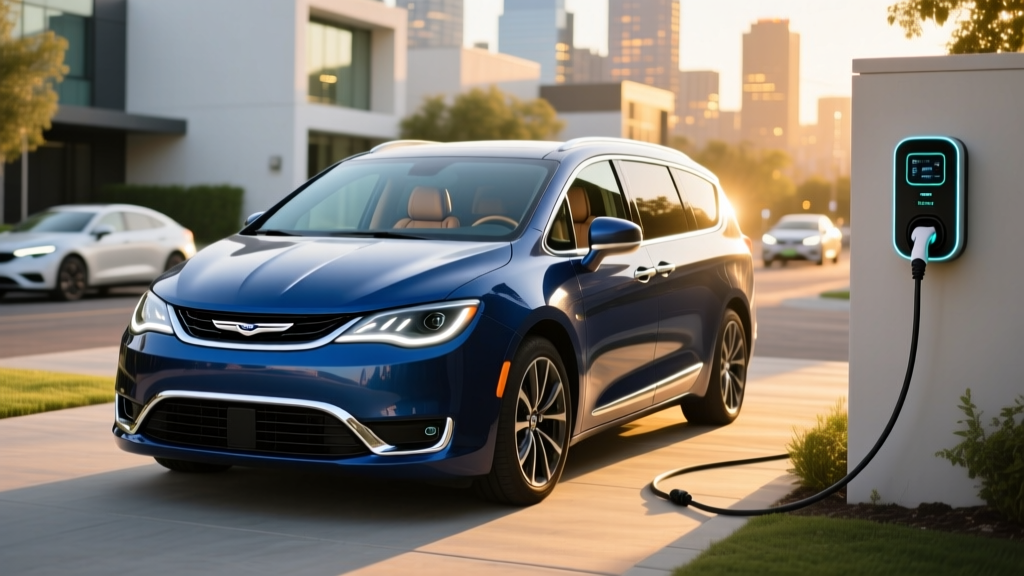
Quick Verdict: The 2026 Chrysler Pacifica Plug-In Hybrid remains the only plug-in hybrid minivan on the U.S. market — a 32-mile electric-only range covers most school runs and grocery trips, and when the battery depletes, it operates as a conventional hybrid returning 30 MPG combined. For families not ready to commit to a full EV, it's a practical bridge.
Pacifica Plug-In Hybrid vs. Conventional Hybrid: What's the Difference?
Chrysler sells the Pacifica in two electrified flavors, and confusing them is easy on a dealership lot. Here's the breakdown:
| Feature | Pacific Hybrid (HEV) | Pacifica Plug-In Hybrid (PHEV) |
|---|---|---|
| Plugs in to charge? | No — charges via engine and regen | Yes — Level 1 (120V) or Level 2 (240V) |
| Electric-only range | None (EV assist only) | 32 miles EPA |
| Battery size | 1.8 kWh (small buffer) | 16.6 kWh usable |
| Combined MPG (gas) | 30 MPG | 30 MPG (after battery depletes) |
| MPGe (electric mode) | N/A | 82 MPGe |
| Starting MSRP | ~$42,095 | ~$51,095 |
| Federal tax credit | None | Up to $7,500 (eligibility varies) |
The conventional Pacifica Hybrid uses its small battery to assist the gas engine at low speeds and during stop-and-go traffic. You never plug it in. The Pacifica plug-in hybrid carries a much larger 16.6 kWh lithium-ion battery that can power the van entirely on electricity for 32 miles before the 3.6L V6 engine kicks in. Once the battery is depleted, it functions identically to the standard hybrid.
Electric-Only Range, MPGe, and Fuel Economy
The headline spec for the Pacifica PHEV is its EPA-rated 32 miles of electric-only driving and 82 MPGe when operating in electric mode. After the battery depletes, the combined fuel economy drops to 30 MPG — identical to the conventional hybrid variant.
| Mode | City | Highway | Combined |
|---|---|---|---|
| Electric-only (MPGe) | 88 MPGe | 76 MPGe | 82 MPGe |
| Hybrid mode (MPG) | 29 MPG | 30 MPG | 30 MPG |
Real-world reality check: The 32-mile electric range is achievable in mild weather with moderate speeds and gentle acceleration. Expect 25–28 miles in mixed suburban/highway driving, and as little as 20–22 miles in cold weather (below freezing), when cabin heating and battery thermal management consume additional energy. In hybrid mode, owners frequently report 31–33 MPG in city driving thanks to generous regenerative braking — hybrids typically exceed EPA city estimates in stop-and-go conditions. Highway hybrid MPG may dip to 27–28 at sustained 75+ mph speeds.
Total combined range (electric + gas) exceeds 520 miles, eliminating range anxiety entirely. Source: EPA Fuel Economy.
Battery, Charging Times, and Powertrain Specs
| Battery capacity | 16.6 kWh usable (lithium-ion) |
| Electric-only range | 32 miles (EPA) |
| Level 1 charging (120V) | ~14 hours (0–100%) |
| Level 2 charging (240V, 32A) | ~2 hours (0–100%) |
| DC fast charging | Not supported |
| Charge port | J1772 (Level 1/2 only) |
| Engine | 3.6L V6 Atkinson-cycle, 262 hp combined system |
| Electric motors | Dual-motor eFlite SI-EVT |
| Combined system output | 262 horsepower |
| 0–60 mph | ~7.1 seconds |
| Drivetrain | Front-wheel drive (no AWD option) |
| Cargo volume (behind 3rd row) | 140.5 cu ft (all seats folded) |
Critical charging note: The Pacifica PHEV does not support DC fast charging. There is no CCS or NACS port. All charging happens via a J1772 connector at Level 1 (standard 120V household outlet) or Level 2 (240V). At Level 1, a full charge takes roughly 14 hours — fine if you plug in every evening and drive 30 miles or fewer the next day. A Level 2 home charger cuts that to about 2 hours, which is far more practical and allows mid-day top-ups.
The eFlite SI-EVT (electrically variable transmission) integrates two electric motors that can drive the wheels independently or work with the V6. The system produces a combined 262 horsepower, which is adequate for merging and passing but not sporty. The Pacifica PHEV is front-wheel drive only — Chrysler does not offer all-wheel drive on the plug-in variant (AWD is available on the gas-only Pacifica).
Pricing, Trims, and Federal Tax Credit Eligibility
The 2026 Pacifica Plug-In Hybrid starts at approximately $51,095 (Select trim) and climbs to around $56,500 for the Limited trim. Destination charges add roughly $1,595.
Federal §30D Tax Credit — Key Requirements (2026):
- Vehicle MSRP must not exceed $80,000 for vans/SUVs (Pacifica qualifies)
- Buyer AGI limits: $300,000 joint / $225,000 head of household / $150,000 single
- Battery components and critical minerals must meet escalating domestic-sourcing thresholds — check current IRS guidance as rules tighten annually
- Credit amount phases based on sourcing compliance: up to $3,750 for critical minerals + up to $3,750 for battery components = $7,500 maximum
- Point-of-sale transfer available — apply credit at purchase instead of waiting for tax filing
Source: IRS Clean Vehicle Credits. Eligibility changes frequently — verify your specific vehicle's VIN and battery sourcing with your dealer and a tax professional before purchase.
If the full $7,500 credit applies, the effective starting price drops to approximately $43,595 — narrowing the gap with the conventional Pacifica Hybrid and making the PHEV considerably more compelling. Some states (California, Colorado, New York, and others) offer additional rebates or HOV-lane access for PHEVs; check your state's energy office for current programs.
Reliability, Battery Warranty, and Replacement Cost
Battery Warranty: Chrysler covers the Pacifica PHEV's high-voltage battery for 10 years or 100,000 miles (whichever comes first) in all 50 states, with a capacity-retention threshold. If the battery drops below approximately 70% of original capacity within the warranty period, Chrysler will repair or replace it at no cost. The powertrain (engine, transmission, electric motors) is also covered for 5 years/60,000 miles.
The Pacifica PHEV's powertrain has been in production since the 2017 model year, giving Chrysler a long track record. The 3.6L Pentastar V6 is one of Stellantis's most proven engines, and the eFlite transmission has accumulated millions of fleet and consumer miles. Common complaints in earlier model years (2017–2019) included software glitches in the hybrid control module and occasional 12V auxiliary battery issues, but the high-voltage battery itself has proven durable.
Battery replacement cost: Out of warranty, a full high-voltage battery replacement for the Pacifica PHEV runs approximately $7,500–$9,500 including parts and labor. However, catastrophic battery failure is rare. More commonly, individual modules can be serviced, reducing cost. Given the 10-year/100,000-mile warranty, most original owners will never face this expense. For used buyers, check remaining warranty coverage via the VIN.
For long-term reliability data, Consumer Reports and J.D. Power track owner-reported issues annually.
Who Should Buy the Pacifica Plug-In Hybrid?
Choose the Pacifica PHEV if:
- Your daily driving is under 35 miles and you can charge at home (Level 2 strongly recommended)
- You need a minivan — sliding doors, three rows, Stow 'n Go seating — but want to minimize fuel costs on school runs and errands
- You take regular road trips where a full EV's charging stops would be inconvenient with kids
- You qualify for the federal tax credit, making the price competitive with the conventional hybrid
Choose the conventional Pacifica Hybrid instead if:
- You cannot install a Level 2 charger at home (apartment, street parking, no garage)
- Your daily mileage consistently exceeds 40+ miles — the PHEV's electric range won't cover enough to justify the price premium
- You need all-wheel drive (available only on the gas Pacifica, not the PHEV)
Consider a full EV (like the Kia EV9) if:
- You can charge at home and rarely drive more than 250 miles without stopping anyway
- You want zero tailpipe emissions and lower per-mile energy costs
- You don't need minivan-specific features like Stow 'n Go (the PHEV's battery eliminates third-row floor stowage)
One practical compromise to note: the Pacifica PHEV's larger battery is mounted under the floor, which eliminates Stow 'n Go seating for the second row. The second-row seats are removable but do not fold into the floor like the conventional hybrid and gas models. If in-floor storage is a dealbreaker, the PHEV may not be the right fit.
Pros
- Only plug-in hybrid minivan available in the U.S.
- 32 miles electric covers most family errands gas-free
- 30 MPG combined after battery depletes — no range anxiety
- 520+ miles total range for road trips
- Up to $7,500 federal tax credit (eligibility-dependent)
- 10-year/100,000-mile battery warranty
- Smooth, quiet electric driving around town
Cons
- No DC fast charging — Level 2 at home is essential
- AWD not available (FWD only)
- Second-row Stow 'n Go eliminated by battery placement
- ~$9,000 price premium over conventional Pacifica Hybrid
- Electric range drops to ~20–22 miles in cold weather
- Not eligible for HOV lane access in all states (check local rules)
Frequently Asked Questions
How many MPG does the Pacifica plug-in hybrid get?
Once the battery is depleted, the Pacifica PHEV returns 30 MPG combined (29 city / 30 highway) as a conventional hybrid. In electric mode, it achieves 82 MPGe combined. Real-world owners often see 31–33 MPG in city driving thanks to regenerative braking.
How far can the Pacifica PHEV drive on electric power alone?
The EPA rates the Pacifica PHEV at 32 miles of electric-only range. In real-world mixed driving, expect 25–28 miles. In cold weather (below 32°F), range can drop to 20–22 miles due to cabin heating demands and reduced battery efficiency.
Does the Pacifica plug-in hybrid qualify for a tax credit?
It may qualify for up to $7,500 under the federal §30D Clean Vehicle Credit, but eligibility depends on your income, the vehicle's battery-sourcing compliance, and current-year IRS rules. Point-of-sale transfer is available so you can apply the credit at purchase. Always verify with IRS.gov and your tax advisor before buying.
Can I charge the Pacifica PHEV at a public DC fast charger?
No. The Pacifica PHEV only supports Level 1 (120V) and Level 2 (240V) charging via a J1772 connector. There is no DC fast-charge capability. This is typical for plug-in hybrids, which have smaller batteries that don't require DC fast charging.
Is the Pacifica PHEV reliable, and what does a battery replacement cost?
The Pacifica PHEV's powertrain is well-established, and the high-voltage battery is covered by a 10-year/100,000-mile warranty. Out-of-warranty battery replacement costs approximately $7,500–$9,500, but full battery failure is uncommon within the warranty period. The 3.6L V6 and eFlite transmission have strong reliability records.
Hybrid vs. PHEV vs. full EV — which minivan is right for me?
If you can charge at home and your daily driving is under 35 miles, the PHEV lets you drive most errands on electricity while keeping a gas engine for road trips. If you can't charge at home, the conventional Pacifica Hybrid gives you strong MPG without plugging in. If you want zero emissions and can charge at home, consider a full EV three-row SUV like the Kia EV9 — but no full-electric minivan currently exists in the U.S. market.
Do I need a Level 2 home charger for the Pacifica PHEV?
You don't strictly need one — a standard 120V outlet will charge the battery overnight in about 14 hours. However, a Level 2 (240V) charger is strongly recommended. It cuts charge time to about 2 hours, lets you top up mid-day, and ensures the battery is full every morning. Budget $800–$2,000 for Level 2 equipment and electrician installation.