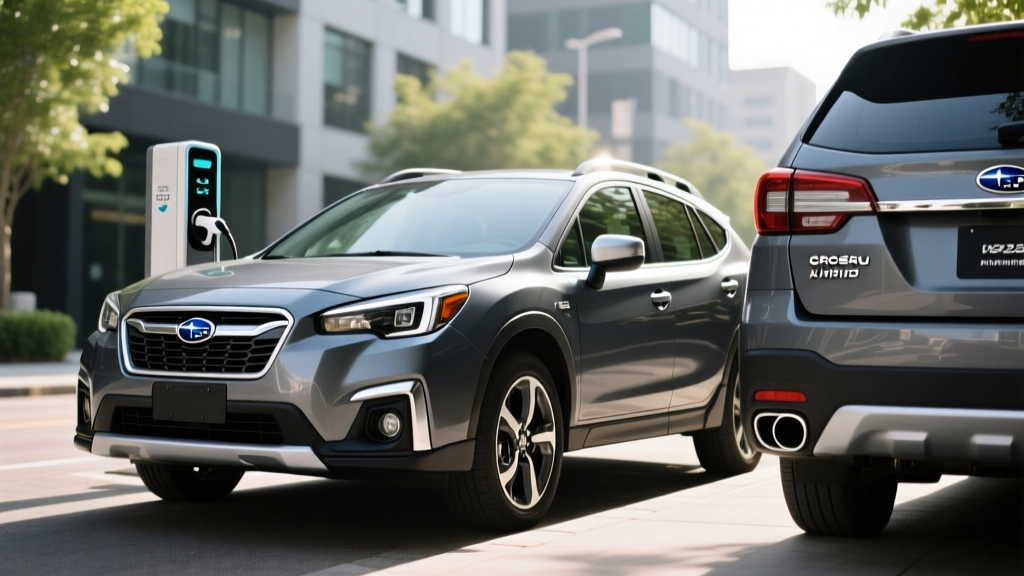
The Subaru Crosstrek has been a staple for outdoorsy drivers who want all-wheel drive without a truck's thirst. For 2026, the top-of-the-line 2026 Crosstrek Limited Hybrid arrives as a plug-in hybrid (PHEV), blending roughly 17 miles of electric-only driving with a gas-powered safety net for longer adventures. But does the PHEV premium over the standard gas Crosstrek make financial sense, and how does real-world MPG stack up against the EPA sticker?
In this guide, we break down the 2026 Crosstrek Limited Hybrid's powertrain, efficiency, electric range, charging logistics, battery warranty, pricing, and tax-credit eligibility. We also compare it against fully electric alternatives and conventional hybrids so you can decide which electrified path fits your driving life.
HEV vs PHEV: Where the Crosstrek Hybrid Lands
Subaru's current-generation Crosstrek Hybrid is a plug-in hybrid electric vehicle (PHEV), not a conventional hybrid (HEV). This distinction matters enormously for your daily routine, fuel costs, and tax-credit eligibility.
| Feature | Conventional Hybrid (HEV) | Plug-In Hybrid (PHEV) |
|---|---|---|
| Plugs in? | No — charges via regenerative braking & engine | Yes — has a usable battery you charge externally |
| Electric-only range | 0–1 mile at very low speeds | Typically 15–40 miles (Crosstrek Hybrid: ~17 mi) |
| Battery size | ~1–2 kWh | ~8–20 kWh (Crosstrek Hybrid: 8.8 kWh usable) |
| Federal tax credit | Not eligible under §30D | May qualify (see eligibility section below) |
| Gas engine backup | Yes | Yes |
If you never plug in, the Crosstrek PHEV still functions as a conventional hybrid — but you're paying extra for battery capacity you never use. This vehicle only makes financial sense if you can charge at home or work most days.
EPA MPG, MPGe, and Electric Range
When the battery is charged, the 2026 Crosstrek Limited Hybrid posts an EPA-estimated 92 MPGe (miles per gallon equivalent) in combined city/highway driving. Once the battery depletes to its gas-only buffer, the hybrid system delivers approximately 35 MPG combined — competitive with the best compact crossover hybrids on the market.
| Driving Mode | City | Highway | Combined |
|---|---|---|---|
| Charge-depleting (EV mode) | 92 MPGe (estimated, electricity + gas blended) | ||
| Charge-sustaining (hybrid only) | 36 MPG | 34 MPG | 35 MPG |
| Electric-only range | ~17 miles | ||
| Total range (battery + full tank) | ~440 miles | ||
For a 15-mile round-trip commute done mostly in town, you could drive months without visiting a gas station — provided you plug in nightly. On road trips, the 13.2-gallon fuel tank gives you the range confidence no pure EV currently matches at this price point.
Powertrain, Horsepower, and Drivetrain
The 2026 Crosstrek Limited Hybrid pairs Subaru's 2.0-liter horizontally opposed (Boxer) four-cylinder engine with two electric motor-generators and a continuously variable transmission (CVT). Combined system output is approximately 148 horsepower.
| Specification | Detail |
|---|---|
| Engine | 2.0L Boxer 4-cylinder |
| Electric motors | Dual motor-generators |
| Combined output | 148 hp |
| Transmission | Lineartronic CVT |
| Drivetrain | Symmetrical All-Wheel Drive |
| 0–60 mph | ~9.5 seconds |
| Towing capacity | 1,000 lbs |
| Ground clearance | 8.7 inches |
| Cargo volume (rear seats up) | 20.8 cu ft |
Symmetrical AWD is standard — a Subaru hallmark. Unlike some competitors that send power only to the front wheels until slip is detected, Subaru's system provides continuous torque to all four wheels, making this one of the most capable PHEVs for snow, gravel, and light trail use. Ground clearance remains at 8.7 inches, identical to the gas Crosstrek, preserving its off-road credibility.
The 148-hp output is modest. The Crosstrek Hybrid won't win drag races, but the electric motor's instant torque (available from 0 rpm) makes around-town acceleration feel peppier than the number suggests. Highway merging requires planning, especially at altitude where naturally aspirated engines lose power.
Battery, Charging, and Plug-In Logistics
The PHEV battery pack holds approximately 8.8 kWh of usable capacity using lithium-ion (NMC chemistry) cells. Unlike a full EV, this PHEV does not support DC fast charging — it's limited to AC Level 1 and Level 2 charging only.
| Charging Level | Power | Time to Full (0–100%) | Where You'll Use It |
|---|---|---|---|
| Level 1 (120V household outlet) | ~1.4 kW | ~5 hours | Overnight at any standard outlet |
| Level 2 (240V home/work charger) | ~3.3 kW | ~2.5 hours | Home garage, workplace, public Level 2 stations |
| DC Fast Charge | N/A — not supported | N/A | Not available on this vehicle |
What this means practically: Most PHEV owners plug in at home every night using a standard 120V outlet (Level 1) and wake up with a full battery. A 5-hour Level 1 charge easily covers the 17-mile electric range. If you want faster top-ups — say, between an evening commute and a morning errand — a Level 2 home charger cuts that to about 2.5 hours.
The lack of DC fast charging is standard for PHEVs in this class. The battery is simply too small to benefit from high-speed DC infrastructure, and adding that hardware would increase cost and weight. For the Crosstrek Hybrid's use case — short electric commutes with gas backup — AC charging is the right engineering choice.
The charge port uses a standard J1772 connector, compatible with virtually every public Level 2 charger in the United States via networks like ChargePoint, EVgo, and Blink.
Pricing, Trims, and Tax-Credit Eligibility
The 2026 Subaru Crosstrek Hybrid is offered exclusively in the Limited trim, positioning it at the top of the Crosstrek lineup with features like leather upholstery, a 11.6-inch infotainment touchscreen, EyeSight driver-assist suite, and heated front seats.
| Item | Estimated Cost |
|---|---|
| 2026 Crosstrek Limited Hybrid MSRP | ~$38,495 |
| Destination charge | $1,420 |
| Total before incentives | ~$39,915 |
Does the 2026 Crosstrek Hybrid Qualify for a Federal Tax Credit?
Under IRS §30D rules, plug-in hybrids may qualify for a federal clean vehicle credit, but eligibility hinges on several requirements that shift frequently. Here's the current checklist for 2026:
- MSRP cap: Vans, SUVs, and pickup trucks must be under $80,000 — the Crosstrek Hybrid clears this easily.
- Buyer income cap: Adjusted gross income must not exceed $150,000 (single), $225,000 (head of household), or $300,000 (joint).
- Battery sourcing: A percentage of critical minerals and battery components must be sourced from the U.S. or free-trade-agreement countries. This requirement tightens annually.
- Final assembly: Vehicle must undergo final assembly in North America. Subaru's Lafayette, Indiana plant assembles many Subaru models, but PHEV variant assembly location must be confirmed on the VIN at purchase.
- Point-of-sale transfer: You can elect to transfer the credit to the dealer at purchase, reducing your out-of-pocket cost immediately rather than waiting for tax filing.
Reliability, Battery Warranty, and Replacement Cost
Subaru's hybrid system has proven durable in real-world use. The Crosstrek Hybrid shares its powertrain architecture with the long-running Prius Prime's dual-motor hybrid layout (via Subaru's partnership with Toyota), benefiting from billions of miles of fleet-wide hybrid reliability data.
| Warranty Coverage | Term |
|---|---|
| Hybrid battery (capacity & defects) | 8 years / 100,000 miles (10 years / 150,000 miles in CARB states) |
| Hybrid system components | 8 years / 100,000 miles |
| Powertrain (engine, transmission) | 5 years / 60,000 miles |
| Bumper-to-bumper | 3 years / 36,000 miles |
Battery degradation: PHEV batteries experience less stress than full EV batteries because the system keeps the state of charge (SoC) within a narrow, protective buffer — typically between 20% and 80% of actual capacity. You'll rarely see meaningful range loss in the first 8–10 years. Real-world data from Toyota/Subaru hybrid platforms shows less than 10% capacity degradation at 150,000 miles for most units.
Out-of-warranty replacement cost: If the hybrid battery fails after warranty expiration, expect a replacement cost of $3,000–$5,000 including labor at a Subaru dealer. Independent hybrid specialists often perform the same job for $2,000–$3,500. Refurbished battery packs are increasingly available for under $2,000. This is significantly cheaper than a full EV battery replacement ($8,000–$20,000+), which is one reason PHEVs appeal to cost-conscious buyers.
2026 Crosstrek Limited Hybrid: Pros and Cons
Pros
- Standard symmetrical AWD — best-in-class traction for snow and trails
- 17 miles of electric-only range covers most short commutes gas-free
- 440+ miles total range eliminates road-trip range anxiety
- 8.7 inches of ground clearance preserves off-road capability
- Hybrid battery warranty up to 10 years / 150,000 miles in CARB states
- EyeSight driver-assist standard (adaptive cruise, lane-keeping, pre-collision braking)
- No DC fast-charging dependency — a standard 120V outlet is sufficient
Cons
- Modest 148 hp — acceleration is leisurely, especially at highway speeds
- Limited trim only — no lower-cost hybrid option in the lineup
- Premium over gas Crosstrek Limited (~$5,000–$6,000 more) takes years to recoup in fuel savings
- Cargo space slightly reduced vs. gas model due to battery placement
- Only ~17 miles electric range — shorter than rivals like the RAV4 Prime (42 mi) or Tucson PHEV (33 mi)
- Federal tax credit eligibility uncertain due to battery-sourcing rules
Hybrid vs PHEV vs EV: Which Should You Choose?
Choose the 2026 Crosstrek Limited Hybrid (PHEV) if:
- You have access to home or workplace charging (even a standard 120V outlet)
- Your daily commute is under 20 miles round-trip
- You regularly drive in snow, rain, or on unpaved roads and need AWD
- You take road trips where charging infrastructure is sparse
- You want to reduce fuel consumption but aren't ready for a full EV
Choose a full EV (e.g., Hyundai Ioniq 5, Subaru Solterra) if:
- You can install a Level 2 home charger and your daily driving is under 250 miles
- You want zero tailpipe emissions and minimal maintenance (no oil changes, no gas engine)
- You qualify for the full $7,500 federal EV tax credit, which offsets higher EV pricing
Choose the standard gas Crosstrek if:
- You cannot charge at home or work
- Your budget is tight and the ~$5,000–$6,000 PHEV premium doesn't pencil out over your ownership period
- You drive mostly highway miles where the hybrid system provides less benefit
The math on fuel savings depends heavily on your local electricity rate, gas prices, and commute length. At $3.50/gallon gas and $0.14/kWh electricity, driving 15 miles per day on electricity costs roughly $0.63 vs. $1.75 on gas — a savings of about $415 per year over a 12,000-mile driving year. The PHEV premium takes roughly 12–14 years to recoup on fuel savings alone, meaning the tax credit and state incentives are essential to making the financial case work. Without incentives, the Crosstrek Hybrid is an emotional purchase (environmental motivation, AWD capability, reduced gas dependency) rather than a purely financial one.
Frequently Asked Questions
How many MPG does the 2026 Crosstrek Limited Hybrid get?
In hybrid-only (charge-sustaining) mode, the EPA estimates 36 city / 34 highway / 35 combined MPG. In real-world city driving with regenerative braking, owners often see 37–39 MPG. Highway driving at 75+ mph and cold weather can reduce this to 30–32 MPG. When the battery is charged, the combined rating is 92 MPGe.
How far can the Crosstrek Hybrid go on electric power alone?
The EPA-estimated electric-only range is approximately 17 miles. In warm weather with moderate speeds, expect 18–19 miles. In freezing temperatures or at highway speeds, expect 13–15 miles. After the battery depletes, the gas engine seamlessly engages and you drive as you would any hybrid — no range anxiety.
Does the 2026 Crosstrek Hybrid qualify for a federal tax credit?
It may qualify for a partial or full §30D clean vehicle credit, but eligibility depends on current-year battery sourcing requirements, your income, and the vehicle's final assembly location. Always verify via the IRS clean vehicle lookup tool or a tax professional before purchasing. State incentives may also apply — check your state's energy office for details.
Is the Crosstrek Hybrid reliable, and what does battery replacement cost?
Subaru's hybrid powertrain, co-developed with Toyota, has a strong reliability record. The hybrid battery is warranted for 8 years/100,000 miles (10 years/150,000 miles in CARB states like California, New York, and others). Out-of-warranty replacement costs approximately $3,000–$5,000 at a dealer, or $2,000–$3,500 at an independent hybrid specialist.
Do I need to install a special charger at home?
No. The Crosstrek Hybrid charges fully overnight on a standard 120V household outlet (Level 1, ~5 hours). A 240V Level 2 charger reduces this to ~2.5 hours and is convenient but not required. The vehicle does not support DC fast charging, which is typical for PHEVs.
How does the Crosstrek Hybrid compare to the Toyota RAV4 Prime?
The RAV4 Prime offers 42 miles of electric range and 302 hp — substantially more than the Crosstrek Hybrid's 17 miles and 148 hp. However, the RAV4 Prime is larger, heavier, and typically costs $5,000–$8,000 more. The Crosstrek Hybrid wins on compact size, lower price, and slightly better off-road ground clearance relative to its footprint.