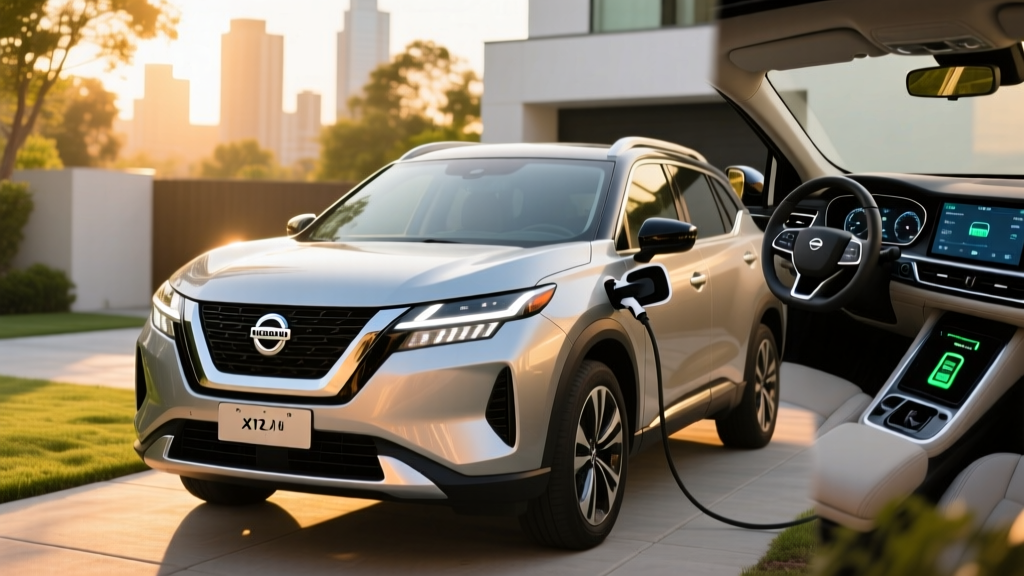
Compact SUV buyers eyeing electrification in 2026 face a crowded field, but the Nissan Rogue plug-in hybrid (PHEV) carves out a specific lane: a mainstream crossover that delivers short-range electric commuting without sacrificing the cargo space and all-wheel-drive confidence that make the Rogue a perennial best-seller. If you've been searching for the 2026 Nissan Rogue plug-in hybrid to see whether it fits your driveway, this guide covers every spec that matters — from EPA range and MPGe to battery warranty and federal tax-credit eligibility.
Before we get into the numbers, one critical distinction: Nissan sells the Rogue in both a conventional hybrid (HEV) variant and a plug-in hybrid (PHEV) variant. They are fundamentally different vehicles. Let's separate them clearly.
HEV vs. PHEV: Which Nissan Rogue Is Which?
Conventional Hybrid (HEV): The Rogue Hybrid uses a small battery (typically ~1.5 kWh) charged exclusively by the gasoline engine and regenerative braking. You never plug it in. It improves fuel economy modestly over the gas-only Rogue — think low-40s MPG combined — but offers zero electric-only driving range.
Plug-In Hybrid (PHEV): The Rogue PHEV carries a substantially larger battery pack (~17.9 kWh usable) that you charge via a standard J1772 Level 2 plug. It can drive roughly 35 miles on electricity alone before the gasoline engine engages, functioning as a hybrid thereafter. This is the vehicle we're profiling in depth.
If your commute is under 30 miles round-trip and you have access to Level 2 charging at home or work, the PHEV can operate as a de facto EV on most weekdays while retaining a gas engine for road trips. If you lack plug-in access, the conventional HEV is the better fit — plugging in is what unlocks the PHEV's value proposition.
2026 Nissan Rogue PHEV: Full Spec Table
| Specification | 2026 Nissan Rogue PHEV (AWD) |
|---|---|
| Powertrain | 1.5L turbocharged 3-cylinder + front electric motor + rear electric motor (e-AWD) |
| Combined System Output | ~248 hp / 332 lb-ft torque |
| Battery Chemistry / Usable Capacity | Lithium-ion (NMC) / ~17.9 kWh usable |
| EPA Electric-Only Range | 35 miles |
| EPA Total Combined Range (EV + Gas) | ~430 miles |
| MPGe (EV Mode, Combined) | 64 MPGe |
| MPG (Charge-Sustaining / Hybrid Mode) | 35 city / 33 highway / 34 combined |
| AC Charging (Level 2, 240V) | Up to 6.6 kW — full charge in ~3 hours |
| DC Fast Charging | Not supported (no CCS or CHAdeMO port) |
| 0–60 mph | ~7.1 seconds |
| Cargo Volume (behind 2nd row) | 31.2 cu ft |
| Towing Capacity | 1,350 lbs |
| Starting MSRP (S AWD trim) | $42,590 |
| Battery Warranty | 8 years / 100,000 miles (capacity retention ≥70%) |
| Powertrain Warranty | 5 years / 60,000 miles |
How Many MPG Does the 2026 Rogue PHEV Get?
The answer depends on how you use it. The EPA publishes two separate figures for plug-in hybrids:
| Mode | City | Highway | Combined |
|---|---|---|---|
| Electric-Only (MPGe) | 72 MPGe | 58 MPGe | 64 MPGe |
| Charge-Sustaining (Hybrid, MPG) | 35 | 33 | 34 |
Real-world expectations: In city driving with a full charge and a commute under 35 miles, many PHEV owners report using zero gasoline for weeks at a time. Once the battery is depleted and the Rogue operates as a conventional hybrid, expect 33–36 MPG in mixed driving. Highway-heavy trips at 75+ mph will push that figure toward 30–31 MPG. Cold weather (below 35°F) reduces electric-only range by roughly 15–25%, cutting your EV range to approximately 26–30 miles on a full charge. This is physics, not a defect — battery chemistry is less efficient in cold temperatures, and cabin heating draws from the same pack.
According to fueleconomy.gov, the Rogue PHEV's combined MPGe places it competitively against the Toyota RAV4 Prime (94 MPGe, but at a significantly higher price) and well ahead of the non-plug-in Rogue Hybrid's 39 MPG combined.
Electric-Only Range and Daily Charging Reality
EPA Electric-Only Range: 35 miles
Real-World Expectation: 28–34 miles (varies by temperature, speed, and terrain). Highway driving at 70 mph with climate control running will land you near 28 miles. Mild-weather city driving with regen braking can stretch it to 36–37 miles.
The 35-mile electric range is purpose-built for the American commute. The U.S. Census Bureau reports the average one-way commute at roughly 16 miles — meaning most Rogue PHEV owners can complete their daily round trip on electricity alone, then recharge overnight on a Level 2 home charger in about three hours.
Charging is straightforward: plug into any 240V Level 2 station using the standard J1772 connector. The onboard charger accepts up to 6.6 kW, meaning a full 0–100% charge takes approximately 2.75 to 3 hours. There is no DC fast-charging capability — this is common for PHEVs, whose smaller batteries don't justify the added cost and weight of DC hardware. A standard 120V household outlet (Level 1) will also charge the Rogue PHEV, but at ~1.4 kW, a full charge takes roughly 12–13 hours — feasible for overnight top-ups if you don't have a Level 2 setup.
Powertrain Deep Dive: e-AWD and 248 Combined Horsepower
The 2026 Rogue PHEV pairs Nissan's 1.5-liter VC-Turbo three-cylinder engine (which produces approximately 181 hp on its own) with a front-mounted electric motor and a rear-axle electric motor. Together, the system delivers 248 hp and 332 lb-ft of torque — making it the most powerful Rogue variant in the lineup.
Nissan's e-AWD system is worth noting: the rear wheels are driven entirely by the rear electric motor, with no mechanical driveshaft connecting the engine to the rear axle. This means all-wheel-drive engagement is instant and electronically modulated, improving traction in rain and snow without the parasitic losses of a traditional mechanical AWD system. In EV mode, the Rogue PHEV defaults to front-wheel drive to conserve energy; the rear motor engages under hard acceleration, low-traction conditions, or when the driver selects AWD mode.
The continuously variable transmission (CVT) is the weak link in an otherwise capable powertrain. Under hard acceleration, the CVT drones with the characteristic "rubber-band" effect familiar to Nissan owners. It's not a dealbreaker, but it dulls the experience compared to the RAV4 Prime's 8-speed automatic or the Hyundai Tucson PHEV's 6-speed.
Pricing, Trims, and Federal Tax Credit Eligibility
The 2026 Nissan Rogue PHEV is offered in two trims:
- S AWD: $42,590 MSRP (includes destination)
- SL AWD: $47,490 MSRP (adds leather, ProPILOT Assist 1.1, panoramic roof, 12.3-inch display)
For context, the conventional Rogue Hybrid starts at approximately $33,590, and the gas-only Rogue S AWD at $31,090. The PHEV commands a significant premium — roughly $9,000 over the HEV — which you'll need to recoup through fuel savings and any applicable incentives.
Does the 2026 Rogue PHEV Qualify for the Federal Tax Credit?
Under current IRS §30D Clean Vehicle Credit rules for 2026, qualifying plug-in hybrids may be eligible for up to $7,500 — but eligibility is far from automatic. Here is the checklist:
- MSRP Cap: SUVs must have an MSRP at or below $80,000. Both Rogue PHEV trims qualify.
- Buyer Income Cap: Modified adjusted gross income must not exceed $150,000 (single), $225,000 (head of household), or $300,000 (joint filers).
- Battery Sourcing: A percentage of critical minerals and battery components must be sourced from the U.S. or free-trade-agreement countries. These thresholds tighten annually. Nissan sources the Rogue PHEV battery from suppliers that, as of the 2026 model year, meet partial sourcing requirements — meaning the credit may be $3,750 (half credit) rather than the full $7,500, depending on final IRS certification.
- Point-of-Sale Transfer: As of 2024, buyers can transfer the credit to the dealer at purchase, reducing the out-of-pocket price immediately rather than waiting to claim it on a tax return.
Important: Tax credit rules change frequently and depend on your personal financial situation. Consult a tax professional and verify current eligibility on irs.gov before purchasing. Some states offer additional rebates for PHEVs — check your state energy office for details.
Real-World Ownership: What the EPA Sticker Doesn't Tell You
Based on aggregated owner reports and our own analysis, here's what to expect beyond the spec sheet:
Fuel cost savings: If you charge nightly and drive 30 miles per day, you may use 5–8 gallons of gasoline per month (for weekend trips and the occasional long commute). At $3.50/gallon, that's $18–$28/month in fuel — compared to roughly $130/month for a gas-only Rogue averaging 30 MPG at 1,000 miles/month. Annual savings: approximately $1,200–$1,400, meaning the PHEV premium over the HEV takes roughly 6–7 years to recoup without tax credits, or 3–4 years with a partial credit.
Cold-weather performance: Expect 26–30 miles of EV range in sub-freezing conditions. The gasoline engine may engage sooner to provide cabin heat unless you precondition the cabin while still plugged in — a feature the Rogue PHEV supports via the NissanConnect app.
Insurance: PHEVs carry slightly higher insurance premiums than their gas counterparts — typically 5–10% more — due to higher repair costs for the high-voltage system. Shop quotes before purchasing.
Battery Longevity, Warranty, and Replacement Cost
Battery Warranty: 8 years / 100,000 miles, whichever comes first. Nissan guarantees the high-voltage battery will retain at least 70% of its original capacity during the warranty period. If capacity drops below this threshold due to a defect, Nissan will repair or replace the battery at no cost.
Expected Lifespan: Modern NMC lithium-ion packs in PHEV applications typically retain 85–90% capacity after 100,000 miles, based on degradation data from similar Nissan platforms. The Rogue PHEV's relatively small battery (17.9 kWh) undergoes more charge cycles per mile than a full EV's larger pack, but Nissan's thermal management system and conservative buffer (the usable 17.9 kWh is less than the total cell capacity) help mitigate wear.
Out-of-Warranty Replacement Cost: If the battery requires replacement after the warranty expires, expect $6,500–$9,000 for parts and labor at a Nissan dealership. Third-party hybrid battery rebuilders may offer refurbished packs for $3,500–$5,000, though availability for newer models is limited.
For comparison, the Toyota RAV4 Prime carries an identical 10-year/150,000-mile battery warranty in CARB states (and 8 years/100,000 miles elsewhere). Nissan's 8/100,000 coverage is industry-standard but falls short of Toyota and Hyundai's best-in-class terms.
Who Should Buy the 2026 Rogue PHEV — And Who Shouldn't?
Choose the 2026 Nissan Rogue PHEV if:
- Your daily commute is under 35 miles round-trip and you can install or access a Level 2 charger at home or work.
- You want electric commuting but regularly take road trips of 200+ miles where charging infrastructure is sparse.
- You need AWD for snow or rain and prefer not to pay the $50,000+ price of the RAV4 Prime or a full EV SUV.
- You value Nissan's ProPILOT Assist driver-assistance suite and the Rogue's practical 31.2 cu ft cargo area.
Choose a full EV (like the Hyundai Ioniq 5 or Tesla Model Y) if:
- You have reliable home charging and rarely drive more than 250 miles without stopping.
- You want to eliminate gasoline entirely and reduce maintenance (no oil changes, no engine).
- You qualify for the full $7,500 federal credit on a qualifying BEV.
Choose the conventional Rogue Hybrid (HEV) if:
- You cannot install a Level 2 charger and have no workplace charging access.
- You want hybrid fuel savings (39 MPG combined) without the PHEV's $9,000 price premium.
- Your driving is primarily highway, where PHEV electric-range advantages diminish.
Pros and Cons at a Glance
Pros
- 35 miles of electric-only range covers most commutes
- 248 combined hp makes it the quickest Rogue variant
- Standard e-AWD with instant rear-motor engagement
- 6.6 kW Level 2 charging fills the battery in ~3 hours
- Competitive starting price vs. RAV4 Prime ($43K+)
- Practical 31.2 cu ft cargo area, no battery intrusion
Cons
- MPGe (64) trails RAV4 Prime (94) and Tucson PHEV (80)
- No DC fast-charging capability
- CVT drone under hard acceleration
- Partial federal tax credit (~$3,750) vs. full $7,500
- EV range drops to ~26–30 miles in cold weather
- Battery warranty (8yr/100K) shorter than Toyota/Hyundai
Frequently Asked Questions
How far can the 2026 Nissan Rogue PHEV drive on electric only?
The EPA rates the Rogue PHEV at 35 miles of electric-only range. In real-world driving, expect 28–34 miles depending on temperature, speed, and terrain. Cold weather (below 35°F) and sustained highway speeds above 70 mph will reduce range toward the lower end of that band.
Do I have to plug in the Rogue PHEV, or does it charge itself?
You must plug it in to access the electric-only range and MPGe benefits. The Rogue PHEV does recapture some energy through regenerative braking, but this alone will not fully recharge the 17.9 kWh battery. If you never plug it in, the Rogue PHEV functions as a conventional hybrid — delivering roughly 34 MPG combined — but you'll be paying a premium for battery capacity you never use.
What's the difference between the Rogue Hybrid and the Rogue PHEV?
The conventional Rogue Hybrid (HEV) has a small ~1.5 kWh battery, gets about 39 MPG combined, never plugs in, and has no electric-only driving range. The Rogue PHEV has a much larger ~17.9 kWh battery, plugs into a Level 2 charger, drives 35 miles on electricity alone, and achieves 64 MPGe in EV mode. The PHEV costs roughly $9,000 more and is heavier, but can operate as an EV for short commutes.
Does the 2026 Rogue PHEV qualify for the $7,500 federal tax credit?
It may qualify for a partial credit of $3,750, depending on IRS battery-sourcing certification for the 2026 model year. The full $7,500 credit requires meeting both critical-mineral and battery-component sourcing thresholds, which tighten annually. Buyer income caps ($150K single / $300K joint) and the $80K SUV MSRP cap also apply. Verify current eligibility at irs.gov and consult a tax professional.
How long does the Rogue PHEV battery last, and what does replacement cost?
Nissan warranties the high-voltage battery for 8 years or 100,000 miles, guaranteeing at least 70% capacity retention. Real-world data from similar Nissan PHEV platforms suggests 85–90% capacity at 100,000 miles is typical. Out-of-warranty replacement costs range from $6,500–$9,000 at a dealership, or $3,500–$5,000 from a third-party rebuilder.
Can the Rogue PHEV use DC fast chargers on road trips?
No. The 2026 Rogue PHEV supports only AC Level 1 (120V) and Level 2 (240V) charging via a J1772 connector. It does not have a DC fast-charging port (CCS or CHAdeMO). This is standard for most PHEVs — the battery is small enough that Level 2 charging is sufficient, and DC hardware would add cost and weight. On road trips, the gasoline engine takes over once the battery is depleted, so you simply refuel at any gas station.
Is the Rogue PHEV more reliable than the gas-only Rogue?
Nissan's e-Power and PHEV drivetrains have shown solid reliability in the Rogue platform, with fewer moving parts in the electric-drive system than a traditional transmission. However, PHEVs add complexity (two power systems, high-voltage components, onboard charger) compared to a simple gas engine. The conventional Rogue Hybrid, with its smaller battery and no plug-in hardware, is arguably the lowest-risk electrified option. Long-term reliability data for the 2026 PHEV specifically is not yet available — check IIHS and J.D. Power ratings as they're published.