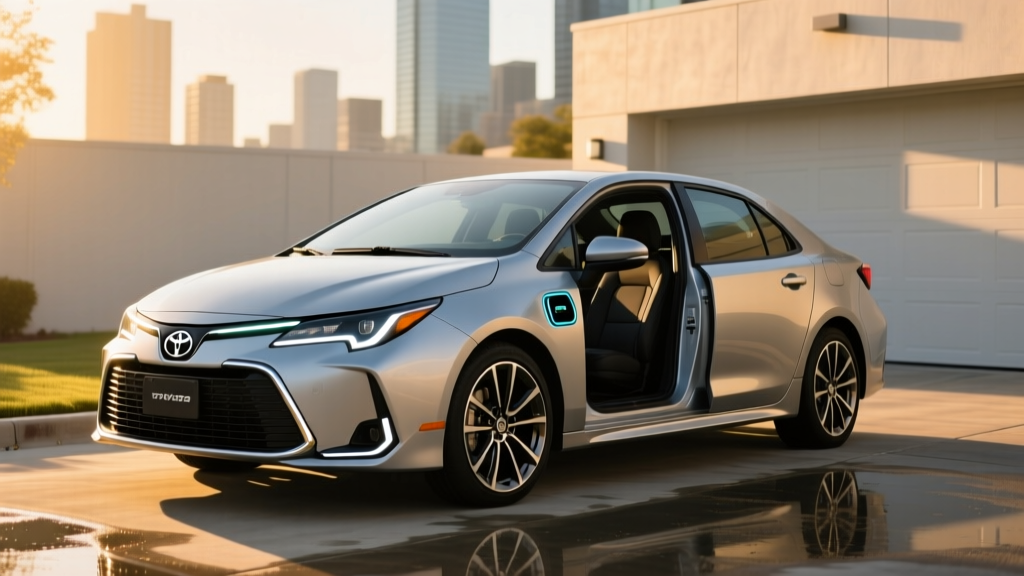
The Toyota Corolla has been the world's best-selling nameplate for decades, and its hybrid variant has quietly become one of the most compelling fuel-sippers on the market. For 2026, the Corolla Hybrid continues to offer what buyers in this segment want most: exceptional fuel economy without the range anxiety, charging logistics, or premium pricing of a full electric vehicle. With a starting MSRP hovering around $24,000 and EPA ratings pushing past 50 MPG, the 2026 Corolla Hybrid positions itself as a pragmatic alternative to both gas-only compacts and more expensive electrified options.
This guide breaks down everything you need to know about the 2026 Corolla Hybrid — from its fifth-generation Toyota Hybrid System powertrain to real-world fuel economy expectations, battery longevity, and whether it qualifies for any federal tax incentives. If you're cross-shopping this against the Corolla gas model, a plug-in hybrid like the Prius Prime, or a full EV, we'll help you decide where this HEV fits.
2026 Corolla Hybrid Powertrain and Performance Specs
The 2026 Corolla Hybrid uses Toyota's fifth-generation hybrid architecture, pairing a 1.8-liter four-cylinder Atkinson-cycle engine with two motor-generators and a compact nickel-metal hydride (NiMH) traction battery. The system sends power to all four wheels through Toyota's electronic on-demand all-wheel drive (AWD), which uses a separate rear-mounted electric motor rather than a mechanical driveshaft.
| Specification | Value |
|---|---|
| Powertrain | 1.8L 4-cyl + 2 motor-generators (eCVT) |
| Combined System Horsepower | 138 hp |
| Gas Engine Output | ~96 hp / 105 lb-ft torque |
| Front Electric Motor | ~80 hp (integrated in transaxle) |
| Rear AWD Motor | ~40 hp (on-demand, up to ~43 mph) |
| Traction Battery | ~1.3 kWh NiMH (sealed, self-charging) |
| Transmission | Electronic CVT (planetary gearset) |
| Drivetrain | Electronic On-Demand AWD (standard) |
| 0–60 mph | ~9.0 seconds (est.) |
| Towing Capacity | Not rated for towing |
The 138 combined horsepower figure won't win any stoplight drag races, but the electric motor's instant torque delivery makes the Corolla Hybrid feel adequately responsive around town — where most hybrid owners do the majority of their driving. The eCVT, which isn't a belt-driven CVT at all but rather a planetary gearset, operates smoothly without the rubber-band sensation associated with conventional continuously variable transmissions.
Fuel Economy: EPA Ratings vs. Real-World MPG
Fuel efficiency is the headline act here. According to EPA data on fueleconomy.gov, the 2026 Corolla Hybrid AWD sedan achieves:
| Driving Cycle | MPG |
|---|---|
| City | 53 MPG |
| Highway | 46 MPG |
| Combined | 50 MPG |
Those numbers put the Corolla Hybrid among the most efficient non-plug-in vehicles sold in the United States. For context, the gas-only 2026 Corolla (2.0L, CVT) rates at roughly 32 city / 41 highway / 35 combined — meaning the hybrid delivers approximately 43% better combined fuel economy.
Hybrid (HEV) vs. Plug-In Hybrid (PHEV): Where the Corolla Fits
A critical distinction for shoppers: the Corolla Hybrid is a conventional hybrid (HEV), not a plug-in hybrid (PHEV). You never plug it in. The small NiMH battery charges entirely through regenerative braking and the gasoline engine. This means zero electric-only driving range, but also zero charging infrastructure requirements.
| Factor | Corolla Hybrid (HEV) | Typical PHEV (e.g., Prius Prime) |
|---|---|---|
| Plug-in Charging Required? | No — self-charging | Yes — for maximum benefit |
| Electric-Only Range | 0 miles (EV assist only) | ~40–45 miles |
| Battery Capacity | ~1.3 kWh (NiMH) | ~13.6 kWh (lithium-ion) |
| Home Charger Needed? | No | Yes (Level 2 recommended) |
| Federal Tax Credit (§30D) | Not eligible | Up to $7,500 (if eligible) |
| Combined MPG (gas mode) | 50 MPG | ~48–52 MPG (after EV range depleted) |
| Upfront Price Premium | ~$1,500–$2,500 over gas model | ~$5,000–$8,000 over gas model |
If you can charge at home and your daily commute falls under 40 miles round-trip, a PHEV like the Prius Prime lets you drive almost entirely on electricity most days while retaining a gas engine for longer trips. But if you live in an apartment without charging access, park on the street, or simply want the lowest upfront cost with no behavioral changes, the Corolla HEV is the more practical electrified choice.
Pricing, Trims, and Tax Credit Eligibility
The 2026 Corolla Hybrid is offered in LE and SE trims. Pricing is estimated as follows (final MSRP subject to Toyota's official release):
- Corolla Hybrid LE: ~$24,050 MSRP (including destination)
- Corolla Hybrid SE: ~$26,550 MSRP (sport-tuned suspension, alloy wheels, paddle shifters)
Even without a federal tax credit, the Corolla Hybrid's low MSRP and 50 MPG combined rating deliver strong ownership economics. At $3.50/gallon gasoline and 15,000 miles driven annually, the hybrid saves approximately $600–$800 per year in fuel costs compared to the gas-only Corolla — paying back its modest price premium in roughly 2–3 years.
Battery Longevity, Warranty, and Replacement Cost
Battery reliability is the single most common concern among first-time hybrid buyers. Toyota's hybrid battery track record is among the strongest in the industry, with millions of Prius and Camry Hybrids logging well past 150,000 miles on their original packs.
Toyota covers the hybrid traction battery for 10 years or 150,000 miles (whichever comes first) in all 50 states. This is one of the most comprehensive hybrid battery warranties in the segment. The hybrid system components (inverter, motor-generators, control module) are also covered under the same 10-year/150,000-mile Hybrid System Warranty.
The Corolla Hybrid's NiMH battery is relatively small and operates within a conservative state-of-charge window (roughly 40%–80%), which significantly reduces degradation compared to larger lithium-ion packs in BEVs and PHEVs. Toyota's battery management system never allows the pack to fully charge or fully discharge, a design choice that trades usable capacity for extreme longevity.
If replacement is eventually needed out of warranty, a new OEM hybrid battery for the Corolla Hybrid typically costs between $2,000 and $3,500 including labor. Refurbished/remanufactured packs are available from $1,000–$1,800. Given the 10-year/150,000-mile warranty coverage and Toyota's track record, most owners will never face this expense.
Driving Experience and Daily Practicality
The 2026 Corolla Hybrid drives like a conventional Corolla, which is to say: competent, comfortable, and unremarkable. The ride is compliant over rough pavement, cabin noise is well-managed for the segment, and the standard Toyota Safety Sense 3.0 suite provides pre-collision braking, lane departure alert with steering assist, full-speed-range adaptive cruise control, and lane tracing assist.
Practically speaking, the hybrid powertrain adds no compromises to cargo space or interior volume. The battery pack is mounted under the rear seats, preserving the full 13.1 cubic feet of trunk space. The standard AWD system engages automatically in low-traction conditions — rain, snow, gravel — without any driver intervention, making this a genuinely capable year-round commuter.
Pros
- 50 MPG combined EPA — among the best non-PHEV sedans
- Standard AWD at no price premium over FWD hybrid competitors
- No plug-in charging required — zero behavioral change
- 10-year/150,000-mile hybrid battery warranty
- Low starting MSRP (~$24,050)
- Toyota Safety Sense 3.0 standard
Cons
- 138 hp — modest acceleration (9-sec 0–60)
- No federal tax credit eligibility
- Not available as a PHEV (no electric-only range)
- Rear seat legroom is average for the class
- Infotainment is functional but not class-leading
- AWD rear motor disengages above ~43 mph
Corolla Hybrid vs. Full EV vs. Gas: Which Should You Choose?
The decision between a conventional hybrid, a full battery-electric vehicle, and a gas-only car depends on your driving patterns, charging access, and budget.
Decision Framework
Choose the 2026 Corolla Hybrid if: You want maximum fuel efficiency with zero lifestyle changes. You can't charge at home (apartment, street parking). You want a sub-$25,000 vehicle with proven reliability and low running costs. You drive 10,000–20,000 miles per year in mixed city/highway conditions.
Choose a full EV (e.g., Chevy Bolt, Tesla Model 3) if: You have reliable home Level 2 charging. Your daily commute is under 200 miles round-trip. You want to eliminate gasoline entirely and reduce maintenance (no oil changes, fewer brake replacements). You're eligible for the full $7,500 federal tax credit, which can make EVs cost-competitive.
Choose a PHEV (e.g., Prius Prime) if: You can charge at home and want electric-only commuting most days, but need gas-engine flexibility for road trips. You want to access the §30D tax credit. Your daily driving is under 40 miles.
Stick with the gas Corolla if: You drive fewer than 8,000 miles per year (the hybrid premium takes too long to pay back). You want the lowest possible purchase price and don't prioritize fuel economy.
Frequently Asked Questions
How many MPG does the 2026 Corolla Hybrid get?
The EPA rates the 2026 Corolla Hybrid AWD at 53 city / 46 highway / 50 combined MPG. In real-world driving, most owners see 48–55 MPG depending on conditions, with city driving often matching or exceeding the EPA rating thanks to regenerative braking.
Does the Corolla Hybrid need to be plugged in?
No. The Corolla Hybrid is a conventional hybrid (HEV) — it charges its own small battery through regenerative braking and the gasoline engine. You simply fill it with gas like any other car.
Is the 2026 Corolla Hybrid reliable, and what does battery replacement cost?
Toyota's hybrid system has an exceptional reliability record spanning over two decades and millions of vehicles. The hybrid battery is covered by a 10-year/150,000-mile warranty. Out-of-warranty replacement costs $2,000–$3,500 for an OEM pack, but most owners never need one.
Does the 2026 Corolla Hybrid qualify for any tax credit?
No. The federal §30D Clean Vehicle Credit requires a plug-in vehicle with a battery capacity of at least 7 kWh. The Corolla Hybrid's ~1.3 kWh NiMH battery makes it ineligible. Some state or utility hybrid incentives may apply — check local programs.
How does the Corolla Hybrid compare to the Prius?
The Prius (redesigned for 2023 and continuing into 2026) offers slightly higher combined MPG (~57 FWD), more horsepower (~194 hp FWD), and a more distinctive design — but at a higher starting price (~$28,500). The Corolla Hybrid is the value play; the Prius is the efficiency-and-performance play. Both use Toyota's proven hybrid architecture.
Can the Corolla Hybrid drive on electric power alone?
Only at very low speeds (under ~15 mph, for short distances such as creeping through a parking lot). The battery is too small for meaningful electric-only driving. For electric-only capability, you'd need a PHEV like the Prius Prime.
Sources: fueleconomy.gov (EPA), Toyota Motor Corporation, IRS.gov. Specifications reflect 2026 model-year data; verify final figures with your dealer.