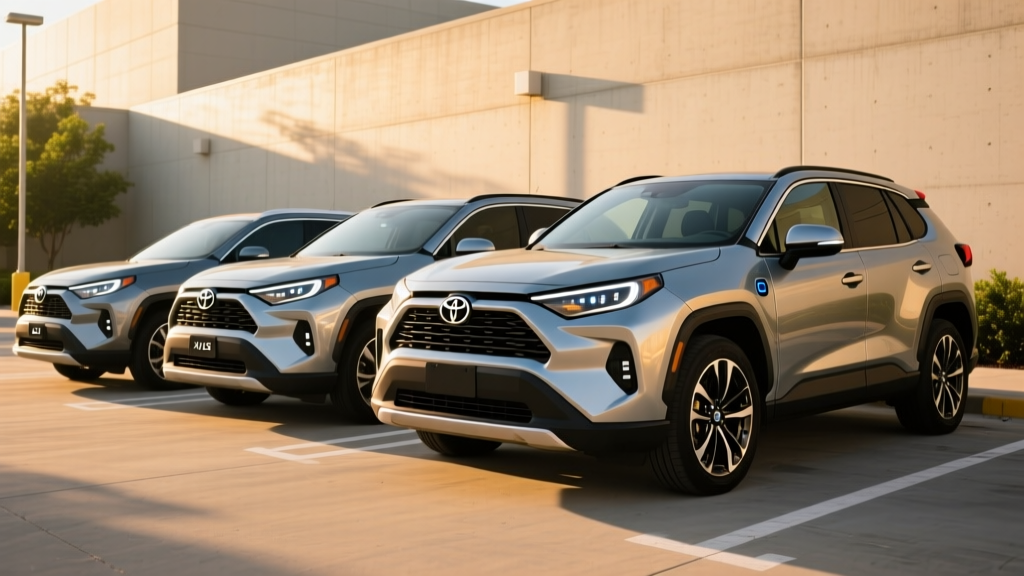
The Toyota RAV4 Hybrid remains one of the most sought-after electrified SUVs in America, and for good reason: it delivers diesel-rivaling fuel economy with no plug, no range anxiety, and Toyota's proven reliability. But with multiple trims, a plug-in Prime variant, and shifting incentive landscapes, pinning down the actual Toyota RAV4 Hybrid MSRP — and whether it's the right electrified choice for you — requires a closer look at the numbers.
This guide covers the 2026 RAV4 Hybrid lineup pricing, EPA and real-world MPG data, the HEV vs. PHEV decision, battery longevity, and tax credit eligibility. Whether you're cross-shopping against a full EV or a conventional gas SUV, the data below will help you decide.
2026 Toyota RAV4 Hybrid MSRP: Trim-by-Trim Pricing
Toyota offers the RAV4 Hybrid across a wide trim range, from the value-oriented LE to the adventure-tuned Woodland Edition. Below are the base MSRP figures before destination charges. Note that dealer markups and regional pricing can shift real transaction prices — especially on popular trims like the XLE and SE.
| Trim | Base MSRP | AWD | Key Features |
|---|---|---|---|
| LE | $33,425 | Standard | 8" touchscreen, TSS 3.0, LED headlights |
| XLE | $35,250 | Standard | Blind-spot monitor, dual-zone climate, Smart Key |
| SE | $37,600 | Standard | Sport-tuned suspension, 19" wheels, SofTex seats |
| XSE | $39,100 | Standard | 10.5" display, ambient lighting, heated front seats |
| XLE Premium | $38,450 | Standard | SofTex, power moonroof, wireless charging |
| Limited | $42,500 | Standard | Panoramic roof, JBL audio, heated/ventilated seats |
| Woodland Edition | $39,900 | Standard | TRD-tuned suspension, all-terrain tires, roof rack |
Source: Toyota.com — 2026 model year pricing. Destination charge (~$1,395) not included. Prices subject to change.
For comparison, the gas-only RAV4 starts around $30,000, making the hybrid premium roughly $3,000–$3,500 at the LE level. That premium is typically recouped in fuel savings within 2–3 years for average drivers covering 12,000–15,000 miles annually.
How Many MPG Does the RAV4 Hybrid Get? EPA vs. Real World
The 2026 RAV4 Hybrid carries EPA ratings of 41 MPG city / 38 MPG highway / 40 MPG combined across all AWD trims, according to fueleconomy.gov. That's a significant advantage over the gas-only RAV4 AWD, which returns 27 city / 34 highway / 30 combined.
| Metric | RAV4 Hybrid AWD | RAV4 Gas AWD |
|---|---|---|
| EPA City MPG | 41 | 27 |
| EPA Highway MPG | 38 | 34 |
| EPA Combined MPG | 40 | 30 |
| Annual Fuel Cost (est.) | ~$1,500 | ~$2,000 |
RAV4 Hybrid (HEV) vs. RAV4 Prime (PHEV): Which One Fits?
This is where buyer confusion often creeps in. Toyota sells two electrified RAV4 variants, and they serve different needs. Let's break down the distinction clearly:
RAV4 Hybrid (HEV)
- Type: Conventional hybrid — no plug required
- Battery: ~1.6 kWh nickel-metal hydride (NiMH)
- Electric-only range: Less than 1 mile at low speeds
- Refueling: Gas station only
- Combined HP: 219
- Best for: Drivers without home charging access who want maximum MPG with zero lifestyle change
RAV4 Prime (PHEV)
- Type: Plug-in hybrid — charges via outlet/station
- Battery: 18.1 kWh lithium-ion
- Electric-only range: 42 miles (EPA)
- Refueling: Plug + gas station
- Combined HP: 302
- Best for: Drivers with home Level 2 charging who want EV-like daily commutes with gas backup for road trips
The RAV4 Prime's 42-mile electric range covers most daily commutes entirely on electricity. Once the battery depletes, it operates as a conventional hybrid returning roughly 38 MPG combined. Total driving range exceeds 600 miles when combining electric and gas.
Charging the Prime: On a standard 120V household outlet (Level 1), the Prime's 18.1 kWh battery charges in approximately 12 hours. With a Level 2 home charger (240V, 3.3 kW onboard charger), it charges in about 4.5 hours. The RAV4 Prime does not support DC fast charging — there is no CCS or CHAdeMO port. This is a deliberate engineering choice by Toyota; the smaller PHEV battery doesn't require the thermal management complexity of DC fast-charge hardware.
| Spec | RAV4 Hybrid (HEV) | RAV4 Prime (PHEV) |
|---|---|---|
| Powertrain | 2.5L 4-cyl + 2 electric motors | 2.5L 4-cyl + 2 electric motors (higher output) |
| Combined Horsepower | 219 HP | 302 HP |
| 0–60 mph | 7.5 sec | 5.7 sec |
| Battery Capacity | ~1.6 kWh (NiMH) | 18.1 kWh (Li-ion) |
| Electric-Only Range | N/A | 42 miles (EPA) |
| Total Range | ~580 miles | ~600+ miles |
| Level 2 Charge Time | N/A (no plug) | ~4.5 hours (3.3 kW) |
| DC Fast Charge | N/A | Not supported |
| Starting MSRP | $33,425 | $46,200 |
Powertrain Deep Dive: How the RAV4 Hybrid Delivers 219 HP and 40 MPG
The RAV4 Hybrid pairs a 2.5-liter Dynamic Force four-cylinder engine (176 HP, 163 lb-ft) with two electric motors — one on each axle — for a combined system output of 219 horsepower. The rear electric motor provides electronic on-demand AWD without a mechanical driveshaft, reducing weight and drivetrain losses.
The hybrid system's efficiency secret is its ability to operate the gasoline engine in its most efficient RPM range while the electric motors handle low-speed acceleration and regenerative braking. In stop-and-go traffic, the engine shuts off entirely, and the vehicle runs on battery power for short distances. This is why the city MPG (41) actually exceeds the highway figure (38) — the opposite of most gas-only vehicles.
The continuously variable transmission (eCVT) is a planetary gearset, not a belt-driven CVT. It's mechanically simple, extremely durable, and contributes to the RAV4 Hybrid's reputation for long-term powertrain reliability.
Battery Warranty, Lifespan, and Replacement Cost
Battery Warranty Coverage
RAV4 Hybrid (HEV): Toyota's Hybrid Battery Warranty covers 10 years or 150,000 miles (whichever comes first) for 2020 and newer models. This applies to the ~1.6 kWh NiMH traction battery.
RAV4 Prime (PHEV): The 18.1 kWh lithium-ion battery is covered for 8 years or 100,000 miles, with a capacity retention threshold of 70%. California-emission-state vehicles may receive extended coverage (10 years/150,000 miles) — check your state's specifics.
Source: Toyota Warranty Guide
Hybrid battery replacement cost is a top concern for buyers. For the RAV4 Hybrid's NiMH pack, replacement runs approximately $3,000–$4,000 at a Toyota dealer, including labor. Independent hybrid specialists often offer refurbished packs for $1,500–$2,500. In practice, Toyota's hybrid batteries are among the most durable in the industry — taxi fleets and high-mileage owners routinely report 200,000+ miles on the original pack with minimal degradation.
The RAV4 Prime's larger lithium-ion pack carries a higher replacement cost: roughly $8,000–$12,000 at current pricing. However, the 70% capacity retention warranty threshold means Toyota will replace or repair the battery if it degrades below that point during the warranty period. Given that PHEV batteries are engineered for daily cycling, real-world degradation data from the current-generation Prime (introduced for 2021) shows strong retention — most owners report 95%+ capacity at 50,000 miles.
Tax Credits and Incentives: Does the RAV4 Hybrid Qualify?
This is where the HEV vs. PHEV distinction has real financial consequences:
- RAV4 Hybrid (HEV): Does not qualify for the federal §30D Clean Vehicle Credit. Conventional hybrids are excluded — the credit applies only to plug-in vehicles with battery capacity ≥7 kWh.
- RAV4 Prime (PHEV): As of 2026, the RAV4 Prime's eligibility for the $7,500 federal tax credit depends on battery component and critical mineral sourcing requirements under the Inflation Reduction Act. Toyota has worked to shift supply chains, but eligibility can change mid-year. Always verify current status on fueleconomy.gov before purchasing.
- Vehicle MSRP cap: $80,000 for SUVs (RAV4 Prime qualifies)
- Buyer AGI cap: $150K single / $300K joint filers
- Battery components must meet North American manufacturing thresholds
- Critical minerals must meet sourcing requirements
- Credit can be transferred to dealer as point-of-sale discount
- Always confirm at IRS.gov before purchase
Some states offer additional rebates for PHEVs (California's CVRP, for example, though program availability changes). The HEV receives no federal incentive, but its lower MSRP and strong fuel economy often make the total cost of ownership competitive without one.
Who Should Choose the RAV4 Hybrid vs. a Full EV or Gas SUV?
Choose the RAV4 Hybrid (HEV) If:
- You lack access to home or workplace charging
- You want EV-like city MPG with zero behavior change
- Your budget starts under $35,000
- You drive 12,000–15,000 miles/year and want $500+/year in fuel savings vs. gas
- You prioritize proven long-term reliability and low maintenance
Choose the RAV4 Prime (PHEV) If:
- You have Level 2 home charging and a commute under 42 miles
- You want daily electric driving with road-trip gas flexibility
- You want 302 HP and a 5.7-second 0–60 time
- You may qualify for the $7,500 federal credit, narrowing the price gap
- You want to "future-proof" before committing to a full BEV
Frequently Asked Questions
How many MPG does the 2026 RAV4 Hybrid actually get in real driving?
EPA rates it at 41 city / 38 highway / 40 combined. In real-world use, city-dominant drivers often see 42–44 MPG thanks to regenerative braking. Highway-heavy driving at 75+ mph may drop to 34–36 MPG. Cold weather reduces efficiency by 5–10%. The annual fuel cost is approximately $1,500 at current gas prices — roughly $500 less than the gas-only RAV4 AWD.
How far can the RAV4 Prime go on electric only?
The EPA rates the RAV4 Prime at 42 miles of electric-only range. In mild weather with moderate speeds, some owners report 45–48 miles. In cold weather or at highway speeds, expect 32–38 miles. Once depleted, the Prime operates as a standard hybrid with ~38 MPG combined.
Is the RAV4 Hybrid reliable, and what does a battery replacement cost?
Toyota's hybrid system is one of the most proven in the industry, with two decades of refinement since the original Prius. The eCVT has no belts or clutches to wear out. Hybrid battery replacement runs $3,000–$4,000 (HEV) or $8,000–$12,000 (Prime), but most packs last well beyond 150,000 miles. The 10-year/150,000-mile hybrid battery warranty on the HEV provides strong protection.
Does the RAV4 Hybrid qualify for any federal tax credit?
No. The conventional RAV4 Hybrid (HEV) does not qualify for the §30D federal Clean Vehicle Credit because it lacks a plug and its battery is below the 7 kWh threshold. Only the RAV4 Prime (PHEV) is potentially eligible for up to $7,500, subject to battery sourcing rules, buyer income caps, and MSRP limits. Verify current eligibility at IRS.gov before purchasing.
Does the RAV4 Hybrid need to be plugged in?
No. The RAV4 Hybrid is a conventional (self-charging) hybrid. It recovers energy through regenerative braking and the gasoline engine — you never plug it in. Only the RAV4 Prime has a charging port.
What's the 5-year cost of ownership vs. the gas RAV4?
Over 5 years at 15,000 miles/year, the RAV4 Hybrid saves approximately $2,500 in fuel costs compared to the gas-only AWD model. That essentially covers the ~$3,400 hybrid price premium within the first few years of ownership, with continued savings afterward. Maintenance costs are comparable, and the hybrid's regenerative braking actually extends brake pad life.