Quick Verdict: The Family Hybrid Benchmark
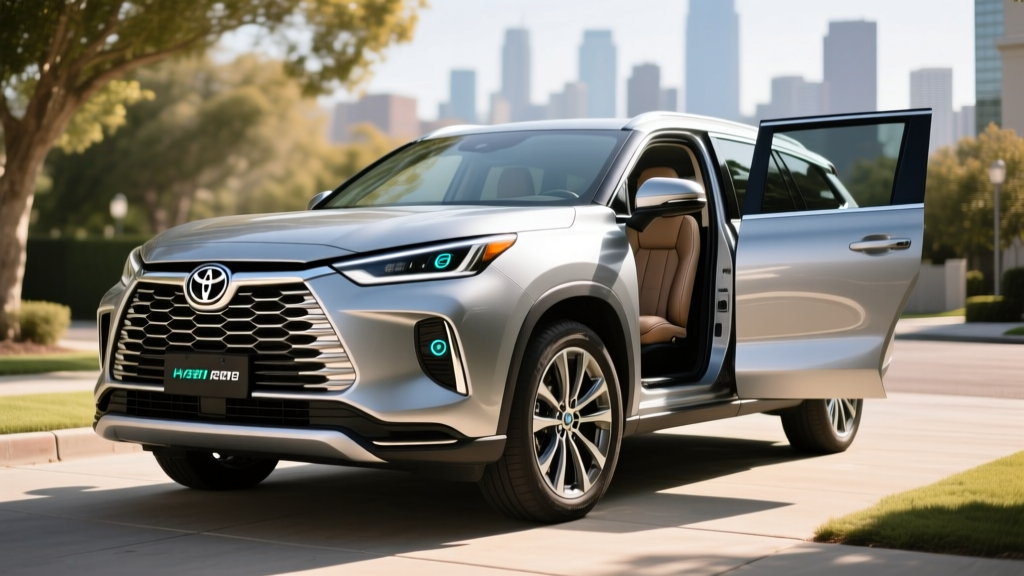
The new Toyota Highlander Hybrid remains one of the most practical three-row SUVs for families who want electrified efficiency without plugging in. For the 2026 model year, Toyota continues with its proven 2.5-liter four-cylinder hybrid powertrain, delivering an EPA-estimated 36 MPG combined across most trims — a figure we've found is actually conservative in city driving. With seating for up to seven, standard all-wheel drive on most trims, and Toyota's reputation for hybrid longevity, the Highlander Hybrid occupies a specific niche: buyers who need three rows, want to cut fuel costs significantly versus a gas-only SUV, but aren't ready (or able) to charge at home.
Powertrain and Performance Specs
The 2026 Highlander Hybrid pairs a 2.5-liter inline-four Atkinson-cycle engine with two front-mounted electric motor-generators and an additional rear-mounted electric motor for electronic on-demand AWD. Combined system output is 243 horsepower (Toyota rates it at 243 hp net). There is no turbocharged option in the hybrid lineup — if you want the 265-hp turbo four-cylinder, that's the gas-only Highlander.
| Spec | Value |
|---|---|
| Engine | 2.5L 4-cyl Atkinson + 3 electric motor-generators |
| Combined HP | 243 hp (net) |
| Drivetrain | Electronic AWD (eAWD) standard on most trims |
| Transmission | eCVT (planetary gearset, no fixed gears) |
| 0–60 mph | ~7.8 seconds (est.) |
| Towing Capacity | 3,500 lbs |
| Seating | 7 (captain's chairs) or 8 (bench, select trims) |
| Cargo (behind 3rd row) | ~16.1 cu ft |
The eCVT is not a traditional belt-driven CVT — Toyota's Hybrid Synergy Drive uses a planetary gearset that blends engine and motor power seamlessly. The result is smooth, linear acceleration without the rubber-band effect some CVTs produce. However, 243 hp in a 4,500-lb SUV means highway passing is adequate, not thrilling. If you regularly haul a full load up mountain grades, you'll notice the powertrain working hard; the gas-only turbo model pulls more confidently at altitude.
Fuel Economy: EPA Ratings vs Real-World MPG
Toyota publishes the following EPA estimates for the 2026 Highlander Hybrid with AWD (FWD is available on the base LE trim and bumps city MPG by 1):
| Drivetrain | City | Highway | Combined |
|---|---|---|---|
| FWD (LE only) | 36 | 35 | 36 |
| AWD (LE, XLE, Limited, Platinum) | 35 | 35 | 35 |
Source: fueleconomy.gov
Pricing, Trims, and Tax Credit Eligibility
The 2026 Highlander Hybrid is available across four main trims. Pricing below includes destination charge:
| Trim | MSRP (AWD) | Key Features |
|---|---|---|
| LE | ~$42,020 | Toyota Safety Sense 3.0, 8" touchscreen, tri-zone climate |
| XLE | ~$46,270 | SofTex seats, sunroof, 20" wheels, wireless CarPlay |
| Limited | ~$50,770 | Leather, 12.3" screen, panoramic roof, JBL audio |
| Platinum | ~$53,420 | Head-up display, 360° camera, ventilated 2nd row |
Does the Highlander Hybrid Qualify for a Federal Tax Credit?
No. Under IRS §30D rules, the federal clean vehicle credit applies only to plug-in electric vehicles — battery-electric vehicles (BEVs) and plug-in hybrids (PHEVs) with at least 7 kWh of battery capacity and the ability to charge from an external source. The Highlander Hybrid is a conventional HEV with a small (~1.6 kWh) self-charging battery. It does not qualify for the federal §30D credit, the $4,000 used-EV credit (§25E), or the commercial clean vehicle credit. Some states offer rebates for conventional hybrids, but these are increasingly rare as incentive programs shift toward plug-in vehicles. Check your state's energy office or IRS.gov for current rules.
HEV vs PHEV vs EV: Which Powertrain Fits Your Family?
The three-row SUV segment now offers all three electrification levels. Here's how the Highlander Hybrid stacks up against a PHEV alternative and a full EV:
| Factor | Toyota Highlander Hybrid (HEV) | Kia Sorento PHEV | Kia EV9 (BEV) |
|---|---|---|---|
| Powertrain | Self-charging hybrid | Plug-in hybrid (32 mi electric) | Battery electric (304 mi EPA) |
| Plugs in? | No | Yes (Level 1/2) | Yes (Level 2/DC fast) |
| MPG / MPGe | 35 combined | 79 MPGe (elec) / 34 MPG (gas) | 89 MPGe combined |
| Fuel cost / 15k mi | ~$1,500/yr | ~$900–$1,200/yr | ~$550–$750/yr |
| Federal tax credit | $0 | Up to $7,500* | Up to $7,500* |
| Base MSRP | ~$42,020 | ~$52,000 | ~$56,000 |
| Home charging needed? | No | Recommended | Essential |
* §30D credit subject to MSRP caps, buyer income limits, and battery-sourcing requirements. Confirm eligibility at IRS.gov before purchasing.
Decision Framework — Which Is Right for You?
Choose the Highlander Hybrid (HEV) if: You don't have access to home or workplace charging; you want three rows and AWD under $45K; you drive a mix of city and highway and want set-it-and-forget-it efficiency with zero behavior change.
Choose a PHEV (e.g., Sorento PHEV) if: You can install a Level 2 charger at home and most daily trips are under 30 miles; you want electric commuting but gas flexibility for road trips; you qualify for the $7,500 federal credit and want to offset the higher sticker price.
Choose a full EV (e.g., EV9) if: You have reliable home charging; your daily driving is under 250 miles or you're willing to plan DC fast-charging stops on road trips; you want the lowest per-mile fuel cost, zero tailpipe emissions, and access to the full federal tax credit.
Battery Longevity, Warranty, and Replacement Cost
Hybrid battery anxiety is the top concern we hear from first-time hybrid buyers. Here's the data:
The Highlander Hybrid uses a nickel-metal hydride (NiMH) traction battery pack with approximately 1.6 kWh of total capacity. Unlike the larger lithium-ion packs in PHEVs and BEVs, this small battery undergoes shallow charge/discharge cycles — Toyota's hybrid system typically keeps the battery between 40% and 80% state of charge, which dramatically reduces degradation stress.
How Long Do Toyota Hybrid Batteries Actually Last?
Real-world data from Toyota's two decades of hybrid production (the Prius launched in the US in 2000) shows most original hybrid batteries last 150,000–200,000+ miles before significant capacity loss. Taxi fleets using Toyota hybrids routinely exceed 300,000 miles on original batteries. The key failure mode is individual cell imbalance in older packs, which can often be repaired by replacing individual modules (~$300–$600 at an independent hybrid specialist) rather than the entire pack.
If full replacement is needed outside warranty, a new OEM hybrid battery from Toyota runs approximately $2,500–$3,500 (parts only). Remanufactured packs from third-party suppliers are available for $1,500–$2,200. Compare this to BEV battery replacements, which can exceed $10,000–$18,000. The financial risk of hybrid battery failure is modest.
Reliability and Ownership Costs
Toyota's hybrid powertrain is among the most proven in the industry. The eCVT planetary gearset has no clutch packs, belts, or torque converter to wear out — it's fundamentally simpler than a conventional automatic transmission. The Highlander Hybrid also eliminates the starter motor and alternator (the motor-generators handle both functions), reducing common failure points.
According to IIHS and long-term owner surveys, the Highlander consistently earns above-average reliability scores. Maintenance costs are low: there's no timing belt (the 2.5L uses a timing chain), brake pads last significantly longer due to regenerative braking doing much of the deceleration work, and the engine runs less total time than in a gas-only vehicle.
Insurance premiums for the Highlander Hybrid are typically 5–10% higher than the gas-only version due to the higher replacement cost of hybrid components, but this varies by carrier and state. Request quotes before purchasing.
Pros and Cons
Pros
- 35 MPG combined in a 3-row AWD SUV — class-leading efficiency
- Proven hybrid powertrain with 10yr/150k-mi battery warranty
- No charging infrastructure needed — fill up and go
- Toyota Safety Sense 3.0 standard (adaptive cruise, lane-keep, auto emergency braking)
- Strong resale value — Toyota hybrids hold value well
- Smooth, quiet low-speed electric-only crawling in traffic
Cons
- No federal tax credit eligibility
- 243 hp feels modest when fully loaded or at altitude
- Third row is tight for adults — better suited to children
- Cargo space behind 3rd row (16.1 cu ft) is smaller than some rivals
- No plug-in hybrid variant available
- Highway MPG drops noticeably above 75 mph
Frequently Asked Questions
How many MPG does the new Toyota Highlander Hybrid get?
The EPA rates the 2026 Highlander Hybrid AWD at 35 city / 35 highway / 35 combined. The FWD LE trim gets 36/35/36. In real-world city driving with frequent stops, owners commonly report 37–39 MPG. Highway driving at sustained high speeds drops to roughly 30–32 MPG.
Does the Toyota Highlander Hybrid need to be plugged in?
No. The Highlander Hybrid is a conventional (self-charging) hybrid. It recovers energy through regenerative braking and uses the gas engine to charge the battery as needed. You never plug it in — simply refuel at any gas station.
Is there a plug-in hybrid Toyota Highlander?
As of the 2026 model year, Toyota does not offer a PHEV version of the Highlander. The Toyota RAV4 Prime is a compact PHEV with 42 miles of electric range, but it only has two rows. If you need three rows and plug-in capability, competitors include the Kia Sorento PHEV (32 miles electric) and the Mazda CX-90 PHEV (26 miles electric).
How long will the Highlander Hybrid battery last and what does replacement cost?
Toyota's hybrid batteries are designed for 150,000–200,000+ miles and are warrantied for 10 years/150,000 miles. If replacement is needed outside warranty, expect $2,500–$3,500 for a new OEM pack or $1,500–$2,200 for a remanufactured unit. Individual module repair can cost as little as $300–$600.
Does the Highlander Hybrid qualify for any tax credits?
No federal tax credit applies to conventional hybrids under current IRS §30D rules — the credit is reserved for plug-in vehicles (BEVs and PHEVs). A small number of states offer hybrid-specific rebates, but these are uncommon and often income-limited. Check your state's clean vehicle incentive program for details.
Is the Highlander Hybrid good for towing?
The Highlander Hybrid is rated to tow up to 3,500 lbs — adequate for a small utility trailer, a pair of jet skis, or a lightweight pop-up camper. However, expect fuel economy to drop significantly (into the low-to-mid 20s MPG) when towing at highway speeds. If you regularly tow heavier loads, consider a body-on-frame SUV like the Toyota Sequoia Hybrid (9,000 lb rating).
How does the Highlander Hybrid compare to the Toyota Grand Highlander Hybrid?
The Grand Highlander is Toyota's larger three-row SUV, offering significantly more third-row legroom and cargo space (it's roughly 6.5 inches longer). The Grand Highlander Hybrid uses a similar 2.5L hybrid powertrain (245 hp) and achieves 34 MPG combined. If third-row comfort for adults is a priority, the Grand Highlander is the better choice — but it starts around $4,000 higher. The standard Highlander Hybrid is more maneuverable in urban settings and slightly more efficient.