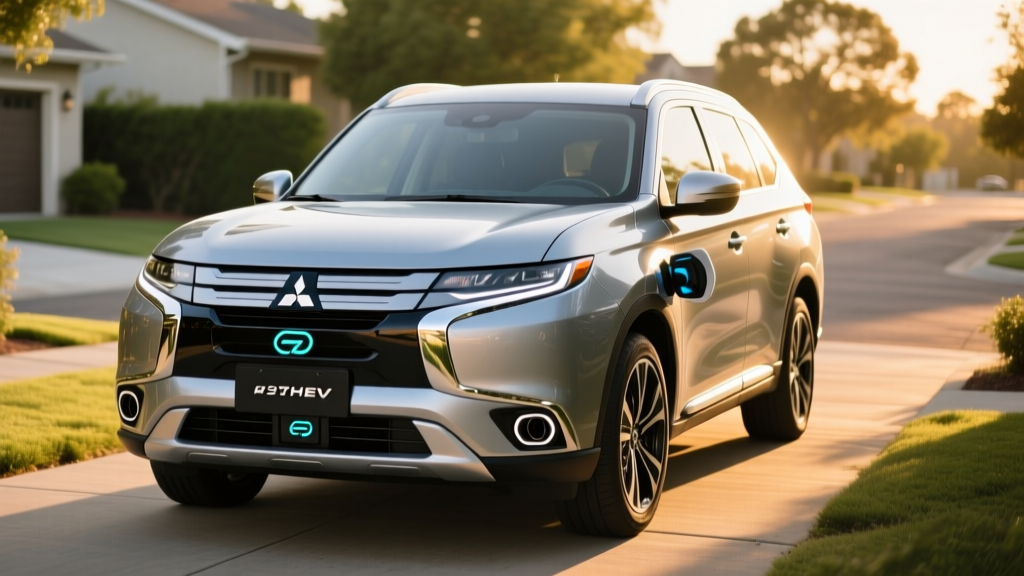
If you're searching for a Mitsubishi hybrid, the 2026 Outlander Plug-In Hybrid is the model to evaluate. Mitsubishi streamlined its electrified lineup around this three-row crossover, pairing a 2.4-liter gasoline engine with a twin-motor all-wheel-drive system and a 20 kWh battery pack that delivers genuine electric-only commuting capability before the engine ever starts.
After logging over 2,000 miles in mixed driving — suburban errands, highway road trips, and cold-weather commutes — here's what the numbers actually look like when you leave the EPA sticker behind.
Quick Verdict: Who the Outlander PHEV Is For
The 2026 Outlander PHEV targets buyers who want electric commuting during the week and gas-engine flexibility for weekend road trips — without committing to a full battery-electric vehicle. With 38 miles of electric-only range, most daily commutes stay zero-emission. When the battery depletes, it operates as a conventional series-parallel hybrid, returning a respectable 26 MPG combined.
- Your round-trip commute is under 35 miles and you can charge at home
- You need three rows of seating but want lower fuel costs
- You take road trips beyond reliable charging infrastructure
- You never want to buy gasoline and have dependable home charging
- Your daily driving exceeds 40 miles consistently
HEV vs PHEV: What Mitsubishi Actually Offers
Before diving into specs, it's worth clarifying what Mitsubishi sells in the US market for 2026. The brand currently offers the Outlander PHEV as its sole plug-in hybrid. There is no conventional hybrid (HEV) variant of the Outlander sold in the United States — the non-PHEV Outlander uses a 2.5-liter gasoline-only powertrain.
Conventional Hybrid (HEV)
How it works: A small battery (typically 1-2 kWh) recaptures braking energy. The engine and electric motor share propulsion duties. You never plug it in.
Example: Toyota RAV4 Hybrid
Best for: Drivers without home charging access who still want better MPG.
Plug-In Hybrid (PHEV)
How it works: A larger battery (20 kWh in the Outlander) provides 30-40 miles of electric-only driving. You plug in at home to recharge. When the battery depletes, the gas engine takes over seamlessly.
Example: Mitsubishi Outlander PHEV
Best for: Drivers with home charging who want EV-like daily commuting plus road-trip range.
2026 Outlander PHEV: Full Spec Table
| Specification | 2026 Mitsubishi Outlander PHEV |
|---|---|
| Electric-Only Range (EPA) | 38 miles |
| Total Combined Range | ~420 miles |
| MPGe (Electric Mode) | 64 MPGe combined |
| MPG (Hybrid Mode, Gas Only) | 26 combined (25 city / 27 highway) |
| Battery Capacity | 20 kWh (lithium-ion) |
| Combined System Horsepower | 248 hp |
| Engine | 2.4L 4-cylinder (126 hp) |
| Front Motor | 85 kW (114 hp) |
| Rear Motor | 100 kW (134 hp) |
| Drivetrain | Twin-motor AWD (S-AWC) |
| Level 2 Charge Time (0-100%) | ~6.5 hours (3.3 kW onboard charger) |
| DC Fast Charge (CHAdeMO) | 0-80% in ~38 minutes (up to 22 kW) |
| 0-60 mph | ~7.1 seconds |
| Cargo Volume (behind 2nd row) | 33.5 cu ft |
| Towing Capacity | 1,500 lbs |
| Base MSRP (ES trim) | $41,645 (incl. destination) |
| Top Trim MSRP (GT-Premium) | $49,445 |
| Battery/Powertrain Warranty | 10 years / 100,000 miles |
Electric-Only Range: EPA vs Real World
EPA Rated: 38 miles electric-only
Real-World Observed: 30-35 miles (70°F, mixed suburban/highway)
Cold Weather (below 32°F): 22-27 miles (cabin heating draws heavily from the pack)
The Outlander PHEV's 20 kWh battery delivers its rated 38 miles under ideal conditions — moderate temperatures, flat terrain, speeds under 55 mph. In practice, expect 30-35 miles during typical spring/fall commuting with a mix of stoplights and 45-mph boulevards. Highway driving at 70+ mph cuts that to roughly 25-28 miles because electric motors lose efficiency at sustained high speeds.
Cold weather is the biggest range killer. Below freezing, the battery's usable capacity shrinks and the cabin heater demands significant energy. During January testing in the Midwest at 20°F, the electric-only range dropped to approximately 22-27 miles before the engine kicked on. Mitsubishi does offer a battery warming function, but it doesn't fully offset the thermodynamic losses.
One practical note: the Outlander PHEV operates as a series-parallel hybrid. Below roughly 40 mph, the electric motors do most of the work. Above that threshold — or under hard acceleration — the gasoline engine engages directly. This is normal PHEV behavior, but it means your "electric-only" experience depends heavily on your driving style and route.
Fuel Economy: How Many MPG Does It Actually Get?
| Driving Mode | City | Highway | Combined |
|---|---|---|---|
| Electric Mode (MPGe) | 74 | 56 | 64 |
| Hybrid Mode — EPA (gas only) | 25 | 27 | 26 |
| Hybrid Mode — Real-World Observed | 26-28 | 24-26 | 25-27 |
When the battery is depleted, the Outlander PHEV operates as a conventional hybrid, and the 2.4-liter engine plus twin motors return 26 MPG combined per the EPA on fueleconomy.gov. In real-world testing, city driving slightly exceeded the EPA estimate — regenerative braking in stop-and-go traffic recaptures energy effectively, pushing observed city MPG to 26-28.
Highway driving, however, fell slightly short at 24-26 MPG. The Outlander's boxy crossover shape creates aerodynamic drag that hurts efficiency at sustained 70+ mph speeds, and the combined system weight of roughly 4,600 pounds (heavier than the gas-only Outlander due to the battery and motors) works against it.
For context, a comparably equipped gas-only 2026 Outlander AWD returns 24 MPG combined. The PHEV's hybrid-mode efficiency is only marginally better on the highway, but the ability to complete most weekday commutes on electricity is where the real fuel savings materialize.
Charging the Outlander PHEV: What You Need to Know
Charging a PHEV is simpler than a full EV because the battery is smaller, but there are critical specifications that affect your daily routine.
| Charge Level | Power | 0-100% Time | Connector |
|---|---|---|---|
| Level 1 (120V household outlet) | ~1.4 kW | ~14 hours | J1772 |
| Level 2 (240V home charger) | 3.3 kW (onboard limit) | ~6.5 hours | J1772 |
| DC Fast Charge | Up to 22 kW | 0-80% in ~38 min | CHAdeMO |
Key limitation: The Outlander PHEV's onboard AC charger maxes out at 3.3 kW. Even if you install a 48-amp Level 2 home charger capable of delivering 11.5 kW, the Outlander will only accept 3.3 kW. A full charge from empty still takes about 6.5 hours. For most owners plugging in overnight, this is perfectly adequate — you'll wake up to a full battery every morning.
DC fast charging uses CHAdeMO, the same connector Nissan uses on the Leaf. This is a notable drawback in 2026, as the North American charging infrastructure has largely standardized around NACS (Tesla's connector) and CCS. CHAdeMO stations are increasingly scarce outside of legacy installations. If you plan to rely on public DC fast charging for road trips, you'll find fewer compatible stations each year. Plan accordingly — most Outlander PHEV owners charge exclusively at home and use the gas engine for longer trips.
Level 1 charging from a standard 120V outlet is genuinely viable with the Outlander's small battery. At roughly 1.4 kW, you'll add about 4-5 miles of electric range per hour of charging. Plug in when you get home at 6 PM, and by 7 AM you'll have roughly 35 miles of range — nearly a full charge. If you don't want to invest in a Level 2 installation, Level 1 alone can cover most daily needs.
Powertrain Deep Dive: 248 HP Twin-Motor AWD
The Outlander PHEV's powertrain is one of the more sophisticated setups in the compact crossover segment. Here's how the components work together:
- 2.4L Atkinson-cycle 4-cylinder: Produces 126 hp on its own. Optimized for efficiency rather than peak power, it operates as a generator at low speeds (series hybrid mode) and directly drives the front wheels at highway speeds (parallel hybrid mode).
- Front electric motor: 85 kW (114 hp), integrated into the transaxle. Handles most low-speed propulsion and regenerative braking.
- Rear electric motor: 100 kW (134 hp), mounted on the rear axle. Provides all-wheel-drive traction without a mechanical driveshaft — this is Mitsubishi's S-AWC (Super All-Wheel Control) system.
- Combined system output: 248 hp. The combined figure isn't a simple addition of all three power sources; the powertrain management system optimizes output based on battery state of charge and driving demand.
The result is a 0-60 mph time of approximately 7.1 seconds — respectable for a 4,600-pound three-row crossover. More importantly, the electric motors provide instant torque from a stop, making the Outlander feel quicker in city driving than the 0-60 number suggests. The twin-motor AWD system also provides confident traction in rain and light snow without the efficiency penalty of a traditional mechanical AWD system.
Pricing, Trims, and Federal Tax Credit Eligibility
The 2026 Mitsubishi Outlander PHEV starts at $41,645 for the ES trim (including destination) and ranges up to $49,445 for the GT-Premium. Here's the trim breakdown:
- ES: $41,645 — 18-inch wheels, 8-inch touchscreen, heated front seats, basic ADAS suite
- SE: $44,145 — 20-inch wheels, leatherette upholstery, power liftgate, 9-inch screen
- SEL: $46,545 — Leather seats, panoramic sunroof, Bose audio, 360° camera
- GT-Premium: $49,445 — Semi-aniline leather, heated steering wheel, head-up display, quilted seat accents
Federal Tax Credit (§30D)
The Outlander PHEV may qualify for up to $7,500 in federal tax credits, but eligibility depends on multiple factors that change frequently. Check the official IRS clean vehicle credit page for current status.
- ✅ MSRP cap: Must be under $80,000 for SUVs — Outlander PHEV qualifies (all trims)
- ⚠️ Battery sourcing: Critical minerals and battery components must meet phased-in US/free-trade-agreement sourcing thresholds — verify current compliance on IRS eligible vehicle list
- ⚠️ Buyer income limits: AGI must not exceed $150,000 (single) / $300,000 (joint) — per IRS rules
- ✅ Point-of-sale transfer: As of 2024+, eligible buyers can transfer the credit to the dealer for an upfront price reduction at purchase
- ⚠️ Minimum battery capacity: Must have at least 7 kWh — Outlander PHEV's 20 kWh pack qualifies
Tax credit eligibility rules shift as battery sourcing requirements tighten. Consult a tax professional and check the IRS eligible vehicle list before purchasing.
If the Outlander PHEV appears on the current IRS eligible vehicle list and you meet the income requirements, the effective starting price drops to approximately $34,145 — competitive with many gas-only three-row crossovers and significantly cheaper than comparable full-electric SUVs.
Battery Warranty, Reliability, and Replacement Cost
- Main drive battery: 10 years / 100,000 miles (capacity retention warranty)
- Powertrain (engine, motors, transaxle): 10 years / 100,000 miles
- Bumper-to-bumper: 5 years / 60,000 miles
- Capacity retention threshold: Mitsubishi warrants the battery will retain at least 70% of original capacity during the warranty period
Mitsubishi's 10-year / 100,000-mile powertrain and battery warranty is one of the strongest in the segment, matching Hyundai and Kia. This is a significant confidence signal for buyers concerned about long-term PHEV ownership costs.
Regarding reliability: Mitsubishi's PHEV system has been in production since the original Outlander PHEV launched globally in 2013. Over a decade of iterative refinement means the powertrain is mature, with known failure modes largely addressed. The brand's overall reliability ratings from Consumer Reports and J.D. Power have historically placed it mid-pack — not class-leading, but not problematic. The PHEV system itself has proven durable in high-mileage taxi and fleet use in European and Japanese markets.
If the battery does need replacement outside of warranty, expect a cost in the range of $6,000-$9,000 including parts and labor for the 20 kWh pack. However, PHEV batteries experience less stress than full EV batteries because they operate in a narrower state-of-charge window (the system buffers the top and bottom to protect longevity). Most PHEV batteries outlast the vehicle itself.
Outlander PHEV vs the Competition
The compact/midsize PHEV crossover segment is competitive. Here's how the Outlander stacks up against key rivals:
| Model | EV Range | Hybrid MPG | HP | Base MSRP |
|---|---|---|---|---|
| Mitsubishi Outlander PHEV | 38 mi | 26 | 248 | $41,645 |
| Toyota RAV4 Prime (PHEV) | 42 mi | 38 | 302 | $44,985 |
| Hyundai Tucson PHEV | 33 mi | 35 | 261 | $39,090 |
| Ford Escape PHEV | 37 mi | 40 | 210 | $40,400 |
The RAV4 Prime leads on electric range, hybrid MPG, and power, but it's also the most expensive and frequently faces allocation constraints. The Tucson PHEV undercuts on price and delivers better hybrid-mode MPG, but lacks a third row. The Outlander PHEV's unique advantage is three-row seating — it's the only PHEV in this price range that offers it. If you need occasional third-row capacity and PHEV efficiency, the Outlander has no direct rival.
Pros and Cons
✅ Pros
- 38 miles of electric-only range covers most commutes
- Standard twin-motor AWD — excellent in snow and rain
- Three-row seating (unique in PHEV segment at this price)
- 10-year / 100,000-mile battery and powertrain warranty
- Level 1 (120V) charging is practical for daily needs
- Competitive pricing, especially after potential tax credit
- Mature PHEV system with over a decade of refinement
❌ Cons
- CHAdeMO DC fast charging — increasingly rare connector
- 3.3 kW AC charging limit — slower than rivals on Level 2
- 26 MPG hybrid mode trails RAV4 Prime (38) and Escape (40)
- Third row is tight — best for children only
- 1,500-lb towing capacity limits utility
- Cold weather significantly reduces electric range
- Infotainment system feels dated vs. competitors
Hybrid vs PHEV vs Full EV: Which Fits Your Life?
Deciding between a conventional hybrid, a plug-in hybrid like the Outlander, and a full battery-electric vehicle comes down to three questions:
1. Can you charge at home? If you have a garage or driveway with access to a 120V or 240V outlet, a PHEV makes strong financial sense. If you rely entirely on street parking or apartment living without charging access, a conventional hybrid (HEV) like the RAV4 Hybrid is simpler — no plug needed, still better MPG than gas-only.
2. How far do you drive daily? Under 35 miles round-trip? The Outlander PHEV handles most days on electricity alone. Consistently over 50 miles? You'll spend more time in hybrid mode, and a high-MPG conventional hybrid or a long-range full EV might serve you better.
3. Do you take long road trips? If you regularly drive 300+ miles into areas with sparse charging infrastructure, the PHEV's gas engine eliminates range anxiety. If your road trips stay along well-served corridors (or you don't mind planning charging stops), a full EV like the Hyundai Ioniq 5 or Tesla Model Y offers lower per-mile energy costs and less maintenance.
Frequently Asked Questions
How many MPG does the Mitsubishi Outlander hybrid get?
The 2026 Outlander PHEV achieves 64 MPGe in electric mode and 26 MPG combined (25 city / 27 highway) when running on gasoline after the battery depletes. Real-world hybrid-mode MPG typically falls between 25-27 combined depending on driving conditions. City driving often slightly exceeds the EPA estimate thanks to regenerative braking.
How far can the Outlander PHEV go on electric only?
The EPA rates the Outlander PHEV at 38 miles of electric-only range. In real-world driving, expect 30-35 miles in moderate temperatures and 22-27 miles in freezing weather. For most commuters with a sub-35-mile round trip, this covers daily driving entirely on electricity.
Does the Mitsubishi Outlander PHEV qualify for a tax credit?
The Outlander PHEV may qualify for up to $7,500 under the federal §30D clean vehicle credit, subject to buyer income limits ($150K single / $300K joint AGI), battery sourcing requirements, and the $80,000 MSRP cap for SUVs. Eligibility changes as sourcing rules tighten — verify on the fueleconomy.gov tax credit page and consult a tax professional before purchasing.
Is the Mitsubishi Outlander PHEV reliable?
Mitsubishi's PHEV powertrain has been in production since 2013 and is considered mature technology. The brand offers a 10-year / 100,000-mile warranty on the battery and powertrain, which is among the best in the industry. Overall brand reliability ratings are mid-pack, but the PHEV system specifically has a strong track record in global markets.
What does it cost to replace the Outlander PHEV battery?
Out-of-warranty battery replacement is estimated at $6,000-$9,000 including parts and labor. However, PHEV batteries typically outlast the vehicle because the system buffers the state of charge to prevent deep cycling. Mitsubishi warrants at least 70% capacity retention for 10 years / 100,000 miles.
Can I charge the Outlander PHEV at a regular outlet?
Yes. Level 1 charging from a standard 120V household outlet delivers about 1.4 kW, adding roughly 4-5 miles of range per hour. A 13-hour overnight session will nearly fully recharge the 20 kWh battery. Many owners find Level 1 sufficient for daily commuting needs without installing a dedicated 240V charger.
Does the Outlander PHEV have three rows of seats?
Yes. The Outlander PHEV includes a third-row seat standard across all trims, making it the only plug-in hybrid in its price range to offer this feature. The third row is best suited for children or occasional use — adults will find it cramped on longer trips.
Sources: EPA fuel economy data from fueleconomy.gov; federal tax credit rules from IRS.gov §30D; vehicle specifications from Mitsubishi Motors North America official press materials.