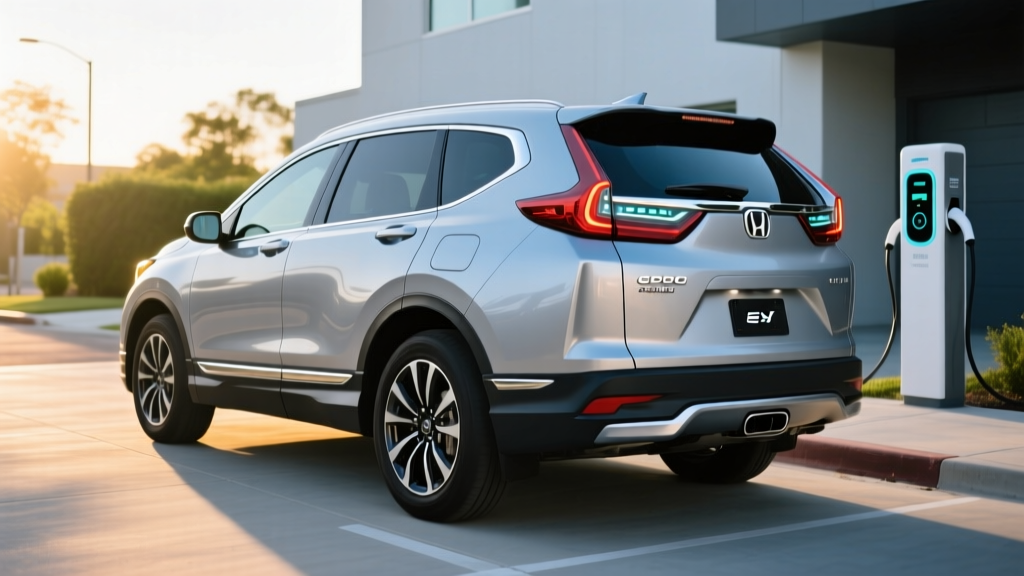
The 2026 Honda CR-V Sport Touring Hybrid sits at the top of Honda's best-selling compact SUV lineup, pairing a turbocharged engine with a two-motor hybrid system that prioritizes fuel economy without asking you to plug in. If you've been weighing whether a conventional hybrid (HEV), a plug-in hybrid (PHEV), or a full battery-electric vehicle (BEV) makes the most sense for your daily driving, this trim — with its loaded feature set and strong EPA ratings — is a practical proving ground for that decision.
In this guide, we break down exactly what the 2026 CR-V Sport Touring Hybrid delivers in MPG, powertrain output, real-world efficiency, battery longevity, and pricing. We'll also clarify where a conventional HEV fits against PHEV and EV alternatives so you can buy with confidence.
HEV vs PHEV vs EV: Where the CR-V Hybrid Fits
Before diving into specs, it's worth defining the three electrified powertrains shoppers cross-shop:
| Powertrain | How It Charges | Electric-Only Range | Plug Required? | Federal Tax Credit |
|---|---|---|---|---|
| HEV (Conventional Hybrid) | Regenerative braking + gasoline engine | None (EV mode limited to ~1 mile at low speed) | No | No |
| PHEV (Plug-In Hybrid) | Plug-in + regen + engine | Typically 25–45 miles | Yes (Level 1 or 2) | Up to $7,500 if eligible (§30D) |
| BEV (Full Electric) | Plug-in only | 200–400+ miles | Yes (Level 2 or DC fast) | Up to $7,500 if eligible (§30D) |
The 2026 Honda CR-V Sport Touring Hybrid is a conventional HEV. It has no plug, no electric-only highway range, and no eligibility for the federal §30D new clean vehicle tax credit. It generates and stores electricity internally through regenerative braking and the gasoline engine, then deploys that energy through its electric motors to assist acceleration and enable brief low-speed EV crawling. If you want plug-in capability in a Honda SUV, you'd look at the discontinued Clarity PHEV's used market or wait for Honda's upcoming PHEV offerings — but for buyers who want zero charging infrastructure hassle, the HEV is the simpler path.
2026 Honda CR-V Sport Touring Hybrid: MPG and Fuel Economy
Fuel economy is the headline reason buyers choose the CR-V Hybrid over its gasoline-only sibling. Here are the official EPA estimates for the 2026 Sport Touring Hybrid with all-wheel drive (the only drivetrain offered on this top trim):
| Driving Cycle | EPA Estimate |
|---|---|
| City | 43 MPG |
| Highway | 36 MPG |
| Combined | 40 MPG |
Source: EPA Fuel Economy.
Real-World MPG vs. EPA Sticker
Honda's two-motor hybrid system excels in stop-and-go city driving, where the electric motors handle most low-speed propulsion and the 1.5-liter turbocharged engine acts primarily as a generator. In real-world mixed commuting, owners frequently report matching or slightly exceeding the 43 MPG city figure — hybrids routinely outperform their EPA city estimates because regenerative braking recaptures energy that a gas car wastes as heat.
Highway driving tells a different story. At sustained 70–80 mph speeds, the aerodynamic drag of a compact SUV and the engine's direct-drive mode push real-world highway fuel economy closer to 33–35 MPG. Cold weather (below 35°F) will reduce efficiency by roughly 5–10% across all driving cycles, as the engine runs more frequently to provide cabin heat and maintain battery temperature.
Powertrain Specs: Horsepower, Engine, and Motors
The 2026 CR-V Sport Touring Hybrid uses Honda's fourth-generation two-motor hybrid system. Here's the full powertrain breakdown:
| Specification | Value |
|---|---|
| Engine | 2.0L Atkinson-cycle 4-cylinder (naturally aspirated) |
| Engine Output | 145 hp / 138 lb-ft torque |
| Electric Motors | Dual-motor hybrid system |
| Combined System Output | 204 hp / 247 lb-ft torque |
| Transmission | e-CVT (no traditional gears) |
| Drivetrain (Sport Touring) | Real-Time AWD (standard on this trim) |
| 0–60 mph | ~7.6 seconds |
| Towing Capacity | 1,000 lbs |
The combined 204 horsepower is a meaningful step up from the non-hybrid CR-V's 190 hp turbocharged 1.5L, and the 247 lb-ft of torque — available almost instantly from the electric motors — gives the hybrid noticeably stronger off-the-line acceleration. The e-CVT operates smoothly without the rubber-band effect of older CVTs, and the transition between electric-only and engine-assisted driving is nearly imperceptible in normal conditions.
On the Sport Touring trim, Honda's Real-Time AWD is standard. The rear axle receives torque via a mechanical connection from the hybrid system, not a separate rear motor (unlike Toyota's RAV4 Hybrid, which uses a dedicated rear electric motor for AWD). This means AWD engagement is reactive rather than predictive, which is adequate for rain and light snow but not as responsive as torque-vectoring electric rear axles.
Pricing and Tax Credit Eligibility
The 2026 Honda CR-V Sport Touring Hybrid carries an MSRP of approximately $40,850 (including destination). This positions it as the most expensive trim in the CR-V lineup, but it includes features that would cost thousands as add-ons elsewhere: a 9-inch touchscreen with wireless Apple CarPlay and Android Auto, a 12-speaker Bose audio system, heated and ventilated front seats, a heated steering wheel, a panoramic moonroof, a wireless phone charger, and Honda's full Honda Sensing suite of driver-assistance features.
Federal Tax Credit: Not Eligible
Because the CR-V Sport Touring Hybrid is a conventional HEV — not a plug-in vehicle — it does not qualify for the IRS §30D New Clean Vehicle Credit. That credit, which offers up to $7,500, is reserved for battery-electric vehicles (BEVs) and plug-in hybrids (PHEVs) that meet battery sourcing, MSRP cap ($80,000 for SUVs), and buyer income requirements.
- Federal §30D credit: Not eligible (HEV, not PHEV or BEV)
- Federal §25D used clean vehicle credit: Not applicable to new HEV purchases
- State incentives: Some states offer rebates for hybrids — check your state energy office or AFDC state incentive database
- Insurance discounts: Some insurers offer minor hybrid discounts; check your provider
For buyers who specifically want federal tax-credit eligibility, the path is a PHEV or BEV. The CR-V Hybrid's value proposition is lower: no plug, no credit, but also no charging hassle and a lower purchase price than most PHEV competitors.
Battery Warranty, Reliability, and Replacement Cost
Real-World Hybrid Battery Longevity
Honda's hybrid battery packs have a strong track record. The lithium-ion pack in the CR-V Hybrid is relatively small (approximately 1.0 kWh usable) compared to a BEV's 60–100 kWh pack, which means individual cells undergo far fewer deep charge-discharge cycles. The battery operates in a narrow state-of-charge window (roughly 40–60% SoC) managed by the hybrid control system, which dramatically reduces degradation stress.
Based on long-term data from Honda's earlier hybrid systems (Insight, Accord Hybrid), owners should expect the battery to last well beyond 150,000 miles under normal use. Failure before 100,000 miles is uncommon. When replacement is eventually needed, a new OEM hybrid battery for the CR-V runs approximately $2,000–$3,500 including labor — a fraction of what a BEV traction battery replacement costs ($10,000–$20,000+).
Overall Reliability
Honda's hybrid powertrain has earned strong reliability marks from both owner surveys and industry analysts. The e-CVT has no belts, bands, or clutch packs to wear — it's a gearset connecting two motor-generators, and failures are rare. The 2.0L Atkinson-cycle engine is naturally aspirated (no turbo), which reduces thermal stress and long-term maintenance complexity compared to the turbocharged 1.5L in the non-hybrid CR-V.
For reference, the NHTSA and IIHS publish crash-test ratings for the CR-V annually — Honda Sensing (forward collision warning, automatic emergency braking, lane-keeping assist, adaptive cruise control) is standard on every trim.
Who Should Choose the CR-V Hybrid vs. a PHEV or EV?
- You don't have access to home or workplace charging (no garage, apartment living, street parking)
- Your daily driving is a mix of city and highway with no single dominant pattern
- You want 40+ MPG without ever thinking about plugging in
- You frequently take long road trips (400+ miles) and don't want to plan around charging stops
- You want a loaded compact SUV under $42,000
- You can charge at home (Level 2, even a 120V outlet) and your commute is under 35 miles round-trip
- You want to drive mostly on electricity daily but keep gas for road trips
- You want to pursue the §30D federal tax credit (up to $7,500 if eligible)
- You have reliable home Level 2 charging
- Your daily driving is under 200 miles and you rarely road-trip beyond 250 miles
- You want near-zero routine maintenance (no oil changes, no spark plugs, minimal brake wear)
- You want the lowest per-mile "fuel" cost (electricity at $0.13/kWh ≈ $0.04/mile vs. gas at $3.40/gal ≈ $0.09/mile at 40 MPG)
The CR-V Hybrid's sweet spot is the buyer who wants electrified efficiency without lifestyle change. If your housing situation makes charging impractical, or if you simply don't want to manage charging logistics, the HEV delivers most of the fuel-cost savings with none of the infrastructure burden.
Pros and Cons at a Glance
Pros
- 43 MPG city / 40 combined EPA — strong real-world efficiency
- 204 hp with instant electric torque feels quicker than the number suggests
- No plug required — zero charging infrastructure needed
- Sport Touring trim is fully loaded at ~$40,850 (no expensive add-on packages)
- Proven hybrid reliability with 8–10 year battery warranty
- Low battery replacement cost ($2,000–$3,500) vs. BEV
- Strong resale value — Honda CR-V historically retains value well
Cons
- No federal tax credit eligibility (HEV, not PHEV/BEV)
- No electric-only highway driving — always uses gasoline
- AWD is mechanical/reactive, not torque-vectoring electric rear axle
- Highway MPG drops to low-to-mid 30s in real-world 70+ mph driving
- Towing limited to 1,000 lbs (not rated for trailers or boats)
- Sport Touring is the only hybrid trim with premium features — no mid-tier hybrid option
Frequently Asked Questions
How many MPG does the 2026 Honda CR-V Sport Touring Hybrid get?
The EPA rates it at 43 MPG city, 36 MPG highway, and 40 MPG combined. Real-world results typically land between 38–42 MPG combined depending on driving mix and climate, with city-heavy commuters often exceeding the EPA city figure.
Does the CR-V Hybrid need to be plugged in?
No. The 2026 CR-V Sport Touring Hybrid is a conventional HEV. It charges its small lithium-ion battery through regenerative braking and the gasoline engine. There is no plug, no charging port, and no electric-only highway range.
How far can the CR-V Hybrid drive on electric power alone?
Only about 1 mile at very low speeds (under 25 mph) in EV mode, typically in parking lots or stop-and-go traffic. This is not a plug-in hybrid — it cannot sustain electric-only driving at highway speeds.
Is the CR-V Hybrid reliable, and what does a battery replacement cost?
Honda's hybrid system has a strong reliability record. The battery is warrantied for 8 years/100,000 miles (10 years/150,000 miles in CARB states). Replacement, if needed after warranty, costs approximately $2,000–$3,500 — far less than a BEV battery replacement.
Does the 2026 CR-V Hybrid qualify for any tax credit?
It does not qualify for the federal §30D new clean vehicle credit, which is limited to PHEVs and BEVs. Some states offer hybrid-specific rebates — check the Alternative Fuels Data Center for your state's current incentives. Consult a tax professional for personal eligibility questions.
What's the difference between the CR-V Hybrid and the CR-V gas model?
The gas-only CR-V uses a 1.5L turbocharged engine making 190 hp and is rated at roughly 29 MPG combined (AWD). The Hybrid uses a 2.0L Atkinson-cycle engine plus two electric motors for 204 hp combined and 40 MPG combined. The hybrid costs roughly $3,000–$4,000 more at equivalent trims but saves approximately $400–$600 per year in fuel for a driver covering 15,000 miles annually.
Hybrid vs PHEV vs EV — which is right for me?
If you can charge at home and commute under 35 miles, a PHEV lets you drive on electricity daily while keeping gas for road trips — and may qualify for up to $7,500 in federal credits. If you have home charging and mostly drive under 200 miles daily, a BEV offers the lowest operating cost. If you can't charge at home or want zero lifestyle change, the CR-V Hybrid delivers 40 MPG without any plug.
Final Verdict: A Practical Electrified SUV Without the Plug
The 2026 Honda CR-V Sport Touring Hybrid isn't trying to be an EV. It's a well-executed conventional hybrid that delivers meaningful fuel savings, strong around-town acceleration, and a premium feature set at a reasonable price. For buyers who lack charging access or who simply want a "fill up and go" ownership experience with 40 MPG, it's one of the strongest choices in the compact SUV segment.
If your situation allows for home charging, a PHEV or BEV will deliver lower per-mile operating costs and potential tax-credit savings. But for the apartment dweller, the street parker, or the road-trip family that doesn't want to route-plan around DC fast chargers, the CR-V Sport Touring Hybrid is the electrified option that asks nothing of you — and delivers on its MPG promise.