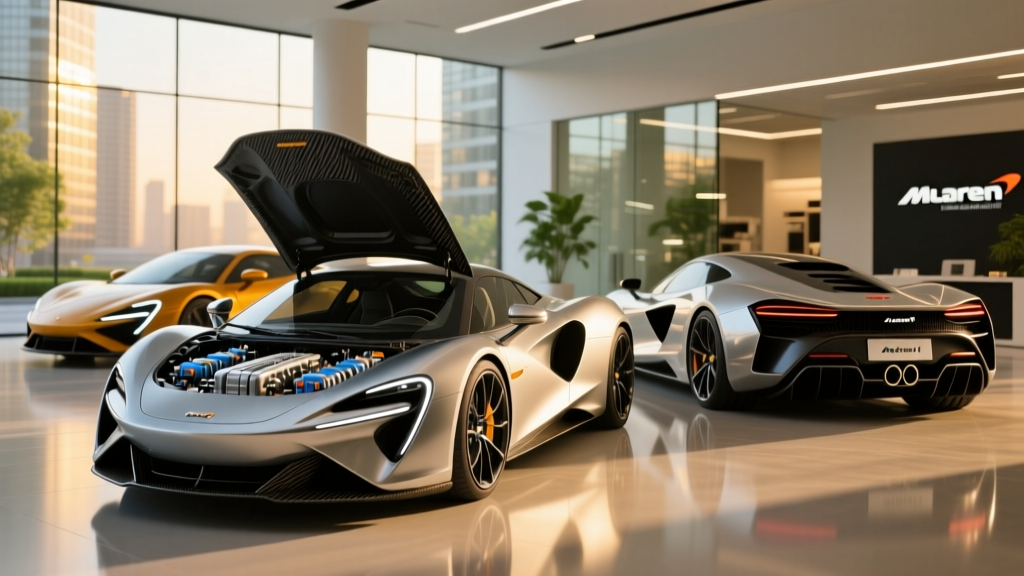
McLaren's hybrid era has matured past the experimental P1 and the limited-run Speedtail. In 2026, the brand fields two distinct hybrid architectures: the twin-turbo V6 plug-in hybrid platform underpinning the Artura coupe and the new Artura Spider, and the naturally aspirated V8 hybrid system powering the flagship W1 hypercar. These aren't economy-minded hybrids — they use electrification to fill torque gaps, enable silent electric-only driving in residential areas, and sharpen throttle response beyond what internal combustion alone can deliver.
This guide breaks down exactly what McLaren's hybrid powertrains deliver in measurable terms: EPA fuel economy, electric-only range, battery capacity, charging logistics, warranty coverage, and real-world ownership considerations for buyers cross-shopping Ferrari's 296 GTB, Lamborghini's Temerario, or Porsche's 911 Turbo S E-Hybrid.
HEV vs PHEV: How McLaren's Two Hybrid Systems Differ
McLaren currently sells two fundamentally different hybrid configurations. Understanding the distinction matters for daily usability, charging requirements, and operating costs.
| Attribute | Artura / Artura Spider (PHEV) | W1 (HEV) |
|---|---|---|
| Hybrid Type | Plug-in Hybrid (PHEV) | Conventional Hybrid (HEV) |
| Plug-in Required? | Yes — Level 2 AC charging | No — regenerates via braking and engine |
| Electric-Only Driving | Yes, up to ~19 miles | No sustained EV mode; electric assist only |
| Battery Usable Capacity | 7.4 kWh (lithium-ion) | ~1.0 kWh (compact high-discharge pack) |
| Primary Benefit | Zero-emission short trips + V6 performance | Instant torque-fill + weight savings vs. PHEV |
| Combined HP | 690 hp | 1,258 hp |
The Artura's PHEV system lets you plug in overnight and drive short distances on electricity alone — practical for exiting a neighborhood silently or navigating congestion. The W1's HEV system never plugs in; its small, high-output battery exists solely to deploy the E-motor's 338 hp in bursts, filling the torque dip that even a 9,200-RPM V8 experiences below 3,000 RPM.
McLaren Artura: Powertrain, MPG, and Electric Range
The Artura pairs a 120-degree twin-turbocharged 3.0L V6 (577 hp) with an axial-flux electric motor (113 hp) integrated into the 8-speed dual-clutch transmission. Combined output reaches 690 hp and 531 lb-ft of torque. The E-motor also serves as the reverse gear — there is no mechanical reverse in the transmission, saving weight.
| Specification | 2026 McLaren Artura Coupe | 2026 McLaren Artura Spider |
|---|---|---|
| Engine | 3.0L Twin-Turbo V6 + E-Motor | 3.0L Twin-Turbo V6 + E-Motor |
| Combined Horsepower | 690 hp | 690 hp |
| Combined Torque | 531 lb-ft | 531 lb-ft |
| 0-60 mph | 3.0 seconds | 3.0 seconds |
| Top Speed | 205 mph | 205 mph |
| Battery (Usable) | 7.4 kWh lithium-ion | 7.4 kWh lithium-ion |
| EPA Electric Range | 19 miles (est.) | 18 miles (est.) |
| EPA Combined MPG (gas) | 18 MPG (est.) | 17 MPG (est.) |
| MPGe (EV + Gas Combined) | ~40 MPGe (est.) | |
| Total Range (EV + Gas) | ~310 miles | ~300 miles |
| Transmission | 8-speed SSG (no reverse gear) | 8-speed SSG (no reverse gear) |
| Curb Weight | 3,382 lbs | 3,439 lbs |
How Many MPG Does the McLaren Artura Hybrid Get?
McLaren's PHEV fuel economy depends heavily on whether you charge regularly. With a depleted battery running purely on gasoline, expect roughly 17-19 MPG combined — typical for a mid-engine twin-turbo supercar. The EPA's fueleconomy.gov database rates PHEVs in two modes: charge-depleting (electricity + gas, measured in MPGe) and charge-sustaining (gas only, measured in MPG).
| Driving Mode | City | Highway | Combined |
|---|---|---|---|
| Charge-Sustaining (Gas Only) | 16 MPG | 20 MPG | 18 MPG |
| Charge-Depleting (EV + Gas) | ~40 MPGe combined | ||
In real-world driving, owners who plug in nightly and commute under 19 miles may go weeks without visiting a gas station. Track-day driving or sustained highway runs above 80 mph will push fuel consumption toward 14-15 MPG, as the E-motor's contribution diminishes at sustained high loads.
Charging the Artura: Level 2 Only, No DC Fast Charging
The Artura supports Level 2 AC charging via a Type 2 / J1772 connector at up to 7.0 kW. A full 0-100% charge takes approximately 2.5 hours on a Level 2 home charger. There is no DC fast-charging capability — the small battery doesn't warrant it, and the added weight of DC charge hardware would compromise the car's power-to-weight ratio.
| Charge Level | Power | 0-100% Time | Availability |
|---|---|---|---|
| Level 1 (120V household) | ~1.4 kW | ~6 hours | Any standard outlet |
| Level 2 (240V home/public) | 7.0 kW | ~2.5 hours | Home wallbox or public AC |
| DC Fast Charge | N/A | N/A | Not supported |
For PHEV owners, a dedicated Level 2 home charger is the practical minimum. A 240V/32A circuit delivers the full 7.0 kW and ensures the battery is replenished overnight between drives.
McLaren W1: The HEV Hypercar Approach
The W1, announced as the successor to the P1 and Senna, uses a radically different hybrid philosophy. Its 4.0L twin-turbocharged flat-plane-crank V8 produces 915 hp on its own, supplemented by a front-mounted E-motor contributing 338 hp for a combined 1,258 hp. The W1 is a conventional hybrid (HEV) — it never plugs in.
The E-motor's role is torque-fill: at low RPM where turbo lag exists, the electric motor delivers instant thrust. The compact ~1.0 kWh battery recharges through regenerative braking and engine-driven generation. There is no electric-only driving mode. This architecture prioritizes minimum weight and maximum performance over zero-emission capability.
| Specification | 2026 McLaren W1 |
|---|---|
| Engine | 4.0L Twin-Turbo V8 + E-Motor (HEV) |
| Combined Horsepower | 1,258 hp |
| 0-60 mph | 2.7 seconds |
| Top Speed | 217 mph (electronically limited) |
| Battery | ~1.0 kWh high-discharge lithium-ion |
| Plug-in Charging | Not supported (HEV) |
| Electric-Only Mode | None |
| Curb Weight | 3,074 lbs |
| Production | 399 units (all allocated) |
| Base Price | $2,100,000 MSRP |
W1 Fuel Economy Expectations
McLaren has not published EPA fuel economy figures for the W1, and given its 399-unit production run and track-focused purpose, official EPA testing is unlikely. Based on comparable hypercars (Aston Martin Valkyrie, Ferrari SF90 in non-EV mode), expect 12-14 MPG combined under mixed driving, with single-digit figures under hard use. Fuel economy is not a purchase criterion at this level.
Pricing, Tax Credits, and Ownership Costs
McLaren's hybrid lineup occupies the upper stratosphere of automotive pricing. Federal tax credit eligibility is a genuine consideration for the Artura but effectively irrelevant for the W1.
| Model | Base MSRP | §30D Federal Tax Credit | Eligibility Notes |
|---|---|---|---|
| Artura Coupe | $249,750 | Not eligible | MSRP exceeds $55,000 sedan cap; exceeds buyer income caps |
| Artura Spider | $273,800 | Not eligible | Same MSRP and income cap limitations |
| W1 | $2,100,000 | Not eligible | Far exceeds all §30D thresholds |
Under current IRS §30D rules, the federal clean vehicle credit caps eligible SUVs at $80,000 MSRP and other vehicles (sedans, coupes) at $55,000. The Artura, classified as a non-SUV, is disqualified by its $249,750 starting price alone. Buyer modified adjusted gross income caps ($150,000 single / $300,000 joint) further limit eligibility. No McLaren hybrid currently qualifies for any federal EV or PHEV tax credit.
Some states offer separate incentives for PHEVs regardless of price. California's CVRP program, for example, has historically offered rebates — but income and MSRP caps vary by jurisdiction. Consult your state's energy office or a tax professional for current local incentives.
Battery Warranty, Reliability, and Replacement Costs
Hybrid battery longevity is a top concern for any electrified vehicle buyer, and supercar applications add the complication of high-discharge cycling and thermal stress.
Is the McLaren Hybrid Reliable?
McLaren's reliability reputation has improved since the early 570S and 720S generations, but the brand still trails Porsche and Ferrari in long-term dependability surveys. The Artura's powertrain represents McLaren's second-generation hybrid architecture — an evolution from the P1's system — with a simpler V6 replacing the V8 and an integrated axial-flux motor replacing the earlier configuration.
The axial-flux E-motor (supplied by YASA, now a Mercedes-Benz subsidiary) is a proven unit also used in the Mercedes-AMG ONE and Ferrari 296 GTB. The 7.4 kWh battery uses cylindrical lithium-ion cells with active liquid cooling. Early Artura owners (2023-2024 models) have reported software-related issues — infotainment glitches, hybrid system warning lights — more frequently than powertrain hardware failures.
Battery Replacement Cost
McLaren does not publish official high-voltage battery replacement pricing. Based on comparable supercar PHEV systems (Ferrari 296 GTB, Porsche 918 Spyder aftermarket replacements), expect a full Artura battery replacement to cost between $15,000 and $25,000 including labor. The W1's smaller battery pack will likely be less expensive to replace but is more integrated into the chassis structure.
For context, most hybrid batteries in supercar applications are replaced under warranty or covered by extended service contracts. McLaren offers prepaid maintenance plans that can be extended beyond the factory warranty period.
Hybrid vs PHEV vs EV: Which McLaren Buyer Profile Fits?
- You want a daily-drivable supercar with the option of silent, zero-emission neighborhood driving
- You have access to Level 2 home charging
- You value fuel flexibility — electric for short commutes, gasoline for road trips
- You're cross-shopping the Ferrari 296 GTB ($325,000+) or Lamborghini Temerario
- Maximum home charging convenience matters — no gas station visits ever
- You prioritize instant torque delivery and low center of gravity
- You don't need a mid-engine layout or supercar ground clearance
- You're among the 399 allocation holders and track performance is the sole priority
- You want hybrid torque-fill without any charging obligation
- Weight savings over a PHEV system is non-negotiable
- You want proven long-term reliability and broader dealer service networks
- Hybrid system complexity and potential out-of-warranty battery costs concern you
- Natural aspiration and high-RPM engagement are your priorities
McLaren Hybrid vs. the Competition
The Artura competes directly with other hybridized supercars. Here's how the key specifications compare:
| Attribute | McLaren Artura | Ferrari 296 GTB | Lamborghini Temerario |
|---|---|---|---|
| Hybrid Type | PHEV | PHEV | PHEV |
| Engine | 3.0L TT V6 | 3.0L TT V6 | 4.0L TT V8 |
| Combined HP | 690 hp | 819 hp | 907 hp |
| 0-60 mph | 3.0 sec | 2.9 sec | 2.7 sec |
| Battery | 7.4 kWh | 7.45 kWh | ~3.8 kWh |
| EV Range | ~19 mi | ~16 mi | ~5 mi |
| Base MSRP | $249,750 | $325,000 | $390,000 |
| Curb Weight | 3,382 lbs | 3,494 lbs | 3,726 lbs |
The Artura undercuts both rivals on price and weight. The Ferrari 296 GTB delivers more power and a slightly more aggressive EV strategy, while the Temerario trades electric range for brute V8 output. The Artura's advantage is its relative lightness — a McLaren obsession — and the lowest entry price in the hybrid supercar segment.
- Lightest in its class at 3,382 lbs
- Usable 19-mile EV range for quiet neighborhood driving
- Lowest MSRP among hybrid supercars
- Axial-flux E-motor delivers seamless torque integration
- 8-speed DCT with no reverse gear saves weight
- Improved infotainment over previous McLaren generations
- 6-year battery warranty is shorter than mainstream PHEVs
- No DC fast charging
- Real-world EV range drops to ~14 miles in cold or highway driving
- Limited dealer network vs. Porsche or Ferrari
- Software-related issues reported by early adopters
- No federal tax credit eligibility
- Battery replacement could cost $15,000-$25,000 out of warranty
Frequently Asked Questions
How many MPG does the McLaren Artura hybrid get?
In charge-sustaining mode (battery depleted, running on gasoline only), the Artura returns approximately 16 MPG city, 20 MPG highway, and 18 MPG combined. When regularly plugged in and driven within its 19-mile electric range, effective economy can reach 40 MPGe or higher depending on trip length and charging frequency. Real-world highway driving at sustained speeds above 75 mph will yield closer to 15-16 MPG on gas alone.
How far can the McLaren Artura go on electric only?
The EPA-estimated electric-only range is approximately 19 miles for the coupe and 18 miles for the Spider. Real-world conditions — highway speeds, cold weather, aggressive throttle use — reduce this to roughly 14-16 miles. The electric-only top speed is limited to 81 mph, sufficient for residential and urban driving but not highway merging at full speed.
Does the McLaren Artura qualify for any tax credit?
No. Under current IRS §30D rules, the Artura's $249,750 MSRP far exceeds the $55,000 cap for non-SUV vehicles. Additionally, most buyers in this price bracket exceed the income caps ($150,000 single / $300,000 joint filers). No federal clean vehicle credit applies. Some state-level incentives for PHEVs may be available regardless of price — check your state's energy office or consult a tax professional for details.
Is the McLaren hybrid system reliable?
McLaren's second-generation hybrid architecture is more refined than the P1-era system, and the YASA axial-flux E-motor is a proven component shared with Ferrari and Mercedes-AMG. Early Artura models (2023-2024) experienced software-related issues more than hardware failures. Long-term reliability data is still limited given the model's 2022 introduction. The 6-year/45,000-mile battery warranty provides coverage, though it's shorter than mainstream PHEV warranties. McLaren's dealer network is also smaller than Ferrari's or Porsche's, which affects service accessibility in some regions.
What does a McLaren hybrid battery replacement cost?
McLaren does not publish official replacement pricing. Industry estimates for the Artura's 7.4 kWh high-voltage battery pack range from $15,000 to $25,000 including labor, based on comparable supercar PHEV battery service costs. The W1's smaller battery may cost less to replace but requires more labor due to structural integration. Most owners will address battery needs under the factory warranty or through extended service contracts.
Does the McLaren W1 plug in?
No. The W1 is a conventional hybrid (HEV), not a plug-in hybrid. Its ~1.0 kWh battery charges exclusively through regenerative braking and engine-driven generation. There is no EV-only driving mode and no charge port. This design choice saves weight and eliminates charging infrastructure dependency, aligning with the W1's track-focused mission.
How does the Artura compare to the Ferrari 296 GTB?
Both use twin-turbo V6 PHEV architectures with nearly identical battery capacities (~7.4 kWh). The Ferrari produces 819 hp versus the Artura's 690 hp, and costs roughly $75,000 more at $325,000 base. The Artura is lighter (3,382 vs. 3,494 lbs) and offers slightly more electric range (19 vs. 16 miles). The 296 GTB has a stronger dealer and service network in North America. Both lack DC fast charging and federal tax credit eligibility.
Sources: McLaren Automotive official specifications, U.S. EPA fueleconomy.gov, IRS §30D Clean Vehicle Credit guidelines. Pricing and specifications reflect 2026 model year data available at time of publication. Tax credit rules are subject to legislative change — consult a tax professional for eligibility.