The Quick Verdict on the Mitsubishi Outlander PHEV
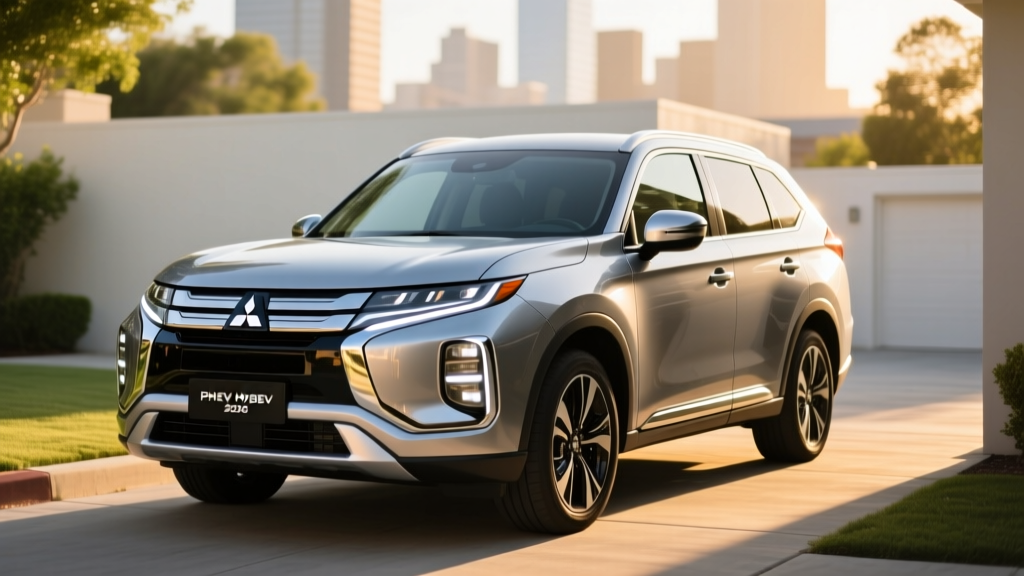
The Mitsubishi Outlander PHEV occupies a specific niche in the electrified SUV market: a three-row plug-in hybrid with DC fast charging capability and standard all-wheel drive, priced below most competitors. For 2026, the Outlander PHEV continues with a 20.0 kWh usable battery delivering an EPA-estimated 38 miles of electric-only range, a combined 248 horsepower from its twin-motor S-AWC powertrain, and a starting MSRP around $41,645.
It isn't the most efficient PHEV on the market, and its electric range trails the Toyota RAV4 Prime's 42 miles. But DC fast charging at up to 22 kW — a rarity among plug-in hybrids — and Mitsubishi's generous battery warranty make it a compelling bridge for buyers who want electric commuting without range anxiety on road trips.
HEV vs PHEV: Where the Mitsubishi Outlander Fits
Mitsubishi offers the Outlander in two distinct electrified flavors, and confusing them is a common mistake. Here's the fundamental difference:
Plug-In Hybrid (PHEV): The Mitsubishi Outlander PHEV hybrid carries a much larger 20.0 kWh lithium-ion battery that you plug in to charge — at home on a Level 2 charger or at a public DC fast-charging station. This larger battery enables 38 miles of pure electric driving before the 2.4-liter gasoline engine kicks in as a generator or direct-drive source.
If you never plug in the Outlander PHEV, it still functions as a conventional hybrid — you just won't capture its efficiency advantage. The EPA rates it at 25 MPG combined once the battery is depleted, which is respectable but not class-leading. The real value emerges when you charge daily and commute within that 38-mile electric envelope.
Fuel Economy, MPGe, and Electric-Only Range
| Metric | EPA Estimate | Real-World Expectation |
|---|---|---|
| MPGe (combined, with charge) | 64 MPGe | 58-68 MPGe depending on driving mix |
| MPG (gas only, battery depleted) | 25 MPG combined | 23-27 MPG (city-favors regen, hwy less efficient) |
| City MPG (gas only) | 25 MPG | 24-27 MPG (regen helps in stop-and-go) |
| Highway MPG (gas only) | 26 MPG | 23-25 MPG (aero drag at 70+ mph) |
| Electric-only range | 38 miles | 32-36 miles (30-34 in cold weather below 40°F) |
| Total combined range | ~420 miles | 380-430 miles depending on conditions |
The 64 MPGe figure applies when you start with a full charge and drive a mix of electric and gas miles. MPGe (miles per gallon equivalent) converts the electricity consumed into a gasoline-equivalent metric. Once the battery depletes, you're driving a 3,900-pound hybrid SUV, and 25 MPG combined reflects that weight.
Powertrain Specs: Twin Motors and S-AWC
| Specification | 2026 Outlander PHEV |
|---|---|
| Engine | 2.4L 4-cylinder Atkinson cycle |
| Front motor output | 114 hp / 188 lb-ft |
| Rear motor output | 134 hp / 144 lb-ft |
| Combined system output | 248 hp |
| Drivetrain | S-AWC (twin-motor AWD, no mechanical link front-to-rear) |
| 0-60 mph | ~7.0 seconds |
| Battery capacity (usable) | 20.0 kWh lithium-ion |
| Electric-only range | 38 miles (EPA) |
| Towing capacity | 1,500 lbs |
| Cargo (behind 2nd row) | 33.5 cu ft (PHEV loses some space to battery) |
The Outlander PHEV's powertrain architecture is unconventional. There is no traditional transmission — the front axle can be driven by the electric motor, the gas engine (via a clutch at highway speeds for direct drive), or both. The rear axle is exclusively electric-motor-driven. This means all-wheel drive is always available through the twin-motor setup, giving Mitsubishi's Super All-Wheel Control (S-AWC) system torque-vectoring capability without a driveshaft connecting front and rear.
The 248 combined horsepower is adequate for merging and passing, though the Outlander PHEV doesn't feel as quick as the RAV4 Prime's 302 hp. The trade-off is that Mitsubishi prioritizes smooth, quiet electric operation at lower speeds over outright performance.
Charging: The PHEV with DC Fast Charging
This is where the Outlander PHEV differentiates itself from nearly every other plug-in hybrid on the market. Most PHEVs — including the RAV4 Prime and Hyundai Tucson PHEV — are limited to Level 2 AC charging only. The Outlander PHEV offers DC fast charging via a CHAdeMO connector.
| Charging Level | Power | Time (0-100%) | Connector |
|---|---|---|---|
| Level 1 (120V household) | ~1.4 kW | ~14-16 hours | J1772 |
| Level 2 (240V home/public) | ~3.3 kW (onboard charger limit) | ~6.5 hours | J1772 |
| DC Fast Charge | Up to 22 kW | 0-80% in ~38 minutes | CHAdeMO |
A few critical caveats on charging:
- The 3.3 kW onboard charger is slow for Level 2. Many PHEVs offer 6.6 kW or 7.2 kW Level 2 charging. At 3.3 kW, a full charge takes 6.5 hours — fine for overnight charging but limiting if you want to top up mid-day.
- CHAdeMO infrastructure is declining. As the industry standardizes on NACS (Tesla's connector) and CCS, CHAdeMO stations are becoming less common. Check your local charging networks — Electrify America has largely phased out CHAdeMO, though some older stations remain.
- DC fast charging a 20 kWh battery is a niche use case. At 22 kW peak, you'll add roughly 15-18 miles of range in 30 minutes. That's useful for extending electric driving on a road trip, but you're far better off letting the hybrid system handle long-distance driving and reserving battery for city miles.
For daily ownership, Level 2 home charging is the sweet spot. Plug in when you get home, wake up to a full 38-mile battery. A standard 120V outlet works but takes 14+ hours — adequate if you drive less than 20 miles daily and can leave it plugged in continuously.
Pricing, Trims, and Tax Credit Eligibility
The 2026 Mitsubishi Outlander PHEV is available in four trims:
- ES: ~$41,645 MSRP — base trim with 18-inch wheels, 8-inch display, heated front seats
- SE: ~$44,145 MSRP — adds synthetic leather, power liftgate, larger infotainment
- SEL: ~$46,645 MSRP — genuine leather, panoramic sunroof, head-up display
- GT-Prestige: ~$49,445 MSRP — Nappa leather, premium audio, advanced safety suite
Federal Tax Credit: The §30D Situation
- Vehicle must have at least 7 kWh of battery capacity (Outlander PHEV qualifies at 20.0 kWh)
- Must be assembled in North America (Outlander PHEV is built in Okazaki, Japan — does NOT qualify for new-vehicle §30D credit)
- Buyer income caps: $150K single / $300K joint (would apply if eligible)
- MSRP cap: $80,000 for SUVs (Outlander PHEV clears this)
- Battery critical minerals and component sourcing requirements (moot due to assembly location)
The Outlander PHEV's Japanese assembly disqualifies it from the federal $7,500 new-vehicle tax credit under current IRS §30D rules. This is a meaningful disadvantage versus the U.S.-assembled Jeep Wrangler 4xe or the RAV4 Prime (also Japan-built, also ineligible). Always verify current eligibility on the IRS website, as sourcing rules and qualifying vehicle lists update periodically.
Some states offer their own PHEV rebates independent of federal rules. Check your state energy office or fueleconomy.gov's incentive finder for local programs. California's CVRP, for instance, has historically excluded PHEVs from its rebate program, but utility-level incentives may apply.
Battery Warranty, Reliability, and Long-Term Costs
- 10 years / 100,000 miles on the high-voltage battery and PHEV components
- 5 years / 60,000 miles basic (bumper-to-bumper)
- 10 years / 100,000 miles powertrain
- Capacity retention threshold: warranty triggers if battery drops below approximately 70% of original capacity
Mitsubishi's 10-year/100,000-mile battery warranty is among the best in the PHEV segment and matches Hyundai/Kia's coverage. For context, Toyota covers the RAV4 Prime battery for 10 years/150,000 miles (a slight edge on mileage).
Regarding reliability: Mitsubishi's PHEV system has been in production since 2013 (the original Outlander PHEV launched globally that year). The powertrain architecture is well-proven. Common issues reported by owners tend to involve infotainment software rather than the hybrid system itself. The battery pack uses lithium-ion cells with an active thermal management system to mitigate degradation.
Battery replacement cost: If out of warranty, a full Outlander PHEV battery replacement currently runs between $8,000 and $12,000 including labor. However, wholesale battery failure is rare — degradation typically manifests as gradual range loss over many years. Most PHEV owners will sell or trade the vehicle before replacement becomes necessary, and the 10-year warranty provides substantial coverage.
Outlander PHEV vs. the Competition
| Spec | Mitsubishi Outlander PHEV | Toyota RAV4 Prime | Hyundai Tucson PHEV |
|---|---|---|---|
| Electric range (EPA) | 38 miles | 42 miles | 33 miles |
| Battery (usable) | 20.0 kWh | 18.1 kWh | 13.8 kWh |
| Combined HP | 248 hp | 302 hp | 261 hp |
| Gas MPG (depleted) | 25 combined | 38 combined | 35 combined |
| DC fast charge | Yes (CHAdeMO, 22 kW) | No | No |
| Third row | Yes | No | No |
| 0-60 mph | ~7.0 sec | ~5.7 sec | ~6.8 sec |
| Base MSRP | ~$41,645 | ~$44,900 | ~$39,095 |
| Federal tax credit | No (Japan-built) | No (Japan-built) | No (Korea-built) |
The RAV4 Prime dominates on electric range, gas-only MPG, and performance — but it costs more, has no third row, and is frequently subject to limited dealer allocation. The Tucson PHEV is the most affordable but offers less electric range and no DC fast charging. The Outlander PHEV's three-row seating and DC charging capability are genuine differentiators if those features match your needs.
- Standard AWD with twin-motor torque vectoring
- Three-row seating (rare in PHEV segment)
- DC fast charging capability (CHAdeMO)
- 10-year/100K-mile battery and powertrain warranty
- Competitive starting price
- Smooth, quiet EV-mode operation at city speeds
- Gas-only MPG (25 combined) lags RAV4 Prime and Tucson PHEV
- 3.3 kW onboard charger is slow for Level 2
- CHAdeMO connector losing ground to NACS/CCS
- No federal tax credit (Japan assembly)
- Third row is tight — best for small children
- Less electric range than RAV4 Prime
Who Should Choose the Outlander PHEV vs. a Full EV or Gas Car?
- Your daily commute is under 35 miles round-trip and you can charge at home
- You need three rows occasionally but don't want a minivan
- You take 2-4 road trips per year and don't want to plan around charging stops
- You live in an area with sparse DC fast-charging infrastructure
- You value a long powertrain warranty for peace of mind
- Your commute is under 40 miles and you want zero gas expenses
- You have reliable home Level 2 charging and access to public fast chargers for trips
- You want to minimize maintenance (no oil changes, no engine)
- You want federal tax credit eligibility (many EVs qualify; this PHEV does not)
- You cannot charge at home (apartment, street parking, no garage)
- You want maximum MPG without plugging in (Highlander Hybrid: 35 MPG combined)
- You want lower upfront cost and simpler ownership
The Outlander PHEV's ideal owner has a garage with a 240V outlet, commutes 20-35 miles daily, and needs the flexibility to drive 400+ miles on road trips without charging logistics. It's a bridge vehicle — not the most efficient in any single metric, but capable across all of them.
Frequently Asked Questions
How many MPG does the Mitsubishi Outlander PHEV get?
The EPA rates the Outlander PHEV at 64 MPGe combined when operating with a charged battery (mix of electric and gas driving). Once the battery depletes, it returns 25 MPG combined as a conventional hybrid — 25 city / 26 highway. In real-world driving, city MPG can edge slightly higher thanks to regenerative braking, while sustained highway driving at 75+ mph may drop to 23-24 MPG.
How far can the Outlander PHEV go on electric only?
The EPA estimates 38 miles of electric-only range. Real-world results typically fall between 32-36 miles in moderate weather, dropping to 28-32 miles in freezing temperatures due to cabin heating demand and reduced battery efficiency. Total combined range (electric + gas) is approximately 420 miles.
Does the Mitsubishi Outlander PHEV qualify for a tax credit?
Under current IRS §30D rules, the Outlander PHEV does not qualify for the federal $7,500 clean vehicle credit because it is assembled in Japan, not North America. Some state or utility-level incentives may apply — check your local programs. Always verify on irs.gov before purchasing.
Is the Outlander PHEV reliable and what does a battery replacement cost?
Mitsubishi's PHEV system has been in production since 2013 and is well-proven. The high-voltage battery carries a 10-year/100,000-mile warranty. Out-of-warranty battery replacement runs $8,000-$12,000, but wholesale failure is uncommon — most owners experience gradual range loss over many years rather than sudden failure.
Can I charge the Outlander PHEV at home?
Yes. A standard 120V outlet (Level 1) provides a full charge in roughly 14-16 hours — workable for light daily driving. A 240V Level 2 home charger fills the 20 kWh battery in about 6.5 hours. Note the onboard charger is limited to 3.3 kW, so upgrading to a 48-amp home charger won't speed things up beyond what a 16-amp circuit provides.
Do I have to plug in the Outlander PHEV?
No. If you never plug it in, the Outlander PHEV operates as a conventional hybrid, using regenerative braking and the gas engine to manage the battery. You'll get roughly 25 MPG combined. However, you'll miss the entire point of the PHEV — the 38 miles of electric driving that delivers 64 MPGe and near-silent commuting. Plugging in is where the value lives.
How does the Outlander PHEV compare to a full EV?
A full EV like the Hyundai Ioniq 5 or Tesla Model Y offers 260-320 miles of range, no gas engine maintenance, and lower per-mile fueling costs. But EVs require charging planning on road trips and access to home charging. The Outlander PHEV gives you 38 electric miles for daily commuting and a gas engine for road trips — a practical compromise if charging infrastructure or range uncertainty concerns you.