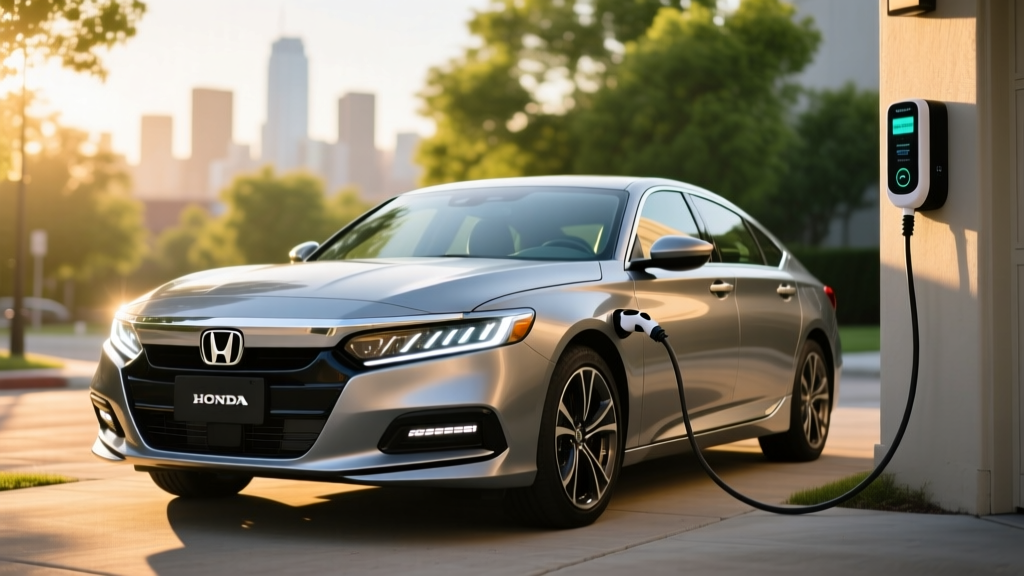
The Honda Accord Hybrid has spent two decades refining the formula for a midsize sedan that sips fuel without feeling like a compromise. For the 2026 model year, Honda continues with its proven two-motor e-CVT system, delivering 48 MPG combined and a cabin that punches above its price class. But in an era of plug-in hybrids offering 30+ miles of electric range and full EVs pushing 300+ miles, where does the Accord Hybrid fit?
This guide breaks down the 2026 Accord Hybrid's powertrain specs, real-world fuel economy, battery longevity, and total cost of ownership — with the exact numbers you need to decide if it's the right electrified sedan for your driveway.
Accord Hybrid Specs at a Glance
| Spec | Value |
|---|---|
| Powertrain | 2.0L DOHC 4-cylinder + two-motor hybrid system |
| Combined Horsepower | 204 hp |
| Combined Torque | 247 lb-ft (electric motor) |
| Transmission | e-CVT (no traditional gears) |
| EPA MPG (City / Hwy / Combined) | 51 / 44 / 48 |
| Fuel Tank | 12.8 gallons |
| Total Range | ~614 miles |
| 0–60 mph | ~7.5 seconds (est.) |
| Drivetrain | Front-wheel drive |
| Hybrid Battery Warranty | 8 years / 100,000 miles |
| Base MSRP (Sport Hybrid) | $34,995 |
| Top Trim MSRP (Sport Touring Hybrid) | $40,395 |
Two important clarifications up front: the Accord Hybrid is a conventional hybrid (HEV), not a plug-in hybrid (PHEV). You never plug it in — it charges its own battery through regenerative braking and the gasoline engine. This also means it does not qualify for the federal §30D new clean vehicle tax credit, which is reserved for plug-in vehicles meeting battery sourcing and MSRP requirements per IRS guidelines.
Fuel Economy: EPA Numbers vs. Real-World MPG
| Trim | City MPG | Highway MPG | Combined MPG |
|---|---|---|---|
| Sport Hybrid | 51 | 44 | 48 |
| EX-L Hybrid | 51 | 44 | 48 |
| Sport-L Hybrid | 51 | 44 | 48 |
| Sport Touring Hybrid | 50 | 43 | 47 |
Source: EPA Fuel Economy
Why does city MPG exceed highway? In a conventional hybrid, the gasoline engine is the weakest link in stop-and-go traffic — idling, accelerating from a stop, and low-speed crawling waste fuel. The Accord Hybrid's system sidesteps this by running on the electric motor alone up to roughly 25 mph under light loads, and by capturing braking energy that a gas car would waste as heat. On the highway, the engine must run continuously to maintain speed, and aerodynamic drag dominates.
How the Two-Motor Hybrid Powertrain Works
The Accord Hybrid uses Honda's fourth-generation two-motor system, which operates differently from Toyota's planetary-gear hybrid setup or a traditional transmission:
- Propulsion Motor (184 hp / 247 lb-ft): Drives the front wheels directly in most conditions. This is the motor you feel when you accelerate.
- Generator Motor: Connected to the 2.0L Atkinson-cycle engine. It either generates electricity to feed the propulsion motor or charges the battery.
- Engine Direct-Drive: At steady highway speeds (roughly 45–80 mph), a lock-up clutch connects the engine directly to the wheels — more efficient than converting mechanical energy to electrical and back.
The result is a system that feels like an EV around town (instant torque, no shift shock) while maintaining highway efficiency through direct mechanical coupling. The combined 204 hp is adequate for merging and passing, though it won't win any drag races against the turbocharged Accord 1.5T (192 hp) or competitors like the Hyundai Sonata Hybrid (192 hp combined).
Hybrid (HEV) vs. Plug-In Hybrid (PHEV) vs. Full EV: Which Fits You?
Conventional Hybrid (HEV)
Example: Accord Hybrid
Plug in? No
Electric-only range: ~1 mile at low speed
Best for: Drivers without home charging access who want maximum MPG with zero behavior change.
Plug-In Hybrid (PHEV)
Example: Toyota Prius Prime
Plug in? Yes (Level 1 or 2)
Electric-only range: 20–45 miles
Best for: Drivers with home/work charging who commute under 40 miles but want gas flexibility for road trips.
Full EV (BEV)
Example: Tesla Model 3, Hyundai Ioniq 6
Plug in? Yes (Level 2 + DC fast)
Range: 250–360+ miles
Best for: Drivers with reliable home Level 2 charging who want zero tailpipe emissions and lowest fuel cost per mile.
The Accord Hybrid sits at the simplest end of the electrified spectrum. If you live in an apartment without charging access, or you take frequent 400+ mile road trips and don't want to plan around DC fast chargers, a conventional hybrid removes every barrier. You fuel up at any gas station and the car manages the rest.
If you do have a garage with a 120V or 240V outlet and your daily commute is under 40 miles round-trip, a PHEV like the Prius Prime (44 miles electric-only, ~52 MPG combined after the battery depletes) could eliminate most of your gasoline use while retaining road-trip range. The trade-off: higher purchase price, a smaller trunk (battery placement), and the need to plug in regularly to capture the benefit.
Pricing, Trims, and Tax Credit Eligibility
| Trim | MSRP | Key Features |
|---|---|---|
| Sport Hybrid | $34,995 | 19" wheels, wireless CarPlay/Android Auto, Honda Sensing suite |
| EX-L Hybrid | $36,495 | Leather seats, power moonroof, heated front seats, 10-speaker audio |
| Sport-L Hybrid | $37,295 | Sport exterior accents + EX-L interior features |
| Sport Touring Hybrid | $40,395 | Navigation, Bose 12-speaker audio, wireless phone charging, heated rear seats |
Destination charges add approximately $1,195 to all trims. Dealer markups vary by region but have moderated significantly — expect MSRP or close to it in most markets for the 2026 model year.
Battery Longevity, Warranty, and Replacement Costs
Hybrid Battery Warranty
Coverage: 8 years / 100,000 miles (10 years / 150,000 miles in CARB states including CA, NY, MA, and others)
What's covered: Battery capacity loss below approximately 60–70% of original, cell failure, and hybrid system components including the inverter and electric motors.
Chemistry: Lithium-ion (small capacity, ~1.0 kWh usable — sized for power delivery, not range)
The Accord Hybrid's battery pack is small — roughly 1.0 kWh of usable capacity — because it doesn't need to store energy for electric-only driving. It acts as a buffer: absorbing regen energy and delivering it on acceleration. This shallow charge/discharge cycling is gentle on lithium-ion cells.
Real-world longevity data: Honda's hybrid systems have proven durable. Taxi and rideshare fleets using Accord and Insight Hybrids have reported 200,000–300,000+ miles on original battery packs. The battery is not a wear item the way a 12V lead-acid battery is — degradation is measured in decades, not years, for Honda's hybrid packs.
Out-of-warranty replacement cost: If the hybrid battery does fail after the warranty period, a refurbished replacement runs approximately $2,000–$3,500 installed at an independent hybrid specialist, or $4,000–$5,500 at a Honda dealer with a new OEM pack. Individual cell module replacement (if only a few cells degrade) can cost $500–$1,200. These costs have dropped significantly as the hybrid fleet ages and the aftermarket matures.
Driving Impressions and Daily Ownership
The Accord Hybrid's greatest strength is transparency. Unlike early hybrids that felt like science experiments, this car drives like a conventional sedan that happens to get exceptional fuel economy. The brake pedal feel — historically a weak point in hybrids due to the transition between regenerative and friction braking — is well-calibrated in the current generation, with predictable modulation.
The e-CVT eliminates shift shock entirely. Acceleration is linear, with the propulsion motor's 247 lb-ft of torque available from zero RPM. Around town, the gasoline engine starts and stops seamlessly — you may not notice it shutting off at red lights. Under hard acceleration, the engine drone is present but less intrusive than in Honda's earlier i-MMD systems, thanks to improved sound insulation and a revised engine mount design.
Cargo space measures 16.7 cubic feet — competitive with the gas Accord and larger than most PHEV sedans (which sacrifice trunk volume to larger battery packs). The rear seats fold 60/40 for longer items, and the trunk pass-through is wide enough for golf bags or ski gear.
Accord Hybrid: Pros and Cons
✓ Pros
- 48 MPG combined — among the highest in the midsize sedan class
- No plug-in required — zero lifestyle change from a gas car
- Strong city MPG (51) where most driving happens
- Proven hybrid reliability with 8–10 year battery warranty
- Spacious interior and 16.7 cu-ft trunk (no battery compromise)
- Honda Sensing ADAS suite standard on all trims
- Linear, EV-like acceleration feel around town
✗ Cons
- No federal tax credit (HEV, not PHEV/BEV)
- Highway MPG (44) trails city rating — road trips less efficient
- Not available with AWD (competitors like Camry offer it)
- No electric-only driving mode beyond ~1 mile at low speed
- Sport Touring Hybrid pushes past $41,000 with destination
- Engine drone under sustained hard acceleration
- FWD only limits traction in snow vs. AWD alternatives
Five-Year Cost of Ownership Estimate
How does the Accord Hybrid stack up against a gasoline midsize sedan and a full EV over five years? Here's a rough comparison assuming 15,000 miles/year, $3.50/gallon regular fuel, and $0.14/kWh home electricity:
| Vehicle Type | Example | Efficiency | 5-Year Fuel Cost |
|---|---|---|---|
| Conventional Hybrid (HEV) | Accord Hybrid (48 MPG) | 48 MPG combined | ~$5,470 |
| Gasoline Sedan | Accord 1.5T (32 MPG) | 32 MPG combined | ~$8,200 |
| Full EV (BEV) | Tesla Model 3 RWD (27 kWh/100mi) | 134 MPGe | ~$1,575 |
The Accord Hybrid saves approximately $2,730 in fuel over five years compared to the gas Accord 1.5T. A full EV saves $3,900+ more — but comes with a higher purchase price, the need for home Level 2 charging installation ($500–$2,000), and potential range planning on road trips. The hybrid's value proposition is simplicity: no charging infrastructure, no behavior change, and immediate fuel savings from day one.
Frequently Asked Questions
How many MPG does the 2026 Accord Hybrid get?
The EPA rates the Accord Hybrid at 51 city / 44 highway / 48 combined MPG (Sport, EX-L, and Sport-L trims). The Sport Touring Hybrid, with its larger 19-inch wheels and additional equipment, drops slightly to 50/43/47 MPG. In real-world driving, expect 46–52 MPG combined depending on your mix of city and highway driving, ambient temperature, and driving style.
Do I need to plug in the Accord Hybrid?
No. The Accord Hybrid is a conventional hybrid (HEV). Its small lithium-ion battery charges through regenerative braking and the gasoline engine. You simply fill up at any gas station — no plug, no charging cable, no home electrical work required.
Is the Accord Hybrid reliable, and what does a battery replacement cost?
Honda's hybrid system has a strong reliability track record across two decades of production. The hybrid battery is warranted for 8 years/100,000 miles (10 years/150,000 miles in CARB states). Out-of-warranty battery replacement runs $2,000–$5,500 depending on whether you use a refurbished pack or new OEM unit, though many packs last 200,000+ miles without issue.
Does the Accord Hybrid qualify for any tax credit?
No federal tax credit applies. The IRS §30D New Clean Vehicle Credit requires plug-in capability (PHEV or BEV) and meeting battery sourcing and MSRP thresholds. The Accord Hybrid, as a conventional HEV, does not meet this requirement. Check your state's energy office or the Alternative Fuels Data Center for any local hybrid or high-efficiency vehicle incentives.
Accord Hybrid vs. Toyota Camry Hybrid — which is better?
Both are excellent, but they differ in key ways. The 2026 Camry Hybrid (now exclusively hybrid) rates at 51 city / 49 highway / 50 combined MPG — slightly better highway efficiency and available AWD. The Accord Hybrid counters with a more spacious rear seat, larger trunk (16.7 vs. 15.1 cu-ft), and a more premium interior feel at the top trim. If highway MPG and AWD matter most, the Camry wins. If interior space and driving refinement are priorities, the Accord edges ahead.
How far can the Accord Hybrid drive on electric power alone?
Only about 1 mile at very low speeds (under 25 mph) in stop-and-go traffic. This is normal for a conventional hybrid — the small battery is designed for assist and energy recovery, not sustained electric driving. If electric-only commuting is your goal, you need a PHEV or full EV.
Should I buy the Accord Hybrid or a full EV?
Choose the Accord Hybrid if you lack reliable home charging, take frequent long road trips, or want the simplest possible ownership experience with no range planning. Choose a full EV (like the Tesla Model 3 or Hyundai Ioniq 6) if you have home Level 2 charging, your daily driving is under 250 miles, and you want the lowest possible per-mile energy cost and zero tailpipe emissions. The hybrid is the pragmatic bridge; the EV is the destination — but only if your lifestyle supports it.