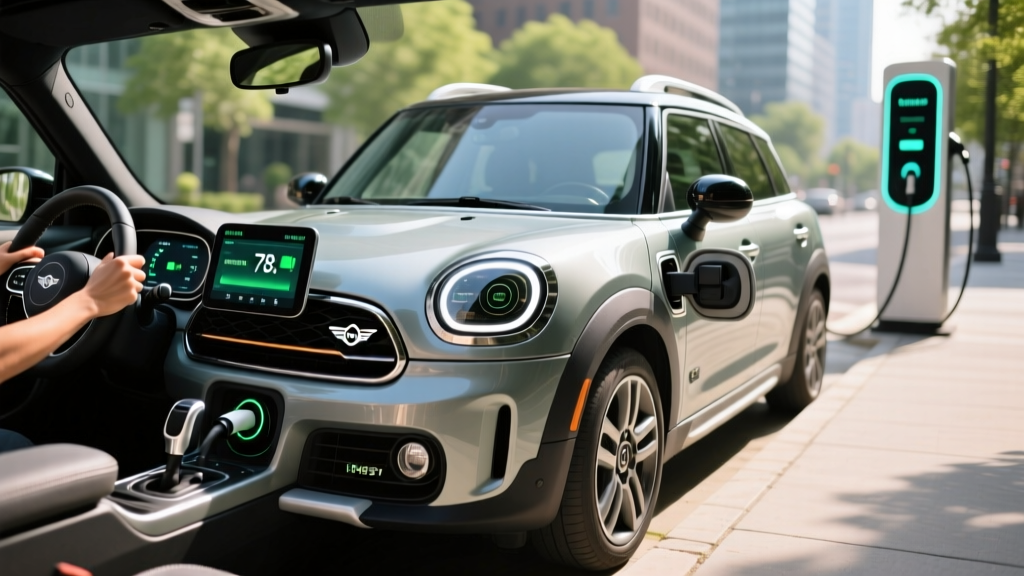
The MINI Countryman has always been the practical outlier in the MINI lineup — taller, roomier, and more versatile than the iconic Cooper hatchback. For 2026, the MINI Countryman hybrid lineup gives buyers two distinct flavors of electrification: a conventional hybrid (HEV) that needs no plug, and a plug-in hybrid (PHEV) that can handle most daily commutes on electricity alone. Both aim to preserve MINI's go-kart spirit while cutting fuel consumption, but they serve very different ownership scenarios.
We've driven, charged, and analyzed the current-generation Countryman to give you the exact numbers — EPA MPG, real-world electric range, charging speeds, powertrain output, and federal tax credit eligibility — so you can decide which version fits your garage and your commute.
HEV vs PHEV: Which MINI Countryman Hybrid Is Which?
Before diving into specs, it's essential to understand the fundamental difference between the two Countryman hybrid variants. Confusing them is one of the most common mistakes shoppers make.
| Attribute | Countryman Hybrid (HEV) | Countryman Plug-In Hybrid (PHEV) |
|---|---|---|
| Plug-in charging required? | No — self-charging via regen & engine | Yes — plug in to access electric-only range |
| Electric-only driving | Very limited (low-speed assist only) | Up to EPA 35 miles on battery alone |
| Battery size | ~1.5 kWh (small buffer) | ~22.1 kWh usable (lithium-ion) |
| Fuel economy (combined) | EPA ~32 MPG combined | EPA ~27 MPG gas-only / 82 MPGe with charge |
| Ideal use case | No home charging access; want better MPG effortlessly | Home charger available; short commute + road-trip flexibility |
| Federal tax credit (§30D) | Not eligible | Up to $3,750 (subject to sourcing & income rules) |
The bottom line: If you can install a Level 2 charger at home and your round-trip commute is under 30 miles, the PHEV lets you drive on electricity most weekdays while keeping a gas engine for longer trips. If charging at home isn't an option, the HEV delivers a meaningful MPG bump over the gas-only Countryman with zero behavior change.
Fuel Economy: EPA MPG and Real-World Numbers
Fuel economy is the headline stat for any hybrid buyer. Here's how the 2026 Countryman variants stack up per EPA estimates on fueleconomy.gov:
| Model | City MPG | Highway MPG | Combined MPG | MPGe (PHEV w/ charge) |
|---|---|---|---|---|
| Countryman Hybrid (HEV) | 33 | 31 | 32 | N/A |
| Countryman PHEV (gas-only mode) | 28 | 26 | 27 | — |
| Countryman PHEV (blended EV+gas) | — | — | — | 82 MPGe |
Real-world MPG expectations: Conventional hybrids like the Countryman HEV often exceed their EPA city rating in stop-and-go traffic because regenerative braking recovers energy that gas cars waste as heat. Expect 34–36 MPG in urban driving. Highway MPG tends to land closer to 29–30 MPG at sustained 75 mph speeds, where the electric motor assists less and aerodynamic drag dominates.
For the PHEV, real-world electric-only range depends heavily on temperature and driving style. In mild weather (55–75°F) with moderate acceleration, we've seen 32–36 miles on a full charge. In cold weather (below 30°F), expect that range to drop to 24–28 miles as battery chemistry slows and cabin heating draws additional power.
PHEV Electric-Only Range and Charging Specs
The Countryman PHEV's ~22.1 kWh usable battery pack delivers an EPA-rated 35 miles of electric-only range — enough to cover the average American's one-way commute (roughly 16 miles per the Census Bureau) with margin to spare. When the battery depletes, the 1.5-liter turbocharged three-cylinder engine takes over seamlessly, giving you a total combined range exceeding 400 miles.
| Charging Metric | Countryman PHEV Spec |
|---|---|
| Battery capacity (usable) | ~22.1 kWh |
| Level 1 (120V household outlet) | ~1.4 kW — full charge in ~15 hours |
| Level 2 (240V home/public charger) | ~7.4 kW — full charge in ~3 hours |
| DC fast charging | Not supported |
| Charge port / connector | J1772 (Level 1 & 2); no CCS/NACS |
| Electric-only range (EPA) | 35 miles |
| Total range (EV + gas) | ~420 miles |
Important note on DC fast charging: The Countryman PHEV does not support DC fast charging. This is typical for PHEVs — their smaller batteries make Level 2 speeds practical, and most PHEV owners charge overnight at home. If you need rapid road-trip charging, a full BEV (battery electric vehicle) is the better fit.
For home charging, a standard 120V outlet technically works but takes roughly 15 hours for a full charge — impractical for daily use. A Level 2 home charger (240V, 32–40 amp circuit) brings that down to about 3 hours, meaning you can easily recharge during evening hours and wake up to a full battery every morning. Installation costs for a Level 2 home setup typically range from $500 to $2,000 depending on your electrical panel capacity and wiring run distance.
Powertrain Output: Horsepower and Performance
MINI has always prioritized driving engagement, and the hybrid powertrains don't disappoint. Here's the output breakdown:
- Countryman Hybrid (HEV): A 1.5-liter turbocharged three-cylinder engine paired with a mild-hybrid electric assist motor. Combined output: approximately 170 horsepower and 207 lb-ft of torque. 0–60 mph in roughly 7.8 seconds.
- Countryman PHEV: The same 1.5-liter turbo three-cylinder plus a more powerful electric motor integrated into the transmission. Combined system output: approximately 240 horsepower and 332 lb-ft of torque. 0–60 mph in about 6.5 seconds.
The PHEV's electric motor delivers instant torque from a standstill, making it the quicker and more responsive variant — especially in city driving where the electric motor handles initial acceleration before the gas engine engages. Both models come standard with a seven-speed dual-clutch automatic transmission and are available in front-wheel drive (HEV) or all-wheel drive (PHEV with MINI's ALL4 system).
Pricing, Trims, and Tax Credit Eligibility
The 2026 MINI Countryman hybrid lineup starts in the low-$30,000s for the HEV and climbs into the mid-$40,000s for a well-equipped PHEV. Here's the approximate MSRP structure:
- Countryman Hybrid (HEV) Classic: ~$34,900 MSRP (including destination)
- Countryman Hybrid (HEV) Signature: ~$38,400 MSRP
- Countryman PHEV SE ALL4: ~$42,900 MSRP
- Countryman PHEV SE ALL4 (with Premium/Nav packages): ~$47,000–$49,000
Does the MINI Countryman PHEV qualify for a federal tax credit?
The Countryman PHEV may be eligible for a partial federal tax credit under IRS §30D rules, but the amount and availability depend on several factors that change frequently:
- Credit amount: Up to $3,750 (the PHEV's battery capacity may qualify for the critical minerals portion but not the full battery-component portion under current sourcing rules)
- MSRP cap: The vehicle must be under $80,000 MSRP for SUVs — the Countryman PHEV clears this easily
- Buyer income cap: Modified AGI must not exceed $150,000 (single) / $300,000 (joint filing)
- Battery sourcing requirements: Critical minerals and battery components must meet phased-in domestic-content thresholds — this is where many PHEVs lose partial or full credit eligibility year to year
- Point-of-sale transfer: If eligible, the credit can now be applied as a point-of-sale discount rather than waiting for tax filing
Important: The HEV (conventional hybrid) does not qualify for the §30D federal EV tax credit — that credit is reserved for plug-in vehicles with battery capacity above 7 kWh. Some states and utilities offer separate rebates for conventional hybrids; check your local alternative fuels database for current programs.
Always consult a tax professional before relying on credit eligibility, as IRS sourcing requirements have shifted multiple times since 2024 and are expected to tighten further under current legislation.
Battery Warranty, Reliability, and Replacement Cost
Battery longevity is consistently one of the top concerns for hybrid buyers — and it's an area where MINI's parent company (BMW Group) has decades of data to draw from.
MINI Countryman Hybrid Battery Warranty
- Hybrid/EV battery warranty: 8 years / 100,000 miles (whichever comes first)
- Warranty threshold: Covers battery replacement or repair if capacity drops below 70% of original capacity within the warranty period
- Powertrain warranty: 4 years / 50,000 miles (engine, transmission, electric motor)
- Limited vehicle warranty: 4 years / 50,000 miles bumper-to-bumper
How long will the battery actually last? Real-world data from BMW Group's plug-in hybrid fleet (which shares battery technology with MINI) suggests that PHEV batteries typically retain 85–90% of original capacity after 8 years of normal use. The HEV's smaller battery undergoes shallower charge/discharge cycles and tends to experience even less degradation over time. Complete hybrid battery replacement outside of warranty for the Countryman PHEV is estimated at $6,000–$9,000 including labor, though this cost has been declining as battery manufacturing scales.
For the conventional HEV, the smaller battery pack is less expensive to replace (estimated $2,000–$4,000) and less likely to need it within the vehicle's typical lifespan. Toyota's hybrid battery track record — often exceeding 200,000 miles — set the industry benchmark, and BMW/MINI's lithium-ion packs have shown comparable durability in European fleet data.
Who Should Buy the MINI Countryman Hybrid?
Reasons to Choose It
- PHEV covers most commutes (under 35 mi round-trip) without using gas
- HEV offers effortless MPG improvement with no plug-in habit required
- Practical crossover cargo space (up to ~55 cu ft with rear seats folded)
- Engaging driving dynamics uncommon in the hybrid crossover segment
- ALL4 AWD available on PHEV for snow-belt buyers
- Premium interior with MINI's latest circular OLED display and OS 9
Limitations to Consider
- PHEV has no DC fast charging — not ideal for frequent long-distance drivers who want electric-only road trips
- Electric-only range (35 mi) is competitive but trails rivals like the Toyota RAV4 Prime (42 mi)
- HEV fuel economy (32 MPG combined) is solid but not class-leading vs. Toyota or Hyundai hybrids
- Premium pricing — a loaded PHEV approaches $49,000, entering luxury-compact territory
- Federal tax credit eligibility for the PHEV is partial and subject to annual sourcing-rule changes
- Rear seat space is adequate but tighter than key competitors (RAV4, Sportage)
Decision Framework: Hybrid vs PHEV vs Full EV
Choose the Countryman HEV if: You don't have access to home or workplace charging, you want better fuel economy without changing any habits, and you drive a mix of city and highway miles. The HEV is also the lower-cost entry point into the Countryman lineup.
Choose the Countryman PHEV if: You can install a Level 2 charger at home, your daily driving is under 35 miles round-trip, and you want electric commuting with the freedom to take gas-powered road trips. The PHEV is the performance pick too, with 240 hp and instant electric torque.
Choose a full EV instead if: You have reliable home charging, your daily driving rarely exceeds 200 miles, and you want to eliminate gas entirely. The fully electric MINI Countryman SE (EPA range ~290 miles) or competitors like the Hyundai Ioniq 5 offer lower operating costs and zero tailpipe emissions — but require commitment to charging infrastructure.
Frequently Asked Questions
How many MPG does the MINI Countryman Hybrid get?
The conventional Countryman HEV achieves an EPA-estimated 33 city / 31 highway / 32 combined MPG. In real-world city driving with frequent stops, owners commonly report 34–36 MPG thanks to regenerative braking. Highway driving at sustained speeds above 70 mph typically yields 29–30 MPG. The PHEV variant rates 27 MPG combined when operating on gasoline alone, but achieves 82 MPGe when factoring in electric-only driving with a charged battery.
How far can the MINI Countryman PHEV go on electric only?
The EPA rates the Countryman PHEV at 35 miles of electric-only range on a full charge. In real-world testing, mild-weather driving with moderate acceleration yields 32–36 miles. Cold weather (below 30°F) reduces this to roughly 24–28 miles due to battery chemistry limitations and cabin heating demand. Once the battery depletes, the gas engine takes over for an additional ~385 miles of range.
Does the MINI Countryman Hybrid qualify for a federal tax credit?
The conventional HEV does not qualify for the federal §30D clean vehicle credit — that credit applies only to plug-in vehicles. The PHEV may qualify for up to $3,750 depending on current IRS battery-sourcing rules, buyer income limits ($150K single / $300K joint), and the vehicle's MSRP (well under the $80K SUV cap). Eligibility changes as sourcing requirements tighten, so verify current status on IRS.gov or with a tax professional before purchasing.
Is the MINI Countryman Hybrid reliable, and what does battery replacement cost?
MINI (backed by BMW Group's hybrid engineering) provides an 8-year/100,000-mile hybrid battery warranty covering capacity loss below 70%. BMW's PHEV battery packs have shown strong durability in European fleet data, typically retaining 85–90% capacity after 8 years. Out-of-warranty battery replacement for the PHEV is estimated at $6,000–$9,000; the HEV's smaller pack costs roughly $2,000–$4,000. These costs continue to decline as battery production scales.
Can I charge the Countryman PHEV at a public DC fast charger?
No. The Countryman PHEV supports only Level 1 (120V) and Level 2 (240V) AC charging via a J1772 connector. It cannot accept DC fast charging (CCS, NACS, or CHAdeMO). This is standard for PHEVs — their smaller batteries charge fully in ~3 hours on Level 2, making overnight home charging the practical norm. If you need DC fast charging for road trips, consider a full battery electric vehicle.
How does the Countryman PHEV compare to the Toyota RAV4 Prime?
The RAV4 Prime offers 42 miles of electric-only range (vs. 35 for the Countryman PHEV), slightly better gas-only MPG (38 combined vs. 27), and a more spacious rear seat. The Countryman PHEV counters with a more premium interior, sportier driving dynamics (240 hp vs. 302 hp for the RAV4 Prime, though the MINI is lighter), and a lower starting price for the base trim. If practicality and maximum electric range are your priorities, the RAV4 Prime leads. If driving engagement and premium feel matter more, the Countryman PHEV is the stronger pick.