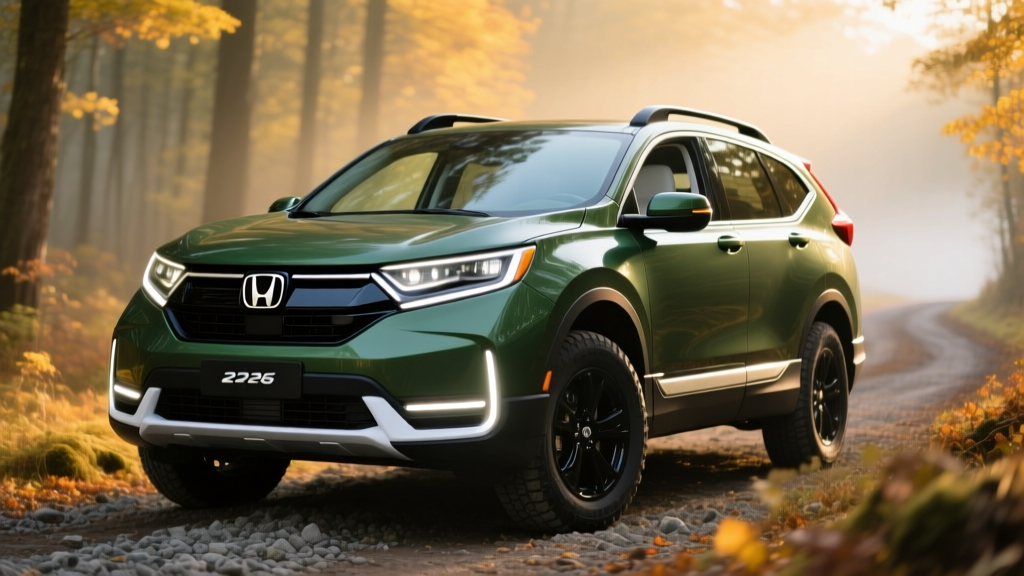
The Honda CR-V Hybrid has been one of the best-selling hybrid SUVs in America for good reason — it delivers genuinely strong fuel economy without asking buyers to plug in or change their habits. For 2026, Honda continues to offer the ruggedly styled TrailSport trim exclusively with its two-motor hybrid powertrain, making it a compelling choice for buyers who want all-weather capability, off-road aesthetics, and sub-30 MPG combined without range anxiety. This review breaks down every spec that matters: real-world MPG, the hybrid system's engineering, battery longevity, pricing, and whether the 2026 Honda CR-V TrailSport Hybrid fits your driveway better than a PHEV or full EV.
HEV vs PHEV: What the CR-V TrailSport Hybrid Actually Is
Before diving into specs, it's critical to understand that the 2026 Honda CR-V TrailSport is a conventional hybrid (HEV), not a plug-in hybrid (PHEV). Honda discontinued the CR-V Plug-In Hybrid (previously sold as the Clarity-based CR-V e:PHEV in some markets) for the current generation in the US. That means:
Conventional Hybrid (HEV) — CR-V TrailSport
- No plug, no charging cable needed
- Small battery (~1.06 kWh usable) recharged by regenerative braking and the gas engine
- Electric motors assist the engine; cannot drive on electric-only power for meaningful distances
- Fuel economy advantage: 40 MPG combined EPA
- No federal EV tax credit eligibility
Plug-In Hybrid (PHEV) — e.g., Toyota RAV4 Prime
- Requires plug-in charging (Level 1 or Level 2)
- Larger battery (18.1 kWh RAV4 Prime) for 42 miles electric-only range
- Can drive on electricity alone at highway speeds
- Fuel economy: 94 MPGe on electric, 38 MPG on gas
- May qualify for up to $7,500 federal tax credit (income/MSRP/sourcing rules apply)
If you were searching for a plug-in CR-V, Honda currently doesn't offer one in the US market. The TrailSport Hybrid is strictly a self-charging HEV — you fill it with gas and drive. The hybrid system's job is to maximize every gallon, not to replace gas with grid electricity.
Fuel Economy: EPA Ratings and Real-World MPG
The 2026 Honda CR-V TrailSport Hybrid carries over the powertrain from the broader CR-V Hybrid lineup. The EPA rates it at the following figures:
| Metric | EPA Rating | Real-World Expectation |
|---|---|---|
| City MPG | 40 MPG | 38–43 MPG (hybrids often beat EPA in stop-and-go) |
| Highway MPG | 34 MPG | 30–34 MPG (aerodynamic drag limits hybrid advantage at 70+ mph) |
| Combined MPG | 37 MPG | 34–39 MPG depending on driving mix |
| Total Range (14.0-gal tank) | ~518 miles | ~475–545 miles |
Source: fueleconomy.gov
Honda's two-motor hybrid system is optimized for city and suburban driving, where the electric motors handle low-speed propulsion and the 2.0-liter Atkinson-cycle engine kicks in primarily as a generator or for direct highway cruising. In real-world testing by multiple reviewers, the CR-V Hybrid consistently matches or exceeds its EPA city rating in urban traffic — a trait common to series-parallel hybrids that can shut off the engine entirely at low loads.
Highway driving is a different story. Above 65 mph, the aerodynamic profile of a compact SUV and the mechanical direct-drive connection reduce the hybrid advantage. Expect 30–33 MPG on sustained interstate trips at 75 mph, especially with the TrailSport's all-terrain tires, which add rolling resistance compared to the standard Hybrid Sport Touring's all-season rubber. In cold weather (below 32°F), plan for a 5–10% drop in fuel economy as the engine runs more frequently to provide cabin heat and maintain battery temperature.
Powertrain and Performance Specs
The 2026 CR-V TrailSport Hybrid uses Honda's fourth-generation two-motor hybrid system. Here's the complete breakdown:
| Specification | Detail |
|---|---|
| Engine | 2.0L DOHC Atkinson-cycle 4-cylinder |
| Engine Power | 145 hp @ 6,100 rpm / 134 lb-ft torque |
| Drive Motor | 181 hp / 247 lb-ft torque |
| Combined System Output | 204 hp / 247 lb-ft torque |
| Transmission | Direct-drive (no traditional transmission; engine clutches at highway speed) |
| Drivetrain | Real Time AWD with torque vectoring |
| 0–60 mph | ~7.6 seconds (est.) |
| Towing Capacity | 1,000 lbs |
| Hybrid Battery | ~1.06 kWh lithium-ion (NMC chemistry) |
| Ground Clearance | 8.3 inches |
The TrailSport trim adds specific tuning to the AWD system, including a revised torque distribution map for loose surfaces, and comes with 18-inch wheels wrapped in all-terrain tires. The 8.3 inches of ground clearance is competitive for the segment — it won't make this a rock crawler, but it handles fire roads, snowy driveways, and rutted campsite trails with confidence.
On the road, the electric motor's 247 lb-ft of torque is available from zero RPM, giving the TrailSport Hybrid strong initial acceleration and responsive passing power. The engine-motor handoff is seamless — one of Honda's engineering strengths in this generation. Under hard acceleration, both the engine and drive motor contribute, reaching the 204 hp combined peak. It's not fast by EV standards, but it's genuinely quicker than most turbocharged gas-only compact SUVs in the 0–40 mph range where it matters for merging and city driving.
Pricing, Trims, and Tax Credit Eligibility
The 2026 Honda CR-V TrailSport Hybrid sits in the middle-upper range of the CR-V lineup. Pricing (including destination charge):
- CR-V Hybrid Sport: ~$36,300
- CR-V Hybrid Sport Touring: ~$41,000
- CR-V TrailSport Hybrid: ~$39,500
The TrailSport Hybrid includes as standard: AWD, Honda Sensing suite (adaptive cruise, lane-keeping, automatic emergency braking), 9-inch touchscreen with wireless Apple CarPlay/Android Auto, heated front seats, power liftgate, and the TrailSport-specific suspension tuning, skid plates, and all-terrain tires.
Federal Tax Credit Status
The 2026 Honda CR-V TrailSport Hybrid is a conventional hybrid (HEV) and does not qualify for the federal §30D New Clean Vehicle Credit. That credit is reserved for plug-in electric vehicles (BEVs and PHEVs) meeting battery sourcing, MSRP, and buyer income requirements per IRS guidelines.
Some states offer hybrid-specific rebates or HOV lane access, but these vary widely. Check your state's energy office or DMV for current programs.
Battery Longevity, Warranty, and Replacement Cost
The most common concern among hybrid buyers is battery lifespan. Honda's hybrid system uses a relatively small lithium-ion battery pack (~1.06 kWh usable capacity) that operates within a narrow state-of-charge window — typically between 20% and 80% SoC — managed by the vehicle's battery management system. This shallow cycling is the key reason hybrid batteries last far longer than EV batteries, which routinely see deeper discharge cycles.
| Battery Metric | Detail |
|---|---|
| Hybrid Battery Warranty | 8 years / 100,000 miles (10 years / 150,000 miles in CARB states) |
| Warranty Coverage Threshold | Capacity below ~60–70% of original |
| Expected Lifespan | 150,000–200,000+ miles based on fleet data |
| Replacement Cost (out of warranty) | $2,000–$4,000 (estimated, including labor) |
| Powertrain Warranty | 5 years / 60,000 miles |
Honda's hybrid battery track record is strong. Third-generation CR-V Hybrids (2020–2022 model years) with 100,000+ miles are showing minimal capacity loss in owner surveys. The Atkinson-cycle engine and two-motor system have fewer moving parts than a conventional automatic transmission — no torque converter, no multi-speed gearbox — which contributes to overall powertrain durability. According to reliability data aggregated by sources like Consumer Reports and J.D. Power, the CR-V Hybrid consistently ranks above average for the compact SUV segment.
If you plan to keep the vehicle beyond 150,000 miles and the battery does degrade, replacement cost is estimated at $2,000–$4,000. This is significantly less than an EV battery replacement ($8,000–$20,000+) because the pack is small. Independent hybrid repair shops can also replace individual modules for less in many cases.
TrailSport Capability: What You Get for Off-Pavement Driving
The TrailSport badge isn't just an appearance package. For 2026, Honda equips the CR-V TrailSport Hybrid with:
- All-terrain tires (Continental CrossContact A/T) on 18-inch wheels — better grip on gravel, mud, and snow
- Revised AWD torque distribution — sends more torque rearward on loose surfaces
- Steel skid plates protecting the engine and fuel tank
- 8.3 inches of ground clearance — 0.6 inches more than the standard Hybrid trims
- Hill descent control for controlled low-speed descents
- Orange contrast stitching and TrailSport badging inside and out
This isn't a Subaru Outback Wilderness or a Ford Bronco Sport Badlands. The TrailSport is a soft-roader — designed for the 95% of "off-road" driving that actually means snowy roads, muddy campsite paths, and gravel driveways. The hybrid powertrain's low-end electric torque is a genuine advantage in these scenarios, providing smooth, controllable power without the wheel spin that a turbocharged gas engine can produce on loose surfaces.
CR-V TrailSport Hybrid vs. the Competition
How does the 2026 Honda CR-V TrailSport Hybrid stack up against rivals? Here's a spec-driven comparison:
| Vehicle | Combined MPG | AWD | HP | Starting MSRP | Ground Clearance |
|---|---|---|---|---|---|
| Honda CR-V TrailSport Hybrid | 37 MPG | Standard | 204 hp | ~$39,500 | 8.3 in |
| Toyota RAV4 Hybrid (TRD Off-Road) | 39 MPG | Standard | 219 hp | ~$40,000 | 8.6 in |
| Ford Escape Hybrid (Timberline est.) | 39 MPG | Standard | 210 hp | ~$38,500 | 8.3 in |
| Subaru Forester Hybrid | 35 MPG | Standard | 194 hp | ~$37,500 | 8.7 in |
The CR-V TrailSport Hybrid gives up 2 MPG combined to the RAV4 Hybrid but counters with a more refined ride, a more modern interior, and Honda's strong resale value. The RAV4 Hybrid's TRD Off-Road trim is the closest direct competitor — it offers slightly more ground clearance and Toyota's legendary hybrid reliability reputation. The Subaru Forester Hybrid trails in MPG but leads in visibility and standard AWD capability. Your choice likely comes down to brand preference, interior ergonomics, and which dealer network is closer to home.
Who Should Buy the CR-V TrailSport Hybrid (and Who Shouldn't)
Choose the CR-V TrailSport Hybrid If:
- You want 37+ MPG without plugging in or changing habits
- You need AWD for snow, rain, or light off-road use
- You can't charge at home (apartment, street parking)
- You want a proven, reliable hybrid with strong resale value
- You prefer Honda's driving dynamics and interior quality
- You want a 500+ mile total range for road trips
Look Elsewhere If:
- You want electric-only commuting (consider a PHEV like the RAV4 Prime or a BEV)
- You need serious off-road capability (Subaru Outback Wilderness, Ford Bronco Sport Badlands)
- You want the federal $7,500 tax credit (only available on PHEVs/BEVs meeting §30D rules)
- You tow more than 1,000 lbs (consider a body-on-frame SUV or truck)
- You want the latest EV tech like V2L or one-pedal driving
Frequently Asked Questions
How many MPG does the 2026 Honda CR-V TrailSport Hybrid get?
The EPA rates it at 40 city / 34 highway / 37 combined MPG. In real-world driving, most owners report 35–42 MPG depending on driving conditions, with city driving often exceeding the EPA estimate and sustained highway driving falling slightly below it.
Does the CR-V TrailSport Hybrid need to be plugged in?
No. It is a conventional hybrid (HEV), not a plug-in hybrid (PHEV). The battery recharges through regenerative braking and the gas engine. You simply fill it with gasoline like any other car.
Does the 2026 CR-V TrailSport Hybrid qualify for a tax credit?
No. The federal §30D New Clean Vehicle Credit applies only to plug-in vehicles (BEVs and PHEVs). The CR-V Hybrid is a conventional HEV and does not qualify. Some states may offer minor hybrid incentives — check your local programs.
How long will the hybrid battery last?
Honda warranties the hybrid battery for 8 years/100,000 miles (10 years/150,000 miles in CARB states). Based on fleet data from earlier CR-V Hybrid generations, most batteries last 150,000–200,000+ miles before significant degradation. Replacement cost out of warranty is estimated at $2,000–$4,000.
Is the CR-V TrailSport Hybrid good in snow?
Yes. The standard Real Time AWD system, all-terrain tires, 8.3 inches of ground clearance, and hill descent control make it a strong choice for snow-belt buyers. The hybrid system's electric torque also provides smooth, predictable power delivery on slippery surfaces.
Hybrid vs PHEV vs EV — which should I choose?
Choose the HEV (CR-V TrailSport Hybrid) if you can't charge at home, want maximum simplicity, and drive a mix of city/highway. Choose a PHEV if you can install a Level 2 charger, have a short commute (under 40 miles), and want electric-only daily driving with gas backup for road trips. Choose a BEV if you have reliable home charging, want the lowest per-mile fuel cost, and are comfortable with 250–350 miles of range.
What is the 0–60 time for the CR-V TrailSport Hybrid?
Honda does not publish an official 0–60 time for the TrailSport Hybrid specifically. Based on independent testing of the CR-V Hybrid AWD powertrain, expect approximately 7.5–7.8 seconds — competitive with turbocharged gas rivals in the segment.