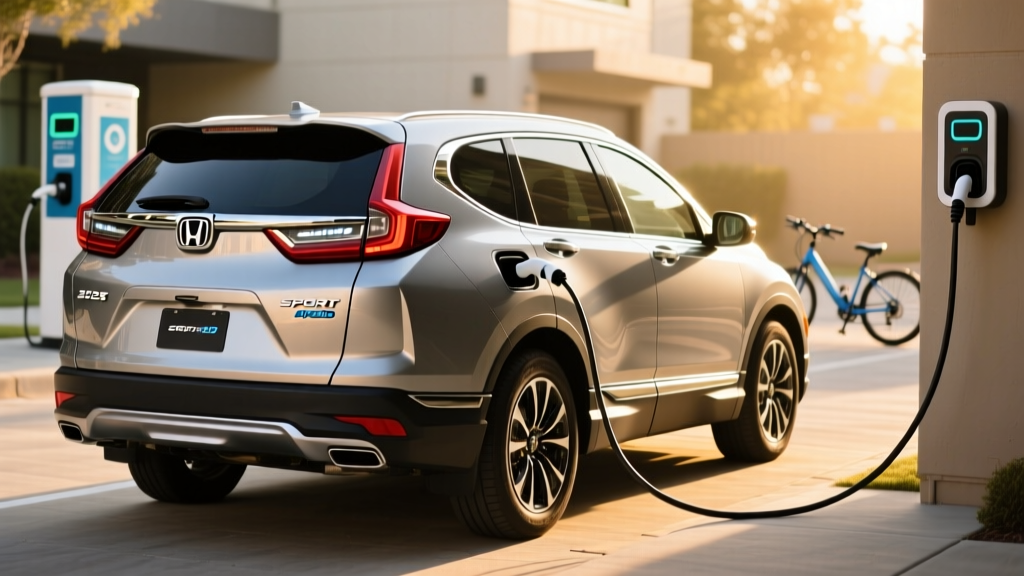
The 2025 Honda CR-V Sport Hybrid occupies a specific niche in the compact SUV market: it delivers meaningful fuel savings over its gas-only sibling without requiring any change in driving habits. No plugs, no charging apps, no range anxiety. You fill it with gas and drive — the hybrid system simply sips less. For the 2025 model year, the Sport Hybrid trim pairs a 2.0-liter four-cylinder engine with a two-motor hybrid system, targeting buyers who want sportier styling and better efficiency than the base CR-V without stepping into plug-in territory.
This review breaks down the EPA numbers, real-world fuel economy, powertrain architecture, ownership costs, and where the CR-V Sport Hybrid fits among the growing field of electrified compact SUVs — including Honda's own CR-V Plug-In Hybrid variant.
HEV vs PHEV: Which CR-V Hybrid Are You Looking At?
Honda sells two electrified CR-V variants, and confusing them is the most common buyer mistake in this segment. Here is the critical distinction:
CR-V Sport Hybrid (HEV)
- Type: Conventional hybrid — no plug required
- How it charges: Regenerative braking and engine-driven generator only
- Electric-only driving: Brief, low-speed assists (under ~1 mile at a time)
- Battery: ~1.1 kWh lithium-ion (small, never externally charged)
- Federal tax credit: Not eligible under IRS §30D
- Starting MSRP: ~$36,395 (Sport Hybrid FWD, 2025)
CR-V Plug-In Hybrid (PHEV — if available in your market)
- Type: Plug-in hybrid — must be plugged in to access electric-only range
- How it charges: Level 1/Level 2 AC charging port, plus regen
- Electric-only driving: Typically 30+ miles on battery alone
- Battery: ~17.7 kWh lithium-ion
- Federal tax credit: Potentially eligible (subject to §30D sourcing and income rules)
- Starting MSRP: Higher — varies by market and trim
The 2025 CR-V Sport Hybrid is the HEV. It is the volume seller in Honda's hybrid lineup and the focus of this review. If you need true electric-only commuting range and have access to home charging, the PHEV variant is worth investigating separately — but it carries a price premium and limited availability in the U.S. market.
Fuel Economy: EPA Ratings and Real-World MPG
The headline number for the 2025 CR-V Sport Hybrid is its EPA-estimated combined fuel economy. According to fueleconomy.gov, the FWD model achieves:
| Drive | City (MPG) | Highway (MPG) | Combined (MPG) |
|---|---|---|---|
| FWD | 43 | 36 | 40 |
| AWD | 40 | 34 | 37 |
For comparison, the gas-only 2025 CR-V with the 1.5L turbocharged engine and AWD returns roughly 29 MPG combined — meaning the hybrid saves approximately 8 MPG, or about 27% less fuel consumed per mile driven.
Real-World MPG: What Owners Actually See
Honda's two-motor hybrid system excels in city driving, where the electric motors handle low-speed propulsion and the engine operates only as a generator. Many owners report exceeding the EPA city estimate of 43 MPG in stop-and-go traffic, with some seeing 45-48 MPG on urban commutes. Highway driving is less favorable — the engine must directly drive the wheels at higher speeds, and aerodynamic drag works against the boxy SUV shape. Expect 32-35 MPG on sustained highway trips at 70+ mph.
Cold weather reduces hybrid efficiency by roughly 10-15% due to increased engine runtime for cabin heating and reduced battery efficiency. In sub-freezing conditions, plan for combined figures closer to 33-35 MPG for the FWD model. This is still meaningfully better than the gas-only CR-V in identical conditions.
Powertrain and Performance Specs
| Specification | 2025 CR-V Sport Hybrid |
|---|---|
| Engine | 2.0L Atkinson-cycle 4-cylinder |
| Engine output | 145 hp / 138 lb-ft torque |
| Electric motors | Two-motor hybrid system |
| Combined system output | 204 hp / 247 lb-ft torque |
| Transmission | e-CVT (direct-drive with engine clutch) |
| 0-60 mph (est.) | ~7.6 seconds |
| Drivetrain | FWD standard, AWD available |
| Towing capacity | 1,000 lbs |
| Fuel tank | 15.3 gallons |
| Total driving range (FWD est.) | ~612 miles |
The two-motor system is key to understanding how this powertrain feels on the road. One motor primarily generates electricity from the engine; the other drives the wheels. At low speeds, the CR-V Sport Hybrid operates almost entirely on electric power, with the engine spinning the generator motor to feed the drive motor. Above roughly 40-50 mph under steady load, a lockup clutch engages and the engine drives the wheels directly — eliminating the conversion losses of the series-hybrid mode.
The 247 lb-ft of torque is available almost immediately from the electric drive motor, giving the Sport Hybrid responsive off-the-line acceleration that the turbocharged gas model cannot match at low speeds. The 204 combined horsepower is adequate for highway merging and passing, though the e-CVT drone under hard acceleration is noticeable.
Pricing, Trims, and Tax Credit Eligibility
The 2025 CR-V Sport Hybrid is available in multiple trim levels. Pricing starts around $36,395 for the Sport Hybrid FWD and climbs to approximately $41,000+ for the fully loaded Sport Touring Hybrid AWD (prices include destination charge but exclude dealer fees).
Federal Tax Credit: What Applies
The conventional CR-V Sport Hybrid (HEV) does not qualify for the IRS §30D Clean Vehicle Credit. That credit applies only to plug-in electric vehicles (BEVs and PHEVs) meeting battery sourcing, MSRP cap, and buyer income requirements. The HEV's small ~1.1 kWh battery and lack of a charging port place it outside the program entirely.
If Honda offers a CR-V Plug-In Hybrid in your market, it may qualify for partial or full §30D credit — but eligibility depends on current-year IRS rules regarding critical mineral sourcing and battery component manufacturing. Always verify on irs.gov before purchasing, as sourcing requirements tighten annually. Consult a tax professional for your specific situation.
Some states and utilities offer separate rebates for conventional hybrids, though these are less common than EV incentives. Check your state energy office or local utility for current programs.
Battery Warranty, Reliability, and Replacement Cost
Honda Hybrid Battery Warranty
Honda covers the CR-V Sport Hybrid's high-voltage battery and hybrid system components for 8 years or 100,000 miles (whichever comes first) under the federal emissions warranty. In states that follow California Air Resources Board (CARB) standards — including California, New York, Massachusetts, and others — hybrid battery coverage extends to 10 years or 150,000 miles.
Honda's two-motor hybrid system has been in production since the early 2000s (across Accord, Civic, and Insight models), and the current-generation system in the CR-V benefits from two decades of refinement. The lithium-ion battery pack is relatively small (~1.1 kWh) and operates within a narrow state-of-charge window — the hybrid control system never fully charges or fully depletes it, which significantly reduces degradation stress.
Real-world data from Honda hybrid owners suggests battery replacement is uncommon within the first 150,000 miles. When replacement is needed, a new OEM hybrid battery for the CR-V typically costs between $2,000 and $4,000 installed — substantially less than a full EV traction battery replacement. Third-party refurbishment options may reduce this further.
The CR-V as a platform earns strong reliability ratings. IIHS typically awards the CR-V Top Safety Pick status, and Honda's hybrid powertrain has proven durable across high-mileage fleet use.
Driving Experience and Daily Ownership
The Sport Hybrid trim adds sport-tuned suspension tuning, larger 19-inch wheels, and gloss-black exterior accents over the base CR-V. The hybrid powertrain's seamless electric assist makes it one of the smoothest compact SUVs in stop-and-go traffic — no turbo lag, no traditional transmission hunting for gears.
The AWD system on hybrid trims uses a rear-mounted electric motor rather than a mechanical driveshaft, providing torque to the rear wheels only when needed. This eliminates the parasitic drivetrain loss of a conventional AWD system and is one reason the AWD hybrid's fuel economy penalty is only 3 MPG combined versus FWD.
Cargo space remains competitive at approximately 39.3 cubic feet behind the rear seats (FWD models), though the hybrid battery's packaging slightly reduces under-floor storage compared to the gas model. The Sport Touring Hybrid trim adds a hands-free power tailgate, wireless Apple CarPlay and Android Auto, a 9-inch touchscreen, and a Bose premium audio system.
CR-V Sport Hybrid vs. The Alternatives
Pros
- 40 MPG combined (FWD) — best-in-class for non-plug-in compact SUVs
- 247 lb-ft torque from electric motor delivers smooth, responsive acceleration
- No charging infrastructure needed — works with any gas station
- Strong reliability track record for Honda's hybrid system
- 8 yr/100k mi battery warranty (10 yr/150k in CARB states)
- Competitive cargo space and passenger room
- Available AWD with minimal fuel economy penalty
Cons
- Not eligible for federal §30D tax credit (HEV, not PHEV/BEV)
- e-CVT drone under hard acceleration
- Towing limited to 1,000 lbs (gas model can tow 1,500 lbs)
- Highway MPG drops noticeably above 70 mph
- Sport trim pricing pushes past $40K when loaded
- No DC fast charging capability (not applicable for HEV)
The Toyota RAV4 Hybrid (EPA 39 MPG combined AWD) is the CR-V Sport Hybrid's most direct rival. The RAV4 Hybrid offers standard AWD, slightly higher towing capacity, and a more rugged design, but its combined output of 219 hp trails the Honda on paper while the real-world difference is negligible. The Hyundai Tucson Hybrid and Kia Sportage Hybrid are also strong contenders, offering comparable MPG with longer standard warranties (10 yr/100k mi powertrain).
Who Should Choose the CR-V Sport Hybrid?
Choose the 2025 CR-V Sport Hybrid if:
- You drive 12,000-20,000 miles per year and want to reduce fuel costs without changing habits
- You lack access to home or workplace charging (apartment, street parking, no 240V outlet)
- You want a proven, reliable hybrid with strong resale value
- Your driving is predominantly city and suburban (where the hybrid advantage is greatest)
- You prefer Honda's interior quality, safety ratings, and dealer network
Consider a PHEV or full EV instead if:
- You have reliable home Level 2 charging and a short commute (a PHEV could cover daily driving on electricity alone)
- You want to qualify for the §30D federal tax credit (requires a BEV or eligible PHEV)
- You drive fewer than 8,000 miles per year (the hybrid premium may not pay back in fuel savings)
- You want zero tailpipe emissions for daily driving (only a BEV delivers this)
Frequently Asked Questions
How many MPG does the 2025 CR-V Sport Hybrid get?
The FWD model is EPA-rated at 43 city / 36 highway / 40 combined MPG. The AWD model drops to 40/34/37 MPG. Real-world city driving often exceeds the EPA estimate, while sustained highway driving above 70 mph may fall 3-5 MPG below the sticker number.
Does the CR-V Sport Hybrid need to be plugged in?
No. The CR-V Sport Hybrid is a conventional hybrid (HEV). Its small battery charges exclusively through regenerative braking and the engine-driven generator. You fuel it like any other gasoline vehicle.
How far can the CR-V Sport Hybrid drive on electric power alone?
Under 1 mile, at low speeds (typically under 25 mph in parking lots or heavy traffic). The system is not designed for sustained electric-only driving — the engine activates frequently to recharge the battery and provide power. For meaningful electric-only range (30+ miles), you need a plug-in hybrid (PHEV) or battery electric vehicle (BEV).
Is the hybrid battery reliable and what does replacement cost?
Honda's hybrid batteries have proven durable, with most lasting well beyond the 8-year/100,000-mile warranty period (10 years/150,000 miles in CARB states). Replacement, if needed, typically runs $2,000-$4,000 installed for a new OEM unit — far less than an EV traction battery.
Does the 2025 CR-V Sport Hybrid qualify for any tax credit?
The HEV version does not qualify for the federal §30D Clean Vehicle Credit, which applies only to plug-in vehicles (BEVs and PHEVs). Some states or utilities may offer hybrid-specific rebates — check your local programs. If Honda offers a CR-V PHEV in your area, it may be eligible depending on current IRS sourcing and income requirements.
How does the CR-V Sport Hybrid compare to the gas-only CR-V?
The hybrid delivers roughly 27% better fuel economy (40 vs. 29 MPG combined), 204 hp vs. 190 hp, and 247 lb-ft of torque vs. 179 lb-ft. The trade-off is a higher starting price (approximately $4,000-$5,000 more), slightly reduced towing capacity (1,000 vs. 1,500 lbs), and marginally less under-floor cargo space.
Is the CR-V Sport Hybrid good for highway road trips?
It is competent and comfortable for long trips, with a total range exceeding 600 miles on a tank. However, the hybrid efficiency advantage narrows on the highway — expect 32-35 MPG at sustained 70-80 mph speeds. The gas-only CR-V achieves roughly 27-29 MPG highway, so the gap is smaller than in city driving.