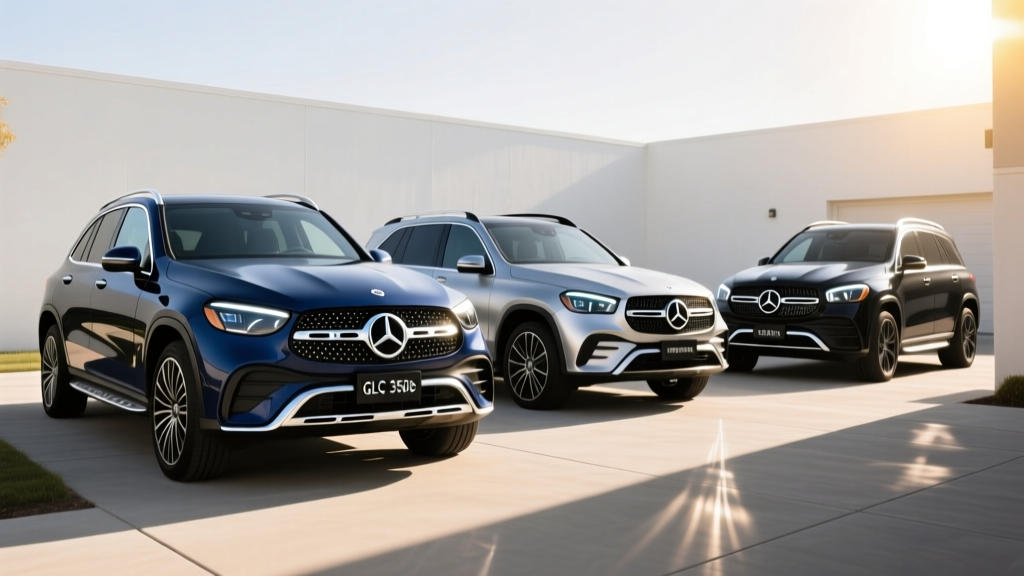
Mercedes-Benz has committed to plug-in hybrid electrification across its SUV lineup, and for 2026 the strategy centers on two high-volume models: the compact GLC 350e 4MATIC and the midsize GLE 350e 4MATIC. Both are plug-in hybrids (PHEVs), not conventional hybrids, meaning they pair a turbocharged gasoline engine with a sizable battery pack you can charge from a wall outlet for genuine electric-only commuting. This is a critical distinction for buyers cross-shopping a Benz SUV hybrid against full battery-electric vehicles like the EQE SUV or conventional gas models.
This guide breaks down every 2026 Mercedes-Benz SUV hybrid with exact EPA figures, real-world efficiency observations, charging logistics, federal tax credit eligibility under current IRS §30D rules, and a decision framework to help you choose between PHEV, full EV, or sticking with gas.
HEV vs PHEV: What Mercedes-Benz Actually Sells
Conventional Hybrid (HEV): A small battery recharged solely by regenerative braking and the engine. No plug. Toyota RAV4 Hybrid is the archetype. Mercedes-Benz does not currently sell a conventional HEV in the U.S. market — all electrified Benz SUVs are plug-in hybrids or full BEVs.
Plug-in Hybrid (PHEV): A larger battery (typically 20-30+ kWh) that you charge via a plug for 30-50+ miles of electric-only range. Once the battery depletes, a gasoline engine takes over and the vehicle operates like a conventional hybrid. The GLC 350e and GLE 350e are PHEVs.
If you see "Mercedes hybrid" in marketing, it almost always refers to these PHEVs. The mild-hybrid 48-volt systems found in models like the GLS 450 are not true hybrids in the fuel-economy sense — they provide brief torque assist and smoother stop-start but deliver negligible electric-only operation.
2026 GLC 350e 4MATIC: Specs, Range, and Efficiency
The GLC 350e is Mercedes's compact luxury PHEV SUV, competing directly with the BMW X3 xDrive30e and Volvo XC60 Recharge. For 2026 it carries over the powertrain introduced with the current generation, built on a 2.0-liter turbocharged inline-four paired with a permanently excited synchronous electric motor integrated into the 9G-TRONIC automatic transmission.
| Spec | Value |
|---|---|
| Combined System Output | 312 hp / 406 lb-ft torque |
| Gas Engine | 2.0L turbo I4, 201 hp |
| Electric Motor | 134 hp (100 kW) |
| Battery (usable) | 25.4 kWh (NMC chemistry) |
| EPA Electric-Only Range | 54 miles |
| EPA MPGe (electric + gas) | 66 MPGe combined |
| EPA MPG (gas-only, battery depleted) | 28 city / 31 hwy / 29 combined |
| Total Combined Range | |
| AC Charging (Level 2) | 7.4 kW onboard charger; ~3.5 hrs 0-100% |
| DC Fast Charging | Not available (AC only) |
| 0-60 mph | 6.2 seconds |
| Cargo Volume | 19.4 cu ft (rear seats up) |
| Base MSRP | $59,250 (incl. destination) |
| Battery/Powertrain Warranty | 6 yr / 62,000 mi (hybrid components); 4 yr / 50,000 mi (bumper-to-bumper) |
Real-World Range Note: The EPA's 54-mile electric-only rating assumes moderate temperatures and mixed driving. In our experience, expect 42-48 miles on the highway at 70 mph, and as low as 35-38 miles in sub-freezing winter conditions due to cabin heating draw and reduced battery efficiency. City driving with frequent regen braking can push the electric range to 50-56 miles, sometimes exceeding the EPA estimate.
GLC 350e Real-World MPG Observations
| Scenario | City | Highway | Combined |
|---|---|---|---|
| EPA Sticker (charge-depleted) | 28 MPG | 31 MPG | 29 MPG |
| Real-World Observed (mixed) | 30-33 MPG | 27-29 MPG | 29-31 MPG |
| With Daily Charging (first 40 mi) | ~90+ MPGe effective | — | Varies by commute |
Like most PHEVs, the GLC 350e exceeds its EPA city rating in stop-and-go traffic thanks to aggressive regenerative braking and electric motor assist. Highway driving is where the turbo four works harder, pulling real-world MPG slightly below the sticker. If you charge nightly and commute under 40 miles, you may go months between fill-ups.
2026 GLE 350e 4MATIC: The Larger PHEV Option
For buyers needing three rows or more cargo space, the GLE 350e applies the same PHEV philosophy to Mercedes's midsize SUV platform. The powertrain uses the same 2.0L turbo I4 and electric motor pairing, tuned for the heavier chassis.
| Spec | Value |
|---|---|
| Combined System Output | 375 hp / 516 lb-ft torque |
| Gas Engine | 2.0L turbo I4, 255 hp |
| Electric Motor | 134 hp (100 kW) |
| Battery (usable) | 23.3 kWh (NMC chemistry) |
| EPA Electric-Only Range | 48 miles |
| EPA MPGe (electric + gas) | 58 MPGe combined |
| EPA MPG (gas-only, battery depleted) | 23 city / 26 hwy / 24 combined |
| Total Combined Range | ~480 miles |
| AC Charging (Level 2) | 7.4 kW; ~3.25 hrs 0-100% |
| DC Fast Charging | Not available |
| 0-60 mph | 6.1 seconds |
| Cargo Volume | 33.3 cu ft (behind 2nd row) |
| Base MSRP | $67,100 (incl. destination) |
| Battery/Powertrain Warranty | 6 yr / 62,000 mi (hybrid components) |
The GLE 350e sacrifices about 6 miles of electric range compared to the GLC 350e due to its 5,000+ lb curb weight, but the trade-off is substantially more interior volume and a notably more refined ride. The 375 combined horsepower makes highway merging effortless even in charge-depleted mode.
Charging Your Mercedes-Benz PHEV: What You Need to Know
Neither the GLC 350e nor GLE 350e supports DC fast charging — a notable limitation if you were hoping to top up at Electrify America or Tesla Supercharger stations on road trips. All charging is AC-only, which is typical for most luxury PHEVs in this class (the BMW X3 xDrive30e also lacks DCFC).
| Charging Level | Power (kW) | Time (0-100%) | Typical Use Case |
|---|---|---|---|
| Level 1 (120V household outlet) | ~1.4 kW | ~18-20 hours | Overnight trickle; not practical for daily full recharge |
| Level 2 (240V, 32A home charger) | 7.4 kW | ~3.5 hours | Standard home wallbox; full charge overnight |
| Level 2 (public, e.g., ChargePoint) | Up to 7.4 kW | ~3.5 hours | Workplace or destination charging |
| DC Fast Charge | N/A | N/A | Not supported on GLC/GLE 350e |
Home charging setup: A Level 2 wallbox (like a ChargePoint Home Flex or Emporia Level 2) on a 40A/240V circuit will fully replenish either PHEV overnight. Installation costs typically range from $500-$1,500 if your electrical panel has capacity, or $2,000-$4,000+ if a panel upgrade is needed. Consult a licensed electrician for a site assessment.
kW vs. kWh reminder: The 7.4 kW onboard charger determines how fast energy flows into the battery (power). The 25.4 kWh battery is the total energy capacity — think of kW as the hose diameter and kWh as the bucket size.
Federal Tax Credit Eligibility for Mercedes PHEVs
Under current IRS §30D Clean Vehicle Credit rules, qualifying PHEVs can receive up to $7,500 in federal tax credits — but eligibility is strict and model-specific. Key requirements for 2026:
- Battery capacity: At least 7 kWh (both GLC and GLE 350e qualify with 23+ kWh)
- MSRP cap: SUVs must be under $80,000 MSRP — the GLC 350e base ($59,250) and GLE 350e base ($67,100) both clear this, but heavily optioned GLE builds may exceed it
- Buyer income cap: AGI must not exceed $150,000 (single), $225,000 (head of household), or $300,000 (married filing jointly)
- Battery component sourcing: A percentage of battery components must be manufactured or assembled in North America — this requirement tightens annually and can disqualify otherwise eligible models mid-year
- Critical minerals: A percentage of critical minerals must be sourced from the U.S. or FTA partners — also tightening annually
- Point-of-sale transfer: Buyers can transfer the credit to the dealer for an immediate price reduction at purchase, rather than waiting to claim it on their tax return
Current status: As of early 2026, the GLC 350e has qualified for a partial or full credit depending on the sourcing compliance period. The GLE 350e's eligibility has been more variable. Because Mercedes-Benz manufactures these vehicles in Germany (Bremen and Tuscaloosa, respectively, depending on model), battery sourcing compliance is the limiting factor — not assembly location. Always verify current eligibility on fueleconomy.gov before purchasing, as the IRS updates qualified vehicle lists periodically.
Battery Warranty & Replacement Cost: Mercedes-Benz covers PHEV high-voltage battery components for 6 years or 62,000 miles (whichever comes first), with a capacity retention threshold typically set at 70% of original capacity. This is shorter than the 8-year/100,000-mile coverage common among Korean and Japanese PHEV manufacturers. If the battery requires out-of-warranty replacement, expect $12,000-$18,000 for the GLC 350e pack and $14,000-$20,000 for the GLE 350e, based on current dealer parts pricing. In practice, NMC battery degradation in PHEVs is modest — most owners report 5-10% capacity loss over 5 years of normal use, well within the warranty threshold.
GLC 350e vs. GLE 350e: Side-by-Side Comparison
| Attribute | GLC 350e 4MATIC | GLE 350e 4MATIC |
|---|---|---|
| Class | Compact Luxury SUV | Midsize Luxury SUV |
| System Horsepower | 312 hp | 375 hp |
| 0-60 mph | 6.2 sec | 6.1 sec |
| EPA Electric Range | 54 miles | 48 miles |
| Battery (usable) | 25.4 kWh | 23.3 kWh |
| EPA MPG (gas-only) | 29 combined | 24 combined |
| Cargo (rear seats up) | 19.4 cu ft | 33.3 cu ft |
| Third Row | No | Optional |
| Base MSRP | $59,250 | $67,100 |
| DC Fast Charge | No | No |
| Towing Capacity | 3,500 lbs | 7,700 lbs |
Best Electric Range: GLC 350e (54 mi vs 48 mi)
Best Fuel Economy (depleted): GLC 350e (29 vs 24 MPG combined)
Best Cargo & Towing: GLE 350e (33.3 cu ft, 7,700 lbs)
Best Performance: GLE 350e (375 hp, 516 lb-ft)
Best Value: GLC 350e ($7,850 less, better efficiency)
Best for Families: GLE 350e (optional 3rd row)
Pros and Cons of Mercedes-Benz PHEV SUVs
Pros
- 54-mile (GLC) and 48-mile (GLE) electric ranges cover most daily commutes without gasoline
- No range anxiety — gas engine provides 400+ miles of backup for road trips
- Mercedes MBUX infotainment and luxury appointments are class-leading
- Strong combined horsepower makes highway merging effortless
- Level 2 home charging fully replenishes battery overnight
- Regenerative braking extends real-world city MPG beyond EPA estimates
Cons
- No DC fast charging — cannot quick-charge on road trips
- Battery warranty (6 yr/62k mi) is shorter than competitors like Hyundai (10 yr/100k mi)
- Out-of-warranty battery replacement is expensive ($12k-$20k)
- Trunk/cargo space is reduced vs. gas-only GLC/GLE due to battery placement
- Federal tax credit eligibility is uncertain and changes with sourcing rules
- MSRP is premium — a well-equipped GLC 350e easily crosses $68,000
Who Should Buy a Mercedes-Benz SUV Hybrid?
Choose a Benz PHEV (GLC 350e or GLE 350e) if:
- Your daily commute is under 50 miles round-trip and you can charge at home nightly
- You want electric commuting but regularly take 300+ mile road trips where charging infrastructure is sparse
- You need luxury features and brand prestige that mainstream PHEVs (Toyota RAV4 Prime, Hyundai Tucson PHEV) don't offer
- You don't qualify for or want the commitment of a full BEV like the EQE SUV
Choose a full EV (EQE SUV, EQS SUV) instead if:
- You have reliable home and workplace charging and rarely drive beyond 250 miles without stopping
- You want to eliminate gasoline costs and maintenance entirely
- You want access to the full $7,500 federal credit with fewer sourcing complications (U.S.-built EQ models may qualify more consistently)
Choose a gas-only GLC or GLE if:
- You cannot install a Level 2 home charger (apartment, no garage)
- Your annual mileage is low enough that fuel savings won't offset the PHEV price premium
- You plan to keep the vehicle 10+ years and want to avoid battery replacement risk
Frequently Asked Questions
How many MPG does the Mercedes-Benz GLC 350e hybrid get?
The EPA rates the 2026 GLC 350e at 28 city / 31 highway / 29 combined MPG when operating on gasoline alone (battery depleted). In real-world city driving with regenerative braking, owners frequently observe 30-33 MPG. When the battery is charged, the effective economy is rated at 66 MPGe combined for the blended electric-plus-gas portion of driving.
How far can the GLE 350e go on electric only?
The EPA rates the 2026 GLE 350e at 48 miles of electric-only range. In real-world conditions, expect 38-44 miles at highway speeds and in cold weather, and up to 50 miles in warm city driving with regen braking. The 23.3 kWh usable battery is sized for typical suburban commutes.
Hybrid vs PHEV vs EV — which Mercedes SUV fits me?
Mercedes doesn't sell conventional hybrids (HEVs) in the U.S. Your choice is between PHEV (GLC/GLE 350e — plug in for ~50 mi electric range, gas backup), full EV (EQE/EQS SUV — 250-300+ mi range, no gas), or gas-only (GLC/GLE 300d/450 — no plug). If you can charge at home and want to eliminate most gas use without range anxiety, the PHEV is the bridge. If charging access is solid and you want zero tailpipe emissions, go full EV. If you can't charge at home, stick with gas.
Is the Mercedes PHEV battery reliable, and what does replacement cost?
Mercedes PHEV battery packs use proven NMC lithium-ion chemistry and real-world degradation data from 2023-2025 models shows 5-10% capacity loss over 5 years — modest and within the 70% retention warranty threshold. The warranty covers 6 years/62,000 miles, which is shorter than industry leaders. Out-of-warranty replacement runs $12,000-$20,000 depending on model. For most owners who plan to trade within 5-7 years, this is unlikely to be an issue.
Does the Mercedes GLC 350e or GLE 350e qualify for the federal tax credit?
Both models meet the battery-capacity and MSRP-cap requirements for the IRS §30D Clean Vehicle Credit. However, eligibility depends on battery-component sourcing and critical-minerals requirements that change annually and can disqualify models mid-year. The GLC 350e (base $59,250) and GLE 350e (base $67,100) are under the $80,000 SUV MSRP cap, but buyer income limits ($150k single / $300k joint) also apply. Check the latest qualified vehicle list on fueleconomy.gov and consult a tax professional before relying on the credit. If eligible, you can transfer the credit to the dealer at point of sale for an immediate price reduction.
Can I DC fast charge the Mercedes GLC 350e on a road trip?
No. Neither the GLC 350e nor GLE 350e supports DC fast charging. The onboard charger is limited to 7.4 kW AC (Level 2). On road trips, you'll operate on the gasoline engine once the battery depletes — which is the PHEV's advantage over a full EV. If DC fast charging is a priority, consider the Mercedes EQE SUV (full EV with ~170 kW DCFC capability).
What is the total ownership cost advantage of a Benz PHEV vs. gas?
If you charge nightly and commute under 50 miles, a GLC 350e owner driving 15,000 miles/year could use roughly 200-300 gallons of gasoline annually (vs. ~517 gallons for the gas-only GLC 300 at 29 MPG combined). At $3.50/gallon, that's a savings of ~$750-$1,100/year on fuel. Add in home electricity cost (~$0.14/kWh × 25 kWh × ~250 charges = ~$875/year) and total "fuel" cost is roughly $1,600-$2,000/year vs. $1,810 for gas-only. The PHEV premium pays for itself through fuel savings in 5-7 years, plus any applicable tax credits. Insurance premiums for PHEVs are typically 5-12% higher than gas equivalents.