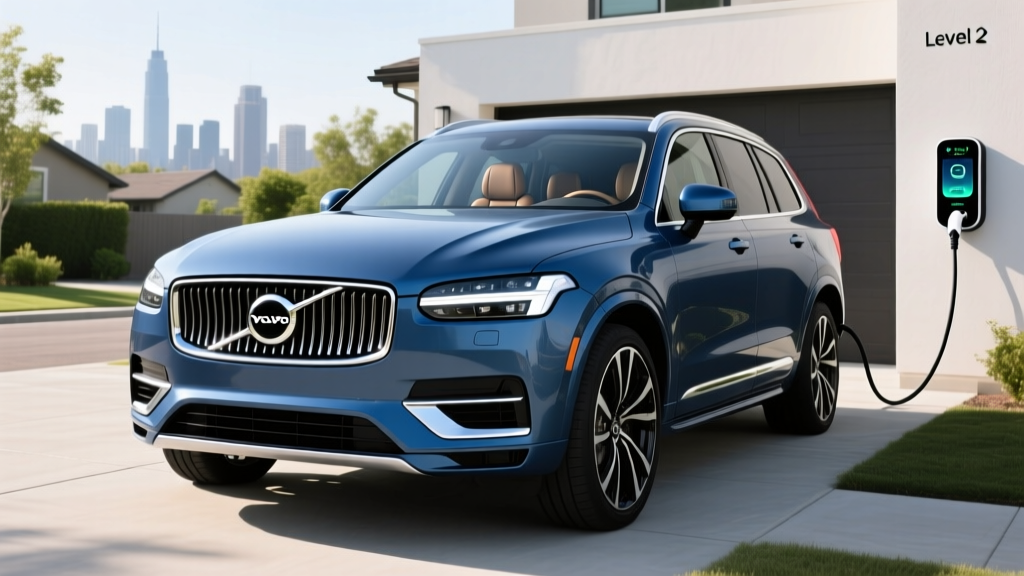
The Volvo XC90 Recharge is the plug-in hybrid (PHEV) version of Volvo's flagship three-row SUV, pairing a turbocharged and supercharged 2.0-liter engine with a rear-axle electric motor for a combined 455 horsepower. For buyers who want electric commuting without fully committing to a battery-electric vehicle, the plug in Volvo XC90 offers a compelling middle ground — but its value proposition depends heavily on your driving habits, charging access, and whether you qualify for federal incentives.
This review covers the current-generation XC90 Recharge (T8 AWD powertrain), examining its real-world electric range, fuel economy, charging logistics, and total ownership costs. We'll also clarify where it fits against a conventional hybrid and a full EV.
HEV vs PHEV: What the XC90 Recharge Actually Is
Before diving into specs, it's essential to distinguish between the two hybrid types Volvo offers in the XC90 lineup:
Conventional Hybrid (HEV) — XC90 B5/B6
- Small battery (~0.5 kWh), no plug
- Regenerative braking charges the battery
- Electric motor assists the gas engine; cannot drive on electric alone for meaningful distances
- No federal tax credit eligibility
- EPA combined: ~26 MPG (B6 AWD)
Plug-In Hybrid (PHEV) — XC90 Recharge T8
- 18.8 kWh usable battery, requires plug-in charging for full benefit
- Can drive up to 33 miles on electric power alone (EPA)
- Gas engine takes over after battery depletes
- May qualify for partial federal tax credit under §30D
- EPA combined (gas only): 27 MPG; MPGe (with charge): 55 MPGe
The XC90 Recharge is firmly in the PHEV category. If you never plug it in, you're carrying 400+ pounds of dead battery weight and getting worse fuel economy than the lighter B6 mild-hybrid. The plug in Volvo XC90 only makes financial and environmental sense if you can charge at home or work regularly.
Electric-Only Range and Total Driving Range
The XC90 Recharge uses an 18.8 kWh lithium-ion battery pack (NMC chemistry) mounted in the center tunnel between the axles. Here's what that delivers in practice:
| Metric | Value |
|---|---|
| Battery capacity (usable) | 18.8 kWh |
| EPA electric-only range | 33 miles |
| Real-world electric range (mixed driving) | 28–32 miles |
| Real-world electric range (highway/cold) | 22–26 miles |
| EPA combined MPGe (charge-depleting) | 55 MPGe |
| Gas tank capacity | 18.8 gallons |
| EPA combined MPG (charge-sustaining) | 27 MPG |
| Total combined range (full battery + full tank) | ~540 miles |
Real-world range reality: The EPA's 33-mile electric estimate assumes moderate temperatures and mixed driving. In our experience, expect 28–32 miles in normal conditions. Highway driving at 70+ mph drops this to roughly 22–25 miles due to aerodynamic drag on this 5,100-lb SUV. In sub-freezing temperatures with cabin heat, plan for 20–24 miles of electric range before the gas engine fires up.
That 33-mile electric range covers most daily commutes. According to EPA data on fueleconomy.gov, the average American drives roughly 37 miles per day — meaning the XC90 Recharge can handle the bulk of weekday driving on electricity if you charge nightly, then switch seamlessly to gas for longer weekend trips without range anxiety.
Powertrain and Performance
The T8 AWD Recharge powertrain is one of the most powerful plug-in hybrid systems in the luxury SUV segment:
| Component | Specification |
|---|---|
| Engine | 2.0L turbocharged + supercharged inline-4 |
| Engine output | 312 hp / 295 lb-ft torque |
| Rear electric motor | 143 hp / 228 lb-ft torque |
| Combined system output | 455 hp / 523 lb-ft torque |
| 0–60 mph | 5.0 seconds |
| Drivetrain | AWD (engine drives front, motor drives rear) |
| Transmission | 8-speed automatic |
The split-axle design is worth noting: the gas engine powers the front wheels while the electric motor powers the rear. In Pure (electric-only) mode, the XC90 Recharge is effectively rear-wheel drive. In Hybrid mode, both power sources engage for all-wheel-drive traction. The transition between electric and gas is nearly imperceptible in normal driving — one of the better-executed PHEV powertrains we've tested.
Charging: Level 2 Only, No DC Fast Charging
The XC90 Recharge supports AC charging only — there is no DC fast charging capability. This is typical for PHEVs with smaller batteries, where the added cost and weight of DC hardware isn't justified.
| Charging Level | Power | Time (0–100%) | Notes |
|---|---|---|---|
| Level 1 (120V household) | ~1.4 kW | ~13–14 hours | Emergency/trickle only |
| Level 2 (240V, 3.6 kW onboard) | 3.6 kW | ~5 hours | Standard home/public charging |
| DC Fast Charge | Not supported | N/A | No CCS/NACS DC port |
Home charging setup: The 3.6 kW onboard charger means a full charge takes about 5 hours on a 240V Level 2 circuit. For most owners, plugging in overnight easily replenishes the battery. A dedicated Level 2 home charger (like a ChargePoint Home Flex or Emporia Vue) on a 240V/20A circuit costs roughly $500–$1,200 for equipment plus $400–$1,500 for electrician installation, depending on panel proximity and local permit requirements.
Level 1 charging from a standard 120V outlet will technically work but requires 13+ hours for a full charge — only practical if your daily electric consumption is under 15 miles and you can top up slowly overnight.
Fuel Economy: EPA vs Real-World MPG
The XC90 Recharge's fuel economy depends entirely on how often you charge and how far you drive between charges:
| Driving Scenario | EPA Estimate | Real-World Expectation |
|---|---|---|
| Combined MPGe (with regular charging) | 55 MPGe | 45–55 MPGe |
| Gas-only combined MPG (battery depleted) | 27 MPG | 24–27 MPG |
| City MPG (gas-only) | 26 MPG | 25–28 MPG |
| Highway MPG (gas-only) | 27 MPG | 24–26 MPG |
How to interpret this: If you charge nightly and drive under 30 miles per day, you may use almost no gasoline during the work week, achieving effective MPGe figures in the 50s. Take a 300-mile road trip without charging stops, and you'll see 24–27 MPG on gasoline alone — better than the non-hybrid B6 (~23 MPG combined) but not dramatically so.
The real-world efficiency sweet spot is owners who charge daily, commute under 30 miles, and take occasional longer trips. In this pattern, many XC90 Recharge owners report using 5–8 gallons of gas per week, compared to 12–15 gallons in a comparable gas-only luxury SUV.
Pricing, Trims, and Federal Tax Credit Eligibility
The XC90 Recharge carries a significant price premium over the mild-hybrid B5/B6 variants. Current MSRP by trim (2025 model year, destination included):
| Trim | MSRP |
|---|---|
| Core Recharge T8 AWD | $78,345 |
| Plus Recharge T8 AWD | $82,695 |
| Ultimate Recharge T8 AWD | $87,095 |
Federal tax credit (§30D) eligibility: The plug in Volvo XC90 Recharge's tax credit status is complex and subject to current-year IRS rules. Because Volvo manufactures the XC90 in Sweden (not North America), it does not qualify for the new-vehicle §30D credit of up to $7,500, which requires final assembly in North America. This is a critical distinction for buyers comparing it against domestically assembled PHEVs like the Jeep Grand Cherokee 4xe or Chrysler Pacifica Hybrid.
§30D New Clean Vehicle Credit requirements (per IRS.gov):
- Final assembly in North America — XC90 Recharge: Does NOT meet
- MSRP under $80,000 for SUVs — Core trim meets; Plus and Ultimate do not
- Buyer income caps ($300K joint / $150K single) — varies by buyer
- Battery critical minerals and component sourcing — varies by model year
The XC90 Recharge fails the North American assembly requirement, disqualifying it from the new-vehicle federal credit regardless of trim or buyer income.
Some buyers may qualify for state-level PHEV incentives (California, Colorado, New York, and others offer rebates for plug-in hybrids), but these vary significantly by jurisdiction. Check your state's energy or DMV website for current programs.
Battery Warranty, Reliability, and Replacement Costs
Volvo Hybrid Battery Warranty: 8 years or 100,000 miles (whichever comes first), covering defects and capacity loss below 70% of original capacity. This meets the industry standard for PHEV battery coverage and is mandated in CARB states (California, New York, etc.) with some states extending to 10 years/150,000 miles.
Reliability: Volvo's T8 powertrain has been in production since 2016 (with the current 18.8 kWh battery introduced for the 2023 model year). Long-term reliability data on the earlier, smaller-battery T8 models is generally positive, with few widespread battery failure reports. The main reliability concerns center on the complex powertrain — turbocharger, supercharger, electric motor, and high-voltage electronics all add potential failure points compared to a simpler gas-only drivetrain.
Battery replacement cost: Out-of-warranty replacement of the 18.8 kWh battery pack currently runs approximately $8,000–$12,000 including labor, based on dealer parts pricing. However, PHEV battery packs rarely require full replacement — individual module replacement or repair is more common and significantly less expensive. The 8-year/100,000-mile warranty provides substantial coverage during the typical ownership period.
For context, IIHS ratings give the XC90 Recharge top marks in crashworthiness, though the driver-assistance system (Pilot Assist) is rated separately from the powertrain.
XC90 Recharge vs Full EV vs Gas: Which Fits You?
Choose the XC90 Recharge (PHEV) if:
- You can charge at home (Level 2) every night
- Your daily commute is under 30 miles round-trip
- You regularly need three rows and take road trips beyond EV charging infrastructure
- You want to reduce gas consumption without committing to a full EV
Choose a full EV (e.g., Volvo EX90, Rivian R1S, Tesla Model X) if:
- You want zero tailpipe emissions and minimal maintenance
- You have reliable home charging and access to DC fast chargers for road trips
- You want to qualify for the $7,500 federal tax credit (many EVs qualify; this PHEV does not)
- You drive in areas with robust public charging networks
Choose the XC90 B5/B6 (mild hybrid) if:
- You cannot charge at home or at work
- You want three-row luxury at a lower entry price ($58,000+)
- You don't want to manage charging routines
- Your driving is mostly highway, where PHEV electric advantage is minimal
Pros
- 455 hp with seamless gas-electric transitions
- 33 miles electric covers most daily commutes
- Three-row seating with no range anxiety on road trips
- Strong build quality and IIHS Top Safety Pick ratings
- 8-year/100,000-mile hybrid battery warranty
Cons
- No federal tax credit (assembled in Sweden)
- No DC fast charging — 5 hours on Level 2
- High entry price ($78,345+ before options)
- Only 33 miles electric — less than rivals like the BMW X5 xDrive50e (38 mi)
- Complex powertrain adds long-term maintenance risk
Frequently Asked Questions
How many MPG does the plug in Volvo XC90 Recharge get?
The EPA rates the XC90 Recharge at 27 MPG combined when running on gasoline alone (26 city / 27 highway). When regularly charged, the combined rating is 55 MPGe. Real-world gas-only driving typically yields 24–27 MPG depending on conditions and driving style.
How far can the XC90 Recharge go on electric only?
The EPA electric-only range is 33 miles. In real-world mixed driving, expect 28–32 miles. Highway driving or cold weather reduces this to roughly 22–26 miles. The total combined range (full battery plus full 18.8-gallon tank) is approximately 540 miles.
Does the XC90 Recharge qualify for the $7,500 federal tax credit?
No. The XC90 Recharge is assembled in Torslanda, Sweden, and does not meet the §30D requirement for North American final assembly. It is ineligible for the federal new-vehicle tax credit regardless of trim or buyer income. State-level incentives may still apply — check your local program.
Is the Volvo XC90 Recharge reliable?
The T8 powertrain has been in production since 2016 with generally positive long-term data. The 8-year/100,000-mile hybrid battery warranty covers capacity loss below 70%. The main concern is overall powertrain complexity — more components means more potential failure points than a simple gas engine or a pure electric drivetrain.
What does it cost to charge the XC90 Recharge at home?
At the US average electricity rate of ~$0.16/kWh, fully charging the 18.8 kWh battery costs roughly $3.00. That's about $0.09 per electric mile — compared to roughly $0.15–$0.20 per mile on gasoline at current prices. Over a year of daily charging and 30-mile commutes, you'd spend approximately $400–$500 on electricity versus $1,200–$1,600 on gasoline for the same miles.
Can the XC90 Recharge tow?
Yes. The XC90 Recharge has a maximum towing capacity of 5,000 pounds when properly equipped, matching the non-hybrid variants. Towing significantly reduces both electric range and gas fuel economy — expect roughly 18–20 MPG gas-only while towing a loaded trailer.
How does the XC90 Recharge compare to the BMW X5 xDrive50e?
The BMW X5 xDrive50e offers slightly more electric range (38 miles EPA), a larger battery (25.7 kWh usable), and qualifies for a partial federal tax credit due to US assembly. However, the X5 has only two rows of seating. If you need three rows, the plug in Volvo XC90 Recharge has few PHEV competitors — the Jeep Grand Cherokee L (three-row PHEV) is less luxurious, and the Mercedes GLS lacks a current PHEV variant in the US market.