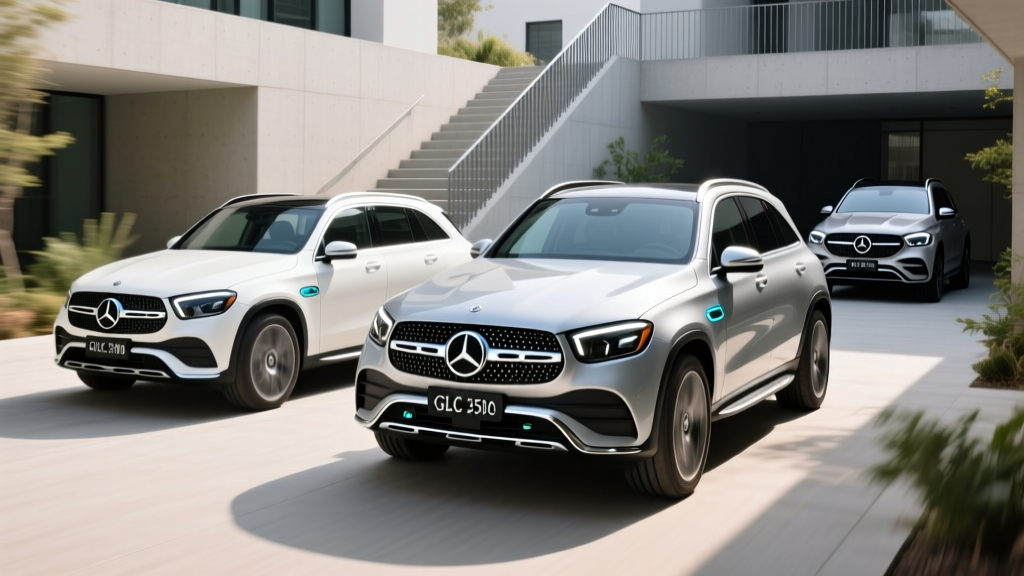
If you want three-pointed-star luxury without committing to a full battery-electric vehicle, the 2026 Mercedes-Benz plug-in hybrid SUV lineup narrows your choice to two models: the compact GLC 350e 4MATIC and the midsize GLE 350e 4MATIC. Both pair a turbocharged four-cylinder gasoline engine with a permanently excited synchronous electric motor and a lithium-ion battery large enough to cover most daily commutes on electricity alone. Below, we break down exact EPA figures, real-world efficiency, charging logistics, pricing, and whether either qualifies for the federal §30D tax credit.
HEV vs PHEV: What Mercedes-Benz Actually Sells
Before diving into specs, it helps to clarify the two hybrid flavors. A conventional hybrid (HEV) like the Toyota RAV4 Hybrid uses a small battery recharged solely by regenerative braking and the engine—you never plug it in. A plug-in hybrid (PHEV) carries a much larger battery that you charge from a wall outlet or public station, enabling 20–50 miles of electric-only driving before the gas engine takes over.
| Feature | Conventional Hybrid (HEV) | Plug-In Hybrid (PHEV) |
|---|---|---|
| Plug-in charging | No | Yes (Level 1 / Level 2) |
| Electric-only range | 0–2 miles at low speed | 20–50+ miles |
| Battery size | 1–2 kWh | 15–35 kWh |
| Federal tax credit | None | Up to $7,500 (varies) |
| Example (Mercedes) | Not currently offered in US | GLC 350e, GLE 350e |
In the US market, Mercedes-Benz currently offers only PHEVs in its SUV lineup—no conventional HEVs. If you see "Mercedes hybrid" referenced online, it almost certainly means one of these plug-in models.
2026 GLC 350e: Specs, Range, and Efficiency
The GLC 350e 4MATIC is the more accessible of the two, riding on the compact GLC platform. It pairs a 2.0-liter turbocharged inline-four (208 hp) with a 134-hp electric motor integrated into the 9-speed automatic transmission, yielding a combined system output of 313 horsepower and 406 lb-ft of torque.
| Spec | 2026 GLC 350e 4MATIC |
|---|---|
| Battery (usable) | 25.4 kWh (NMC lithium-ion) |
| EPA electric-only range | 38 miles |
| Total combined range | ~430 miles |
| EPA MPGe (electric + gas) | 66 MPGe |
| EPA MPG (gas-only, charge-depleted) | 25 city / 29 hwy / 27 combined |
| Combined horsepower | 313 hp / 406 lb-ft |
| 0–60 mph | 6.5 seconds |
| Level 2 charge rate | 7.4 kW (J1772 connector) |
| DC fast charging | Not available |
| Base MSRP | $59,900 |
2026 GLE 350e: The Larger PHEV Option
The GLE 350e 4MATIC uses the same powertrain architecture—2.0L turbo four plus electric motor—but tuned for its heavier midsize chassis. Combined output is 302 hp and 384 lb-ft. The battery is slightly smaller in usable capacity due to packaging, but the GLE's more aerodynamic profile helps it achieve competitive electric range.
| Spec | 2026 GLE 350e 4MATIC |
|---|---|
| Battery (usable) | 23.3 kWh (NMC lithium-ion) |
| EPA electric-only range | 35 miles |
| Total combined range | ~440 miles |
| EPA MPGe (electric + gas) | 58 MPGe |
| EPA MPG (gas-only, charge-depleted) | 22 city / 26 hwy / 24 combined |
| Combined horsepower | 302 hp / 384 lb-ft |
| 0–60 mph | 7.0 seconds |
| Level 2 charge rate | 7.4 kW (J1772 connector) |
| DC fast charging | Not available |
| Base MSRP | $69,500 |
Charging: Level 2 Only, No DC Fast Charge
Neither the GLC 350e nor GLE 350e supports DC fast charging—a limitation common to most PHEVs, whose smaller batteries and onboard charger architectures aren't designed for 50+ kW public chargers. Both accept up to 7.4 kW on Level 2 (240V), which refills the battery from 0–100% in approximately 3.5 hours.
| Charging Level | Power | Time (0–100%) | Miles of Electric Range Added per Hour |
|---|---|---|---|
| Level 1 (120V household) | ~1.4 kW | ~18 hours | ~5 miles/hr |
| Level 2 (240V home/public) | 7.4 kW | ~3.5 hours | ~12 miles/hr |
| DC Fast Charging | N/A | N/A | N/A |
Home charging reality: A Level 2 home charger (such as a ChargePoint Home Flex or Tesla Wall Connector with J1772 adapter) is strongly recommended. Overnight charging on Level 2 easily refills the battery for the next morning's commute. Level 1 from a standard 120V outlet works but is painfully slow—you'd need nearly a full day to recharge from empty.
Installation cost for a Level 2 home charger typically runs $800–$2,000 depending on whether your electrical panel needs an upgrade. If you already have a 240V outlet (dryer or EVSE) near your parking spot, costs drop to just the equipment ($300–$700).
Fuel Economy: EPA vs Real-World MPG
How many MPG does a Mercedes-Benz plug-in hybrid SUV get? The answer depends entirely on how often you charge.
| Model | City MPG | Highway MPG | Combined MPG | MPGe (with charge) |
|---|---|---|---|---|
| GLC 350e (charge-depleted) | 25 | 29 | 27 | 66 MPGe |
| GLE 350e (charge-depleted) | 22 | 26 | 24 | 58 MPGe |
Real-world MPG observations: Like most PHEVs, these models can exceed EPA city ratings when you regularly charge and drive mostly within the electric range. A GLC 350e owner with a 20-mile round-trip commute who charges nightly may use almost zero gasoline for months. Conversely, if you never plug in, you'll get the charge-depleted numbers (27 combined for the GLC, 24 for the GLE)—respectable for luxury AWD SUVs, but not class-leading among hybrids.
On long highway road trips where the battery is depleted early, expect fuel economy to settle near the EPA highway figures. The GLC's 29 mpg highway is genuinely useful; the GLE's 26 mpg is adequate for its size. According to fueleconomy.gov, both models rank competitively against other luxury PHEV SUVs.
Tax Credit Eligibility: The §30D Picture
Does a Mercedes-Benz plug-in hybrid SUV qualify for the federal EV tax credit? Under current IRS §30D rules, PHEVs are eligible if they meet battery capacity, critical-mineral sourcing, MSRP, and buyer income requirements.
- Battery capacity: Must be ≥ 7 kWh (both Mercedes PHEVs qualify at 23–25 kWh)
- MSRP cap: SUVs must be ≤ $80,000 (GLC 350e at $59,900 ✓; GLE 350e at $69,500 ✓)
- Buyer income cap: AGI ≤ $150,000 (single) or ≤ $300,000 (joint)
- Critical minerals & battery components: Must meet annual sourcing thresholds — this is where eligibility often fails for European-assembled vehicles
- Assembly: Final assembly must occur in North America (verify VIN at fueleconomy.gov)
Current status for 2026: Both the GLC 350e and GLE 350e are assembled in Bremen, Germany, which disqualifies them from the new-vehicle §30D credit under the North American final-assembly requirement. However, if you purchase a qualifying used Mercedes PHEV (model year 2024 or earlier, from a dealer, ≤ $25,000), you may be eligible for the up-to-$4,000 used clean vehicle credit under §25E, subject to income caps. Always verify current eligibility on IRS.gov or consult a tax professional before purchase.
Battery Warranty, Reliability, and Replacement Cost
Is this hybrid reliable? Mercedes-Benz PHEV powertrains have been in production since 2019 (third-generation PHEV architecture). The 2.0L M254 engine is well-proven, and the electric motor is integrated into the transmission housing with no additional belts or complex linkages. The main reliability unknown is long-term battery degradation. Based on owner reports and industry data, NMC batteries in PHEVs typically lose 8–12% capacity over 5 years with normal use—well within the warranty threshold.
Battery replacement cost: If the high-voltage battery fails out of warranty, replacement currently runs $8,000–$12,000 including parts and labor at a Mercedes dealer. This is lower than full EV battery replacements because the PHEV pack is significantly smaller (~25 kWh vs 75–100 kWh in a BEV).
Who Should Buy a Mercedes-Benz PHEV SUV?
Choose the GLC 350e if:
- Your daily commute is under 35 miles round-trip and you can charge at home
- You want luxury features and AWD without the $70K+ price tag
- You take regular road trips where charging infrastructure is uncertain
- You want to reduce fuel consumption without range anxiety
Choose the GLE 350e if:
- You need three-row-capable midsize space (or simply prefer a larger SUV)
- Your commute is under 30 miles and you value ride comfort over agility
- You tow occasionally (GLE is rated up to 3,500 lbs with the PHEV powertrain)
Choose a full EV instead if:
- You have reliable home Level 2 charging and rarely drive beyond 250 miles in a day
- You want zero maintenance on the powertrain (no oil changes, no spark plugs)
- You want to maximize federal tax credits (many BEVs still qualify where PHEVs don't)
Choose a conventional gas SUV instead if:
- You cannot charge at home or at work
- Your annual mileage is very low (the PHEV premium won't pay back)
- You prioritize lowest upfront cost over fuel savings
Pros
- 35–38 miles of electric-only range covers most commutes
- Seamless transition between electric and gas power
- Mercedes MBUX infotainment and luxury appointments
- No range anxiety on road trips—gas engine covers long hauls
- Quietest daily driving experience when in EV mode
Cons
- No DC fast charging — long trips don't benefit from public chargers
- Assembled in Germany — no federal new-vehicle tax credit
- Heavy: PHEV powertrain adds ~400 lbs vs gas-only GLC/GLE
- Cargo space slightly reduced vs non-hybrid variants
- Premium fuel recommended for optimal performance
Frequently Asked Questions
How many MPG does the Mercedes-Benz plug-in hybrid SUV get?
The GLC 350e achieves 25 city / 29 highway / 27 combined MPG when running on gasoline alone (battery depleted). The GLE 350e gets 22/26/24 MPG. When charged regularly, both achieve 58–66 MPGe combining electric and gasoline operation.
How far can the Mercedes PHEV SUV go on electric only?
The EPA rates the GLC 350e at 38 miles of electric-only range and the GLE 350e at 35 miles. Real-world highway driving at 70 mph reduces this to approximately 30–32 miles; cold weather (below 35°F) drops it to 25–28 miles.
Hybrid vs PHEV vs EV — which fits my lifestyle?
If you can charge at home and your daily driving is under 35 miles, a PHEV lets you commute on electricity while keeping gas capability for road trips. A full EV (like the Mercedes EQB or EQE SUV) offers lower running costs and zero tailpipe emissions but requires charging planning on long trips. A conventional hybrid (not offered by Mercedes in the US) works if you cannot plug in at all.
Is the Mercedes PHEV reliable and what does battery replacement cost?
The PHEV powertrain has been in production since 2019 with no widespread failure patterns. The high-voltage battery is warrantied for 6 years / 62,000 miles. Out-of-warranty replacement costs $8,000–$12,000. Expected degradation is 8–12% over 5 years.
Does the Mercedes-Benz plug-in hybrid SUV qualify for any tax credit?
The new-vehicle §30D federal credit requires North American final assembly, and both the GLC 350e and GLE 350e are built in Germany—making them ineligible. However, a qualifying used PHEV (≤$25,000, from a dealer) may be eligible for the up-to-$4,000 used clean vehicle credit under §25E. State incentives vary; check your local energy office or afdc.energy.gov for state-specific programs.
Can I DC fast charge the GLC 350e or GLE 350e?
No. Neither model supports DC fast charging. Maximum charge rate is 7.4 kW on Level 2 (240V), taking approximately 3.5 hours for a full charge. This is typical for PHEVs, whose smaller batteries don't justify the cost and weight of DC fast-charge hardware.
What happens if I never plug in the PHEV?
You'll operate exclusively in hybrid mode, getting the charge-depleted MPG figures (27 combined for GLC, 24 for GLE). You'll also miss the efficiency and cost benefits that justify the PHEV price premium. If you cannot charge regularly, a conventional hybrid or efficient gas vehicle is a more cost-effective choice.
Sources: fueleconomy.gov (EPA ratings), Mercedes-Benz USA (manufacturer specifications), IRS.gov (§30D and §25E credit rules). All specs reflect 2026 model year data available at time of publication. Tax credit eligibility is subject to change; consult a tax professional.