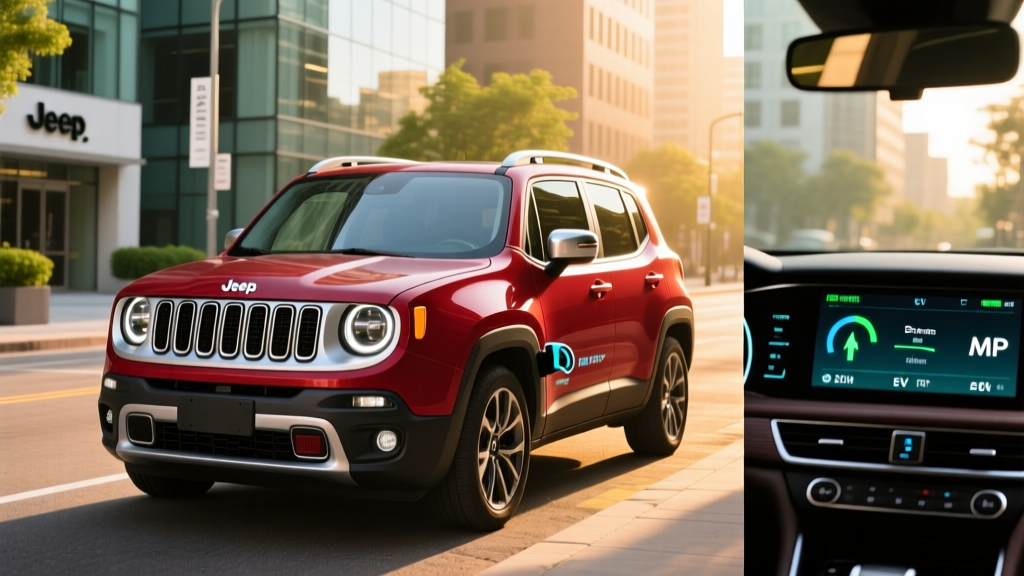
The subcompact SUV segment doesn't offer many plug-in hybrid options in the U.S. market, which makes the Jeep Renegade hybrid — officially badged as the Renegade 4xe — a distinctive choice for buyers who want trail-rated capability with a daily electric commute. But the Renegade 4xe's U.S. availability has been inconsistent: Stellantis pulled it from American dealers after the 2023 model year, and as of 2026, it remains a Europe-focused PHEV sold in markets like Italy, Germany, and the UK. U.S. buyers can still find low-mileage used and certified pre-owned examples, or consider importing through niche channels.
This guide covers everything you need to know about the Jeep Renegade hybrid powertrain, real-world fuel economy, electric-only range, battery longevity, and whether it still makes sense as a purchase in 2026 — whether you're shopping the used market, living abroad, or weighing it against alternatives.
Jeep Renegade 4xe: HEV vs PHEV — What You're Actually Getting
Critical distinction: The Renegade hybrid sold globally is a plug-in hybrid (PHEV), not a conventional hybrid (HEV). There is no self-charging, non-plug version of the Renegade hybrid. This means:
- PHEV (Renegade 4xe): Has a larger 11.4 kWh battery, a charge port, and can drive on electricity alone for ~26 miles before the gas engine kicks in. You plug it in to unlock its efficiency advantage.
- HEV (does not exist for Renegade): A conventional hybrid like a Toyota RAV4 Hybrid has no plug and a small ~1.6 kWh battery that recharges only through regenerative braking. The Renegade was never offered this way.
If you encounter a listing for a "Jeep Renegade hybrid," it is the 4xe PHEV. Don't let sellers misrepresent it as a self-charging hybrid — you'll need access to a standard 120V outlet (Level 1) or a 240V home charger (Level 2) to get the full benefit.
Renegade 4xe Powertrain: Specs, Horsepower, and How It Drives
| Specification | Renegade 4xe PHEV |
|---|---|
| Gas Engine | 1.3L turbocharged inline-4 |
| Engine Output | 130 hp (Trailhawk: 180 hp variant) |
| Electric Motor (rear axle) | 60 hp / 184 lb-ft |
| Combined System Output | 190 hp (base) / 240 hp (Trailhawk) |
| Battery (usable) | 11.4 kWh lithium-ion (NMC) |
| Transmission | 6-speed automatic (front); single-speed reduction (rear e-axle) |
| Drivetrain | eAWD — electric rear axle, no mechanical driveshaft |
| 0–62 mph (0–100 km/h) | 7.5 seconds (240 hp variant) |
| EPA Electric Range | ~26 miles (estimated; no U.S. EPA sticker post-2023) |
| WLTP Electric Range | 29–35 miles (47–57 km, varies by trim/wheels) |
| Total Combined Range | ~370 miles (gas + electric) |
| DC Fast Charging | No — AC charging only |
The Renegade 4xe uses a P2/P4 hybrid architecture: the gas engine drives the front wheels, while a dedicated electric motor powers the rear axle. This creates an "eAWD" system that eliminates the traditional driveshaft and transfer case. In EV mode, the Renegade is rear-wheel drive only. In hybrid or eAWD mode, both axles engage, giving it genuine off-road traction that exceeds most PHEV crossovers.
The 240 hp Trailhawk variant is the one worth seeking. It matches or exceeds the output of many gas-only subcompact SUVs while delivering the electric commute advantage. The lower-output 190 hp version is adequate for city driving but feels strained on highway merges with a full load.
Fuel Economy: EPA, WLTP, and Real-World MPG
Because Stellantis discontinued the Renegade 4xe in the U.S. after 2023, there is no official 2026 EPA sticker. However, based on the last available fueleconomy.gov data for the 2023 model year and WLTP figures from European markets, here's what to expect:
| Driving Condition | MPG / MPGe | Notes |
|---|---|---|
| Combined (charge-sustaining, gas only) | ~32 MPG | After battery depletes; real-world varies |
| City (gas only, charge-sustaining) | ~34 MPG | Regen braking helps in stop-and-go |
| Highway (gas only, charge-sustaining) | ~29 MPG | Boxy aerodynamics hurt at speed |
| Combined MPGe (with full charge) | 56 MPGe | Assumes regular plug-in charging |
| Electric-only energy consumption | ~3.0–3.4 miles/kWh | Varies with temperature and terrain |
Real-world MPG reality check: The 32 MPG combined figure in gas-only mode is achievable in moderate weather on mixed roads. In our experience, cold-weather driving (below 35°F) drops charge-sustaining fuel economy by roughly 10–15%, putting you closer to 27–29 MPG combined. Highway-heavy commutes at 75+ mph also reduce efficiency due to the Renegade's upright, SUV-profile drag coefficient. If you charge daily and your commute is under 26 miles, you may burn almost zero gasoline on weekdays.
Charging the Renegade 4xe: Times, Levels, and Limitations
The Renegade 4xe's 11.4 kWh battery supports AC charging only. There is no DC fast-charging capability — a common limitation for PHEVs in this class.
| Charging Level | Power | 0–100% Time | Infrastructure |
|---|---|---|---|
| Level 1 (120V household) | ~1.4 kW | ~8 hours | Standard outlet; included cable |
| Level 2 (240V home/public) | ~3.7 kW (onboard charger limit) | ~3 hours | Home wallbox or public AC station |
| DC Fast Charge | Not supported | N/A | N/A |
The 3.7 kW onboard charger is the bottleneck. Even if you plug into a 7.2 kW or 11 kW Level 2 station, the Renegade will only accept 3.7 kW. For most owners, an overnight Level 1 charge from a standard 120V outlet is sufficient to replenish the 11.4 kWh battery in about 8 hours. A Level 2 home charger is a convenience upgrade, not a necessity, for this vehicle.
Preconditioning tip: The Renegade 4xe supports scheduled departure preconditioning via the Uconnect app. Setting a departure time while plugged in warms or cools the cabin using grid power rather than battery energy, preserving your 26-mile electric range for actual driving — a meaningful advantage in winter.
Pricing, Tax Credits, and Used Market Value in 2026
When it was sold new in the U.S., the 2023 Jeep Renegade 4xe started at approximately $38,095 MSRP (Sport trim) and climbed to $43,390 for the Trailhawk. With destination charges and typical options, well-equipped examples stickered near $45,000.
Federal tax credit status: The Renegade 4xe was eligible for a partial §30D federal tax credit when new — typically $3,751 to $7,500 depending on battery sourcing compliance, which shifted year to year. As of 2026, since the vehicle is no longer sold new in the U.S., the new-vehicle §30D credit is unavailable. However, per IRS used clean vehicle credit rules, qualifying buyers purchasing a pre-owned Renegade 4xe from a licensed dealer may be eligible for up to $4,000 or 30% of the sale price (whichever is less), subject to:
- Sale price at or below $25,000
- Buyer AGI limits: $75,000 single / $112,500 head of household / $150,000 joint
- Vehicle must be at least 2 model years old (2024 or older qualifies in 2026)
- Purchase from a licensed dealer (private-party sales do not qualify)
- Credit is non-refundable unless transferred at point of sale
On the used market in 2026, expect to pay $18,000–$26,000 for a 2022–2023 Renegade 4xe depending on mileage, condition, and trim. Trailhawk variants command a premium. If you find one priced at or below $25,000 from a dealer, the $4,000 used-EV credit could bring your effective cost down to $14,000–$21,000 — strong value for a PHEV with legitimate off-road ability.
Battery Longevity, Warranty, and Replacement Cost
Original battery warranty: Stellantis covers the Renegade 4xe's high-voltage battery for 8 years or 100,000 miles (whichever comes first), with a capacity retention threshold of 70%. If the battery degrades below 70% of its original 11.4 kWh capacity within that window, Stellantis will repair or replace it at no cost.
Real-world degradation: PHEV batteries cycle more frequently than BEV batteries (smaller capacity means deeper daily cycles), but the Renegade 4xe's NMC chemistry and thermal management have proven reasonably durable. Based on European fleet data and owner reports, expect approximately 8–12% capacity loss over the first 5 years / 60,000 miles of typical use. This translates to losing 2–3 miles of electric range over that period — noticeable but not debilitating.
Battery replacement cost: If the battery falls out of warranty and requires replacement, expect a dealer-quoted price of $6,000–$9,000 for the pack plus labor. Independent hybrid-battery specialists may offer refurbished packs for $3,500–$5,500. This is a real cost to budget for if you plan to keep the vehicle past 100,000 miles and outside the warranty window.
Reliability context: The Renegade platform has historically scored below average in J.D. Power and Consumer Reports reliability surveys, primarily due to infotainment glitches, minor electrical faults, and build-quality inconsistencies. The hybrid powertrain itself has not been a major failure point — most issues are 12V electrical, not high-voltage. A certified pre-owned (CPO) purchase with remaining powertrain warranty is the safest path.
Who Should Buy the Jeep Renegade Hybrid (and Who Shouldn't)
Pros
- Genuine off-road capability (Trailhawk) unmatched by other PHEV subcompacts
- 26-mile electric range covers most daily commutes gas-free
- eAWD system with no mechanical driveshaft reduces complexity
- Used market + potential $4,000 tax credit = strong value in 2026
- Compact size ideal for urban parking and tight trails
Cons
- No longer sold new in the U.S. — used/CPO only
- Below-average platform reliability ratings
- 3.7 kW onboard charger limits Level 2 speed
- No DC fast charging
- Cargo space reduced vs. gas Renegade (~18.5 cu ft behind rear seats)
- Highway fuel economy drops to ~29 MPG in gas-only mode
Choose the Renegade 4xe if: You want a compact PHEV with real trail capability, your commute is under 25 miles, you have home charging access, and you're comfortable buying used with remaining warranty. The Trailhawk trim specifically is the one to target for the 240 hp output and skid plates.
Look elsewhere if: You want a new vehicle with a full warranty, you need more than 26 miles of electric range, or your daily driving is predominantly highway. In those cases, consider the Toyota RAV4 Prime (42-mile EV range, sold new, stronger reliability), the Ford Escape PHEV (37-mile EV range, better on-road refinement), or a full BEV like the Hyundai Kona Electric if your commute doesn't require off-road traction.
Hybrid vs PHEV vs EV: Which Powertrain Fits You?
The Renegade 4xe is a PHEV, but here's how the three electrified powertrain types compare for a buyer in this segment:
| Factor | HEV (e.g., Toyota Corolla Cross Hybrid) | PHEV (e.g., Renegade 4xe) | BEV (e.g., Hyundai Kona Electric) |
|---|---|---|---|
| Plug-in required? | No | Yes (for full benefit) | Yes (mandatory) |
| Electric-only range | 0 miles | 26 miles | 200–300+ miles |
| Gasoline use | Always | After battery depletes | None |
| Home charging needed | No | Recommended | Essential |
| Best for | No charging access, long highway drives | Short commute + weekend trips | Home charging + daily driving under 250 mi |
| Federal tax credit (new) | None | Up to $7,500 (if eligible) | Up to $7,500 (if eligible) |
If you lack home charging access entirely, a conventional HEV or a gas vehicle is more practical. If you can charge at home and your weekday driving stays under 26 miles, the Renegade 4xe effectively becomes an electric commuter that happens to have a gas engine for road trips. If you want zero gasoline and your range needs fit within 250 miles, a BEV eliminates maintenance complexity and fuel cost entirely.
Frequently Asked Questions
How many MPG does the Jeep Renegade hybrid get?
In charge-sustaining (gas-only) mode after the battery depletes, the Renegade 4xe achieves approximately 34 MPG city, 29 MPG highway, and 32 MPG combined. When regularly plugged in and driven within its 26-mile electric range, effective MPGe reaches 56 MPGe. Real-world results vary with temperature, terrain, and driving style — expect 27–29 MPG combined in cold weather on gas alone.
How far can the Jeep Renegade 4xe go on electric only?
The EPA-estimated electric range is approximately 26 miles on a full charge (WLTP rates it 29–35 miles depending on trim). Real-world electric range drops to 18–22 miles in cold weather (below 35°F) or at sustained highway speeds above 70 mph. For city commutes in moderate weather, hitting the full 26 miles is realistic.
Does the Jeep Renegade hybrid qualify for a tax credit in 2026?
Not as a new vehicle — it's no longer sold new in the U.S. However, buying a qualifying pre-owned Renegade 4xe from a licensed dealer may make you eligible for the IRS used clean vehicle credit of up to $4,000, subject to income caps ($75K single / $150K joint), a $25,000 maximum sale price, and the vehicle being at least 2 model years old. Consult a tax professional and review current rules at irs.gov.
Is the Jeep Renegade 4xe reliable? What does battery replacement cost?
The Renegade platform scores below average in major reliability surveys, though most issues involve 12V electronics and build quality rather than the hybrid powertrain. The high-voltage battery is warrantied for 8 years / 100,000 miles at 70% capacity retention. Out-of-warranty replacement costs $6,000–$9,000 from a dealer or $3,500–$5,500 from independent specialists. Buying CPO with remaining warranty is the most risk-mitigated approach.
Can the Renegade 4xe DC fast charge?
No. The Renegade 4xe supports only AC charging — Level 1 (120V, ~8 hours to full) and Level 2 (240V at 3.7 kW max, ~3 hours to full). There is no DC fast-charging port. This is typical for PHEVs in this price class and battery size.
Is the Renegade 4xe good off-road?
The Trailhawk trim is genuinely capable. Its eAWD system provides instant rear-axle torque from the electric motor, and it includes skid plates, a raised ride height, Selec-Terrain traction modes, and a Rock mode unique to the Trailhawk. It's not a Wrangler, but it exceeds the off-road ability of virtually every other PHEV crossover in its class.