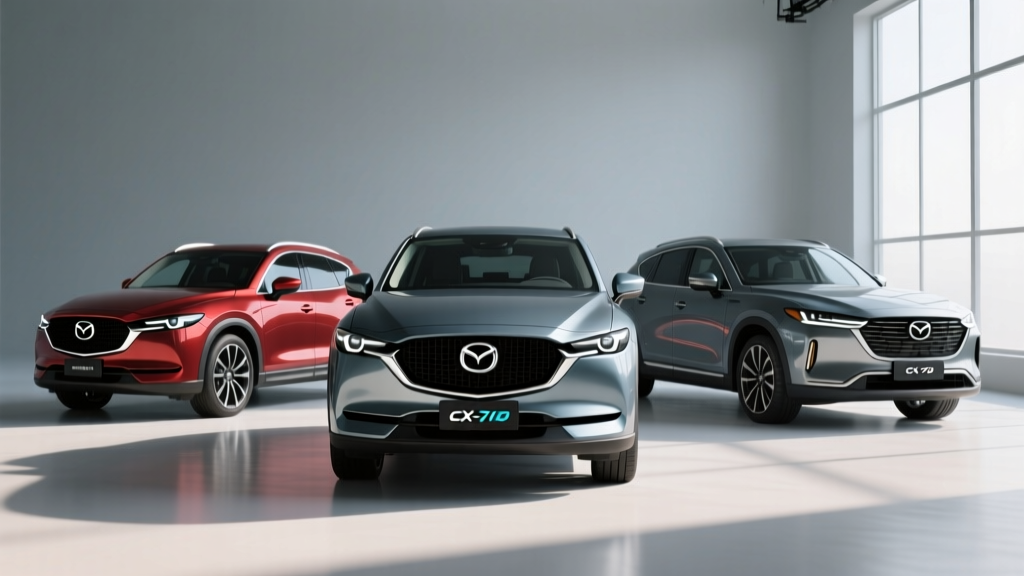
Mazda has steadily expanded its electrified lineup, and by the 2026 model year, buyers searching for mazda hybrid modelle have three distinct options spanning conventional hybrid and plug-in hybrid architectures. Each targets a different use case: the CX-50 Hybrid maximizes fuel economy for daily commuting, the CX-70 PHEV offers a midsize two-row SUV with meaningful electric-only range, and the CX-90 PHEV delivers three-row family hauling with plug-in capability. This guide breaks down every spec that matters — EPA MPG, battery chemistry and capacity, charging times, powertrain output, real-world efficiency, warranty coverage, and federal tax credit eligibility under current IRS §30D rules.
HEV vs PHEV: Understanding Mazda's Two Hybrid Approaches
Before comparing individual models, it's critical to distinguish the two hybrid architectures Mazda deploys, because they serve fundamentally different ownership patterns.
Conventional Hybrid (HEV) — CX-50 Hybrid
- No plug required. The battery recharges through regenerative braking and the gasoline engine.
- Small battery (~1.1 kWh) buffers energy for stop-start and low-speed electric assist.
- Best for: Drivers without home charging access who want better MPG without behavioral change.
- No federal tax credit under §30D (HEVs have not qualified since 2010).
Plug-In Hybrid (PHEV) — CX-70 & CX-90 PHEV
- Plug-in capable. Charges via Level 1 (120V) or Level 2 (240V) — no DC fast charging.
- Larger battery (17.8 kWh total / ~14.2 kWh usable) provides 26–29 miles of electric-only driving.
- Best for: Drivers with home Level 2 charging who commute under 30 miles round-trip and want EV-like daily driving with gas-engine road-trip flexibility.
- May qualify for partial federal tax credit depending on battery sourcing and buyer income (details below).
The choice between HEV and PHEV isn't about which is "better" — it's about whether you can charge at home and whether your daily mileage falls within the PHEV's electric-only envelope.
2026 Mazda CX-50 Hybrid: MPG, Powertrain & Real-World Efficiency
The CX-50 Hybrid pairs a 2.5-liter four-cylinder engine with Toyota's hybrid transaxle system (a carryover of the Mazda-Toyota collaboration). It operates as a conventional HEV — you never plug it in, and the 1.1 kWh nickel-metal hydride battery manages energy recapture automatically.
| Spec | Value |
|---|---|
| Powertrain | 2.5L I4 + electric motor (HEV) |
| Combined Horsepower | 219 hp |
| Battery Capacity | 1.1 kWh (NiMH) |
| Drivetrain | AWD (standard) |
| EPA MPG (City / Hwy / Combined) | 39 / 34 / 37 |
| 0–60 mph | ~7.8 seconds |
| Cargo Volume | 31.4 cu ft (rear seats up) |
| Base MSRP (Preferred Hybrid) | $35,395 |
| Federal Tax Credit | None (HEV) |
Real-world MPG note: Hybrids often exceed their EPA city estimate in stop-and-go traffic because regenerative braking recaptures energy that gas cars waste as heat. On the highway, where regen opportunities decrease and aerodynamic drag dominates, expect the CX-50 Hybrid to deliver closer to 32–34 mpg at sustained 70+ mph speeds. In mixed suburban driving, owners commonly report 35–38 mpg. Cold weather (below 35°F) reduces efficiency by roughly 5–8% due to increased engine runtime for cabin heating.
2026 Mazda CX-70 PHEV: Electric-Only Range, Charging & Battery Specs
The CX-70 PHEV is Mazda's two-row midsize plug-in, sharing its inline-six-based platform with the three-row CX-90 but configured for buyers who don't need third-row seating. Its 17.8 kWh lithium-ion battery (approximately 14.2 kWh usable to protect longevity) delivers an EPA-rated 29 miles of electric-only range.
| Spec | Value |
|---|---|
| Powertrain | 2.5L I4 PHEV + electric motor |
| Combined Horsepower | 323 hp / 369 lb-ft torque |
| Battery (Total / Usable) | 17.8 kWh / ~14.2 kWh (Li-ion) |
| EPA Electric-Only Range | 29 miles |
| Total Combined Range (EV + Gas) | ~430 miles |
| EPA MPGe (Charge-Sustaining) | 25 mpg (gas-only mode) |
| Level 1 Charging (120V, 1.4 kW) | ~10 hours (0–100%) |
| Level 2 Charging (240V, 7.2 kW) | ~2.5 hours (0–100%) |
| DC Fast Charging | Not supported |
| 0–60 mph | ~6.3 seconds |
| Base MSRP (Preferred PHEV) | $41,945 |
Charging reality check: The CX-70 PHEV's 7.2 kW onboard charger is adequate for overnight Level 2 replenishment but means no DC fast charging capability — a common PHEV limitation shared with nearly all competitors in this segment. A full charge on a home Level 2 station (240V, 32A circuit) takes roughly 2.5 hours. On a standard 120V household outlet (Level 1), plan for an overnight session of about 10 hours. For a 29-mile electric range, most commuters can fully recharge each night on Level 1 alone, but Level 2 provides margin for mid-day top-ups.
2026 Mazda CX-90 PHEV: Three-Row Plug-In With 26 Miles Electric
The CX-90 PHEV uses the same 2.5-liter PHEV powertrain as the CX-70 but in a larger, heavier three-row chassis. The result is slightly lower electric-only range (EPA-rated 26 miles) and marginally reduced gas-mode efficiency, but it remains one of the few PHEVs offering three-row seating with plug-in capability.
| Spec | Value |
|---|---|
| Powertrain | 2.5L I4 PHEV + electric motor |
| Combined Horsepower | 323 hp / 369 lb-ft torque |
| Battery (Total / Usable) | 17.8 kWh / ~14.2 kWh (Li-ion) |
| EPA Electric-Only Range | 26 miles |
| Total Combined Range | ~410 miles |
| EPA MPG (Charge-Sustaining) | 25 mpg combined (gas-only) |
| Level 2 Charging (7.2 kW) | ~2.5 hours (0–100%) |
| DC Fast Charging | Not supported |
| 0–60 mph | ~6.8 seconds |
| Cargo Volume (behind 3rd row) | 14.9 cu ft |
| Base MSRP (Preferred PHEV) | $50,945 |
Real-world electric range: The EPA's 26-mile figure assumes moderate temperatures and mixed driving. In practice, expect 22–25 miles in warm conditions and 18–21 miles when temperatures drop below freezing, as battery chemistry becomes less efficient and cabin heating draws additional energy. Highway-speed electric-only driving also reduces range — plan for roughly 20 miles at 70 mph before the gas engine engages.
Side-by-Side MPG & Range Comparison
| Model | Type | EPA City | EPA Hwy | EPA Combined | EV-Only Range | Total Range |
|---|---|---|---|---|---|---|
| CX-50 Hybrid | HEV | 39 mpg | 34 mpg | 37 mpg | N/A | ~460 mi |
| CX-70 PHEV | PHEV | — | — | 25 mpg (gas) / 56 MPGe | 29 mi | ~430 mi |
| CX-90 PHEV | PHEV | — | — | 25 mpg (gas) / 56 MPGe | 26 mi | ~410 mi |
Source: fueleconomy.gov — EPA estimates. Real-world results vary with temperature, terrain, and driving style.
Federal Tax Credit Eligibility for Mazda PHEVs (2026 IRS §30D Rules)
Only the PHEV models (CX-70, CX-90) are potentially eligible for the federal clean vehicle credit. The CX-50 Hybrid, as a conventional HEV, does not qualify. However, PHEV eligibility is not guaranteed — it depends on several intersecting requirements under current IRS §30D rules:
- MSRP cap: SUVs must have an MSRP at or below $80,000. Both CX-70 PHEV and CX-90 PHEV trims fall under this cap.
- Buyer income cap: Modified adjusted gross income (MAGI) must not exceed $150,000 (single), $225,000 (head of household), or $300,000 (joint filers).
- Battery sourcing: A percentage of critical minerals and battery components must be sourced from the U.S. or free-trade-agreement countries. This requirement tightens annually. Mazda's supply chain compliance varies by model year — check the IRS qualified vehicles list before purchasing.
- Point-of-sale transfer: As of 2024+, eligible buyers can transfer the credit to the dealer at purchase, reducing the vehicle price upfront rather than waiting for a tax refund.
- Credit amount: Up to $3,750 or $7,500 depending on whether the vehicle meets critical minerals requirements, battery component requirements, or both.
Practical guidance: Consult a tax professional and verify the specific VIN on the IRS qualified list before assuming credit eligibility. State-level incentives (such as California's CVRP or Colorado's innovative motor vehicle credit) may stack on top — check your state's energy office for current programs.
Battery Warranty, Longevity & Replacement Cost
Mazda Hybrid Battery Warranty Coverage
Mazda covers hybrid and PHEV battery packs under its powertrain warranty:
- CX-50 Hybrid (HEV): Hybrid battery warranted for 8 years / 100,000 miles (10 years / 150,000 miles in CARB states including CA, NY, MA, and others adopting California emissions standards).
- CX-70 & CX-90 PHEV: High-voltage battery warranted for 8 years / 100,000 miles against defects and excessive capacity loss (typically defined as falling below 70% of original capacity).
How long do hybrid batteries actually last? Real-world data from Toyota's hybrid systems (which share architecture with Mazda's HEV setup) shows most hybrid batteries last 150,000–200,000+ miles before significant degradation. PHEV batteries experience more charge cycles but benefit from larger buffers and active thermal management. Mazda's NiMH battery in the CX-50 Hybrid is a proven, conservative chemistry with a long track record.
Replacement cost if out of warranty: A hybrid battery replacement for the CX-50 Hybrid is estimated at $2,500–$4,000 (parts and labor). PHEV battery replacement for the CX-70/CX-90 would likely range $6,000–$9,000 given the larger lithium-ion pack. These figures are estimates based on comparable systems — exact Mazda pricing will become clearer as vehicles age past warranty. For context, most hybrid owners never need a battery replacement during typical ownership.
Hybrid vs PHEV vs Full EV: Which Mazda Fits Your Driving Pattern?
Choose the CX-50 Hybrid (HEV) if:
- You cannot charge at home (apartment, street parking, no garage outlet).
- Your daily driving is unpredictable — sometimes 10 miles, sometimes 200.
- You want better MPG without changing any habits.
- Budget is a priority ($35K starting MSRP, no charging infrastructure cost).
Choose the CX-70 or CX-90 PHEV if:
- You have (or can install) a Level 2 home charger.
- Your daily commute is under 25–30 miles round-trip.
- You take occasional road trips and don't want to plan around DC fast chargers.
- You want to reduce gasoline consumption by 60–80% on typical weekly driving.
- You need three rows (CX-90) or prefer a two-row midsize (CX-70).
Choose a full EV instead if:
- Your daily driving is under 200 miles and you can charge at home.
- You want zero tailpipe emissions and minimal maintenance (no oil changes, no engine).
- You're eligible for the full $7,500 federal tax credit on a qualifying BEV.
- You have access to reliable DC fast charging for road trips.
The PHEV sweet spot is narrow but real: home charging access plus a short commute plus occasional long trips. If any of those three conditions isn't met, either the HEV (no charging, unpredictable mileage) or a full BEV (home charging, predictable mileage) is likely the better financial and practical choice.
Reliability, Ownership Costs & What Owners Report
Mazda's hybrid systems lean heavily on proven Toyota hybrid architecture (for the CX-50 Hybrid) and a newer but conventional PHEV setup (CX-70/CX-90). Key reliability considerations:
- HEV system (CX-50): Toyota's hybrid synergy drive has decades of fleet and consumer data showing exceptional longevity. The NiMH battery is less energy-dense than lithium-ion but more tolerant of temperature extremes and deep cycling.
- PHEV system (CX-70/CX-90): Mazda's 2.5L PHEV powertrain is newer to market. Early owner reports indicate smooth EV-to-gas transitions, but long-term data (5+ years) is still accumulating.
- Maintenance savings: Hybrids and PHEVs still require engine oil changes, spark plugs, and transmission fluid. However, regenerative braking extends brake pad life significantly — many hybrid owners report 80,000+ miles on original brake pads.
- Insurance: PHEVs typically carry a 5–10% insurance premium over their gas counterparts due to higher repair costs for high-voltage components. Get quotes before purchasing.
Pros — Mazda Hybrid Modelle Lineup
- CX-50 Hybrid delivers class-leading 39 city MPG without plug-in requirement
- PHEV models offer genuine 26–29 mile electric commute capability
- AWD standard across all hybrid/PHEV trims
- 8-year/100,000-mile hybrid battery warranty (10yr/150K in CARB states)
- Premium interior quality at mainstream pricing
Cons — Mazda Hybrid Modelle Lineup
- No DC fast charging on PHEV models (limits public charging utility)
- PHEV electric range (26–29 mi) trails segment leaders like RAV4 Prime (42 mi)
- CX-50 Hybrid uses older NiMH chemistry vs competitors' lithium-ion
- HEV models receive no federal tax credit
- Cargo space reduced in PHEV models due to battery placement
Frequently Asked Questions
How many MPG does the Mazda CX-50 Hybrid get in real-world driving?
The EPA rates it at 39 city / 34 highway / 37 combined. Real-world city driving often yields 37–40 mpg thanks to regenerative braking. Highway driving at 70+ mph typically returns 31–34 mpg. Cold weather reduces these figures by approximately 5–8%.
How far can the Mazda CX-70 PHEV go on electric power alone?
The EPA rates the CX-70 PHEV at 29 miles of electric-only range. In warm, moderate-speed conditions, expect 25–28 miles. In freezing temperatures or at highway speeds, plan for 18–22 miles before the gasoline engine engages.
Does the Mazda CX-90 PHEV qualify for the $7,500 federal tax credit?
It may qualify for up to $3,750 or $7,500 depending on battery sourcing compliance and your income level. The MSRP cap ($80,000 for SUVs) is met. However, eligibility depends on critical minerals and battery component sourcing, which changes annually. Verify your specific vehicle on the IRS qualified vehicles list and consult a tax professional.
Do Mazda hybrid batteries need to be replaced, and what does it cost?
Most hybrid batteries last well beyond their warranty period — 150,000+ miles is typical for NiMH systems. If replacement is needed out of warranty, expect $2,500–$4,000 for the CX-50 Hybrid and $6,000–$9,000 for CX-70/CX-90 PHEV batteries. Mazda's warranty covers defects and excessive degradation for 8 years / 100,000 miles (10 years / 150,000 miles in CARB states).
Can I charge the Mazda CX-70 or CX-90 PHEV at a DC fast charger?
No. Mazda's PHEVs support only Level 1 (120V, ~1.4 kW) and Level 2 (240V, up to 7.2 kW) AC charging. This is common for PHEVs — the relatively small battery doesn't justify the cost and weight of DC fast-charge hardware. Plan to charge at home or at Level 2 destination chargers.
Which Mazda hybrid is best for someone who can't charge at home?
The CX-50 Hybrid. As a conventional HEV, it requires no plug-in charging — the system manages battery energy automatically through regenerative braking and engine operation. You'll get 37 mpg combined without any infrastructure investment or behavioral change.
Is Mazda's hybrid system as reliable as Toyota's?
The CX-50 Hybrid uses Toyota's hybrid synergy drive components under the Mazda-Toyota joint venture, giving it the same proven reliability track record. The CX-70 and CX-90 PHEV systems are Mazda's own design and are newer to market — long-term reliability data is still being established, but the architecture is conventional and well-understood.
Sources: U.S. EPA fueleconomy.gov, IRS §30D Qualified Vehicles, Mazda USA official specifications.