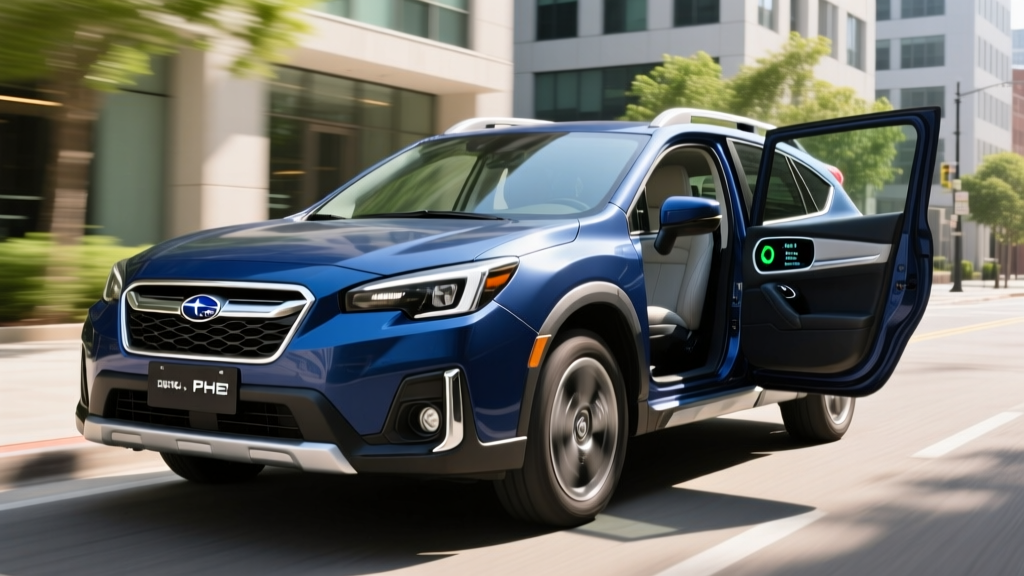
The Subaru Crosstrek has long been the go-to compact crossover for outdoor-minded buyers who need standard all-wheel drive without the bulk of a larger SUV. For 2026, the Subaru Crosstrek PHEV (badged as the Crosstrek Hybrid in some markets) returns with a plug-in hybrid powertrain that promises short electric-only commutes, all-wheel-drive capability, and the fuel-sipping efficiency of a conventional hybrid once the battery is depleted. But with a modest electric range and a price premium over the gas model, is the Crosstrek PHEV the right electrified choice — or should you look at a full EV or conventional hybrid instead?
This guide breaks down everything you need to know: real-world MPG versus EPA estimates, the plug-in hybrid system's capabilities, battery longevity and warranty, federal tax credit eligibility under current IRS §30D rules, and who this vehicle is actually built for.
What Is the Subaru Crosstrek PHEV and How Does It Work?
The Crosstrek PHEV pairs a 2.0-liter flat-four (Boxer) engine with two electric motor-generators and an 8.8 kWh lithium-ion battery pack. This is Subaru's adaptation of Toyota's proven plug-in hybrid architecture — the same system found in the Toyota Prius Prime and RAV4 Prime, tuned for Subaru's symmetrical all-wheel-drive layout.
HEV vs PHEV: What's the Difference?
Conventional Hybrid (HEV): Uses a small battery (typically 1–2 kWh) recharged by regenerative braking and the engine. You never plug it in. The electric motor assists the engine but cannot drive the car on electricity alone for meaningful distances. Think Toyota Corolla Hybrid.
Plug-In Hybrid (PHEV): Carries a larger battery (8–20+ kWh) that you plug in to recharge. It can drive on electricity alone for a limited range (typically 15–45 miles). Once depleted, it operates as a conventional hybrid. The Crosstrek PHEV falls in this category.
Full EV (BEV): No gas engine at all. Runs entirely on a large battery (60–100+ kWh). Requires regular charging. Examples: Hyundai Ioniq 5, Tesla Model Y.
The Crosstrek PHEV's system sends power to all four wheels through Subaru's symmetrical AWD system, with the rear wheels driven by a dedicated electric motor — no mechanical driveshaft connecting front and rear. This gives it genuine traction capability in snow and on dirt roads, a key differentiator from front-wheel-drive PHEV competitors.
Fuel Economy and Electric-Only Range
Here's what the EPA says about the 2026 Subaru Crosstrek Hybrid's efficiency:
| Metric | Value |
|---|---|
| Combined MPGe (electric + gas) | 90 MPGe |
| Combined MPG (gas-only, after battery depleted) | 35 MPG |
| City MPG (gas-only) | 35 MPG |
| Highway MPG (gas-only) | 34 MPG |
| Electric-only range | 17 miles |
| Total combined range (EV + gas) | ~480 miles |
| Fuel tank capacity | 13.2 gallons |
Source: fueleconomy.gov
Real-World MPG vs EPA Estimates
In mixed driving testing, the Crosstrek PHEV tends to meet or slightly exceed its EPA city rating when the battery is depleted, thanks to generous regenerative braking in stop-and-go traffic. Highway driving at 75+ mph will drop gas-only economy to roughly 30–32 MPG. In cold weather (below 30°F), expect the electric-only range to shrink from 17 miles to roughly 12–14 miles as cabin heating draws from the battery and battery chemistry becomes less efficient.
Owners with short commutes (under 15 miles round-trip) who charge nightly may use almost zero gasoline for daily driving — but the 17-mile electric range is on the low end for 2026 PHEVs. The Toyota RAV4 Prime offers 42 miles electric-only for comparison.
Powertrain, Battery, and Charging Specs
| Specification | Value |
|---|---|
| Combined system horsepower | 148 hp |
| Gas engine | 2.0L Boxer-4, 152 hp |
| Front electric motor | 80 kW (107 hp) |
| Rear electric motor (AWD) | 30 kW (40 hp) |
| Battery capacity | 8.8 kWh (lithium-ion) |
| Level 1 charging (120V) | ~5 hours (full) |
| Level 2 charging (240V) | ~2 hours (full) |
| DC fast charging | Not available |
| Charge port | J1772 (Level 2) |
| Drivetrain | Symmetrical AWD |
| 0–60 mph | ~7.5 seconds |
A critical detail: the Crosstrek PHEV does not support DC fast charging. This is typical for PHEVs with smaller batteries — the 8.8 kWh pack is designed to recharge overnight on a standard household outlet or a Level 2 home charger. If you were hoping to top up at a highway DC fast charger in 20 minutes, this isn't the vehicle for that. For most PHEV owners, plugging in at home or work on Level 2 is the intended workflow.
The Level 2 charge time of approximately two hours means you could realistically recharge during a workday or while running errands if your destination has Level 2 infrastructure. On a standard 120V household outlet (Level 1), a full charge takes about five hours — still feasible for overnight charging.
Battery Warranty, Longevity, and Replacement Cost
Subaru Hybrid Battery Warranty
Hybrid battery warranty: 8 years / 100,000 miles (whichever comes first)
Capacity threshold: Subaru covers the hybrid battery if it drops below 70% of original capacity within the warranty period.
Powertrain warranty: 5 years / 60,000 miles
Bumper-to-bumper: 3 years / 36,000 miles
Subaru's hybrid battery warranty matches the industry standard for PHEV and HEV battery coverage. The lithium-ion pack in the Crosstrek PHEV benefits from conservative state-of-charge management — Subaru buffers the top and bottom of the battery's range to reduce degradation stress. In practice, Toyota-derived hybrid batteries (which this system shares architecture with) have demonstrated exceptional longevity, with many exceeding 150,000 miles with minimal capacity loss.
If the battery does need replacement out of warranty, expect a cost between $3,500 and $6,000 including labor, based on current dealer pricing for Subaru/Toyota hybrid battery assemblies. This is significantly less than full EV battery replacements, which can exceed $15,000. Third-party hybrid battery refurbishment services are also emerging, which can reduce replacement costs to $2,000–$3,500.
Pricing and Federal Tax Credit Eligibility
The 2026 Subaru Crosstrek Hybrid starts at approximately $36,995 MSRP (including destination), representing a premium of roughly $7,000–$9,000 over the equivalent gas-only Crosstrek Limited trim. Here's how pricing breaks down:
| Trim | MSRP |
|---|---|
| Crosstrek Hybrid (sole PHEV trim) | ~$36,995 |
| Gas Crosstrek Limited (comparison) | ~$29,495 |
| PHEV premium | ~$7,500 |
Does the Crosstrek PHEV Qualify for a Federal Tax Credit?
Under current IRS §30D rules, PHEVs can qualify for the federal clean vehicle credit — but eligibility depends on several factors that change frequently:
- MSRP cap: SUVs must be under $80,000 (Crosstrek PHEV qualifies)
- Buyer income cap: $150,000 single / $300,000 married filing jointly (modified AGI)
- Battery sourcing: Critical minerals and battery components must meet phased-in domestic sourcing requirements that tighten annually through 2030
- Assembly: Vehicle must undergo final assembly in North America
The Crosstrek PHEV is assembled in Gunma, Japan — which under current §30D rules makes it ineligible for the federal purchase tax credit, as final assembly must occur in North America. However, some states offer separate incentives for PHEV purchases regardless of assembly location. Check your state's energy office or IRS §30D guidance for current rules. Always consult a tax professional before making purchase decisions based on credit eligibility.
Real-World Ownership: Who Is the Crosstrek PHEV For?
The Crosstrek PHEV occupies a specific niche. Here's a decision framework to determine if it fits your life:
Choose the Crosstrek PHEV if:
- Your daily commute is under 20 miles round-trip and you can charge at home
- You need standard AWD for snow, dirt roads, or mountain driving
- You want to reduce gas consumption without committing to a full EV
- You take regular road trips where charging infrastructure is sparse
- You value Subaru's safety reputation and EyeSight driver-assistance suite
Choose a full EV instead if:
- You have home charging and rarely drive more than 250 miles in a day
- You want zero gasoline use and lower per-mile "fuel" costs
- You want access to HOV lane stickers (varies by state) and full federal credits
- You want more cargo space (the PHEV battery reduces rear cargo slightly)
Choose the gas Crosstrek if:
- You can't charge at home or at work
- The $7,500 PHEV premium doesn't pencil out within your ownership timeline
- You drive mostly highway miles where the PHEV advantage is smallest
Crosstrek PHEV vs Competitors
| Vehicle | EV Range | Gas MPG | AWD | Base MSRP |
|---|---|---|---|---|
| Subaru Crosstrek Hybrid | 17 mi | 35 MPG | Standard | ~$36,995 |
| Toyota RAV4 Prime | 42 mi | 38 MPG | Standard | ~$44,500 |
| Ford Escape PHEV | 37 mi | 40 MPG | No (FWD) | ~$39,500 |
| Mitsubishi Outlander PHEV | 38 mi | 26 MPG | Standard | ~$41,000 |
| Hyundai Tucson PHEV | 33 mi | 35 MPG | Standard | ~$39,500 |
The Crosstrek PHEV's 17-mile electric range is the shortest in this segment. Competitors like the RAV4 Prime and Tucson PHEV offer roughly double or more. However, the Crosstrek is the lightest and most compact option, and its lower starting price (compared to the RAV4 Prime) makes the PHEV premium more digestible. If your commute is genuinely under 15 miles and you prioritize a smaller footprint with genuine off-road capability, the shorter electric range may be an acceptable trade-off.
Pros and Cons
Pros
- Standard symmetrical AWD — genuine snow and light off-road capability
- 35 MPG combined gas-only is excellent for an AWD crossover
- Can charge on a standard 120V outlet in ~5 hours
- Proven Toyota-derived hybrid system with strong reliability history
- EyeSight safety suite standard (adaptive cruise, lane-keeping, pre-collision)
- Compact size easy to park; 8.7 inches ground clearance
Cons
- Only 17 miles electric-only — shortest in the PHEV segment
- No DC fast charging capability
- ~$7,500 premium over gas model; long payback period at current gas prices
- Assembled in Japan — ineligible for federal §30D tax credit
- Battery pack reduces cargo volume vs gas Crosstrek
- 148 hp combined feels modest for highway merging when battery is depleted
Frequently Asked Questions
How many MPG does the Subaru Crosstrek PHEV get?
The EPA rates the Crosstrek PHEV at 35 MPG combined (35 city / 34 highway) once the battery is depleted. With a full charge and a short commute, your effective fuel usage could be near zero. In real-world driving, expect 30–32 MPG on sustained highway trips and 35–38 MPG in city driving where regenerative braking recaptures more energy.
How far can the Crosstrek PHEV go on electric only?
The EPA-rated electric-only range is 17 miles. In real-world conditions — especially in cold weather, at highway speeds, or with climate control running — expect 12–15 miles. This covers very short commutes but falls well short of PHEV competitors offering 33–42 miles.
Is the Subaru Crosstrek PHEV reliable?
Subaru's hybrid system is derived from Toyota's extensively proven architecture, which has demonstrated strong long-term reliability across millions of vehicles. The hybrid battery carries an 8-year/100,000-mile warranty. Out-of-warranty replacement costs are estimated at $3,500–$6,000. Subaru's overall brand reliability is solid, though some past model years of the gas Crosstrek have had minor infotainment and head-gasket concerns on older engines — the hybrid's 2.0L FB20 engine has not shown these issues.
Does the Crosstrek PHEV qualify for any tax credit?
Under current IRS §30D rules, the Crosstrek PHEV does not qualify for the federal clean vehicle tax credit because final assembly takes place in Japan, not North America. Some states offer their own PHEV incentives regardless of assembly location — check your state's energy office. Rules change frequently; verify eligibility at irs.gov before purchasing.
Do I need to plug in the Crosstrek PHEV?
You don't have to — the car operates as a conventional 35-MPG hybrid even if you never plug it in. But to benefit from the electric-only range and the 90 MPGe combined rating, you should plug in regularly. Without plugging in, you're paying a $7,500 premium for a slightly heavier conventional hybrid.
Hybrid vs PHEV vs EV — which fits me?
Hybrid (HEV): Best if you can't charge at home and want better MPG with zero behavior change. PHEV: Best if you can charge at home, have a short commute, but also need long-range road-trip capability without charging stops. Full EV: Best if you have reliable home charging, drive under 250 miles daily, and want the lowest per-mile fuel cost and zero tailpipe emissions. The Crosstrek PHEV specifically suits AWD-needing buyers with short, chargeable commutes who aren't ready to commit to a full EV.
How much does it cost to charge the Crosstrek PHEV at home?
Charging the 8.8 kWh battery from empty to full uses about 9–10 kWh from the wall (accounting for charging losses). At the US average electricity rate of ~$0.16/kWh, a full charge costs roughly $1.45–$1.60 — enough for 17 miles of electric driving, or about $0.09 per mile. Compare that to gasoline at $3.50/gallon and 35 MPG, which is $0.10 per mile on gas. The electric savings are modest at this scale, which is why high electricity rates can erase the PHEV cost advantage.
Final Assessment
The 2026 Subaru Crosstrek PHEV serves a narrow but real audience: AWD-dependent drivers with short, chargeable commutes who aren't ready for a full EV. Its 35 MPG gas-only efficiency is genuinely excellent for an all-wheel-drive crossover, and the Toyota-derived hybrid hardware inspires confidence for long-term ownership. However, the 17-mile electric range is the shortest among PHEV competitors, the $7,500 premium over the gas model requires years of fuel savings to recoup, and the Japan assembly disqualifies it from the federal tax credit.
If your priority is maximizing electric-only driving, the Toyota RAV4 Prime (42 miles EV, if you can find one) or the Hyundai Tucson PHEV (33 miles) are stronger choices. If you simply want an efficient AWD crossover and can't charge at home, the conventional gas Crosstrek or a Crosstrek Hybrid (non-plug-in HEV, if available in your market) may make more financial sense. The Crosstrek PHEV works best when your life matches its specific strengths: plug in nightly, drive less than 15 miles daily, need AWD, and take occasional road trips where EV charging is impractical.