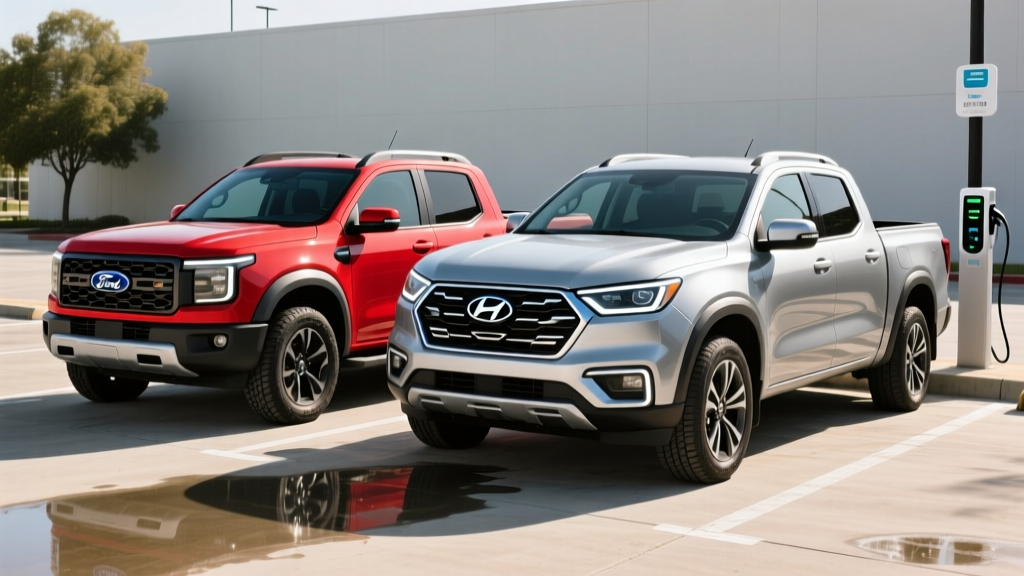
If you want a pickup that sips fuel without the range anxiety of a full EV or the premium price of a full-size hybrid, compact trucks are where the value lives. The search for the cheapest hybrid truck in 2026 narrows quickly to two contenders: the Ford Maverick Hybrid and the Hyundai Santa Cruz. Both start under $30,000, both deliver over 35 MPG combined, and neither requires a plug.
But "cheapest" doesn't mean identical. Their powertrains, bed designs, and real-world efficiency diverge in ways that matter once you leave the dealership. Here's a data-driven breakdown to help you pick the right one — or decide whether a plug-in hybrid or full EV truck makes more sense for your situation.
HEV vs PHEV: What Kind of Hybrid Truck Are You Buying?
Before comparing specs, it's worth clarifying what "hybrid truck" actually means in 2026, because the terminology trips up a lot of shoppers.
Conventional Hybrid (HEV)
- No plug required. The battery recharges through regenerative braking and the gasoline engine.
- Small battery (typically 1–2 kWh) — assists the engine during acceleration and enables low-speed electric-only driving for short distances.
- Primary benefit: significantly better MPG than a gas-only equivalent, especially in city driving.
- Examples: Ford Maverick Hybrid, Hyundai Santa Cruz (gas-only; no hybrid variant currently offered — see note below).
Plug-In Hybrid (PHEV)
- Requires plugging in to access the full electric-only range (typically 20–40 miles).
- Larger battery (10–20 kWh) that can be charged via Level 1 (120V), Level 2 (240V), or in some models, DC fast charging.
- Primary benefit: daily commutes on electricity alone, with a gas engine for longer trips.
- Current truck availability: No compact PHEV truck is on sale in the U.S. as of 2026. The Jeep Gladiator 4xe has been announced but not yet released.
Key takeaway for this comparison: When buyers search for the cheapest hybrid truck, they're almost always looking for a conventional HEV — a truck that gets great MPG without needing a charger. That's exactly what the Maverick Hybrid delivers. The Santa Cruz, while a strong competitor in the compact truck segment, does not currently offer a hybrid powertrain, which makes this a less direct rivalry than it might appear.
Ford Maverick Hybrid: Specs, MPG, and Pricing
The Maverick Hybrid remains the most affordable hybrid pickup you can buy new in the United States. Here are the 2026 model-year figures:
| Specification | 2026 Ford Maverick Hybrid |
|---|---|
| Powertrain | 2.5L Atkinson-cycle I4 + electric motor |
| Combined Horsepower | 191 hp |
| Drivetrain | FWD standard (AWD available) |
| EPA MPG (City / Hwy / Combined) | 42 / 33 / 38 (FWD) |
| EPA MPG (AWD) | 38 / 31 / 34 |
| Battery | ~1.1 kWh lithium-ion (self-charging, no plug) |
| Bed Length | 4.5 ft (54.4 cu ft volume) |
| Max Towing | 2,000 lbs (4,000 lbs with tow package, gas only) |
| 0–60 mph | ~8.5 seconds (FWD hybrid) |
| Starting MSRP | ~$27,995 (XL trim, including destination) |
| Hybrid Battery Warranty | 8 years / 100,000 miles |
Source: fueleconomy.gov and Ford Motor Company.
Real-World MPG: What to Actually Expect
The EPA's 42 city / 33 highway split is a hallmark of hybrid efficiency — the electric motor does the heavy lifting at low speeds, where gas engines are least efficient. In practice, many Maverick Hybrid owners report matching or exceeding the 42 city MPG in stop-and-go commuting, especially in mild weather. Highway fuel economy tends to settle around 30–33 MPG at 70–75 mph, consistent with the EPA estimate. In cold weather (below 30°F), expect a 5–10% drop across the board as the engine runs more frequently to provide cabin heat and maintain battery temperature.
| Driving Scenario | Expected MPG (FWD Hybrid) |
|---|---|
| City / stop-and-go | 38–44 MPG |
| Highway (65–70 mph) | 31–34 MPG |
| Highway (75+ mph) | 28–31 MPG |
| Cold weather combined | 32–36 MPG |
| Towing (hybrid, light loads) | 18–22 MPG |
Hyundai Santa Cruz: The Gas-Only Alternative
The Hyundai Santa Cruz competes directly with the Maverick on price and size, but it does not offer a hybrid variant as of the 2026 model year. Its standard and turbocharged 2.5L four-cylinder engines deliver respectable but noticeably lower fuel economy:
| Specification | 2026 Hyundai Santa Cruz (2.5L NA) | 2026 Santa Cruz Turbo |
|---|---|---|
| Horsepower | 191 hp | 281 hp |
| EPA MPG (City / Hwy / Combined) | 22 / 26 / 23 | 19 / 27 / 22 |
| Starting MSRP | ~$28,250 | ~$32,000 (SEL Premium) |
| Bed Length | 4.3 ft (with under-bed storage) | 4.3 ft |
| Max Towing | 3,500 lbs (turbo AWD) | 5,000 lbs (turbo AWD) |
The Santa Cruz's advantage lies in its available turbocharged engine, AWD standard on turbo trims, and a clever lockable under-bed storage compartment. But if fuel economy is your priority, the Maverick Hybrid's 38 MPG combined versus the Santa Cruz's 22–23 MPG combined is not close. Over 15,000 miles per year at $3.40/gallon, that's roughly $1,100–$1,300 in annual fuel savings with the Maverick Hybrid.
Hybrid Truck MPG Table: Side-by-Side
| Truck | City MPG | Highway MPG | Combined MPG | Est. Annual Fuel Cost* |
|---|---|---|---|---|
| Ford Maverick Hybrid (FWD) | 42 | 33 | 38 | ~$1,340 |
| Ford Maverick Hybrid (AWD) | 38 | 31 | 34 | ~$1,500 |
| Ford Maverick Gas (2.0L EcoBoost AWD) | 22 | 29 | 25 | ~$2,040 |
| Hyundai Santa Cruz (2.5L NA) | 22 | 26 | 23 | ~$2,220 |
| Hyundai Santa Cruz Turbo (AWD) | 19 | 27 | 22 | ~$2,320 |
*Based on 15,000 miles/year at $3.40/gallon regular unleaded. Source: fueleconomy.gov.
Does the Cheapest Hybrid Truck Qualify for a Tax Credit?
This is where buyer expectations often collide with tax code reality. Under IRS §30D rules for new clean vehicles, the federal tax credit of up to $7,500 applies to plug-in electric vehicles (BEVs) and plug-in hybrids (PHEVs) that meet battery sourcing, critical minerals, MSRP cap, and buyer income requirements.
The Ford Maverick Hybrid is a conventional HEV — it does not plug in and does not qualify for the §30D federal tax credit. No conventional hybrid truck currently qualifies. If a PHEV truck becomes available (such as a future Maverick PHEV or Gladiator 4xe), it would need to meet all of the following to be eligible:
- MSRP at or below $80,000 for trucks
- Buyer AGI at or below $150,000 (single) / $300,000 (joint)
- Battery components manufactured or assembled in North America (phased thresholds)
- Critical minerals sourced from the U.S. or FTA partners
Some states offer their own hybrid or efficiency rebates — check your state energy office or AFDC state incentive database for current programs. But at the federal level, the Maverick Hybrid's value proposition is straightforward: a low purchase price and dramatically lower fuel costs, no credit paperwork required.
Battery Reliability and Replacement Cost
Hybrid battery anxiety is one of the most common questions from first-time hybrid buyers. Here's what the data shows:
Ford covers the Maverick Hybrid's battery pack for 8 years or 100,000 miles (10 years / 150,000 miles in California Air Resources Board states). The hybrid battery is approximately 1.1 kWh — far smaller than a BEV or PHEV pack — and it operates within a narrow state-of-charge window managed by the vehicle's thermal and powertrain systems. This shallow cycling significantly extends cell life.
Based on historical data from Toyota and Ford hybrid platforms (the Escape Hybrid has been on the road since 2005), hybrid battery packs routinely last 150,000–200,000+ miles before significant degradation. If replacement is needed out of warranty, a Maverick Hybrid battery pack is estimated at $2,500–$4,000 including labor — a fraction of the $10,000–$20,000 cost of a full EV battery replacement. The smaller the pack, the less expensive the failure.
Bottom line: Hybrid battery replacement is rare, inexpensive relative to BEV packs, and covered for the vast majority of ownership. This is not a cost that should deter a purchase.
Pros and Cons: Maverick Hybrid at a Glance
Pros
- Best-in-class city MPG (42 EPA) among all pickups
- Starting MSRP under $28,000 — cheapest hybrid truck available
- No plug required; refuel at any gas station
- Strong reliability history from Ford's hybrid powertrain lineage
- Compact size makes it easy to park and maneuver in urban settings
- Available AWD (with modest MPG penalty)
Cons
- Bed is only 4.5 feet — limiting for longer cargo
- Hybrid towing limited to 2,000 lbs (4,000 lbs on gas-only models)
- AWD hybrid drops to 34 MPG combined
- No off-road-oriented hybrid trim (FX4 is gas-only)
- High demand means dealer markups are still common in some markets
- 191 hp is adequate but not quick — ~8.5 sec 0–60
Hybrid vs PHEV vs Full EV Truck: Which Fits You?
Not every truck buyer should buy a hybrid. Here's a practical decision framework:
Choose the Maverick Hybrid if: You want the lowest fuel cost without changing your refueling habits. You commute in city or suburban traffic where hybrid efficiency shines. You don't have access to home charging. You want a truck under $30,000 and don't need heavy towing.
Choose a PHEV truck (when available) if: You have home Level 2 charging and a short daily commute (under 30 miles). You want to drive on electricity most days but need gas flexibility for weekend hauling or road trips. You're willing to pay a premium for the larger battery and plug-in capability.
Choose a full EV truck (Ford F-150 Lightning, Rivian R1T, Chevrolet Silverado EV) if: You have reliable home charging, your daily driving is within the truck's range, you want zero tailpipe emissions, and your budget accommodates a $50,000–$80,000+ purchase (before incentives). EV trucks offer massive torque, a frunk, and V2L/V2H capability that hybrids can't match — but at a significantly higher entry price.
Choose a gas-only truck if: You tow heavy loads regularly, you drive mostly highway miles (where the hybrid advantage shrinks), or you need a full-size bed and 10,000+ lb towing capacity that no compact or midsize hybrid currently offers.
Frequently Asked Questions
How many MPG does the cheapest hybrid truck get?
The 2026 Ford Maverick Hybrid (FWD) is EPA-rated at 42 city / 33 highway / 38 combined. The AWD version drops to 38 / 31 / 34. Real-world results typically match or exceed the city figure in stop-and-go driving and track close to EPA on the highway.
Is there a plug-in hybrid truck I can buy?
Not as of early 2026. The Jeep Gladiator 4xe has been announced but is not yet on sale. No compact PHEV truck exists in the U.S. market currently. All available hybrid trucks are conventional HEVs that don't require plugging in.
Does the Ford Maverick Hybrid qualify for a federal tax credit?
No. The §30D federal clean vehicle credit applies only to plug-in vehicles (BEVs and PHEVs). Conventional hybrids like the Maverick Hybrid are not eligible. Some state or local incentives may apply — check the AFDC database for your area.
Is the Maverick Hybrid reliable? What does battery replacement cost?
Ford's hybrid system has a strong track record dating back to the 2005 Escape Hybrid. The hybrid battery is warrantied for 8 years / 100,000 miles (10 / 150,000 in CARB states), and real-world data shows these packs commonly last 150,000–200,000+ miles. Out-of-warranty replacement is estimated at $2,500–$4,000 — modest compared to full EV battery costs.
Can I tow with the Maverick Hybrid?
Yes, but with limits. The hybrid is rated for 2,000 lbs of towing. If you need 4,000 lbs, you'll need the gas-only 2.0L EcoBoost with the 4K Tow Package. For anything beyond that, you're looking at midsize or full-size trucks.
Is the Hyundai Santa Cruz available as a hybrid?
No. The 2026 Santa Cruz is offered only with gasoline engines (2.5L naturally aspirated or 2.5L turbo). Hyundai has not announced a hybrid variant. If hybrid fuel economy is your priority, the Maverick Hybrid is the clear choice in this segment.
The cheapest hybrid truck in 2026 isn't a complicated decision — it's the Ford Maverick Hybrid. At under $28,000 to start and 38 MPG combined, it delivers fuel savings that no other new pickup can match, without requiring a charger, a tax-credit application, or a change in how you refuel. If you need more bed, more tow capacity, or more power, you'll pay for it in either fuel economy or purchase price. For the urban and suburban truck buyer who wants utility without the thirst, the Maverick Hybrid is still the one to beat.