Quick Verdict: The Mazda CX-70 PHEV in a Nutshell
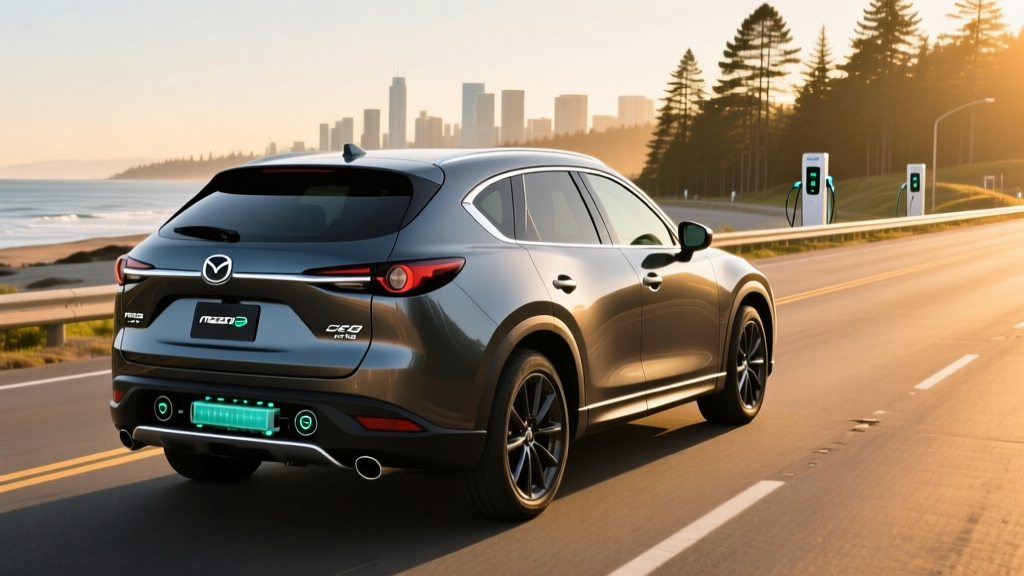
The 2026 Mazda CX-70 PHEV occupies a specific niche: a premium two-row midsize crossover that lets you commute on electricity most weekdays while keeping a turbocharged inline-six for road trips. It is not a conventional hybrid — Mazda offers no standard HEV variant of the CX-70 in the U.S. market. The sole electrified powertrain is the plug-in hybrid (PHEV), pairing a 2.5-liter four-cylinder with a 17.8 kWh battery pack for an EPA-rated 26 miles of electric-only driving.
For buyers cross-shopping the Toyota Highlander Hybrid, Hyundai Santa Fe PHEV, or Jeep Grand Cherokee 4xe, the CX-70 PHEV leans harder into driving dynamics and interior material quality, while conceding some practicality (two rows vs. three) and electric range (26 mi trails some rivals). If your daily commute falls under 25 miles round-trip and you have access to a Level 2 home charger, the CX-70 PHEV can operate as a de facto EV on weekdays and a 400+ mile cruiser on weekends.
HEV vs. PHEV: What the CX-70 Actually Is
Conventional Hybrid (HEV): A small battery (typically 1–2 kWh) recharges through regenerative braking and the engine. You never plug it in. MPG improves across the board, especially in city driving. Example: Toyota RAV4 Hybrid.
Plug-In Hybrid (PHEV): A larger battery (here, 17.8 kWh) can be charged from a wall outlet or charger, enabling 20–40+ miles of electric-only driving before the gas engine engages. Once the battery depletes, it operates like a conventional hybrid. Example: Mazda CX-70 PHEV.
The Mazda CX-70 is sold exclusively as a PHEV in its electrified form. There is no HEV (self-charging hybrid) CX-70 available in the United States for the 2026 model year. Mazda also offers a mild-hybrid inline-six (the CX-70 I-6 Turbo), but that system provides minimal electric assist and cannot drive on electricity alone — it is not a hybrid in the traditional fuel-economy sense.
Fuel Economy and Electric Range: The Numbers
| Metric | EPA Rating | Real-World Expectation |
|---|---|---|
| Electric-only range | 26 miles | 22–24 mi (highway/cold weather); up to 28 mi (city, mild temps) |
| MPGe (electric + gas) | 56 MPGe | Varies with charging frequency |
| Combined MPG (gas-only, battery depleted) | 25 MPG | 23–27 MPG depending on driving mix |
| City MPG (gas-only) | 24 MPG | 22–26 MPG |
| Highway MPG (gas-only) | 27 MPG | 25–29 MPG at 70 mph |
| Total combined range | ~430 miles | ~390–450 mi depending on conditions |
Source: EPA Fuel Economy Guide.
The 26-mile electric range is enough to cover the average American's one-way commute (approximately 16 miles, per Census Bureau data), meaning many owners will burn little to no gasoline on weekdays if they charge nightly. However, 26 miles trails rivals like the Hyundai Santa Fe PHEV (31 mi) and Toyota RAV4 Prime (42 mi). If your commute exceeds 30 miles round-trip, the engine will engage before you reach home, and your effective fuel savings narrow.
In real-world driving, PHEVs reward city-heavy routes: regenerative braking recaptures energy in stop-and-go traffic, and electric-only mode is most efficient at lower speeds. Highway driving at 75+ mph depletes the battery faster and yields lower gas-only MPG due to the CX-70's 4,600-pound curb weight and the inline-four operating outside its optimal efficiency band.
Powertrain, Battery, and Charging Specs
| Specification | Detail |
|---|---|
| Engine | 2.5L inline-4, naturally aspirated (189 HP, 189 lb-ft) |
| Electric motor | 173 HP, 202 lb-ft (integrated into transmission) |
| Combined output | 327 HP, 344 lb-ft torque |
| Transmission | 8-speed automatic (no CVT) |
| Drivetrain | All-wheel drive (standard) |
| Battery capacity | 17.8 kWh (lithium-ion) |
| Usable battery capacity | ~14.2 kWh (estimated, accounting for buffer) |
| AC charging (Level 2) | ~6.6 kW; 0–100% in ~2.5 hours |
| Level 1 (120V outlet) | ~1.2 kW; 0–100% in ~12 hours |
| DC fast charging | Not supported |
| 0–60 mph | ~6.3 seconds (estimated) |
| Towing capacity | 3,500 lbs |
The CX-70 PHEV does not support DC fast charging — a notable limitation for road-trippers hoping to top up at highway charging stations. You are limited to Level 1 (standard 120V outlet) or Level 2 (240V, like a home wallbox or public AC charger). At 6.6 kW on Level 2, a full charge takes roughly 2.5 hours, which is manageable overnight at home or during a workday at an office charger. On a standard 120V household outlet, expect about 12 hours for a full charge — plan accordingly.
The 327 combined horsepower makes the CX-70 PHEV the most powerful variant in the CX-70 lineup. The electric motor's instant torque fills in the low-end gap inherent to the naturally aspirated 2.5L engine, delivering confident highway merging and passing. Mazda's decision to use a conventional 8-speed automatic rather than a CVT contributes to a more natural, engaging driving feel — a brand hallmark.
Pricing, Trims, and Tax Credit Eligibility
| Trim | 2026 MSRP (est.) | After Potential Federal Credit |
|---|---|---|
| PHEV Preferred | $55,825 | As low as ~$48,325* |
| PHEV Premium | $59,225 | As low as ~$51,725* |
| PHEV Premium Plus | $62,475 | As low as ~$54,975* |
*Federal §30D credit eligibility depends on battery sourcing, buyer income, and MSRP caps. See details below.
Federal §30D Plug-In Hybrid Tax Credit — Key Requirements (2026):
- Credit amount: Up to $7,500, split into $3,750 for battery components (must be manufactured in North America) and $3,750 for critical minerals (must be sourced from the U.S. or FTA partners).
- MSRP cap: SUVs/vans must be under $80,000. The CX-70 PHEV qualifies — all trims fall well below this threshold.
- Buyer income cap: Modified AGI must not exceed $150,000 (single), $225,000 (head of household), or $300,000 (joint filers).
- Point-of-sale transfer: You can transfer the credit to the dealer at purchase, reducing your out-of-pocket cost immediately — rather than waiting for a tax refund.
- Battery sourcing: The CX-70 PHEV's battery component and critical-mineral sourcing determines how much of the $7,500 you actually receive. Check the latest fueleconomy.gov listing for the current credit amount assigned to this specific model.
Consult a tax professional or reference IRS.gov §30D guidance for your personal eligibility.
Real-World Ownership: MPG, Charging Habits, and Costs
PHEV fuel economy is uniquely dependent on owner behavior. If you charge nightly and drive under 26 miles daily, your gas consumption approaches zero on weekdays. Owners who rarely plug in will see closer to the 25 MPG combined gas-only figure — which is respectable for a 4,600-lb AWD SUV, but not dramatically better than the mild-hybrid CX-70 I-6 Turbo (24 MPG combined).
Cost-to-charge math: At the U.S. average electricity rate of ~$0.17/kWh, fully recharging the CX-70 PHEV's ~14.2 kWh usable battery costs approximately $2.41. That buys you roughly 24 real-world electric miles — equivalent to about $0.10 per mile. Compare that to gasoline at $3.40/gallon and 25 MPG: $0.136 per mile. The per-mile savings on electricity are modest (~26%), but compound over thousands of commute miles annually.
Home charging setup: Most PHEV owners install a 240V Level 2 outlet or wallbox in their garage. A basic 32-amp Level 2 charger costs $300–$600 for the equipment, plus $500–$2,000 for electrician installation (depending on panel capacity and run length). The CX-70 PHEV's 6.6 kW onboard charger means you don't need a high-amperage (48-amp or 80-amp) unit — a standard 32-amp circuit delivers the maximum charge rate.
Battery Warranty, Reliability, and Replacement Cost
Mazda Hybrid Battery Warranty: 8 years / 100,000 miles (whichever comes first), covering defects and capacity loss below a specified threshold (typically 60–70% of original capacity, per Mazda's hybrid warranty documentation).
Powertrain Warranty: 5 years / 60,000 miles.
Limited Vehicle Warranty: 3 years / 36,000 miles.
PHEV battery packs are engineered for longevity. The 17.8 kWh pack in the CX-70 is relatively small compared to a full EV's 75–100 kWh battery, and Mazda's thermal management system keeps cell temperatures within safe operating ranges. Based on industry data from similar PHEV platforms (Toyota, Hyundai, BMW), hybrid battery degradation typically averages 1–2% per year under normal use, meaning you can expect roughly 85–90% capacity retention at the 8-year mark.
Battery replacement cost: If the pack does need replacement outside warranty, expect $6,000–$10,000 for the battery module assembly, plus $1,000–$2,000 in labor. This is significantly less than full EV battery replacements ($12,000–$22,000) because the PHEV pack is smaller. However, out-of-warranty PHEV battery failure remains uncommon within the first 10–12 years based on historical data from earlier-generation PHEVs.
Mazda's overall reliability ratings have been strong in recent model years. The CX-70's powertrain is shared with the CX-90 PHEV (introduced for 2024), which has accumulated real-world fleet data without widespread battery or motor issues. The naturally aspirated 2.5L engine is a proven, simple design with fewer failure points than turbocharged alternatives.
Who Should Buy the CX-70 PHEV — And Who Shouldn't
Pros
- Premium interior materials rivaling BMW X5 and Genesis GV70 at a lower price point
- 327 HP with smooth electric torque delivery — genuinely quick for a family SUV
- 26-mile EV range covers most daily commutes without burning gas
- Conventional 8-speed automatic (no CVT drone) and rear-biased AWD for engaging handling
- 3,500-lb towing capacity (best in PHEV crossover class)
- Qualifies for partial or full $7,500 federal tax credit (verify current sourcing status)
Cons
- 26-mile EV range trails RAV4 Prime (42 mi), Tucson PHEV (33 mi), Santa Fe PHEV (31 mi)
- No DC fast charging — road-trip charging limited to slow Level 2
- Two rows only — no third-row option (CX-90 PHEV adds that seat)
- Gas-only MPG (25 combined) is only marginally better than the non-PHEV mild-hybrid CX-70
- Starting MSRP above $55,000 — premium pricing for a Mazda badge
Choose the Mazda CX-70 PHEV if:
- Your daily round-trip commute is under 26 miles and you can charge at home nightly
- You want a premium-feeling two-row SUV without paying luxury-badge prices
- You take regular road trips and don't want to depend on public DC fast-charging networks
- You value driving dynamics and a conventional automatic over maximum fuel efficiency
Look elsewhere if:
- Your commute exceeds 35 miles — consider the RAV4 Prime (42 mi EV range) or a full EV like the Hyundai Ioniq 5 (310+ mi range)
- You need a third row — the CX-90 PHEV offers the same powertrain with three rows
- Maximum fuel economy is the priority — the Toyota Highlander Hybrid (35 MPG combined, no plug needed) delivers better gas mileage without charging hassle
- You want DC fast charging for road trips — PHEVs generally don't offer this; consider a full BEV
Frequently Asked Questions
How many MPG does the Mazda CX-70 hybrid get?
The 2026 Mazda CX-70 PHEV achieves an EPA-rated 25 MPG combined (24 city / 27 highway) once the battery is depleted and the vehicle operates on gasoline alone. When factoring in electric-only driving, the combined rating is 56 MPGe. Real-world results vary: expect 23–27 MPG gas-only depending on driving style, terrain, and temperature.
How far can the CX-70 PHEV go on electric only?
The EPA rates the CX-70 PHEV at 26 miles of electric-only range. In real-world conditions, expect 22–24 miles on the highway or in cold weather, and up to 28 miles in city driving at moderate temperatures. The 17.8 kWh battery pack provides enough range for most daily commutes when charged nightly.
Hybrid vs. PHEV vs. EV — which fits my lifestyle?
HEV (conventional hybrid): Best if you can't charge at home and want better MPG without changing habits. No plug needed. Example: Toyota Highlander Hybrid (35 MPG).
PHEV (plug-in hybrid): Best if you have home charging, a short commute, and take occasional road trips. You get EV-like daily driving with gas-engine range for long trips. Example: Mazda CX-70 PHEV.
BEV (full electric vehicle): Best if you have reliable home charging, drive under 300 miles daily, and want the lowest per-mile fuel cost and zero tailpipe emissions. Example: Tesla Model Y (320 mi range).
Is the CX-70 PHEV reliable, and what does a battery replacement cost?
Mazda's PHEV powertrain is shared with the CX-90 PHEV and uses a proven naturally aspirated engine with a well-tested hybrid system. The battery is covered by an 8-year/100,000-mile warranty. Out-of-warranty battery replacement is estimated at $7,000–$12,000 (parts and labor), though premature failures are uncommon based on industry PHEV data.
Does the Mazda CX-70 PHEV qualify for a tax credit?
The CX-70 PHEV may qualify for up to $7,500 under the federal §30D Clean Vehicle Credit, depending on current battery-component and critical-mineral sourcing compliance. The vehicle's MSRP is under the $80,000 SUV cap. Buyer income limits apply ($150K single / $300K joint). The credit can be transferred to the dealer at point of sale for an immediate price reduction. Verify the current credit amount on fueleconomy.gov before purchasing, as sourcing requirements tighten annually.
Can the CX-70 PHEV charge at public DC fast chargers?
No. The CX-70 PHEV only supports AC charging — Level 1 (120V, ~1.2 kW) and Level 2 (240V, up to 6.6 kW). It cannot use DC fast chargers (50–350 kW) found at Electrify America, EVgo, or Tesla Supercharger stations. For road trips, the gas engine provides full range without needing to stop and charge.