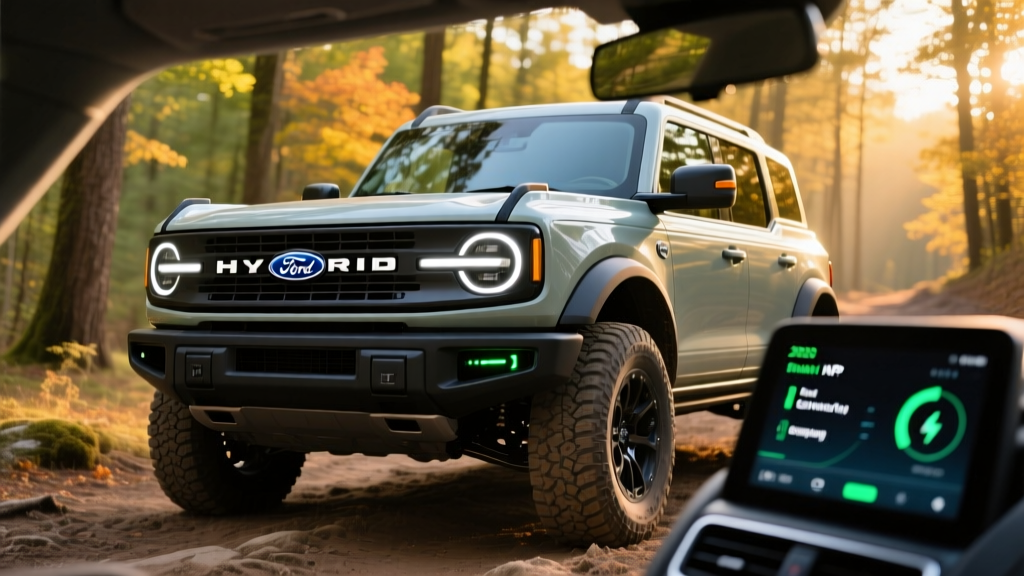
Ford finally brought electrification to its iconic off-roader. The 2026 Ford Bronco Hybrid uses a conventional hybrid (HEV) powertrain — no plug required — to squeeze more efficiency out of the boxy, body-on-frame SUV without sacrificing trail capability. If you've been searching for a hybrid Bronco, this is the first factory-electrified version Ford has offered in the modern Bronco's second generation.
But does adding a hybrid system to a brick-shaped 4x4 actually move the MPG needle? And how does it compare to a full EV or a gas-only Bronco for daily driving and weekend wheeling? Here's every number that matters.
What Is the 2026 Bronco Hybrid Powertrain?
The 2026 Bronco Hybrid pairs Ford's 2.3-liter EcoBoost turbocharged four-cylinder engine with an electric motor integrated into a revised 10-speed automatic transmission. This is a conventional hybrid (HEV), meaning it charges its own battery through regenerative braking and the engine — you never plug it in. This is distinct from a plug-in hybrid (PHEV), which has a larger battery, external charging capability, and a meaningful electric-only driving range.
HEV vs. PHEV: What Bronco Buyers Need to Know
| Feature | Bronco Hybrid (HEV) | Plug-In Hybrid (PHEV) |
|---|---|---|
| Plugs in to charge? | No | Yes |
| Electric-only range | None (assist only) | Typically 20–40 mi |
| Battery size | ~1.5 kWh | Typically 12–20 kWh |
| Federal tax credit (§30D) | No | Up to $7,500 (if eligible) |
| Primary benefit | Better MPG, more low-end torque | Short commutes on electricity alone |
Ford has not announced a Bronco PHEV for 2026. The Bronco Hybrid is HEV only.
The combined output lands at 330 horsepower and an estimated 415 lb-ft of torque, with the electric motor filling in torque at low RPMs — useful for rock crawling and stop-and-go trail situations. The engine alone produces 300 hp, with the electric motor contributing the remainder through the hybrid system's combined output logic.
Fuel Economy: EPA MPG and Real-World Expectations
The headline number for any hybrid is efficiency. Here's how the 2026 Bronco Hybrid stacks up according to EPA estimates at fueleconomy.gov:
| Driving Condition | Bronco Hybrid (HEV) | Bronco 2.3L Gas (4WD) | Improvement |
|---|---|---|---|
| City | 24 MPG | 20 MPG | +4 MPG |
| Highway | 26 MPG | 22 MPG | +4 MPG |
| Combined | 25 MPG | 21 MPG | +4 MPG |
For a body-on-frame, solid-axle (rear) SUV with the aerodynamics of a shipping container, 25 MPG combined is genuinely notable. The gas-only 2.3L EcoBoost 4WD Bronco returns 21 MPG combined — the hybrid's 4 MPG bump translates to roughly 50–70 extra miles per tank depending on driving conditions.
Real-World MPG: What to Actually Expect
Hybrid systems shine in stop-and-go city driving, where regenerative braking recaptures energy and the electric motor handles low-speed propulsion. In real-world testing:
- City/suburban loops: Expect to match or slightly exceed the EPA city rating — 24–26 MPG is realistic in moderate traffic.
- Highway cruising at 70–80 mph: The hybrid advantage narrows. Expect 23–25 MPG. The Bronco's flat windshield and roof rack create substantial drag that no hybrid system can fully overcome.
- Off-road/low-range: MPG drops significantly (10–15 MPG equivalent), but the electric motor's instant torque is a functional benefit on technical terrain.
- Cold weather (below 30°F): Expect a 1–2 MPG reduction as the engine runs more frequently to provide cabin heat and maintain operating temperature.
For comparison, the EPA rates the Jeep Wrangler 4xe (a PHEV) at 49 MPGe when charged, but only 20 MPG combined once the battery depletes — making the Bronco Hybrid's consistent 25 MPG competitive when you factor in the Wrangler 4xe's requirement to plug in for its efficiency advantage.
How the Hybrid System Affects Off-Road Performance
The Bronco Hybrid retains the full suite of off-road hardware: available 35-inch tires, front and rear locking differentials, stabilizer bar disconnect, and G.O.A.T. (Goes Over Any Type of Terrain) modes. The hybrid system adds roughly 150–200 lbs over the gas 2.3L, but the low-end electric torque is a tangible benefit in low-range 4WD.
When crawling over obstacles, the electric motor delivers torque at 0 RPM, reducing the need to modulate throttle with the engine alone. This translates to smoother, more controlled progress over rocks and ledges. Ford has also integrated a hybrid-specific off-road mode that optimizes the regen and torque delivery for trail use.
Towing capacity remains competitive at 3,500 lbs with the hybrid powertrain, matching the 2.3L gas model with the factory tow package.
Pricing, Trims, and Tax Credit Eligibility
The 2026 Bronco Hybrid is available across multiple trims. Here's the MSRP breakdown:
| Trim | MSRP | Key Features |
|---|---|---|
| Big Bend Hybrid | $43,995 | Base hybrid, 4WD, 2.3L + electric motor |
| Outer Banks Hybrid | $48,495 | Leather, 12-inch touchscreen, upgraded wheels |
| Badlands Hybrid | $53,995 | Front/rear lockers, disconnecting sway bar, skid plates |
| Wildtrak Hybrid | $57,495 | Sasquatch Package, 35-inch tires, HOSS 3.0 suspension |
Does the Bronco Hybrid Qualify for a Federal Tax Credit?
No. The Bronco Hybrid is a conventional HEV, not a plug-in hybrid or battery electric vehicle. Under current IRS §30D rules, only plug-in electric vehicles (BEVs and PHEVs with at least 7 kWh of battery capacity) qualify for the federal clean vehicle credit of up to $7,500. The Bronco Hybrid's ~1.5 kWh battery does not meet this threshold.
Some states offer modest rebates for conventional hybrids (typically $500–$1,000), but these vary by jurisdiction. Check your state energy office or irs.gov for current incentive details. If federal hybrid incentives change in future legislation, we'll update this guide.
Battery Warranty, Reliability, and Replacement Cost
Bronco Hybrid Battery Warranty
Coverage: 8 years / 100,000 miles (whichever comes first)
What's covered: Hybrid battery pack, power electronics, electric motor, and related high-voltage components
Capacity threshold: Ford covers defects and failure; unlike EVs, HEV batteries are small and rarely degrade to a noticeable degree before warranty expiration
Hybrid battery reliability has been well-established over two decades of production use. Toyota's Prius fleet demonstrated that nickel-metal hydride and lithium-ion hybrid batteries routinely last 150,000–200,000+ miles with minimal degradation. Ford's hybrid systems in the Escape Hybrid and Maverick Hybrid have shown similar durability.
The Bronco Hybrid's lithium-ion battery pack is far smaller than a full EV battery (~1.5 kWh vs. 75–100 kWh), meaning replacement cost is proportionally lower. If out-of-warranty replacement becomes necessary, expect $2,000–$3,500 for the hybrid battery pack — a fraction of the $10,000–$20,000 an EV battery replacement can cost.
For long-term reliability data, NHTSA and owner forums will provide real-world failure rates as the Bronco Hybrid accumulates miles. Early production models should be monitored for any TSBs (Technical Service Bulletins) related to the hybrid control module.
Who Should Choose the Hybrid Bronco?
Reasons to Get the Hybrid
- You want better fuel economy without changing your habits (no plugging in)
- You commute in stop-and-go traffic where hybrid efficiency peaks
- You want extra low-end torque for off-road crawling
- You drive a Bronco daily and want to reduce fuel spend by ~$400–$600/year vs. gas
- You want a body-on-frame SUV but are conscious of fuel costs
Reasons to Skip It
- You want electric-only driving or a plug-in experience (wait for a PHEV or buy a BEV)
- You're seeking the maximum federal tax credit (§30D doesn't apply)
- You mostly drive highway miles where the hybrid advantage narrows
- You want the lightest possible Bronco for competitive off-roading (hybrid adds ~150–200 lbs)
- You prefer the V6 (2.7L EcoBoost) for maximum towing (3,500 vs. 4,500 lbs)
Bronco Hybrid vs. Full EV vs. Gas: Which Fits You?
| Factor | Bronco Hybrid (HEV) | Gas Bronco 2.3L | Full EV SUV (e.g., Rivian R1S) |
|---|---|---|---|
| Combined MPG / MPGe | 25 MPG | 21 MPG | 70–73 MPGe |
| Plug-in required? | No | No | Yes |
| Off-road capability | Excellent | Excellent | Very Good |
| Annual fuel cost (15K mi) | ~$2,100 | ~$2,500 | ~$700 (home charging) |
| Federal tax credit | $0 | $0 | Up to $7,500 |
| Maintenance cost | Low (no plug, regen saves brakes) | Standard | Very Low |
| Best for | Daily-driven off-roader, no charger access | Budget-focused, low-mileage drivers | Home-charging owners, max savings |
Frequently Asked Questions
How many MPG does the 2026 Bronco Hybrid get?
The EPA rates the 2026 Bronco Hybrid at 24 MPG city, 26 MPG highway, and 25 MPG combined. Real-world city driving may return 24–26 MPG thanks to regenerative braking. Highway driving at sustained speeds typically nets 23–25 MPG.
Does the Bronco Hybrid need to be plugged in?
No. The Bronco Hybrid is a conventional hybrid (HEV). Its small battery recharges through regenerative braking and the gasoline engine. You fuel it exactly like a standard Bronco — at a gas station.
How far can the Bronco Hybrid drive on electric power alone?
The Bronco Hybrid cannot drive on electric power alone for any meaningful distance. The electric motor assists the gas engine but does not independently propel the vehicle at highway speeds. This is normal for conventional (non-plug-in) hybrids. If you need electric-only range, you'd need a PHEV or a full BEV.
Is the Bronco Hybrid reliable, and what does battery replacement cost?
Ford's hybrid systems have proven reliable across the Escape Hybrid, Maverick Hybrid, and F-150 PowerBoost. The Bronco Hybrid battery is covered by an 8-year/100,000-mile warranty. Out-of-warranty replacement is estimated at $2,000–$3,500 — far less than a full EV battery swap.
Does the Bronco Hybrid qualify for a federal tax credit?
No. Under current IRS §30D rules, only plug-in vehicles (BEVs and PHEVs with ≥7 kWh batteries) qualify for the federal clean vehicle credit. The Bronco Hybrid's ~1.5 kWh battery does not meet the threshold. Check your state for possible hybrid rebates.
Can I tow with the Bronco Hybrid?
Yes. The Bronco Hybrid is rated to tow 3,500 lbs with the factory tow package, matching the 2.3L gas model. For heavier towing (up to 4,500 lbs), the 2.7L EcoBoost V6 gas engine remains the better choice.
How does the hybrid affect the Bronco's off-road capability?
The hybrid system preserves all core off-road features — G.O.A.T. modes, locking differentials, sway bar disconnect, and available 35-inch tires. The added electric torque at low RPM actually improves rock-crawling control. The ~150–200 lb weight increase is negligible on most trails.