Quick Verdict: The Mercedes-Benz GLC Plug-In Hybrid for 2026
The 2026 Mercedes-Benz GLC 350e 4MATIC occupies a narrow but compelling lane: a luxury compact SUV that handles weekday commutes on electricity alone yet carries a turbocharged engine for weekend road trips. With an EPA-rated 34 miles of electric-only range and a combined 54 MPGe when operating in hybrid mode, it targets buyers who want EV-like daily driving without committing to a full battery-electric vehicle. Starting at $59,900, the GLC plug-in hybrid undercuts fully electric luxury SUVs like the BMW iX and Mercedes EQE SUV while offering genuine versatility for households that can't yet rely on charging infrastructure alone.
But the GLC 350e isn't perfect. Its DC fast-charging capability maxes out at 60 kW — slow by modern EV standards — and its all-electric range, while sufficient for many commutes, falls short of rivals like the Volvo XC60 Recharge (35 miles) and the BMW X5 xDrive50e (38 miles). Here's everything you need to know before you buy.
HEV vs. PHEV: What the Mercedes-Benz GLC Plug-In Hybrid Actually Is
Before diving into specs, it's worth clarifying terminology because Mercedes sells both hybrid types globally, and confusion here leads to bad purchase decisions.
Conventional Hybrid (HEV)
A standard hybrid like the Toyota RAV4 Hybrid uses a small battery (typically 1-2 kWh) charged entirely by the gas engine and regenerative braking. You never plug it in. It improves fuel economy modestly — think 40 MPG combined vs. 28 MPG for a gas-only equivalent — but cannot drive on electricity alone for meaningful distances.
Plug-In Hybrid (PHEV) — GLC 350e
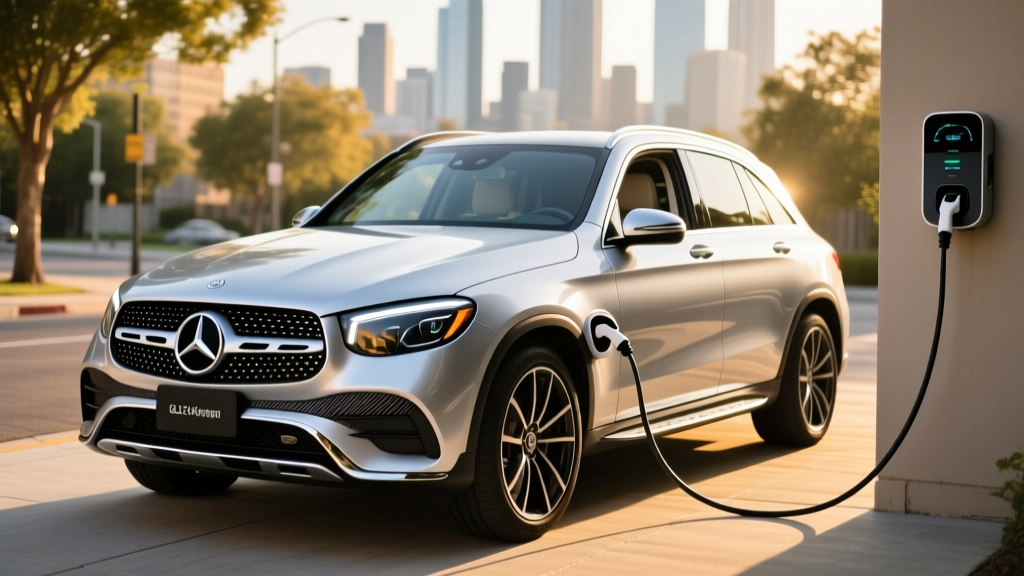
The Mercedes-Benz GLC plug-in hybrid (badged GLC 350e) carries a much larger 31.2 kWh battery pack that you charge by plugging in. It can drive up to 34 miles on electricity alone before the gas engine engages. Once the battery depletes, it operates like a conventional hybrid, using both the engine and regenerative braking to maintain efficiency.
The GLC 350e is strictly a PHEV. There is no conventional HEV version of the current-generation GLC sold in the United States. If you see "GLC Hybrid" in older forums or international markets, that refers to mild-hybrid or diesel-hybrid variants not available here.
Range, Efficiency, and Real-World MPG
The EPA rates the 2026 GLC 350e at 54 MPGe (miles per gallon equivalent) when operating in combined electric-plus-gas mode, and 34 miles of electric-only range. Once the battery is depleted and the vehicle operates as a conventional hybrid, the EPA rates it at 25 MPG combined.
| Mode | City | Highway | Combined |
|---|---|---|---|
| Charge-Sustaining (Hybrid) | 24 MPG | 26 MPG | 25 MPG |
| Charge-Depleting (EV + Gas) | 54 MPGe combined | ||
| Electric-Only Range | 34 miles (EPA) | ||
| Total Range (EV + Gas Tank) | ~440 miles | ||
Source: EPA Fuel Economy
Real-World MPG vs. EPA Sticker
EPA electric range: 34 miles. In real-world testing, expect 28-32 miles of electric driving in mixed city/highway conditions at moderate temperatures. In cold weather (below 35°F), that figure drops to roughly 22-26 miles due to cabin heating demands and reduced battery efficiency. Highway driving at 70+ MPH also reduces electric range to around 25-28 miles.
Charge-sustaining MPG: 25 combined. Owners who regularly deplete the battery and then drive long distances report 23-27 MPG in hybrid mode, closely matching the EPA figure. City-heavy driving in hybrid mode can push this slightly higher thanks to regenerative braking.
The 17.2-gallon fuel tank gives the GLC 350e a total combined range of approximately 440 miles when starting with a full charge and a full tank — enough for most road trips without range anxiety.
Powertrain: 335 Horsepower from Turbo Four + Electric Motor
The GLC 350e pairs a 2.0-liter turbocharged inline-four engine (208 hp, 236 lb-ft) with a permanently excited synchronous electric motor (134 hp, 325 lb-ft) integrated into the nine-speed automatic transmission. Combined system output is 335 horsepower and 406 lb-ft of torque, routed through Mercedes' 4MATIC all-wheel-drive system.
| Gas Engine | 2.0L turbocharged I4, 208 hp / 236 lb-ft |
| Electric Motor | 134 hp / 325 lb-ft (integrated in transmission) |
| Combined Output | 335 hp / 406 lb-ft |
| Transmission | 9-speed automatic (9G-TRONIC) |
| Drivetrain | 4MATIC AWD |
| 0-60 MPH | 6.2 seconds (manufacturer estimate) |
| Top Speed | 130 MPH (electronically limited) |
| Towing Capacity | 3,500 lbs (with optional tow package) |
The electric motor provides instant torque from a stop, making the GLC 350e feel quicker than its 0-60 time suggests in city driving. The transition between electric and gas power is well-managed — one of the smoother PHEV handoffs in the luxury segment. However, under hard acceleration, the four-cylinder engine becomes audibly strained, a reminder that this isn't the GLC 43 AMG.
Battery, Charging, and the 60 kW DC Fast-Charging Limitation
The GLC 350e carries a 31.2 kWh total capacity lithium-ion battery pack (approximately 25.4 kWh usable, with the remainder reserved as a buffer to protect longevity). The pack uses NMC (nickel manganese cobalt) chemistry, which offers higher energy density than LFP but requires more careful thermal management to limit degradation over time.
| Level | Power | Time (0-100%) | Notes |
|---|---|---|---|
| Level 1 (120V household) | ~1.4 kW | ~22 hours | Emergency/trickle only |
| Level 2 (240V home/public) | 9.6 kW | ~3.5 hours | Primary home charging method |
| DC Fast Charge | 60 kW peak | ~30 min (10-80%) | Optional on some trims; CCS connector |
The 9.6 kW onboard AC charger is competitive for the class — it means a full overnight charge on a home Level 2 station in about 3.5 hours, or a quick top-up during a workday. However, the 60 kW DC fast-charging cap is the GLC 350e's most notable charging weakness. Modern dedicated EVs charge at 150-350 kW. Even rival PHEVs like the BMW X5 xDrive50e accept up to 7.4 kW AC only (no DC), so Mercedes at least offers DC capability — but at 60 kW, a 10-80% charge takes roughly 30 minutes, which is slow for road-trip pit stops.
For most PHEV buyers, this won't matter. The primary charging routine is plugging in at home overnight, where Level 2 speed is perfectly adequate. DC fast charging on a PHEV is a convenience for occasional long trips, not a daily necessity.
Pricing, Trims, and Federal Tax Credit Eligibility
The 2026 Mercedes-Benz GLC 350e 4MATIC starts at $59,900 (including destination), available in a single well-equipped trim. Popular options include the AMG Line exterior package ($2,500), the Pinnacle Trim upgrade with MBUX augmented-reality navigation ($3,200), and the Driver Assistance Package with Distronic adaptive cruise ($1,950). A reasonably equipped example typically lands between $63,000 and $68,000.
Does the GLC 350e Qualify for the Federal §30D Tax Credit?
Under current IRS rules for 2026, the GLC 350e may qualify for up to $3,750 of the federal plug-in vehicle credit, but full $7,500 eligibility is unlikely due to battery component and critical mineral sourcing requirements. Here's the checklist:
- MSRP cap: SUVs must be under $80,000 — the GLC 350e qualifies ✓
- Buyer income cap: AGI must not exceed $150K (single), $225K (head of household), or $300K (joint) ✓
- Battery capacity: Must be ≥7 kWh — the 31.2 kWh pack qualifies ✓
- Critical minerals requirement ($3,750): Must meet escalating percentage thresholds for US-sourced or FTA-partner-sourced minerals — partial compliance likely
- Battery components requirement ($3,750): Must meet escalating percentage thresholds for North American manufacturing — compliance uncertain for Mercedes' supply chain
- FEOC restriction: Battery cannot contain components from a Foreign Entity of Concern (China, Russia, etc.) after 2024 — Mercedes has been restructuring supply chains but verify at point of sale
- Point-of-sale transfer: Eligible buyers can transfer the credit to the dealer for an immediate price reduction rather than waiting for tax filing
Always verify current eligibility on IRS.gov and confirm with your tax professional before purchase. Sourcing rules tighten annually.
Some states offer additional PHEV incentives. California's Clean Vehicle Rebate Project (CVRP), for example, has historically offered rebates for qualifying PHEVs, though amounts and eligibility change frequently. Check your state's energy or environmental agency for current programs.
Battery Warranty, Reliability, and Long-Term Ownership Costs
GLC 350e Hybrid Battery Warranty
Mercedes-Benz covers the high-voltage battery pack for 6 years or 62,000 miles (whichever comes first), with a capacity retention guarantee of 70%. This is notably shorter than the 8-year/100,000-mile battery warranties offered by most competitors, including Toyota, BMW, and Volvo. The standard vehicle limited warranty is 4 years/50,000 miles.
This shorter battery warranty is a genuine concern for a vehicle in this price class. If you plan to keep the GLC 350e beyond six years, you're accepting the risk of potential battery replacement costs outside warranty. A PHEV battery replacement of this capacity typically runs $8,000 to $14,000 including labor, though actual failure rates for modern NMC packs are low — most PHEV batteries retain 85-90% capacity after 100,000 miles based on industry data.
Mercedes-Benz reliability ratings have been middling in recent years. J.D. Power's 2025 Vehicle Dependability Study ranked Mercedes below industry average, and the GLC specifically has seen recalls related to software and electrical systems. The plug-in hybrid powertrain adds complexity (two power sources, high-voltage systems, additional cooling circuits) compared to a conventional gas GLC, which means more potential failure points long-term.
For comparison, the Toyota RAV4 Prime PHEV offers an 8-year/100,000-mile hybrid battery warranty and benefits from Toyota's historically stronger reliability record, though it lacks the Mercedes' luxury appointments and performance.
Who Should Buy the GLC Plug-In Hybrid — And Who Shouldn't
Pros
- 34-mile EV range covers most daily commutes without using gas
- 335 hp provides confident acceleration and highway merging
- Premium interior with MBUX infotainment and available augmented-reality nav
- 440+ mile total range eliminates road-trip range anxiety
- Level 2 home charging in ~3.5 hours is practical for overnight routine
- Available DC fast charging (rare for PHEVs in this class)
Cons
- 6-year/62,000-mile battery warranty is shorter than competitors
- 60 kW DC fast charging is slow by modern standards
- $59,900 starting price; well-optioned examples exceed $65K
- Four-cylinder engine sounds strained under hard acceleration
- Federal tax credit likely limited to $3,750 (not full $7,500)
- Below-average predicted reliability for the luxury segment
Should You Choose the GLC 350e PHEV, a Full EV, or a Gas GLC?
Choose the GLC 350e plug-in hybrid if: You have home Level 2 charging, your daily commute is under 30 miles round-trip, you take road trips of 200+ miles several times per year, and you want a luxury compact SUV without committing to full electric. The PHEV is ideal for one-car households in areas with sparse public charging.
Choose a full EV (like the Mercedes EQB or BMW iX3) if: You have reliable home charging, your daily driving rarely exceeds 200 miles, you want the lowest per-mile fuel cost, and you want to eliminate oil changes and gas-engine maintenance entirely. Full EVs also tend to qualify for larger tax credits.
Choose the gas-only GLC 300 if: You cannot charge at home, you drive mostly highway miles (where PHEV advantage diminishes), you want a lower purchase price ($47,000 starting), or you prioritize long-term reliability simplicity over fuel savings.
2026 GLC 350e vs. Key Rivals
| Spec | Mercedes GLC 350e | BMW X3 xDrive30e | Volvo XC60 Recharge |
|---|---|---|---|
| Base MSRP | $59,900 | $58,200 | $60,350 |
| EV Range (EPA) | 34 mi | 31 mi | 35 mi |
| Combined HP | 335 hp | 288 hp | 455 hp |
| Battery (kWh total) | 31.2 | 22.0 | 18.8 |
| AC Charge Rate | 9.6 kW | 7.4 kW | 7.4 kW |
| DC Fast Charge | 60 kW | Not available | Not available |
| 0-60 MPH | 6.2 sec | 6.1 sec | 4.5 sec |
| Battery Warranty | 6 yr / 62K mi | 8 yr / 80K mi | 8 yr / 80K mi |
| MPGe (combined) | 54 | 52 | 56 |
The GLC 350e's key advantage over the BMW X3 PHEV and Volvo XC60 Recharge is its DC fast-charging capability and larger battery. The Volvo wins on power and MPGe, while the BMW offers a longer battery warranty at a slightly lower price. Your choice will likely come down to brand preference, interior taste, and how much you value the Mercedes MBUX ecosystem.
Frequently Asked Questions
How many MPG does the Mercedes-Benz GLC plug-in hybrid get?
The EPA rates the 2026 GLC 350e at 54 MPGe combined when using both electric and gas power, and 25 MPG combined once the battery is depleted and it operates as a conventional hybrid. Real-world hybrid-mode MPG ranges from 23-27 depending on driving style and conditions. If you charge daily and commute under 34 miles, you may use very little gasoline at all.
How far can the GLC 350e go on electric only?
The EPA rates the GLC 350e at 34 miles of electric-only range. In real-world driving, expect 28-32 miles in moderate temperatures, dropping to 22-26 miles in cold weather below 35°F. Highway driving at sustained speeds above 70 MPH reduces electric range to approximately 25-28 miles.
Does the GLC 350e qualify for a federal tax credit?
The GLC 350e likely qualifies for a partial federal tax credit of up to $3,750 under the IRS §30D program for 2026, though the full $7,500 depends on battery component and critical mineral sourcing compliance. Eligibility also depends on your income (AGI caps apply) and the vehicle's MSRP (must be under $80,000 for SUVs). The credit can be transferred to the dealer at point of sale for an immediate price reduction. Verify current status at fueleconomy.gov and consult a tax professional.
Is the GLC plug-in hybrid reliable, and what does battery replacement cost?
Mercedes-Benz ranks below industry average in J.D. Power dependability studies, and the PHEV powertrain adds complexity over a gas-only model. The high-voltage battery is covered for 6 years/62,000 miles — shorter than the 8-year/100,000-mile coverage from BMW, Toyota, and Volvo. Out-of-warranty battery replacement is estimated at $8,000-$14,000. However, modern NMC battery packs rarely fail catastrophically; gradual capacity loss to 85-90% over 100,000 miles is more typical.
Hybrid vs. PHEV vs. EV — which powertrain fits me?
A conventional hybrid (HEV) is best if you cannot charge at home and want modest fuel savings without behavior change. A plug-in hybrid (PHEV) like the GLC 350e is ideal if you can charge at home, commute under 35 miles daily, but still need gas-engine range for road trips. A full EV is best if you have home charging, rarely drive more than 200 miles in a day, and want the lowest operating cost and minimal maintenance. The PHEV is the transitional option — it gives you EV-like daily driving with a gas safety net.
Can I charge the GLC 350e at a Tesla Supercharger?
Not directly. The GLC 350e uses a CCS1 connector for DC fast charging. Tesla Superchargers use the NACS connector. As of 2026, Tesla has opened some Supercharger stations to non-Tesla vehicles via the built-in Magic Dock adapter, but availability varies by station. For reliable DC fast charging, use Electrify America, EVgo, or ChargePoint networks, which natively support CCS1.
What happens if I never plug in the GLC 350e?
You can operate the GLC 350e without ever plugging it in — it will function as a conventional hybrid, using the gas engine and regenerative braking to maintain a small battery buffer. However, you'll get only 25 MPG combined, which is worse than many dedicated hybrids and negates the PHEV's primary advantage. If you can't charge regularly, a gas-only GLC 300 or a conventional hybrid SUV is a better financial choice.