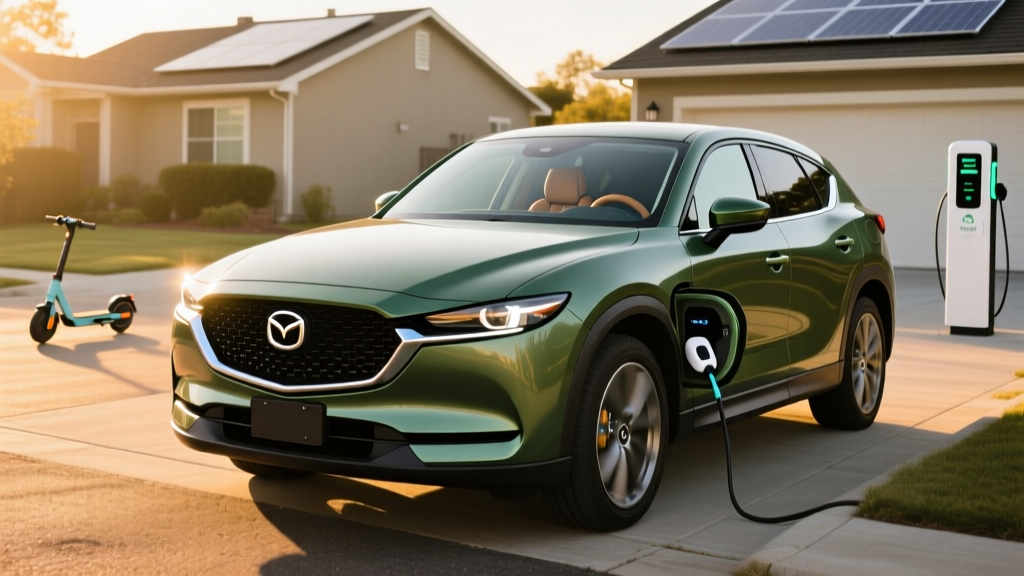
The Mazda CX-50 Hybrid pairs Toyota's proven hybrid powertrain with Mazda's premium interior and rugged styling. For 2026, the CX-50 Hybrid Premium trim sits near the top of the lineup, offering buyers a compelling alternative to both conventional gas SUVs and full battery-electric vehicles. But does the real-world fuel economy match the EPA sticker, and is this the right electrified choice for your daily drive?
| Spec | Value |
|---|---|
| Powertrain | 2.5L 4-cyl + electric motor (HEV) |
| Combined Horsepower | 219 hp |
| Drivetrain | AWD (electronic on-demand) |
| EPA MPG (City / Hwy / Combined) | 39 / 37 / 38 |
| Battery Type | Nickel-metal hydride (NiMH), ~1.6 kWh |
| 0-60 mph | ~7.4 seconds (est.) |
| Cargo Volume | 31.4 cu ft (rear seats up) |
| Towing Capacity | 3,500 lbs |
| Base MSRP (Premium trim) | ~$43,550 |
| Hybrid Battery Warranty | 8 years / 100,000 miles |
Understanding the CX-50 Hybrid: HEV vs PHEV vs EV
Before evaluating the CX-50 Hybrid Premium, it's critical to understand what type of electrified vehicle this is — and what it is not.
Conventional Hybrid (HEV) — What the CX-50 Hybrid Is
A conventional hybrid like the CX-50 uses a small battery (typically 1-2 kWh) paired with a gasoline engine. The battery charges through regenerative braking and the engine — you never plug it in. The electric motor assists during acceleration and enables brief electric-only driving at low speeds. The result is significantly better fuel economy than a gas-only vehicle, with zero change to your refueling habits.
Plug-In Hybrid (PHEV) — What the CX-50 Hybrid Is Not
A PHEV has a larger battery (typically 12-25 kWh) that you can charge via a wall outlet or charging station. PHEVs offer 25-50 miles of electric-only range before the gas engine kicks in. Mazda does not currently offer a CX-50 PHEV in the US market. If you want plug-in capability with similar size, consider the Toyota RAV4 Prime or Hyundai Tucson PHEV.
Battery Electric Vehicle (BEV) — Full Electric
A BEV has no gas engine — it runs entirely on a large battery (60-100+ kWh) and requires regular charging. BEVs offer the lowest operating costs and zero tailpipe emissions but require access to home or workplace charging for practical ownership.
Fuel Economy: EPA Ratings and Real-World MPG
| Driving Cycle | EPA Rating | Real-World Expectation |
|---|---|---|
| City | 39 MPG | 38-42 MPG (hybrids often exceed EPA in stop-and-go) |
| Highway | 37 MPG | 34-37 MPG (less regen benefit at steady speed) |
| Combined | 38 MPG | 36-40 MPG depending on driving mix |
The CX-50 Hybrid's EPA ratings are competitive with the Toyota RAV4 Hybrid (41/38/40) and slightly behind the Honda CR-V Hybrid (43/36/40). In real-world driving, conventional hybrids like this one typically exceed their EPA city rating because regenerative braking is most effective in stop-and-go traffic. Highway driving yields less benefit, as the electric motor can't assist as much at sustained speeds.
Owners who drive primarily in urban or suburban conditions can expect to see 40+ MPG regularly. Highway-heavy commuters may see figures closer to 35-36 MPG, particularly in colder weather when the engine runs more frequently for cabin heating.
For context, the gas-only CX-50 with the turbo engine achieves just 25 MPG combined — meaning the hybrid delivers roughly 50% better fuel economy while adding 40 horsepower.
Powertrain Performance: Toyota Tech, Mazda Tuning
The CX-50 Hybrid uses Toyota's fourth-generation hybrid system, adapted for Mazda's platform. The 2.5-liter naturally aspirated four-cylinder engine produces 176 hp on its own, with the electric motor adding additional torque for a combined system output of 219 hp.
Acceleration is brisk for a compact SUV — expect 0-60 mph times in the mid-7-second range, which is quicker than most competitors in this segment. The CVT transmission is smooth but can drone under hard acceleration, a common hybrid characteristic. Mazda's tuning prioritizes responsiveness at low speeds, making the CX-50 Hybrid feel eager around town.
The AWD system uses a separate rear-mounted electric motor that engages when slip is detected or during hard acceleration. Unlike mechanical AWD, there's no driveshaft connecting front and rear axles — this reduces weight and drivetrain losses while still providing confident traction in rain and light snow.
Pricing, Trims, and Tax Credit Eligibility
The 2026 Mazda CX-50 Hybrid is offered in several trims, with the Premium sitting near the top:
- Select Hybrid: ~$35,550
- Preferred Hybrid: ~$38,550
- Premium Hybrid: ~$43,550
- Premium Plus Hybrid: ~$46,550
The Premium trim adds features like a panoramic moonroof, 10.25-inch infotainment display, Bose 12-speaker audio, heated and ventilated front seats, and a heated steering wheel.
Federal Tax Credit Status
The CX-50 Hybrid is a conventional hybrid (HEV), not a plug-in vehicle. It does not qualify for the federal §30D clean vehicle tax credit, which is reserved for battery-electric vehicles and plug-in hybrids with at least 7 kWh of battery capacity. Some states may offer small incentives for hybrid purchases — check your local DMV or energy office for details.
If federal tax incentives are a priority, consider a PHEV like the RAV4 Prime or a BEV like the Tesla Model Y or Hyundai Ioniq 5, which may qualify for up to $7,500 depending on income, MSRP caps, and battery sourcing requirements per current IRS rules.
Battery Longevity, Warranty, and Replacement Costs
Hybrid Battery Warranty
Mazda covers the CX-50 Hybrid's battery with an 8-year / 100,000-mile warranty (10 years / 150,000 miles in California and states following CARB emissions rules). This warranty covers battery capacity loss below a specified threshold, typically around 60-70% of original capacity.
The CX-50 Hybrid uses a nickel-metal hydride (NiMH) battery pack, which is less energy-dense than lithium-ion but has a proven track record for longevity. Toyota's hybrid batteries — which share similar chemistry and design — routinely last 150,000-200,000 miles before significant degradation. Many Prius and Camry Hybrid owners report original batteries still functioning well past 200,000 miles.
If replacement is needed out of warranty, expect costs in the $2,000-$4,000 range for the hybrid battery pack — significantly less than a full EV battery replacement. Third-party refurbishment services can reduce this cost further.
Real-World Ownership: Who Should Choose the CX-50 Hybrid?
Pros
- 38 MPG combined with no plug-in required
- Premium interior with upscale materials
- 3,500-lb towing capacity (best in hybrid compact SUV class)
- Strong reliability outlook from Toyota hybrid tech
- AWD standard on all hybrid trims
Cons
- No electric-only range (unlike PHEVs)
- No federal tax credit eligibility
- Slightly lower MPG than RAV4 Hybrid
- CVT drone under hard acceleration
- Premium trim pricing approaches luxury territory
Choose the CX-50 Hybrid Premium If:
- You want better fuel economy without changing your refueling habits
- You don't have access to home or workplace charging
- You value Mazda's premium interior and driving dynamics
- You need towing capability (3,500 lbs vs 1,500-2,000 lbs for most competitors)
- You plan to keep the vehicle 8+ years and want proven hybrid reliability
Consider a PHEV Instead If:
- You have home charging and a short commute (25-40 miles)
- You want to drive mostly on electricity with gas as backup
- You want federal tax credit eligibility
Consider a Full EV Instead If:
- You have reliable home charging access
- You want the lowest operating costs and zero tailpipe emissions
- Your daily driving is under 250 miles and you can plan longer trips around charging
Reliability and Safety Ratings
The CX-50 Hybrid benefits from Toyota's decades of hybrid refinement. The hybrid system itself is one of the most reliable powertrains on the market, with fewer moving parts than a conventional automatic transmission (no traditional gearbox, no starter motor, no alternator).
The CX-50 earned a Top Safety Pick+ rating from IIHS in prior model years, with top marks in crashworthiness and crash avoidance. The hybrid variant shares the same structure and safety systems, including Mazda's i-Activsense suite of driver-assistance features (adaptive cruise control, lane-keeping assist, automatic emergency braking).
For official safety data, check NHTSA's 5-star safety ratings when 2026 model testing is published.
Frequently Asked Questions
How many MPG does the CX-50 Hybrid get?
The EPA rates the CX-50 Hybrid at 39 city / 37 highway / 38 combined MPG. Real-world results vary: city drivers often see 40+ MPG, while highway-heavy driving may yield 34-37 MPG.
Does the CX-50 Hybrid need to be plugged in?
No. The CX-50 Hybrid is a conventional HEV that charges its battery through regenerative braking and the gasoline engine. You never plug it in — just fill up at a gas station like any other vehicle.
Is there a plug-in hybrid (PHEV) version of the CX-50?
As of 2026, Mazda does not offer a CX-50 PHEV in the US market. If you want a similar-size PHEV, consider the Toyota RAV4 Prime (42 miles electric-only) or Hyundai Tucson PHEV (33 miles electric-only).
How long will the hybrid battery last?
Based on Toyota's hybrid track record, expect 150,000-200,000+ miles before significant degradation. The battery is warrantied for 8 years / 100,000 miles (10/150,000 in CARB states).
What does a hybrid battery replacement cost?
Out-of-warranty replacement typically costs $2,000-$4,000 for the hybrid battery pack. Refurbished or aftermarket options may reduce this cost.
Does the CX-50 Hybrid qualify for any tax credits?
No federal tax credit applies to conventional hybrids. The §30D credit is reserved for BEVs and PHEVs. Check your state's energy office for any local hybrid incentives.
How does the CX-50 Hybrid compare to the RAV4 Hybrid?
The RAV4 Hybrid achieves slightly better fuel economy (41/38/40 vs 39/37/38) and has a lower starting price. The CX-50 Hybrid offers a more premium interior, better towing capacity (3,500 vs 1,750 lbs), and more rugged styling. Both use Toyota's hybrid system.
For official fuel economy data, see fueleconomy.gov.