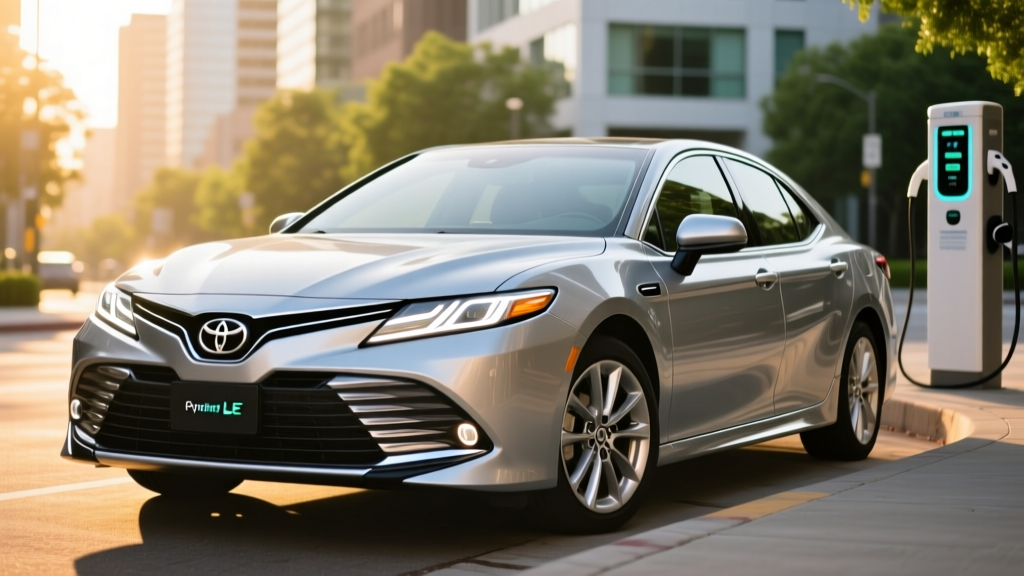
The 2025 Toyota Camry is now exclusively hybrid. Toyota dropped the four-cylinder gas model entirely for this generation, betting that its fifth-generation hybrid system delivers the efficiency buyers want without the range compromises of a full EV. The base LE trim starts under $29,000 and carries an EPA rating of 51 MPG combined — a figure that, in real-world driving, many owners actually exceed in city conditions.
This guide breaks down exactly what the 2025 Toyota Camry Hybrid LE delivers: powertrain specs, real-world fuel economy, battery longevity, warranty coverage, and whether it qualifies for federal tax incentives. If you're cross-shopping this against a plug-in hybrid or a battery-electric vehicle, we'll clarify where the conventional HEV fits in the electrification spectrum.
HEV vs. PHEV vs. EV: Where the Camry Hybrid LE Fits
Before diving into specs, it's critical to understand what the Camry Hybrid LE is — and what it isn't. This is a conventional hybrid electric vehicle (HEV), not a plug-in hybrid (PHEV) and not a battery-electric vehicle (BEV). You never plug it in. The gasoline engine and regenerative braking recharge a small battery that assists the engine and enables brief electric-only driving at low speeds.
| Feature | HEV (Camry Hybrid LE) | PHEV (e.g., RAV4 Prime) | BEV (e.g., Tesla Model 3) |
|---|---|---|---|
| Plug-in charging required? | No | Yes (Level 1 or 2) | Yes (Level 2 or DC fast) |
| Electric-only range | ~1 mile at low speed | 25–42 miles typical | 250–360+ miles |
| Battery size | ~1.1 kWh (small buffer) | 13–18 kWh usable | 60–82 kWh usable |
| Fuel source | Gasoline + regen | Gasoline + grid electricity | Grid electricity only |
| Federal tax credit (§30D)? | No | Up to $7,500 (if eligible) | Up to $7,500 (if eligible) |
| Best for | No home charging access | Short commutes + road trips | Home charging + lower running cost |
The Camry Hybrid LE is the right call if you lack reliable access to a home charger or apartment charging, drive long or unpredictable distances, or simply want maximum efficiency with zero behavior change. If you can charge at home and want electric-only commuting, a PHEV or BEV will cut your fuel costs further — but at higher purchase prices and with charging logistics to manage.
Powertrain and Performance Specs
Every 2025 Camry uses Toyota's fifth-generation hybrid system. The LE pairs a 2.5-liter four-cylinder engine with two electric motor-generators through an electronically controlled continuously variable transmission (eCVT). Front-wheel drive is standard; all-wheel drive (AWD) adds a third electric motor on the rear axle and is available on higher trims but not on the LE.
| Specification | 2025 Camry Hybrid LE (FWD) |
|---|---|
| Engine | 2.5L inline-4 (Atkinson cycle) |
| Combined system horsepower | 225 hp |
| Transmission | eCVT (planetary gearset) |
| Drivetrain | Front-wheel drive |
| Hybrid battery | Lithium-ion, ~1.1 kWh (gross) |
| 0–60 mph (est.) | ~7.1 seconds |
| Curb weight | ~3,495 lbs |
| Cargo volume | 15.1 cu ft |
The 225 hp figure represents combined output from the engine and electric motors — not simply added together, as peak outputs occur at different RPMs. In practice, the electric motor fills in torque at low speeds where the Atkinson-cycle engine is weakest, giving the Camry Hybrid LE responsive off-the-line acceleration that feels quicker than the 0–60 time suggests. Highway passing power is adequate, though the eCVT drone under hard acceleration reminds you this is an efficiency-first powertrain.
Fuel Economy: EPA Ratings and Real-World MPG
This is the headline number, and it's a strong one. The 2025 Camry Hybrid LE carries the highest EPA rating in the Camry lineup thanks to lighter weight and aerodynamic advantages over higher trims with larger wheels.
| Driving Cycle | EPA Rating | Real-World Expectation |
|---|---|---|
| City | 53 MPG | 50–58 MPG (hybrids often exceed EPA in stop-and-go) |
| Highway | 50 MPG | 44–49 MPG (sustained 70+ mph reduces regen benefit) |
| Combined | 51 MPG | 47–54 MPG depending on driving mix |
According to fueleconomy.gov, the Camry Hybrid LE achieves its combined 51 MPG rating. Source: EPA.
Why Hybrids Often Beat EPA in the City
Unlike gas cars, hybrids thrive in stop-and-go traffic. Every brake application regenerates energy back into the battery, and the engine shuts off at stops. In dense urban driving with frequent deceleration, owners regularly report 55+ MPG on the Camry Hybrid LE. Conversely, sustained highway driving at 75–80 mph reduces the regenerative advantage, and real-world highway figures typically land in the mid-to-high 40s. Cold weather (below 35°F) can reduce efficiency by 5–10% as the engine runs more frequently to provide cabin heat.
With a 13.2-gallon fuel tank, total range sits around 670 miles on a fill-up under combined driving — enough for most drivers to go two weeks between gas station visits.
Pricing, Trims, and Tax Credit Eligibility
The 2025 Camry Hybrid LE starts at a $28,700 MSRP (plus $1,095 destination), making it one of the most affordable midsize sedans on the market — hybrid or otherwise. For reference, the non-hybrid base Camry from the prior generation started at a similar price, meaning Toyota absorbed the hybrid premium entirely.
| Trim | MSRP (incl. destination) | Key Additions Over LE |
|---|---|---|
| LE (base) | $29,795 | Base: 8" touchscreen, wireless CarPlay/Android Auto, TSS 3.0 |
| SE | $31,295 | Sport-tuned suspension, 18" wheels, paddle shifters |
| XLE | $33,795 | Leather-trimmed seats, 12.3" display, ambient lighting |
| XSE | $34,795 | Sport styling + premium interior, available AWD |
Does the Camry Hybrid LE Qualify for a Federal Tax Credit?
No. The federal §30D Clean Vehicle Credit applies only to plug-in electric vehicles (PHEVs and BEVs) with a battery capacity of at least 7 kWh, per IRS guidelines. The Camry Hybrid LE's ~1.1 kWh battery disqualifies it entirely. There is no federal tax credit for conventional hybrids in 2025 or 2026.
Some states offer rebates or HOV lane access for hybrids, but these vary by jurisdiction and change frequently. Check your state's energy or DMV website for current programs. A licensed tax professional can advise on any applicable local incentives.
Battery Longevity, Warranty, and Replacement Cost
Hybrid battery anxiety is the number-one concern for first-time hybrid buyers. The data is reassuring: Toyota's hybrid batteries have demonstrated exceptional longevity across millions of vehicles over two decades of Prius, Camry, and RAV4 Hybrid production.
2025 Camry Hybrid Battery Warranty
- Hybrid battery coverage: 10 years / 150,000 miles (whichever comes first)
- Hybrid system components: 8 years / 100,000 miles
- Capacity retention threshold: Toyota warrants the battery against defects and abnormal degradation; there is no published minimum SoH percentage, but replacement is covered if the battery fails diagnostic testing
- Powertrain warranty: 5 years / 60,000 miles
- Basic warranty: 3 years / 36,000 miles
Real-World Battery Lifespan
Toyota's lithium-ion hybrid batteries in the fifth-generation system are smaller and experience shallower charge-discharge cycles than EV batteries, which significantly reduces degradation stress. Fleet data and owner reports indicate most Camry Hybrid batteries last well beyond 150,000 miles without replacement. Failures before 100,000 miles are rare.
If replacement is needed out of warranty, a new OEM hybrid battery for the Camry typically costs between $2,000 and $4,000 installed at a dealership. Refurbished or reconditioned units from third-party suppliers can reduce this to $1,000–$2,000. Individual module replacement (only the degraded cells) is sometimes possible for under $1,000 at specialist hybrid shops.
Reliability Track Record
Toyota's hybrid system is among the most proven powertrains in the industry. The eCVT has no traditional transmission clutches or bands to wear — it's a planetary gearset with far fewer failure points than a conventional automatic. IIHS and NHTSA ratings for the 2025 Camry were strong, with the model earning top marks in crash testing. Toyota Safety Sense 3.0 is standard on every trim, including the LE, providing pre-collision braking, lane departure alert, dynamic radar cruise control, and lane tracing assist.
Ownership Costs: Camry Hybrid LE vs. Gas Sedan vs. EV
The Camry Hybrid LE's value proposition becomes clearest when you model five-year ownership costs. Here's a comparison assuming 15,000 miles/year, $3.50/gallon regular fuel, and $0.16/kWh home electricity.
| Cost Category | Camry Hybrid LE (51 MPG) | Honda Accord 1.5T (33 MPG combined) | Tesla Model 3 RWD (27 kWh/100mi) |
|---|---|---|---|
| Purchase price (MSRP) | $29,795 | $28,990 | $38,990 |
| Federal tax credit | $0 | $0 | Up to $7,500 (if eligible) |
| Effective purchase price | $29,795 | $28,990 | ~$31,490 |
| 5-year fuel/energy cost | ~$5,150 | ~$7,955 | ~$2,160 |
| 5-year maintenance (est.) | ~$2,500 | ~$3,200 | ~$1,500 |
| 5-year total (purchase + fuel + maint.) | ~$37,445 | ~$40,145 | ~$35,150 |
The Camry Hybrid LE lands between the gas Accord and the Tesla Model 3 on five-year cost. It doesn't need the $7,500 tax credit to be competitive — its low MSRP and minimal maintenance (no transmission fluid changes, reduced brake wear from regen) keep it affordable. The Model 3 wins on running costs if you qualify for the credit and have home charging, but the Camry eliminates charging logistics entirely.
Who Should Choose the Camry Hybrid LE — and Who Shouldn't
Choose the Camry Hybrid LE if:
- You lack home or workplace charging access (apartment, street parking)
- You want 50+ MPG with zero behavior change — just fill up with gas
- Your budget is under $32,000 out the door
- You drive a mix of city and highway and want consistent efficiency in both
- You prioritize long-term reliability and low maintenance costs
- You want a midsize sedan with a large trunk (15.1 cu ft) and comfortable rear seat
Look elsewhere if:
- You want electric-only commuting (consider a PHEV like the RAV4 Prime or Prius Prime)
- You want to eliminate gasoline entirely (consider a BEV like the Model 3 or Ioniq 6)
- You need AWD — it's not available on the LE trim
- You want sporty driving dynamics — the eCVT prioritizes smoothness over engagement
- You want to claim the $7,500 federal EV tax credit
Frequently Asked Questions
How many MPG does the 2025 Toyota Camry Hybrid LE get?
The EPA rates the 2025 Camry Hybrid LE at 53 city / 50 highway / 51 combined MPG. In real-world city driving with frequent stops, many owners report 54–58 MPG. Highway driving at sustained speeds above 70 mph typically yields 44–49 MPG.
Does the Camry Hybrid LE need to be plugged in?
No. The Camry Hybrid LE is a conventional hybrid (HEV). Its small battery recharges through regenerative braking and the gasoline engine. There is no plug, no charging cable, and no electric-only commuting range to manage.
Does the 2025 Camry Hybrid qualify for any federal tax credit?
No. The IRS §30D Clean Vehicle Credit applies only to plug-in vehicles (PHEVs and BEVs) with batteries of at least 7 kWh. The Camry Hybrid's ~1.1 kWh battery does not qualify. No federal tax credit exists for conventional hybrids in 2025 or 2026. Check your state for any local hybrid incentives.
How long does the Camry Hybrid battery last, and what does replacement cost?
Toyota covers the hybrid battery for 10 years or 150,000 miles. Real-world data shows most batteries last well beyond 150,000 miles without issues. If replacement is needed out of warranty, expect $2,000–$4,000 for a new OEM battery installed, or $1,000–$2,000 for a refurbished unit.
Is the Camry Hybrid LE reliable?
Toyota's hybrid system has over 20 years of production history across millions of vehicles. The eCVT design eliminates traditional transmission wear points, and the hybrid battery experiences shallow cycles that minimize degradation. The Camry Hybrid is widely regarded as one of the most reliable vehicles in its class.
How does the Camry Hybrid LE compare to a full EV?
A BEV like the Tesla Model 3 offers lower per-mile energy costs (~$0.05/mile vs. ~$0.07/mile for the Camry Hybrid) and zero tailpipe emissions, but requires home or workplace charging, has higher upfront cost, and involves range planning for long road trips. The Camry Hybrid LE costs less upfront, needs no charging infrastructure, and delivers 670+ miles of total range per tank — making it the pragmatic choice for buyers without reliable charging access.
Is AWD available on the Camry Hybrid LE?
No. All-wheel drive is available on the SE, XLE, and XSE trims (adding a rear electric motor), but the base LE is front-wheel drive only. If AWD is essential, you'll need to step up to the SE at $31,295.