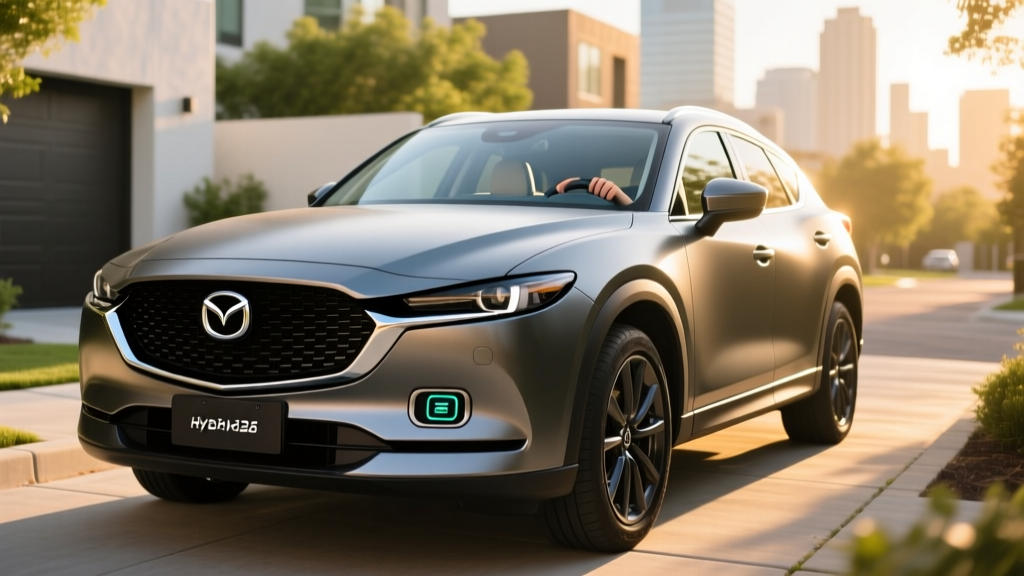
The Mazda CX-50 Hybrid pairs Toyota's proven hybrid powertrain with Mazda's signature driving dynamics and upscale interior. For 2026, it remains one of the few compact SUVs that offers genuine hybrid efficiency without sacrificing engagement behind the wheel. If you've been searching for a cx50 hybrid review that goes beyond the brochure, this guide covers exact EPA figures, real-world MPG expectations, powertrain details, pricing, and the ownership questions that actually matter before you sign.
Quick Verdict: Who the CX-50 Hybrid Is For
The CX-50 Hybrid targets buyers who want hybrid fuel economy in a compact SUV but aren't ready — or able — to plug in. It's a conventional hybrid (HEV), not a plug-in hybrid (PHEV). That means no charging cable, no electric-only range, and no federal tax credit. What you get instead is a simple ownership experience: fill up with gas, average around 38 MPG in mixed driving, and enjoy a cabin that punches above its price class.
The CX-50 Hybrid is a conventional hybrid (HEV). It recharges its small battery through regenerative braking and the gasoline engine. You never plug it in. A plug-in hybrid (PHEV) like the Toyota RAV4 Prime has a larger battery you charge from a wall outlet, giving 30–40 miles of electric-only driving before the gas engine kicks in. The CX-50 does not offer a PHEV variant.
Fuel Economy: EPA Ratings and Real-World MPG
The headline number for the CX-50 Hybrid is its EPA-estimated fuel economy. Mazda equips it with the same 2.5-liter four-cylinder hybrid system found in the Toyota RAV4 Hybrid and Venza, tuned for Mazda's all-wheel-drive platform.
| Metric | Value |
|---|---|
| City MPG | 39 MPG |
| Highway MPG | 37 MPG |
| Combined MPG | 38 MPG |
| Fuel Tank Capacity | 14.5 gallons |
| Estimated Total Range | ~551 miles |
Source: fueleconomy.gov
Real-World MPG: What to Actually Expect
Hybrids tend to meet or exceed their EPA city estimates because stop-and-go driving maximizes regenerative braking and electric-motor assist. In real-world mixed commuting, owners consistently report 37–41 MPG. On sustained highway trips at 75+ mph, expect a slight dip to roughly 34–36 MPG — the engine carries more of the load at higher speeds where regenerative braking opportunities are limited.
Cold weather reduces hybrid efficiency by roughly 5–10% due to increased engine warm-up time and cabin heating demands. In sub-freezing conditions, plan on 34–36 MPG combined until temperatures recover.
Powertrain: Toyota Hybrid Muscle in a Mazda Chassis
Mazda licensed Toyota's fourth-generation hybrid system for the CX-50 Hybrid. It's a proven, durable architecture that has powered millions of RAV4 Hybrids, Highlanders, and Camrys. Here are the exact specifications:
| Specification | Value |
|---|---|
| Engine | 2.5L 4-cylinder Atkinson cycle |
| Electric Motors | Front + Rear (eAWD) |
| Combined Net Horsepower | 219 hp |
| Drivetrain | Electronic AWD (standard) |
| Transmission | eCVT (planetary gearset) |
| 0-60 mph (est.) | ~7.2 seconds |
| Hybrid Battery | ~1.6 kWh NiMH (sealed) |
| Towing Capacity | 1,500 lbs |
The 219-hp combined output gives the CX-50 Hybrid confident passing power and a 0-60 time competitive with turbocharged rivals. The electronic AWD system uses the rear electric motor to send torque to the rear wheels when slip is detected — there's no mechanical driveshaft connecting the front and rear axles.
Pricing, Trims, and Tax Credit Eligibility
The CX-50 Hybrid is available across multiple trims for 2026. Pricing starts in the mid-$30,000 range and climbs to the mid-$40,000s for fully loaded models.
| Trim Level | Approx. MSRP |
|---|---|
| Preferred Hybrid | ~$35,500 |
| Premium Hybrid | ~$38,500 |
| Premium Plus Hybrid | ~$41,500 |
Pricing is approximate and based on manufacturer MSRP; destination charges and dealer markups may apply. Verify current pricing at MazdaUSA.com.
The CX-50 Hybrid is a conventional HEV, not a plug-in vehicle. Under IRS §30D clean vehicle credit rules, only plug-in electric vehicles (BEVs and PHEVs with sufficient battery capacity) qualify for the federal tax credit of up to $7,500. The CX-50 Hybrid does not qualify for any federal purchase incentive. Some states may offer minor rebates for hybrid vehicles — check your state's energy office for current programs.
Battery Warranty, Reliability, and Replacement Costs
Hybrid battery longevity is the single most common concern among first-time hybrid buyers. Here's what the data shows for the CX-50 Hybrid's powertrain:
- Hybrid battery coverage: 8 years / 100,000 miles (10 years / 150,000 miles in CARB states including CA, NY, MA, and others)
- Powertrain warranty: 5 years / 60,000 miles
- Battery chemistry: Nickel-metal hydride (NiMH) — proven technology with decades of field data from Toyota/Mazda applications
- Capacity retention threshold: Warranty covers failure or capacity loss below ~60% of original
How Long Will the Hybrid Battery Last?
The Toyota-derived hybrid system in the CX-50 uses a small NiMH battery that cycles shallowly — it rarely charges above 80% or discharges below 40% state of charge. This shallow cycling dramatically extends battery life. Real-world data from RAV4 Hybrid and Camry Hybrid owners shows these batteries routinely lasting 150,000–200,000+ miles before any meaningful degradation. Many outlast the vehicle itself.
Battery Replacement Cost
If the hybrid battery does fail outside of warranty, replacement costs typically range from $2,000 to $4,000 for a refurbished or new unit, plus labor. Independent hybrid specialists often offer refurbished batteries at the lower end of that range. Given the shallow-cycling design and 8–10 year warranty, out-of-pocket replacement during typical ownership is uncommon.
CX-50 Hybrid vs RAV4 Hybrid vs CR-V Hybrid
The compact hybrid SUV segment is competitive. Here's how the CX-50 Hybrid stacks up against its two biggest rivals on the specs that matter:
| Spec | Mazda CX-50 Hybrid | Toyota RAV4 Hybrid | Honda CR-V Hybrid |
|---|---|---|---|
| Combined MPG | 38 | 39–41 | 37–40 |
| Horsepower | 219 hp | 219 hp | 204 hp |
| AWD | Standard | Standard | Standard |
| Starting MSRP | ~$35,500 | ~$33,500 | ~$35,000 |
| Cargo (rear seats up) | 31.4 cu ft | 37.6 cu ft | 36.3 cu ft |
| Towing | 1,500 lbs | 1,750 lbs | 1,000 lbs |
The RAV4 Hybrid edges out the CX-50 on cargo space and a slight MPG advantage, while the CX-50 offers a more premium interior and Mazda's tuning for a more engaging drive. The CR-V Hybrid splits the difference with excellent practicality but less power.
Pros and Cons
Pros
- 38 MPG combined with AWD standard — no plug-in needed
- Premium interior materials rival luxury compact SUVs
- 219 hp provides confident highway merging and passing
- Toyota-sourced hybrid system with deep reliability data
- 8–10 year hybrid battery warranty
- Standard AWD with rear electric motor for snow/rain traction
Cons
- Less cargo space than RAV4 Hybrid and CR-V Hybrid
- No federal tax credit (HEV, not PHEV)
- Towing limited to 1,500 lbs
- Higher starting price than RAV4 Hybrid
- No PHEV variant available for electric-only commuting
- Infotainment lacks a touchscreen on lower trims
Hybrid vs PHEV vs EV: Which Powertrain Fits You?
Choosing between a conventional hybrid, plug-in hybrid, and full electric vehicle comes down to your daily routine, charging access, and budget.
Decision Framework
Choose the CX-50 Hybrid (HEV) if:
- You don't have access to home or workplace charging
- You want maximum simplicity — no cables, no apps, no charging planning
- Your daily commute is longer than 30–40 miles (PHEV electric range won't cover it)
- You take frequent road trips and don't want to plan around charging stops
Choose a PHEV (like the RAV4 Prime or Tucson PHEV) if:
- You can install a Level 2 charger at home
- Your daily commute is under 35 miles round-trip (you'll rarely use gas)
- You want to qualify for the $7,500 federal tax credit (if the model meets §30D sourcing and income rules)
Choose a full EV (like the IONIQ 5 or Model Y) if:
- You have reliable home charging and your daily driving is under 250 miles
- You want the lowest per-mile fuel cost and minimal maintenance
- You want to maximize federal and state incentives
Frequently Asked Questions
How many MPG does the CX-50 Hybrid get?
The 2026 Mazda CX-50 Hybrid is EPA-rated at 39 MPG city, 37 MPG highway, and 38 MPG combined. In real-world mixed driving, most owners report 37–41 MPG, with highway-only driving at 75+ mph returning roughly 34–36 MPG.
Does the CX-50 Hybrid need to be plugged in?
No. The CX-50 Hybrid is a conventional hybrid (HEV). Its battery charges through regenerative braking and the gasoline engine. You simply fill it with regular unleaded gasoline and drive.
Is there a plug-in hybrid (PHEV) version of the CX-50?
As of 2026, Mazda does not offer a CX-50 PHEV. If you want a Mazda plug-in hybrid, the CX-90 PHEV is available in the midsize three-row segment, and the CX-70 PHEV covers the two-row midsize category. For a compact PHEV rival, look at the Toyota RAV4 Prime or Hyundai Tucson PHEV.
Does the CX-50 Hybrid qualify for any tax credit?
No federal tax credit applies. The IRS §30D clean vehicle credit requires a plug-in vehicle with a minimum battery capacity. Conventional hybrids like the CX-50 Hybrid are excluded. Some states may offer small rebates for hybrid purchases — check your state's clean energy programs.
How reliable is the CX-50 Hybrid?
The hybrid powertrain is sourced from Toyota, which has produced millions of units of this system across the RAV4 Hybrid, Camry Hybrid, and Highlander Hybrid with well-documented long-term reliability. Mazda's build quality and interior materials add to the ownership experience. The hybrid battery carries an 8-year/100,000-mile warranty (10 years/150,000 miles in CARB states).
What does it cost to replace the hybrid battery?
Out-of-warranty hybrid battery replacement typically costs $2,000–$4,000 including labor. However, the shallow-cycling NiMH design means most batteries last 150,000–200,000+ miles, and many never need replacement during the vehicle's usable life.
How does the CX-50 Hybrid compare to the gas-only CX-50?
The gas-only CX-50 with the turbo 2.5L engine makes up to 256 hp and gets roughly 24–26 MPG combined. The Hybrid gives up some peak horsepower (219 hp) but gains roughly 12–14 MPG in combined driving. Over 15,000 miles per year, that translates to roughly $500–$700 in annual fuel savings at $3.50/gallon, paying back the hybrid premium in approximately 3–5 years depending on trim.