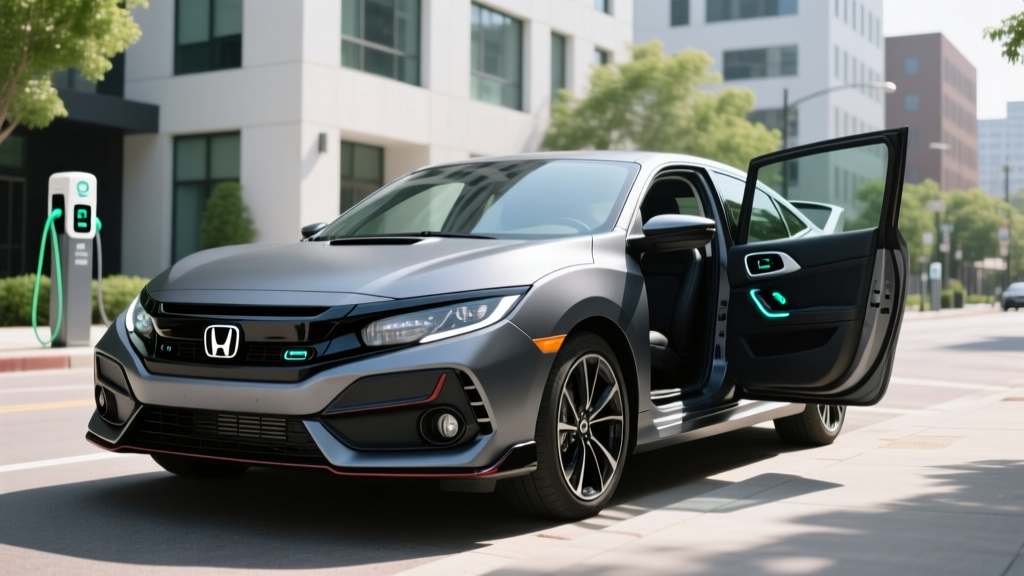
The Honda Civic Sport Touring Hybrid Hatchback occupies a specific niche: it's the electrified, practical, and feature-loaded version of America's best-selling compact hatchback — without requiring you to plug in, change your driving habits, or install a home charger. For 2026, it remains one of the most compelling arguments for a conventional hybrid (HEV) over both a pure gas car and a full battery-electric vehicle.
This guide breaks down every number that matters — EPA fuel economy, real-world MPG, powertrain output, cargo capacity, battery warranty, and tax-credit eligibility — so you can decide whether the Sport Touring Hybrid Hatchback is the right electrified vehicle for your commute.
Quick Verdict: Who Is This Car For?
The Civic Sport Touring Hybrid Hatchback is engineered for buyers who want:
- Exceptional fuel economy without plugging in (conventional HEV, not a PHEV)
- Hatchback cargo versatility — 24.4 cu ft behind the rear seats, expanding to 47.0 cu ft with seats folded
- Top-trim features — Bose audio, wireless CarPlay/Android Auto, leather-trimmed seats, Honda Sensing suite
- Responsive power — 200 combined horsepower from the two-motor hybrid system
- Low ownership friction — no charging equipment, no range anxiety, no home electrical upgrades
It is not for buyers who want electric-only driving, zero tailpipe emissions, or eligibility for the $7,500 federal EV tax credit. For those needs, a plug-in hybrid or full BEV is required.
HEV vs PHEV vs EV: Where Does the Civic Hybrid Fit?
A common source of confusion is the difference between a conventional hybrid (HEV), a plug-in hybrid (PHEV), and a battery-electric vehicle (BEV). The Civic Sport Touring Hybrid is a conventional HEV. Here's what that means in practice:
| Attribute | HEV (Civic Hybrid) | PHEV (e.g., Toyota Prius Prime) | BEV (e.g., Chevy Equinox EV) |
|---|---|---|---|
| Plug-in required? | No | Yes (for EV range) | Yes |
| Electric-only range | ~1 mi (low-speed assist) | 30–45 mi | 250–350+ mi |
| Battery size | ~1.1 kWh (buffer) | 10–18 kWh | 60–100+ kWh |
| Home charger needed? | No | Recommended (Level 2) | Essential (Level 2) |
| Federal tax credit (§30D) | Not eligible | Up to $7,500 (if eligible) | Up to $7,500 (if eligible) |
| Tailpipe emissions | Yes (reduced vs gas) | Yes (when engine runs) | None |
| Upfront cost premium | ~$1,000–$2,000 over gas | ~$4,000–$7,000 over gas | ~$5,000–$15,000 over gas |
The Civic Hybrid captures braking energy and excess engine output to charge its small lithium-ion battery pack, then deploys that energy to assist acceleration and enable brief electric-only operation at low speeds. You never plug it in — it refuels at any gas station like a conventional car.
Fuel Economy: EPA Ratings and Real-World MPG
The headline number for the 2026 Civic Sport Touring Hybrid Hatchback is its EPA-estimated combined fuel economy. Here is the full breakdown from fueleconomy.gov:
| Metric | EPA Estimate |
|---|---|
| City MPG | 50 MPG |
| Highway MPG | 45 MPG |
| Combined MPG | 48 MPG |
| Fuel tank capacity | 12.4 gallons |
| Total driving range | ~595 miles (EPA est.) |
Real-World MPG: What Owners Actually See
Honda's two-motor hybrid system excels in city driving, where regenerative braking and electric assist are used most frequently. In real-world testing and owner reports:
- City / suburban driving: Many drivers report 50–55 MPG, occasionally exceeding the EPA city estimate thanks to frequent stop-and-go regen opportunities.
- Highway cruising (70–80 mph): Expect 40–44 MPG. Hybrids lose their advantage at sustained high speed because the gasoline engine runs continuously and aerodynamic drag dominates.
- Cold weather (below 35°F): A 5–10% reduction is typical as the engine runs more often for cabin heat and the battery is less efficient. Expect 43–46 MPG combined in winter conditions.
- Overall blended driving: Most owners see 46–50 MPG in mixed use, closely tracking or slightly exceeding the 48 MPG combined EPA figure.
This is a meaningful advantage over the gas-only Civic Hatchback, which is rated at 30 city / 38 highway / 33 combined MPG in its Sport Touring trim. That's a 45% improvement in city fuel economy and roughly 35% better combined.
Powertrain and Performance Specs
The Civic Sport Touring Hybrid uses Honda's fourth-generation two-motor hybrid system, which pairs a 2.0-liter Atkinson-cycle four-cylinder engine with two electric motors. Combined output is substantially higher than the gas-only Civic's 1.5-liter turbo.
| Specification | Civic Sport Touring Hybrid Hatchback |
|---|---|
| Engine | 2.0L Atkinson-cycle inline-4 |
| Hybrid system | Two-motor (drive + generator) |
| Combined horsepower | 200 hp |
| Combined torque | 232 lb-ft |
| Transmission | e-CVT (direct drive, no traditional gears) |
| Drivetrain | Front-wheel drive |
| 0–60 mph (est.) | ~7.2 seconds |
| Battery type | Lithium-ion (~1.1 kWh usable) |
| Cargo volume (rear seats up) | 24.4 cu ft |
| Cargo volume (rear seats folded) | 47.0 cu ft |
The 200 hp and 232 lb-ft of torque give the Civic Hybrid a noticeably quicker launch feel than the 180 hp gas turbo model. Electric motors deliver peak torque instantly from a stop, which translates to confident merging and passing. The e-CVT operates without the rubber-band sensation of older CVTs because Honda's system primarily uses the drive motor for propulsion, engaging the gasoline engine through a lockup clutch at highway speeds.
Battery Warranty, Lifespan, and Replacement Cost
Hybrid battery longevity is one of the most common concerns among first-time hybrid buyers. Here's what Honda covers:
Honda Hybrid Battery Warranty
- Coverage: 8 years / 100,000 miles (10 years / 150,000 miles in CARB states including CA, CT, MA, ME, NJ, NY, OR, RI, VT, WA)
- What's covered: Hybrid battery pack, hybrid control module, electric drive motor, and related hybrid-system components
- Capacity threshold: Honda warrants against abnormal degradation and defects — there is no published minimum capacity-retention percentage, unlike BEV warranties
How Long Do Honda Hybrid Batteries Actually Last?
Honda's hybrid batteries are far smaller (~1.1 kWh) than those in a BEV (60–100+ kWh), and they operate within a narrow state-of-charge window (roughly 40–80% SoC) managed by the vehicle's battery management system. This shallow-cycling strategy dramatically reduces cell stress.
Based on data from Honda's earlier hybrid models (Insight, Accord Hybrid, CR-V Hybrid), most hybrid battery packs last well beyond 150,000 miles with minimal degradation. Failures within the warranty period are uncommon, and out-of-warranty replacements for Honda hybrid battery packs currently range from $2,000 to $4,000 (parts and labor), depending on the service provider. Refurbished packs are often available for less.
For context, a Toyota Prius hybrid battery replacement typically costs $2,500–$3,500, and many Prius batteries exceed 200,000 miles before needing service. Honda's system uses similar lithium-ion chemistry and management strategies.
Pricing, Trims, and Tax Credit Eligibility
The 2026 Honda Civic Sport Touring Hybrid Hatchback is the top trim in the Civic Hybrid Hatchback lineup. Here's the pricing breakdown:
| Trim | MSRP (2026 est.) |
|---|---|
| Sport Hybrid Hatchback | ~$29,450 |
| Sport Touring Hybrid Hatchback | ~$31,450 |
The Sport Touring trim adds Bose 12-speaker audio, a 9-inch touchscreen with wireless Apple CarPlay and Android Auto, leather-trimmed seats, heated rear seats, a power moonroof, rain-sensing wipers, and Honda's Low-Speed Braking Control.
Federal Tax Credit: Does It Qualify?
No. The Civic Sport Touring Hybrid is a conventional HEV, not a plug-in vehicle. Under current IRS §30D rules, only battery-electric vehicles (BEVs) and plug-in hybrids (PHEVs) with at least 7 kWh of battery capacity are eligible for the federal clean vehicle credit of up to $7,500. The Civic Hybrid's ~1.1 kWh battery does not meet this threshold.
For the latest eligibility rules on plug-in vehicles — including MSRP caps ($55,000 for cars, $80,000 for SUVs/trucks), buyer income limits, and battery critical-mineral sourcing requirements — consult the IRS clean vehicle credit page.
Some states offer rebates or incentives for conventional hybrids, but these vary widely. Check your state energy office or the Alternative Fuels Data Center for state-specific programs.
Cost of Ownership: Hybrid vs Gas Civic
The hybrid carries a modest price premium over the gas-only Civic Sport Touring Hatchback (~$1,000–$1,500 more). Here's how that premium pays back through fuel savings:
| Metric | Gas Civic Sport Touring (33 MPG comb.) | Civic Sport Touring Hybrid (48 MPG comb.) |
|---|---|---|
| Annual mileage (assumed) | 15,000 mi | 15,000 mi |
| Annual fuel use | 455 gallons | 313 gallons |
| Annual fuel cost ($3.50/gal) | $1,592 | $1,094 |
| 5-year fuel cost | $7,960 | $5,470 |
| 5-year fuel savings (hybrid) | ~$2,490 | |
At $3.50/gallon and 15,000 miles per year, the hybrid saves roughly $498 annually in fuel costs. The ~$1,500 price premium pays for itself in approximately 3 years. If gas prices rise or you drive more than average, payback is faster.
Insurance costs for the Civic Hybrid are generally within $50–$100/year of the gas model — not the significant premiums sometimes seen with full EVs. Maintenance costs are also comparable; the hybrid system adds no routine service items, and regenerative braking reduces brake pad wear.
Pros and Cons
Pros
- 50 MPG city / 48 combined — best in the compact hatchback segment
- 200 hp and instant electric torque — quicker than the gas Civic
- No plug-in required — zero lifestyle change vs a gas car
- 24.4 cu ft cargo — hatchback versatility for gear and groceries
- 8-year/100,000-mi hybrid battery warranty (10 yr in CARB states)
- Top-trim features (Bose, leather, wireless phone integration)
- Excellent IIHS safety ratings and Honda Sensing ADAS suite
Cons
- No federal tax credit (HEV, not PHEV/BEV)
- No electric-only driving mode for zero-emission commutes
- Highway MPG drops to ~40–44 at sustained 75+ mph
- FWD only — no AWD option (unlike the Subaru Crosstrek Hybrid)
- Modest ~1.5-year fuel payback if you drive fewer than 10,000 mi/year
Hybrid vs PHEV vs EV: Which Should You Choose?
Decision Framework
- Choose the Civic Hybrid (HEV) if: You want maximum fuel economy with zero charging infrastructure, you lack access to home or workplace charging, you take frequent long road trips, or your budget is under $35,000.
- Choose a PHEV (e.g., Prius Prime, Hyundai Tucson PHEV) if: You have home charging, your daily commute is under 40 miles (covering most trips on electricity), and you want the flexibility of a gas engine for longer trips.
- Choose a BEV (e.g., Chevy Equinox EV, Hyundai Ioniq 5) if: You have reliable Level 2 home charging, want zero tailpipe emissions, your daily driving is under 250 miles, and you want to maximize tax-credit savings and minimize fuel costs.
Frequently Asked Questions
How many MPG does the Honda Civic Sport Touring Hybrid Hatchback get?
The EPA rates it at 50 MPG city, 45 MPG highway, and 48 MPG combined. Real-world city driving often yields 50–55 MPG, while sustained highway driving at 75+ mph typically returns 40–44 MPG.
Does the Civic Hybrid need to be plugged in?
No. It is a conventional hybrid (HEV), not a plug-in hybrid (PHEV). The battery charges through regenerative braking and the gasoline engine. You refuel only at gas stations.
How far can the Civic Hybrid drive on electric power alone?
Only about 1 mile at very low speeds (under 25 mph) in stop-and-go traffic. It does not have a meaningful electric-only driving range like a PHEV. The electric motor primarily assists the gasoline engine during acceleration.
Is the hybrid battery reliable, and what does replacement cost?
Honda hybrid batteries have a strong reliability record, typically lasting 150,000+ miles with minimal degradation. The battery is warranted for 8 years / 100,000 miles (10 years / 150,000 miles in CARB states). Out-of-warranty replacement costs $2,000–$4,000 including labor.
Does the Civic Hybrid qualify for any federal tax credit?
No. Under current IRS §30D rules, only plug-in vehicles (BEVs and PHEVs) with at least 7 kWh of battery capacity qualify for the federal clean vehicle credit. The Civic Hybrid's ~1.1 kWh battery does not meet this requirement. Some state-level incentives may apply — check the Alternative Fuels Data Center.
Is the Civic Sport Touring Hybrid Hatchback better than the gas Civic?
If fuel economy matters, yes. The hybrid delivers 48 MPG combined versus 33 MPG combined for the gas Sport Touring — a 45% improvement. It also produces more torque (232 vs 177 lb-ft) for a more responsive driving feel. The price premium of ~$1,500 pays for itself in roughly 3 years through fuel savings.
What safety ratings does the Civic Hybrid Hatchback have?
The Civic Hatchback has earned top marks from both the NHTSA (5-Star Overall) and the IIHS (TOP SAFETY PICK). The Honda Sensing suite includes adaptive cruise control, lane-keeping assist, automatic emergency braking, and traffic-sign recognition as standard equipment on all trims.
Bottom Line
The 2026 Honda Civic Sport Touring Hybrid Hatchback delivers on a simple promise: class-leading fuel economy in a practical, well-equipped, and engaging hatchback — with no charging cables, no range calculations, and no lifestyle compromises. At ~$31,450 MSRP and with fuel savings that pay back the hybrid premium in about three years, it's one of the most financially rational electrified vehicles on the market. It won't qualify for federal tax credits and it won't drive on electricity alone for more than a mile. But if your goal is to cut fuel costs by 35–45% without changing how you refuel, the Civic Sport Touring Hybrid Hatchback is hard to beat.