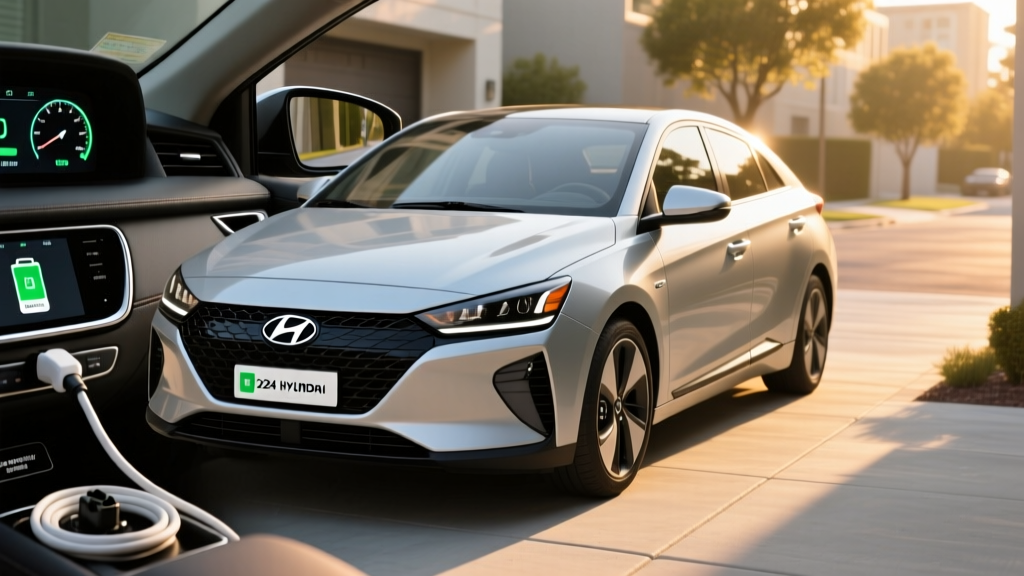
The Hyundai Ioniq nameplate has always been about efficiency-first engineering, and the 2024 Hyundai Ioniq Hybrid continues that mission as a practical, no-compromise compact hatchback. Unlike many hybrids that sacrifice cargo space or driving refinement to chase EPA numbers, the Ioniq Hybrid manages to deliver class-leading fuel economy while remaining a genuinely livable daily driver. For buyers weighing the 2024 Hyundai Ioniq Hybrid against rivals like the Toyota Prius or Honda Insight, this guide covers every spec that matters — from real-world MPG to battery longevity and total ownership cost.
HEV vs PHEV: Understanding the Two Ioniq Hybrid Variants
Hyundai offers the 2024 Ioniq in two distinct electrified configurations, and confusing them is one of the most common buyer mistakes. Here's the fundamental difference:
Conventional Hybrid (HEV)
- No plug required. The battery charges via regenerative braking and the gasoline engine.
- Small 1.56 kWh lithium-ion battery pack.
- Electric motor assists the gas engine but cannot drive the car on electricity alone for meaningful distances.
- Best for drivers without home charging access who still want maximum MPG.
Plug-in Hybrid (PHEV)
- Plugs in to charge. Larger 8.9 kWh battery enables real electric-only driving.
- 29 miles of EPA-rated electric-only range before the gas engine engages.
- Can be charged on a standard 120V outlet (Level 1) in roughly 4 hours or a 240V Level 2 charger in about 2 hours 15 minutes.
- No DC fast charging capability — typical for PHEVs in this class.
- Best for drivers with home or workplace charging who want EV-like commuting with gas backup.
The HEV is simpler and cheaper upfront; the PHEV costs more initially but can eliminate gasoline use entirely on short commutes. Neither variant should be confused with the fully electric Ioniq 5 or Ioniq 6, which are battery-electric vehicles (BEVs) with no gasoline engine.
Fuel Economy: EPA Ratings and Real-World MPG
According to fueleconomy.gov, the 2024 Hyundai Ioniq Hybrid's EPA ratings break down as follows:
| Trim | City MPG | Highway MPG | Combined MPG |
|---|---|---|---|
| Blue | 58 | 60 | 59 |
| SEL / Limited | 50 | 52 | 51 |
| Metric | Value |
|---|---|
| Electric-Only Range | 29 miles |
| Combined MPGe (electric + gas) | 119 MPGe |
| Gas-Only Combined MPG (after battery depleted) | 52 MPG |
| Total Combined Range (electric + gas) | d>~620 miles |
Powertrain Specs: What's Under the Hood
Both the HEV and PHEV versions of the 2024 Ioniq share Hyundai's proven 1.6-liter GDI 4-cylinder engine paired with a permanent-magnet synchronous electric motor and a 6-speed dual-clutch automatic transmission (DCT). This is not a CVT — a distinction that matters for driving feel.
| Specification | HEV | PHEV |
|---|---|---|
| Gas Engine | 1.6L GDI I-4, 104 hp | 1.6L GDI I-4, 104 hp |
| Electric Motor | 32 kW (43 hp) | 44.5 kW (60 hp) |
| Combined System Output | 139 hp / 195 lb-ft | 156 hp / 195 lb-ft |
| Battery Capacity | 1.56 kWh (Li-ion) | 8.9 kWh (Li-polymer) |
| Transmission | 6-speed DCT | 6-speed DCT |
| 0–60 mph (est.) | ~9.5 sec | ~8.5 sec |
| Drivetrain | FWD | FWD |
The 6-speed DCT is a key differentiator versus the Toyota Prius's e-CVT. Acceleration feels more natural and direct, with defined gear shifts rather than the rubber-band effect some drivers dislike in CVTs. The trade-off: slightly less seamless low-speed transitions, though Hyundai's calibration is among the smoothest in the segment.
Pricing, Trims, and Tax Credit Eligibility
The 2024 Hyundai Ioniq Hybrid is positioned as an accessible efficiency play, with MSRPs that undercut many rivals:
| Model / Trim | MSRP (incl. destination) |
|---|---|
| Ioniq Hybrid Blue | ~$26,900 |
| Ioniq Hybrid SEL | ~$29,250 |
| Ioniq Hybrid Limited | ~$33,500 |
| Ioniq Plug-in Hybrid SE | ~$34,100 |
| Ioniq Plug-in Hybrid SEL | ~$36,400 |
| Ioniq Plug-in Hybrid Limited | ~$38,600 |
Federal Tax Credit: The PHEV Advantage
Under IRS §30D rules, the conventional Ioniq Hybrid (HEV) does not qualify for the federal clean vehicle tax credit — it lacks the minimum battery capacity and plug-in capability required. The Ioniq Plug-in Hybrid (PHEV), however, may be eligible for a partial or full credit depending on battery sourcing and critical mineral requirements that the IRS updates annually.
- Income caps apply: Modified AGI must not exceed $150,000 (single), $225,000 (head of household), or $300,000 (joint filers).
- MSRP cap: The vehicle must have an MSRP below $55,000 for sedans/hatchbacks — all Ioniq PHEV trims qualify.
- Battery sourcing rules: The credit is split into two $3,750 halves — one for critical minerals, one for battery component assembly. Sourcing requirements tighten each year. Consult the IRS qualified vehicle list for current-year eligibility.
- Point-of-sale transfer: As of 2024, eligible buyers can transfer the credit to the dealer at purchase, reducing the purchase price directly rather than waiting for a tax refund.
State incentives vary widely. California's CVRP, Colorado's innovative motor vehicle credit, and various utility rebates may stack on top. Check your state's energy office for current programs.
Battery Longevity, Warranty, and Replacement Costs
Battery & Powertrain Warranty Coverage
| Hybrid Battery Warranty | 10 years / 100,000 miles |
| Hybrid System Components | 10 years / 100,000 miles |
| Powertrain Warranty | 10 years / 100,000 miles |
| New Vehicle Limited Warranty | 5 years / 60,000 miles |
Note: In states that follow California emissions standards (CARB states), the hybrid battery warranty may extend to 10 years / 150,000 miles. Hyundai covers battery capacity degradation that falls below approximately 70% of original capacity during the warranty period.
Hybrid battery replacement cost is a top buyer concern. For the Ioniq HEV's 1.56 kWh pack, out-of-warranty replacement typically runs $2,000–$3,500 including labor. The PHEV's larger 8.9 kWh pack is more expensive — expect $4,000–$6,500 if needed outside warranty coverage. However, Hyundai's hybrid batteries have demonstrated strong longevity in fleet data. Most hybrid battery failures occur within the warranty window, and the lithium-ion chemistry used here degrades slowly under normal thermal management. At 150,000+ miles, some capacity loss is expected, but complete failure is uncommon.
Reliability and Safety Ratings
The Ioniq Hybrid platform has been on the road since 2017, giving Hyundai extensive real-world reliability data. The 1.6L GDI engine and 6-speed DCT pairing is well-proven across the Hyundai/Kia lineup. Common trouble spots in earlier model years included DCT hesitation at low speeds and 12V auxiliary battery drain — both largely addressed in the 2024 refresh through software updates and an integrated 12V lithium auxiliary battery that eliminates the traditional lead-acid battery failure point.
Safety ratings are strong. The NHTSA awarded the Ioniq Hybrid a 5-Star Overall Safety Rating. Standard Hyundai SmartSense includes forward collision-avoidance assist with pedestrian detection, lane keeping assist, blind-spot collision warning, rear cross-traffic collision-avoidance assist, and driver attention warning. The Limited trim adds highway driving assist and navigation-based smart cruise control.
Who Should Choose the Ioniq Hybrid vs a Full EV or Gas Car
Pros
- Class-leading 59 MPG combined (Blue trim)
- 6-speed DCT feels more natural than CVT rivals
- 10-year / 100k-mile hybrid battery warranty
- Hatchback cargo versatility (23.8 cu ft behind rear seats)
- Strong standard safety tech suite
- PHEV variant offers 29-mi EV range + potential tax credit
Cons
- Modest 139 hp (HEV) — not a performance pick
- Rear seat headroom tight for taller passengers
- No AWD option (FWD only)
- Infotainment lags behind competitors in responsiveness
- Dealer markups possible in high-demand markets
- PHEV has no DC fast charging
Decision Framework: Which Powertrain Is Right for You?
Choose the Ioniq Hybrid (HEV) if: You don't have reliable access to home or workplace charging, you want maximum MPG without any behavior change, or you're replacing a gas car and want the simplest transition. The Blue trim at ~$26,900 with 59 MPG combined is one of the most cost-efficient vehicles you can buy.
Choose the Ioniq Plug-in Hybrid (PHEV) if: Your daily commute is under 30 miles round-trip and you can charge at home (even a standard 120V outlet works overnight). You'll drive on electricity most days, use gas only for longer trips, and may qualify for up to $7,500 in federal tax credits that effectively close the price gap with the HEV.
Choose a full EV (e.g., Ioniq 5, Chevy Bolt) if: You have home Level 2 charging, your daily driving is under 250 miles, you want zero tailpipe emissions and minimal maintenance, and you're ready to commit to electric-only driving. A full EV eliminates oil changes and reduces brake wear through regen, but requires charging infrastructure confidence.
Stick with a conventional gas car if: You drive very few miles annually (under 6,000), the hybrid premium won't pay back in fuel savings within your ownership timeline, or you need AWD in a segment where the Ioniq doesn't offer it.
Frequently Asked Questions
How many MPG does the 2024 Hyundai Ioniq Hybrid actually get?
The EPA rates the Blue trim at 58 city / 60 highway / 59 combined MPG, and the SEL/Limited at 50/52/51 MPG. In real-world mixed driving, many owners report matching or slightly exceeding EPA numbers in city-heavy conditions, with highway-only driving at higher speeds dropping to the mid-40s.
How far can the Ioniq PHEV go on electric power alone?
The EPA rates the Ioniq Plug-in Hybrid at 29 miles of electric-only range. In practice, gentle driving in moderate temperatures can yield 30–33 miles, while aggressive acceleration, cold weather, or highway speeds may reduce this to 22–25 miles. Once the battery is depleted, the car operates as a conventional hybrid at approximately 52 MPG combined.
Does the conventional Ioniq Hybrid need to be plugged in?
No. The standard Ioniq Hybrid (HEV) never needs to be plugged in. Its small 1.56 kWh battery charges through regenerative braking and the gasoline engine. You fuel it exactly like a conventional car — the hybrid system works automatically in the background.
Is the Ioniq Hybrid reliable, and what does battery replacement cost?
The Ioniq Hybrid platform has been in production since 2017 with strong reliability records. Hyundai backs the hybrid battery with a 10-year / 100,000-mile warranty. Out-of-warranty replacement runs approximately $2,000–$3,500 for the HEV pack and $4,000–$6,500 for the PHEV pack. Complete battery failures are rare within normal vehicle lifespans.
Does the 2024 Ioniq Hybrid qualify for a federal tax credit?
The conventional hybrid (HEV) does not qualify for the §30D federal tax credit. The Plug-in Hybrid (PHEV) may qualify for up to $7,500, subject to IRS battery sourcing requirements, buyer income caps, and MSRP limits. Always verify current eligibility on the IRS qualified vehicles list before purchasing, as sourcing rules change periodically.
How does the Ioniq Hybrid compare to the Toyota Prius?
The 2024 Toyota Prius achieves up to 57 MPG combined (LE trim) versus the Ioniq Blue's 59 MPG — a negligible real-world difference. The Prius offers AWD availability and a more powerful 196 hp powertrain, while the Ioniq counters with a more engaging DCT transmission, lower starting price, and a longer 10-year powertrain warranty versus Toyota's 8-year hybrid battery coverage. Both are excellent — test-drive both and compare dealer pricing in your area.