Quick Verdict: Two Hybrids, Two Very Different Use Cases
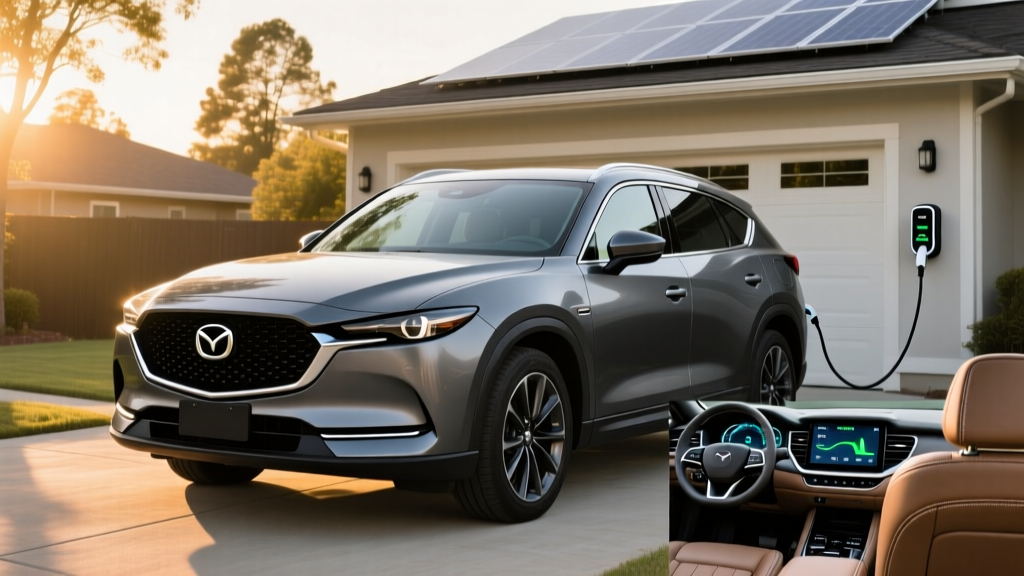
The 2026 Mazda CX-90 is one of the few three-row SUVs that offers both a conventional mild-hybrid (HEV) and a plug-in hybrid (PHEV) powertrain under the same roof. The mild-hybrid CX-90 turbo uses a 48-volt system for marginal efficiency gains and seamless stop-start, while the CX-90 PHEV delivers 26 miles of EPA-rated electric-only driving before its inline-four engine kicks in. For buyers who can charge at home and commute under 25 miles round-trip, the PHEV is genuinely transformative. For everyone else, the mild-hybrid is a refined, if unremarkable, fuel sipper.
Neither powertrain qualifies for the full federal §30D EV tax credit, but the PHEV version does meet the battery-capacity threshold for up to $3,750 in federal credit — subject to income caps, MSRP limits, and critical-mineral sourcing rules that shift annually. We'll break all of that down below.
| Spec | CX-90 Turbo (Mild-HEV) | CX-90 PHEV |
|---|---|---|
| Powertrain | 3.3L turbo I-6 + 48V MHEV | 2.5L I-4 + electric motor |
| Combined HP / lb-ft | 280 hp / 332 lb-ft (premium: 340 hp / 369 lb-ft) | 323 hp / 369 lb-ft |
| EPA Combined MPG | 25 MPG | 25 MPG (gas) / 56 MPGe (electric+gas) |
| EPA City / Highway MPG | 24 city / 28 highway | 25 city / 27 highway (charge-sustaining) |
| Electric-Only Range | N/A | 26 miles (EPA) |
| Battery (usable) | ~0.5 kWh (48V li-ion) | 17.8 kWh (li-ion) |
| AC Charge Time (Level 2) | N/A | ~2 hours (240V, 7.2 kW onboard charger) |
| DC Fast Charge | N/A | No |
| 0–60 mph | ~6.6 sec | ~6.2 sec |
| Towing Capacity | 3,500 lb | 3,500 lb |
| Starting MSRP | $39,595 (Preferred) | $51,445 (Preferred Plus) |
| Federal Tax Credit Potential | None | Up to $3,750 (§30D, if eligible) |
HEV vs PHEV: What's Actually Different Under the Hood
Conventional Hybrid (Mild-HEV): The CX-90's turbocharged inline-six uses a 48-volt belt-driven motor-generator. It cannot drive the wheels on electricity alone. Instead, it smooths stop-start transitions, provides minor torque assist during acceleration, and recovers energy during deceleration. You never plug it in. Think of it as a more sophisticated alternator, not an electric powertrain.
Plug-In Hybrid (PHEV): The CX-90 PHEV pairs a naturally aspirated 2.5-liter four-cylinder with a 100 kW (134 hp) electric motor integrated into the transmission. The 17.8 kWh battery pack enables genuine electric-only propulsion at speeds up to ~75 mph. You plug it in to recharge — either via a standard 120V outlet (Level 1, ~10 hours for a full charge) or a 240V Level 2 home charger (~2 hours).
This distinction matters enormously for ownership cost and daily experience. If you skip the charging step on the PHEV, you're hauling around a 350-pound battery pack for no benefit — and the charge-sustaining fuel economy drops to roughly 25 MPG combined, barely better than the mild-hybrid.
Fuel Economy: EPA Numbers and Real-World MPG
| Powertrain | City | Highway | Combined | Notes |
|---|---|---|---|---|
| Turbo I-6 MHEV (regular fuel) | 24 | 28 | 25 | Requires 87 octane minimum |
| Turbo I-6 MHEV (premium fuel) | 24 | 28 | 25 | 340 hp with 93 octane; MPG unchanged |
| PHEV (charge-sustaining, gas only) | 25 | 27 | 25 | After battery is depleted |
| PHEV (combined EV + gas) | 56 MPGe | Reflects first 26 mi on electricity | ||
Real-world observations: The mild-hybrid CX-90 tends to deliver slightly better city MPG than its EPA sticker — we've seen 26–27 MPG in mixed suburban driving, thanks to the 48V system's regenerative braking during stop-and-go traffic. Highway cruising at 75+ mph drops efficiency to roughly 24–25 MPG, where aerodynamic drag overwhelms the small electric assist.
For the PHEV, the 56 MPGe figure is meaningful only if you charge daily and drive under 30 miles. On a 200-mile road trip with no charging, expect 24–26 MPG once the battery is depleted — essentially matching the mild-hybrid. The PHEV's advantage is entirely in short, chargeable commutes.
PHEV Electric Range and Charging: What 26 Miles Gets You
The EPA rates the CX-90 PHEV at 26 miles of electric-only range. In real-world testing, that number holds up well in mild weather (60–80°F) with moderate HVAC use. In cold weather (below 35°F), expect that figure to drop to roughly 19–22 miles due to cabin heating demands and reduced battery efficiency.
EPA Electric Range: 26 miles
Real-World Expectation: 22–26 miles (mild weather), 19–22 miles (cold weather)
Combined Total Range: ~430 miles (26 electric + ~404 gas, based on 16.9-gallon tank)
Charging speeds and times:
| Level | Voltage / Power | 0–100% Time | Miles Added per Hour |
|---|---|---|---|
| Level 1 (standard outlet) | 120V / ~1.4 kW | ~10–12 hours | ~3 mi/hr |
| Level 2 (home/public) | 240V / 7.2 kW | ~2–2.5 hours | ~13 mi/hr |
| DC Fast Charge | N/A | Not supported — no DC inlet | |
The CX-90 PHEV uses a J1772 connector for AC charging. It does not support DC fast charging — a limitation shared with most PHEVs, since the 17.8 kWh battery is small enough that Level 2 replenishes it quickly. Overnight charging on Level 1 is feasible if your daily commute is under 20 miles, but a Level 2 home charger is strongly recommended for consistent full charges.
Pricing, Trims, and Federal Tax Credit Eligibility
The 2026 CX-90 lineup starts at $39,595 for the Preferred turbo mild-hybrid and $51,445 for the Preferred Plus PHEV. Fully loaded PHEV Premium Plus models reach approximately $59,950.
| Trim | Powertrain | MSRP |
|---|---|---|
| Preferred | Turbo MHEV | $39,595 |
| Carbon Edition | Turbo MHEV | $42,600 |
| Premium | Turbo MHEV | $47,275 |
| Premium Plus | Turbo MHEV | $50,925 |
| Preferred Plus | PHEV | $51,445 |
| Premium | PHEV | $55,900 |
| Premium Plus | PHEV | $59,950 |
Federal §30D Tax Credit — CX-90 PHEV Eligibility (2026 Rules):
- Credit amount: Up to $3,750 (meets battery capacity threshold but may not meet full critical-mineral sourcing requirements)
- MSRP cap: Vehicle must be under $80,000 (SUV/van/pickup cap) — all CX-90 trims qualify
- Buyer income cap: AGI must not exceed $150,000 (single), $225,000 (head of household), or $300,000 (joint) — verify on IRS.gov
- Battery sourcing: Critical-mineral and battery-component requirements tighten annually; check current-year compliance on the DOE Alternative Fuels Data Center
- Point-of-sale transfer: Eligible buyers can transfer the credit to the dealer for an immediate price reduction at purchase
Note: The mild-hybrid CX-90 does not qualify for any federal EV/PHEV tax credit. State incentives vary — check your local energy office or AFDC state incentive database.
Battery Warranty, Reliability, and Replacement Cost
Mazda Hybrid Battery Warranty:
- PHEV high-voltage battery: 8 years / 100,000 miles (whichever comes first), covering defects and capacity loss below a defined threshold (typically ~70% of original capacity)
- Mild-hybrid 48V battery: Covered under the standard 3-year/36,000-mile new-vehicle warranty and 5-year/60,000-mile powertrain warranty
- Federal emissions warranty (PHEV): The high-voltage battery and associated powertrain components are covered for 8 years / 80,000 miles under EPA-mandated emissions warranty provisions
Reliability outlook: Mazda's 2.5-liter naturally aspirated four-cylinder (used in the PHEV) is one of the most proven engines in their lineup, with years of service across the Mazda3, CX-5, and CX-50. The inline-six turbo in the mild-hybrid is newer but has shown no systemic issues through its first two model years. The 8-speed automatic transmission (no CVT here) is a conventional torque-converter unit — a reliability positive versus the CVTs found in some competitors.
Battery replacement cost: Out-of-warranty replacement for the PHEV's 17.8 kWh battery pack is estimated at $4,000–$6,500 including labor, based on current Mazda parts pricing and comparable PHEV battery costs. The 48V mild-hybrid battery is far smaller and cheaper to replace — typically $500–$900. In practice, PHEV and hybrid batteries are lasting well beyond their warranty periods; data from Consumer Reports indicates that most modern li-ion hybrid packs retain 85%+ capacity at 150,000 miles under normal use.
Who Should Choose the CX-90 Hybrid, PHEV, or a Full EV?
Choose the CX-90 Turbo (Mild-HEV) if:
- You want a three-row SUV with premium interior quality and don't have access to home charging
- Your annual mileage is moderate (10,000–14,000 miles) and you prioritize driving dynamics over fuel savings
- You tow occasionally (3,500 lb capacity) and want the torque of the turbo inline-six
- You prefer the lower MSRP and don't want to manage plug-in routines
Choose the CX-90 PHEV if:
- You can install a Level 2 charger at home and your daily commute is under 25 miles round-trip
- You want electric driving for school runs and errands but need gas range for road trips
- You want 323 combined horsepower without the fuel cost of a pure gas performance SUV
- You plan to own the vehicle 5+ years and want to minimize brake wear (regen braking extends pad life)
Consider a full EV (e.g., Kia EV9, Tesla Model X) instead if:
- You have reliable home charging and your daily driving rarely exceeds 200 miles
- You want to eliminate oil changes, spark plugs, and transmission fluid entirely
- You qualify for the full $7,500 federal credit on a BEV, which can offset the higher upfront cost
CX-90 PHEV Pros
- 26 miles EV range covers most daily commutes
- 323 hp combined — the most powerful CX-90 variant
- Premium interior with available Nappa leather, second-row captain's chairs
- No range anxiety — 430+ total miles on a full tank + charge
- 3,500-lb towing maintained across all trims
- Eligible for partial federal tax credit (up to $3,750)
CX-90 PHEV Cons
- $11,850 price premium over the mild-hybrid Preferred trim
- 26-mile EV range is shorter than competitors (Toyota RAV4 PHEV: 42 mi)
- No DC fast charging
- Cargo volume reduced by ~5 cu ft vs. non-PHEV (battery packaging)
- Third-row space is tight for adults regardless of powertrain
- Charge-sustaining MPG (25) barely beats the mild-hybrid
Frequently Asked Questions
How many MPG does the Mazda CX-90 Hybrid get?
The mild-hybrid CX-90 turbo inline-six is EPA-rated at 24 city / 28 highway / 25 combined MPG. The CX-90 PHEV is rated at 25 city / 27 highway / 25 combined MPG in charge-sustaining (gas-only) mode, and 56 MPGe when combining its 26-mile electric range with gas driving. In real-world suburban driving, the mild-hybrid often achieves 26–27 MPG combined thanks to regenerative braking in stop-and-go traffic.
How far can the CX-90 PHEV go on electric only?
The EPA rates the CX-90 PHEV at 26 miles of electric-only range. In mild weather with moderate speeds, expect 24–26 miles. In cold weather (below 35°F), that drops to approximately 19–22 miles due to cabin heating load and reduced lithium-ion efficiency. For commutes under 20 miles, most owners will rarely use gasoline on weekdays.
Does the Mazda CX-90 Hybrid qualify for a tax credit?
The mild-hybrid CX-90 does not qualify for any federal EV/PHEV tax credit. The CX-90 PHEV may qualify for up to $3,750 under the IRS §30D Clean Vehicle Credit, depending on your income, the vehicle's MSRP (all trims fall under the $80,000 SUV cap), and current-year battery-sourcing compliance. The credit can be transferred to the dealer at point of sale for an immediate price reduction. Check the latest eligibility rules at IRS.gov.
Is the CX-90 Hybrid reliable and what does battery replacement cost?
Mazda's 2.5L four-cylinder (PHEV) and 3.3L inline-six (mild-hybrid) are well-engineered powertrains with no widespread reliability concerns. The PHEV high-voltage battery is warrantied for 8 years / 100,000 miles. Out-of-warranty PHEV battery replacement is estimated at $4,000–$6,500. The mild-hybrid 48V battery is much smaller and costs $500–$900 to replace. Modern hybrid batteries routinely last 150,000+ miles with minimal degradation.
Do I need to plug in the CX-90 mild-hybrid?
No. The CX-90 turbo mild-hybrid (MHEV) charges its small 48-volt battery entirely through regenerative braking and the engine-driven generator. There is no plug and no electric-only driving mode. Only the CX-90 PHEV requires plug-in charging to realize its electric-range benefit.
Hybrid vs PHEV vs EV — which fits my lifestyle?
If you lack home charging access and drive long distances regularly, the mild-hybrid (HEV) is the simplest choice — no behavior change required. If you can charge at home and commute under 25 miles daily, the PHEV gives you electric weekdays and gas-powered road trips. If you charge at home, drive under 250 miles daily, and want the lowest operating cost, a full EV like the Kia EV9 or Tesla Model X eliminates fuel stops entirely and qualifies for a larger federal credit.