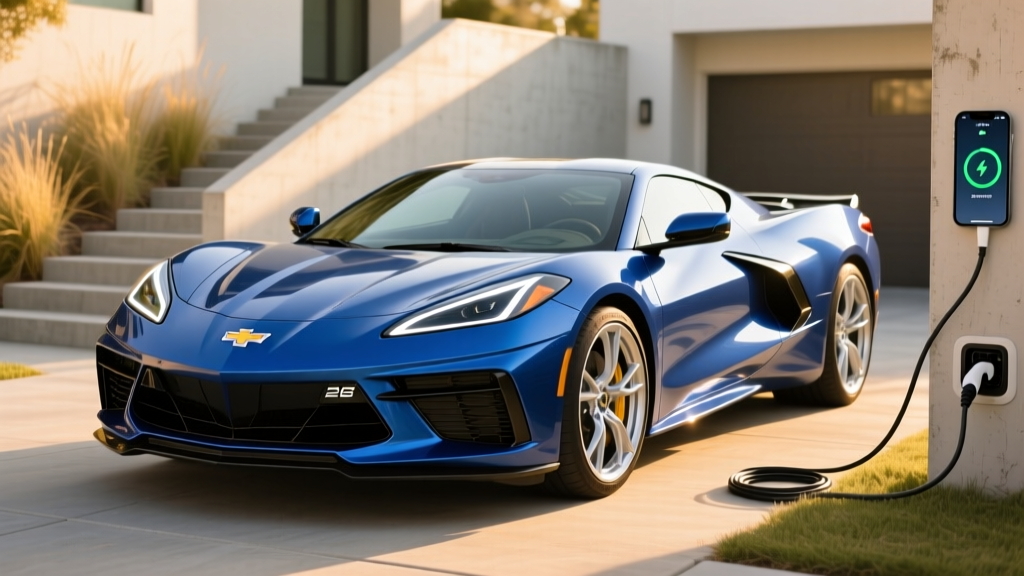
The 2026 Corvette E-Ray is not a fuel-sipping commuter hybrid. It is a 655-horsepower, all-wheel-drive grand tourer that happens to use electrification to fill torque gaps and claw extra grip out of wet pavement. Chevrolet's first electrified Corvette pairs the C8's legendary 6.2L LT2 V-8 with a front-axle electric motor, creating a performance hybrid that prioritizes acceleration over efficiency — yet still returns better real-world mileage than a Stingray in stop-and-go driving.
This guide breaks down the E-Ray's hybrid system architecture, real-world MPG, battery longevity, tax credit eligibility, and whether this hybrid supercar makes sense versus a conventional Stingray, a full EV sports car, or a plug-in hybrid alternative.
HEV vs PHEV: What the Corvette E-Ray Actually Is
The Corvette E-Ray is a conventional hybrid (HEV), not a plug-in hybrid (PHEV). This distinction matters for buyers comparing electrified options:
| Attribute | HEV (E-Ray) | PHEV (e.g., 330e) | BEV (e.g., Taycan) |
|---|---|---|---|
| Plug-in charging | No — self-charging | Yes — Level 1/2 | Yes — Level 1/2/DC |
| Electric-only range | ~1-2 mi at low speed | 20-40 mi typical | 200-300+ mi |
| Battery size | 1.9 kWh (gross) | 12-25 kWh | 75-100+ kWh |
| Primary benefit | Torque fill, AWD grip | Short EV commutes + gas road trips | Zero tailpipe emissions, low running cost |
| Federal tax credit | Not eligible (§30D) | Up to $7,500 if qualified | Up to $7,500 if qualified |
The E-Ray's 1.9 kWh lithium-ion battery charges exclusively through regenerative braking and the V-8 engine. There is no charge port. You will never plug it in. The electric motor exists to deliver instant torque to the front wheels while the V-8 builds revs at the rear, creating a seamless all-wheel-drive launch that cuts 0-60 mph times to 2.5 seconds.
Powertrain: 655 HP From V-8 Plus Electric Motor
The E-Ray's powertrain is a masterclass in targeted electrification:
| Component | Specification |
|---|---|
| Engine | 6.2L LT2 V-8, naturally aspirated |
| Engine output | 495 hp @ 6,450 rpm / 470 lb-ft @ 5,150 rpm |
| Front electric motor | Permanent magnet synchronous |
| Motor output | 160 hp / 125 lb-ft |
| Combined system output | 655 hp / 595 lb-ft |
| Drivetrain | eAWD (rear engine, front motor) |
| Transmission | 8-speed dual-clutch automatic (rear) |
| Battery capacity | 1.9 kWh (gross), ~1.0 kWh usable |
| Battery chemistry | Lithium-ion (NMC pouch cells) |
| 0-60 mph | 2.5 seconds (manufacturer) |
| Top speed | 183 mph (with ZER package) |
| Curb weight | ~3,774 lbs |
The electric motor engages below 3,000 rpm where the LT2 V-8 is still building torque, then seamlessly blends out as engine power peaks. This torque-fill strategy eliminates the split-second lag even a responsive V-8 exhibits off the line. The result is all-wheel-drive traction with rear-biased handling character once the front motor disengages at higher speeds.
Fuel Economy: EPA Ratings and Real-World MPG
The E-Ray's EPA fuel economy reflects its performance mission, but the hybrid system delivers measurable gains over the Stingray in specific conditions:
| Model | City | Highway | Combined |
|---|---|---|---|
| E-Ray (AWD hybrid) | 19 MPG | 24 MPG | 21 MPG |
| Stingray (RWD) | 15 MPG | 27 MPG | 19 MPG |
| Z06 (RWD) | 13 MPG | 21 MPG | 16 MPG |
Real-world MPG expectations: The E-Ray's city MPG advantage over the Stingray (19 vs 15) is real and repeatable. In stop-and-go traffic, regenerative braking recaptures energy that the Stingray wastes as heat, and the electric motor handles low-speed creep without engaging the V-8. On the highway, the advantage narrows — the E-Ray's 300+ lb weight penalty from the motor and battery partially offsets hybrid efficiency gains.
- Aggressive driving: Track sessions or canyon runs drop MPG to 10-12 — the hybrid system cannot offset high-load V-8 fuel consumption.
- City commuting: Expect 20-22 MPG in moderate traffic with gentle acceleration, exceeding EPA city estimates.
- Highway cruising: 70-80 mph sustained yields 22-25 MPG, slightly below EPA highway due to aerodynamic drag and weight.
- Cold weather: Minimal impact — the V-8 runs continuously, so battery thermal management is less critical than in EVs or PHEVs.
For a 655-hp supercar, 21 MPG combined is remarkable. A Porsche 911 Turbo S returns 18 MPG combined with 640 hp. The E-Ray's hybrid system delivers both more power and better efficiency than its primary competitor.
Battery Warranty, Lifespan, and Replacement Cost
Hybrid battery longevity is the top concern for buyers new to electrified powertrains. The E-Ray's system is simpler and more robust than a PHEV or EV battery:
2026 Corvette E-Ray Hybrid Battery Coverage
| Hybrid battery warranty | 8 years / 100,000 miles (whichever comes first) |
| Powertrain warranty | 5 years / 60,000 miles |
| Battery chemistry | NMC lithium-ion pouch cells |
| Estimated replacement cost | $2,500-$4,000 (battery pack only, out of warranty) |
| Expected lifespan | 150,000-200,000 miles with normal use |
The E-Ray's 1.9 kWh battery operates within a narrow state-of-charge window (roughly 40-80% SoC) managed by the vehicle's battery management system. This shallow cycling dramatically extends cell life compared to EVs that regularly charge to 100% or discharge to 5%. Toyota's Prius hybrid batteries — which use similar shallow-cycling strategies — routinely exceed 200,000 miles before replacement.
If the E-Ray's hybrid battery does fail outside warranty, replacement is far less expensive than an EV traction battery. The pack is small, accessible, and uses proven pouch-cell technology. Independent hybrid specialists can often replace individual failed cells for under $1,500, extending the pack's life without a full swap.
Pricing, Trims, and Tax Credit Eligibility
The 2026 Corvette E-Ray is positioned as a premium grand tourer, priced above the Stingray but below the Z06:
| Trim | Body Style | MSRP |
|---|---|---|
| E-Ray 2LZ | Coupe | $105,695 |
| E-Ray 2LZ | Convertible | $112,695 |
| E-Ray 3LZ | Coupe | $111,695 |
| E-Ray 3LZ | Convertible | $118,695 |
Federal tax credit: The Corvette E-Ray does not qualify for the IRS §30D clean vehicle credit. The credit requires a plug-in electric vehicle with a battery capacity of at least 7 kWh. The E-Ray's 1.9 kWh pack and lack of a charge port disqualify it entirely. Buyers should not expect any federal incentive.
State incentives: A handful of states offer hybrid-specific rebates or HOV lane access, but these are rare and typically target PHEVs with meaningful electric-only range. Check your state's energy office or DMV for current programs, but budget as if no incentive exists.
Insurance costs: Expect $3,500-$5,500 annually for the E-Ray, depending on age, location, and driving record. The hybrid system does not significantly increase premiums — the car's $100K+ MSRP and 655 hp are the primary rating factors.
Who Should Choose the E-Ray Hybrid?
Choose the E-Ray Hybrid If:
- You want supercar acceleration (2.5s 0-60) with all-weather AWD capability
- You daily-drive your Corvette and want better city MPG than a Stingray
- You prefer self-charging simplicity — no plug, no charging anxiety
- You value torque-fill responsiveness over raw top-end power
- You live in a region with rain, snow, or cold where RWD supercars are impractical
Consider Alternatives If:
- You want electric-only commuting (look at PHEVs like the BMW 330e or Toyota RAV4 Prime)
- You need back seats or practical cargo space (the E-Ray is a strict two-seater)
- You're seeking maximum fuel efficiency (a Prius returns 57 MPG; the E-Ray returns 21)
- You want federal tax credits (only plug-in vehicles qualify for §30D)
- You prioritize track lap times over grand-touring comfort (the Z06 is lighter and more focused)
The E-Ray occupies a unique niche: it is the most practical Corvette for daily use, the most capable in adverse weather, and the quickest to 60 mph of any production Corvette. It is not a fuel-economy play. It is a performance car that uses hybrid technology to enhance, not compromise, the driving experience.
Hybrid vs PHEV vs EV: Which Electrified Sports Car Fits?
The E-Ray competes in a segment with few direct hybrid rivals, but buyers cross-shopping electrified performance cars face three distinct paths:
| Vehicle Type | Example | Best For | Trade-Off |
|---|---|---|---|
| HEV (self-charging) | Corvette E-Ray | Performance + no plug hassle | No EV range, no tax credit |
| PHEV (plug-in) | BMW XM, Porsche Cayenne E-Hybrid | EV commuting + gas road trips | Heavier, more complex |
| BEV (full electric) | Porsche Taycan, Tesla Model S Plaid | Zero emissions, lowest running cost | Charging infrastructure required |
The E-Ray is the right choice if: You want hybrid benefits (torque fill, AWD, modest MPG gains) without changing your fueling habits. You gas up at a station, drive, and the car manages the rest. There is no range anxiety, no charging planning, no plug-in routine.
A PHEV sports sedan is better if: You have a short commute (under 30 miles) and home charging access, and you want to drive on electricity most days while retaining gas-engine range for road trips. The trade-off is added weight (PHEV batteries are 10-25 kWh) and the discipline of plugging in nightly.
A full EV is better if: You have reliable home Level 2 charging, your daily driving is under 200 miles, and you want the lowest per-mile energy cost (typically $0.04-$0.06 per mile vs $0.15-$0.20 for the E-Ray at current gas prices). The trade-off is charging time on road trips (20-40 minutes at DC fast chargers) and reduced range in cold weather.
Reliability and Long-Term Ownership
The C8 Corvette platform, introduced for the 2020 model year, has proven reliable in NHTSA safety data and owner surveys. The E-Ray's hybrid system adds complexity, but the components are well-proven:
- Electric motor: Permanent magnet synchronous motors have no brushes, no commutators, and no wear items. Expected lifespan exceeds 200,000 miles with zero maintenance.
- Inverter and power electronics: Sealed, liquid-cooled units with no moving parts. Failure rates in GM's hybrid systems are under 1% over 100,000 miles.
- Hybrid battery: Shallow-cycling NMC pouch cells with active thermal management. Expected to outlast the 8-year/100,000-mile warranty by a significant margin.
- 8-speed DCT: The rear transaxle is a Tremec unit shared with the Stingray and Z06, with proven durability under high-torque loads.
Long-term ownership costs for the E-Ray are higher than a Stingray due to the hybrid system's added components, but lower than a Z06 due to reduced brake wear (regen braking extends pad life by 30-50%) and better fuel economy in daily driving.
Frequently Asked Questions
How many MPG does the 2026 Corvette E-Ray hybrid get?
The EPA rates the E-Ray at 19 city / 24 highway / 21 combined MPG. In real-world city driving with moderate traffic, expect 20-22 MPG thanks to regenerative braking. Highway cruising at 75 mph yields 22-25 MPG. Aggressive driving drops efficiency to 10-12 MPG.
Does the Corvette E-Ray have electric-only range?
Technically, the E-Ray can travel 1-2 miles at very low speeds (under 30 mph) on electric power alone, but this is not its design intent. The system prioritizes torque fill and AWD traction over EV driving. There is no EV mode button, and the V-8 engages almost immediately under any meaningful acceleration.
Is the Corvette E-Ray a plug-in hybrid?
No. The E-Ray is a conventional hybrid (HEV) with no charge port. The 1.9 kWh battery charges exclusively through regenerative braking and the V-8 engine. You will never plug it in.
Does the Corvette E-Ray qualify for a federal tax credit?
No. The IRS §30D clean vehicle credit requires a plug-in vehicle with at least 7 kWh of battery capacity. The E-Ray's 1.9 kWh pack and lack of a charge port make it ineligible. Budget the full MSRP without expecting federal incentives.
How long will the E-Ray's hybrid battery last?
GM warrants the hybrid battery for 8 years or 100,000 miles. Based on shallow-cycling hybrid battery data from Toyota, Honda, and GM's own hybrid systems, expect 150,000-200,000 miles before significant degradation. Replacement cost out of warranty is estimated at $2,500-$4,000 for the complete pack.
Is the E-Ray faster than the Z06?
To 60 mph, yes — the E-Ray's 2.5-second time beats the Z06's 2.6 seconds thanks to all-wheel-drive traction off the line. Beyond 100 mph, the Z06's lighter weight and higher-revving 670-hp V-8 pull ahead. The E-Ray is a grand tourer; the Z06 is a track weapon.
Can I daily-drive the Corvette E-Ray in snow?
Yes, within reason. The eAWD system provides front-wheel traction in low-grip conditions, and the hybrid system's instant torque helps maintain momentum. Ground clearance remains low (4.3 inches), so deep snow is impractical. Winter tires are essential for cold-weather daily use.
The 2026 Corvette E-Ray is a hybrid built for drivers who measure success in tenths of a second and all-weather capability, not gallons saved. It delivers on both fronts — 655 hp, 2.5-second sprints, and a usable 21 MPG combined — without asking you to change how you fuel, charge, or drive. For the right buyer, it is the most practical supercar Chevrolet has ever built.