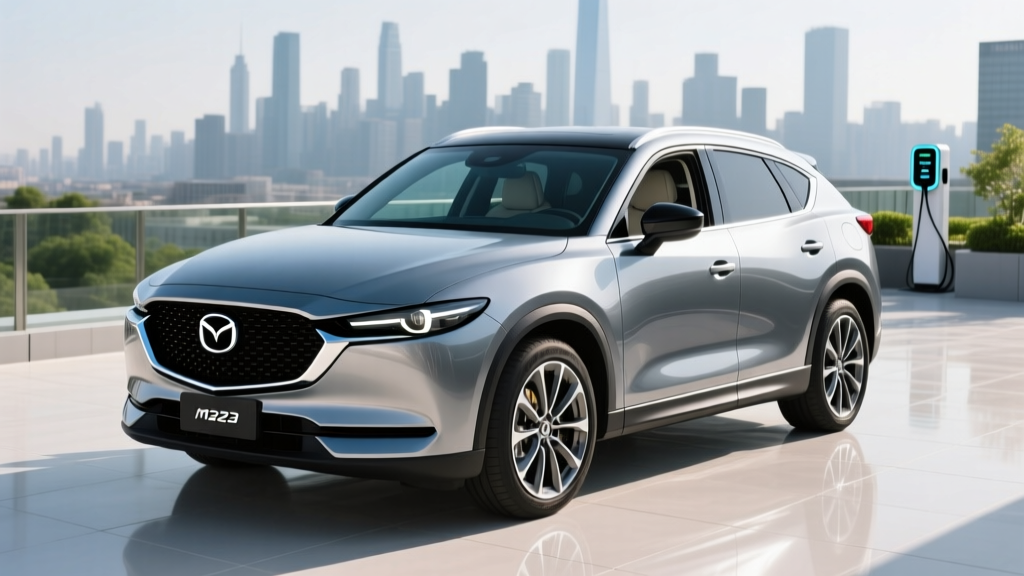
Quick Verdict: The CX-70 PHEV Bridges Two Worlds
The 2026 Mazda CX-70 Hybrid is exclusively a plug-in hybrid (PHEV), not a conventional self-charging hybrid. Mazda pairs a 2.5-liter four-cylinder engine with a 17.8 kWh battery pack and an electric motor integrated into the eight-speed automatic transmission, yielding 327 combined horsepower and an EPA-estimated 26 miles of electric-only driving. Starting at $41,695 before destination, the CX-70 PHEV targets midsize-SUV buyers who want EV-like commuting without range anxiety on road trips. It qualifies for a reduced federal tax credit under current IRS §30D rules, though exact amounts depend on battery-sourcing compliance and buyer income limits.
| Spec | Value |
|---|---|
| Powertrain | 2.5L I-4 + electric motor (PHEV) |
| Combined Horsepower | 327 hp / 382 lb-ft torque |
| Battery (usable) | 17.8 kWh lithium-ion |
| EPA Electric-Only Range | 26 miles |
| EPA Combined (gas-only) | 25 MPG |
| EPA City / Highway (gas) | 24 city / 27 highway |
| MPGe (electric + gas) | 56 MPGe combined |
| Total Combined Range | ~490 miles |
| Level 2 Charge Time (0–100%) | ~2.5 hours at 7.2 kW |
| DC Fast Charging | Not supported |
| 0–60 mph | 5.9 seconds |
| Towing Capacity | 3,500 lbs |
| Base MSRP (Preferred) | $41,695 |
| Battery Warranty | 8 years / 100,000 miles |
HEV vs PHEV: Why the CX-70 Is Plug-In Only
Some shoppers searching for a "CX-70 hybrid" expect a conventional hybrid (HEV) like the Toyota Highlander Hybrid — one that never plugs in and recharges its small battery through regenerative braking and engine power. That is not what Mazda offers here.
| Feature | HEV (e.g., Highlander Hybrid) | PHEV (CX-70 Hybrid) |
|---|---|---|
| Plugs in? | No | Yes (J1772 / Level 2) |
| Battery Size | 1–2 kWh | 17.8 kWh |
| Electric-Only Range | 0–1 miles at low speed | 26 miles |
| Gas Engine | Always available | Always available |
| Home Charging Needed? | No | Recommended for full benefit |
| Federal Tax Credit | No | Partial (see below) |
The CX-70 PHEV's 17.8 kWh pack is roughly ten times larger than a typical HEV battery. That capacity is what enables 26 miles of genuine zero-emission driving at speeds up to 75 mph. If you never plug in, the CX-70 still functions as a heavy hybrid — but you'll forfeit the electric range and much of the fuel-cost savings that justify the PHEV premium.
Fuel Economy: EPA Numbers vs Real-World MPG
| Mode | EPA Estimate | Real-World Expectation |
|---|---|---|
| Electric-only range | 26 miles | 22–28 mi (weather/terrain dependent) |
| MPGe (charge-sustaining + EV) | 56 MPGe | Varies heavily by plug-in frequency |
| Gas-only city | 24 MPG | 25–27 MPG (hybrids often beat EPA in city) |
| Gas-only highway | 27 MPG | 24–26 MPG (aerodynamic drag, speed) |
| Gas-only combined | 25 MPG | 24–26 MPG |
A key nuance with any PHEV: the published MPGe figure (56 MPGe) assumes you start each trip with a full battery and drive within the electric-only window most of the time. If your daily commute is 20 miles round-trip and you charge nightly, you may burn almost no gasoline on weekdays. Conversely, if you never plug in, expect a steady 24–26 MPG combined — respectable for a 4,800-pound AWD SUV, but not class-leading next to lighter HEV competitors.
In cold weather (below 32°F), expect the electric-only range to drop 20–30% due to battery chemistry limitations and cabin-heating demand. That 26-mile EPA range may shrink to 18–20 miles in January in northern climates. The gas engine will compensate seamlessly — you won't be stranded — but your electricity savings narrow.
Powertrain Deep Dive: 327 HP From Four Cylinders
Mazda's PHEV system pairs a turbocharged 2.5-liter inline-four (producing 189 hp on its own) with a 132-kW electric motor sandwiched between the engine and the eight-speed automatic transmission. Combined output reaches 327 horsepower and 382 lb-ft of torque when the battery is sufficiently charged. All power routes through Mazda's i-Activ all-wheel-drive system.
The result is a 0–60 mph time of approximately 5.9 seconds — quick for a midsize two-row SUV and noticeably faster than most V6 competitors. The electric motor fills the torque gap at low RPMs before the turbo spools, eliminating the lag common in turbo-only setups. At highway speeds, the system operates primarily on the gas engine, with the electric motor providing assist during acceleration or capturing energy during deceleration through regenerative braking.
Driving modes include EV (electric-only up to 75 mph), Charge Mode (engine recharges the battery while driving — useful before entering a zero-emission zone or preparing for an electric-arrival at your destination), and a standard hybrid mode that blends both power sources automatically.
Charging the CX-70 PHEV: Level 2 Only, No DC Fast Charge
The CX-70 PHEV accepts Level 2 AC charging at up to 7.2 kW through a standard J1772 connector. A full 0–100% charge takes approximately 2.5 hours on a 240-volt Level 2 home charger. On a standard 120-volt Level 1 household outlet, expect 8–10 hours for a full charge — viable for overnight top-ups if your daily electric usage stays under 15 miles.
Critically, the CX-70 PHEV does not support DC fast charging. This is standard for most PHEVs in this segment (the Toyota RAV4 Prime and Hyundai Tucson PHEV also lack DC fast-charge capability). The battery is simply too small to justify the added cost and weight of DC hardware. For the target use case — overnight home charging followed by an electric commute — Level 2 is entirely sufficient.
Home Level 2 installation typically costs $500–$1,500 for the charger unit plus $500–$2,000 for electrician labor, depending on panel proximity and local permitting. If your electrical panel is near capacity, a 200-amp panel upgrade could add $1,500–$3,000. Consult a licensed electrician for a site-specific quote.
Pricing, Trims, and Federal Tax Credit Eligibility
The 2026 CX-70 PHEV is offered in three trims:
- Preferred: $41,695 MSRP (+ $1,420 destination)
- Carbon Edition: $47,595 MSRP
- Premium Plus: $54,400 MSRP
All trims fall under the IRS §30D MSRP cap of $80,000 for SUVs, making them potentially eligible for the federal plug-in hybrid tax credit. However, the credit amount is not a guaranteed $7,500 for every buyer. Under current IRS rules, the credit is split into two $3,750 halves:
- $3,750 for meeting critical-minerals sourcing requirements
- $3,750 for meeting battery-component manufacturing requirements
As of the 2026 model year, Mazda's battery supply chain partially qualifies, meaning buyers may receive $3,750 rather than the full $7,500. Additionally, buyer income caps apply ($150,000 single / $300,000 joint filers), and the credit can now be transferred to the dealer at point of sale as an instant discount under IRS §30D(g). Always verify current eligibility on fueleconomy.gov and consult a tax professional before relying on credit projections.
Reliability, Battery Warranty, and Replacement Costs
Battery Warranty: Mazda covers the CX-70 PHEV's high-voltage battery for 8 years or 100,000 miles (whichever comes first), with a capacity-retention threshold typically set at 70% of original capacity. In California-emission states (CARB states), coverage extends to 10 years / 150,000 miles.
PHEV batteries face less stress than full-EV batteries because they operate in a narrower state-of-charge window — the system reserves a buffer at the top and bottom of the pack, preventing the deep cycles that accelerate degradation. Mazda's 17.8 kWh pack is liquid-cooled, further protecting longevity.
Based on industry data from similar PHEV platforms, expect 8–12% capacity loss over the first 8 years under normal use. Out-of-warranty replacement for a PHEV battery of this size typically runs $5,000–$8,000 including labor — significantly less than a full-EV battery replacement, which can exceed $15,000. However, most PHEV batteries outlast the vehicle itself; early failures are rare and usually covered under warranty.
Mazda's overall reliability reputation is strong, with the brand consistently ranking in the top third of Consumer Reports reliability surveys. The CX-70's inline-four engine is a proven design shared across the Mazda lineup, and the eight-speed automatic avoids the complexity of a CVT.
Pros
- 327 hp delivers genuine performance; 5.9s 0–60
- Premium interior materials rival European competitors
- 26-mile EV range covers most commutes
- No range anxiety — gas engine for road trips
- 3,500-lb towing capacity (rare for PHEVs)
- Standard AWD across all trims
Cons
- Only 26 miles EV range (RAV4 Prime offers 42)
- No DC fast charging
- Gas-only MPG (25 combined) trails lighter HEV rivals
- Federal tax credit may be partial ($3,750 not $7,500)
- Two-row only — no third-seat option (see CX-90 PHEV)
- Requires home charging access to maximize value
CX-70 PHEV vs Full EV vs Gas SUV: Which Fits You?
Choose the CX-70 PHEV if:
- Your daily commute is under 30 miles round-trip and you can charge at home
- You take road trips 4+ times per year where charging infrastructure is uncertain
- You want EV-like daily driving but aren't ready to commit to a full BEV
- You need towing capability (3,500 lbs) that most electric SUVs lack at this price
Choose a full EV (e.g., Hyundai Ioniq 5, Tesla Model Y) if:
- You have reliable home Level 2 charging and your trips rarely exceed 250 miles
- You want zero tailpipe emissions and minimal maintenance (no oil changes, no engine)
- You want to maximize the full $7,500 federal tax credit (more EVs qualify fully)
Choose a gas SUV or conventional HEV if:
- You cannot install a home charger (apartment, no garage, no 240V access)
- Your budget is under $38,000 and you need lower upfront cost
- You drive 20,000+ highway miles per year where PHEV electric range offers minimal benefit
Frequently Asked Questions
How many MPG does the Mazda CX-70 Hybrid get?
When the battery is depleted and the CX-70 operates as a conventional hybrid, the EPA rates it at 24 city / 27 highway / 25 combined MPG. In real-world city driving, PHEVs often exceed their EPA city estimate thanks to regenerative braking — expect 25–27 MPG in stop-and-go traffic. Highway driving at 75+ mph may drop to 23–25 MPG. When factoring in electric-only miles, the combined rating is 56 MPGe.
How far can the CX-70 PHEV go on electric only?
The EPA estimates 26 miles of electric-only range. In mild weather (50–80°F) on flat terrain, owners report 24–28 miles. In cold weather (below freezing), expect 18–22 miles. At sustained highway speeds above 70 mph, the electric range shortens to approximately 20–22 miles due to aerodynamic drag.
Does the CX-70 Hybrid qualify for a tax credit?
Yes, but the amount varies. Under current IRS §30D rules, the CX-70 PHEV may qualify for up to $3,750 (half of the maximum $7,500) depending on battery-sourcing compliance for the 2026 model year. Buyer income must be below $150,000 (single) or $300,000 (joint). The credit can be applied at point of sale as an instant price reduction. Verify exact eligibility on fueleconomy.gov before purchasing.
Is the CX-70 Hybrid reliable and what does battery replacement cost?
Mazda has a strong reliability track record, and the 2.5L turbo engine is a proven design. The high-voltage battery is warranted for 8 years / 100,000 miles (10 years / 150,000 in CARB states). PHEV batteries experience less degradation than full-EV batteries due to smaller charge windows. Out-of-warranty replacement costs approximately $5,000–$8,000, though most PHEV batteries last the life of the vehicle.
Do I have to plug in the CX-70 PHEV?
No — the CX-70 will operate as a conventional hybrid if you never plug it in, using the gas engine and regenerative braking to maintain the battery. However, you'll miss the 26-mile electric range and the fuel-cost savings that justify the PHEV price premium. To maximize value, plan to charge at home nightly using a Level 2 (240V) outlet.
What's the difference between the CX-70 PHEV and the CX-90 PHEV?
The CX-70 is a two-row midsize SUV; the CX-90 is mechanically identical but adds a third row and slightly more cargo space. Both share the same 327-hp PHEV powertrain, 17.8 kWh battery, and 26-mile electric range. Choose the CX-70 if you don't need a third row and prefer a lower starting price (roughly $3,000 less than the CX-90 PHEV at equivalent trims).