Quick Verdict: The CR-V Hybrid Earns Its Spot
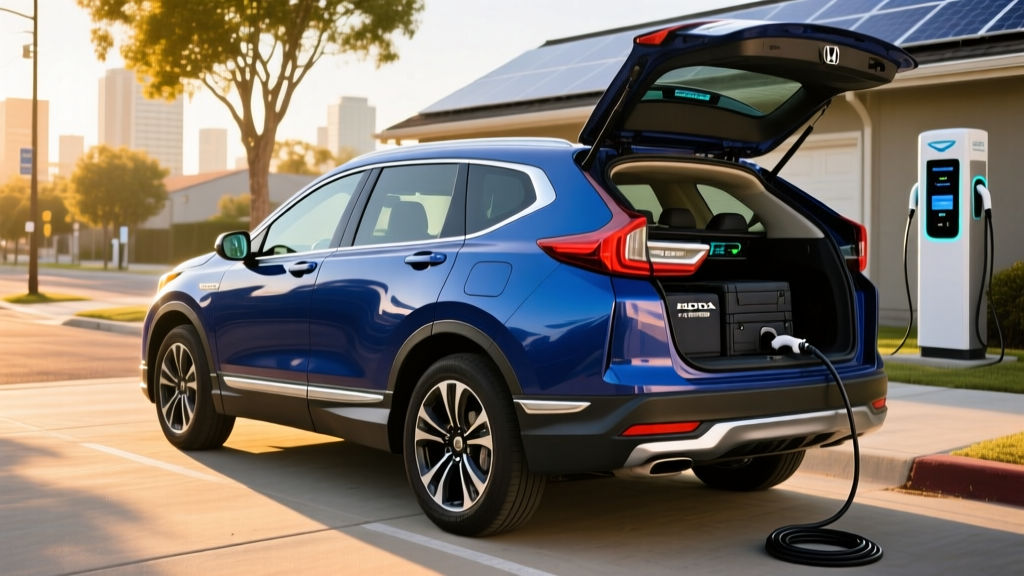
The 2023 Honda CR-V Hybrid represents a generational leap for Honda's best-selling SUV. Built on an all-new sixth-generation platform, it pairs a 2.0-liter Atkinson-cycle four-cylinder with a two-motor hybrid system for an EPA-estimated 40 MPG city and 34 MPG highway in front-wheel-drive form. For buyers who want SUV practicality without the charging logistics of a full EV, the CR-V Hybrid sits at the top of the compact hybrid crossover segment — alongside the Toyota RAV4 Hybrid and Hyundai Tucson Hybrid — offering a compelling blend of efficiency, cargo space, and Honda's reputation for long-term reliability.
This is a conventional hybrid (HEV), not a plug-in hybrid (PHEV). You never plug it in. The system recovers energy through regenerative braking and the gasoline engine to keep a small battery charged. If you're looking for electric-only driving, you'll need to look elsewhere — Honda does not currently offer a CR-V PHEV in the US market.
EPA Fuel Economy vs. Real-World MPG
| Drivetrain | City MPG | Highway MPG | Combined MPG |
|---|---|---|---|
| FWD (Sport, Sport Touring) | 43 | 36 | 40 |
| AWD (Sport, Sport Touring) | 40 | 34 | 37 |
Source: EPA / fueleconomy.gov
Powertrain: Two-Motor Hybrid System Explained
| Specification | 2023 CR-V Hybrid |
|---|---|
| Engine | 2.0L Atkinson-cycle DOHC 4-cylinder |
| Engine Output | 145 hp @ 6,100 rpm / 138 lb-ft torque |
| Electric Motors | Dual-motor system (propulsion + generator) |
| Combined System Output | 204 hp / 247 lb-ft torque |
| Transmission | Direct-drive (no traditional gearbox) |
| 0–60 MPH (est.) | ~7.6 seconds |
| Drivetrain | FWD standard; Real Time AWD available |
| Towing Capacity | 1,000 lbs |
Honda's fourth-generation two-motor hybrid system operates primarily as a series hybrid at low and moderate speeds — the gasoline engine spins a generator motor that feeds electricity to the propulsion motor, which drives the wheels. At highway speeds, a lock-up clutch connects the engine directly to the wheels for improved efficiency. This architecture eliminates the need for a conventional transmission, resulting in smooth, linear acceleration without shift shock.
The 247 lb-ft of torque is available almost instantly from the electric propulsion motor, making the CR-V Hybrid feel noticeably more responsive off the line than the non-hybrid 1.5L turbo CR-V (which produces 190 hp and 179 lb-ft). Merging onto highways and climbing grades is handled with less strain, and the transition between electric and gasoline power is among the smoothest in the segment.
HEV vs. PHEV vs. EV: Which Powertrain Fits You?
| Factor | Conventional Hybrid (HEV) | Plug-In Hybrid (PHEV) | Battery Electric (BEV) |
|---|---|---|---|
| Plug in to charge? | No | Yes (for EV range) | Yes (always) |
| Electric-only range | None (EV assist only) | 20–45 miles typical | 200–400+ miles |
| Home charging needed | No | Recommended (Level 2) | Essential |
| Fuel cost per mile | ~$0.10–0.13 | ~$0.04–0.10 (varies) | ~$0.03–0.06 |
| Federal tax credit | None | Up to $7,500 (if eligible) | Up to $7,500 (if eligible) |
| Range anxiety | None | None (gas backup) | Varies by driver |
| Best for | No home charging; simplicity | Short commute + home charger | Home charging + mostly daily driving |
The 2023 CR-V Hybrid is an HEV. It does not plug in, does not offer electric-only driving, and does not qualify for the federal §30D clean vehicle tax credit. That credit, governed by IRS rules, applies only to plug-in vehicles (PHEVs and BEVs) meeting battery sourcing, MSRP, and buyer income requirements.
- You don't have access to home or workplace charging
- You want maximum fuel efficiency with zero behavior change
- You frequently take long road trips and don't want to plan around charging stops
- You want a lower purchase price than a comparable PHEV or EV
- You have reliable Level 2 home charging and a commute under 30 miles
- You want to qualify for the federal tax credit (up to $7,500 point-of-sale)
- You want to minimize or eliminate gasoline use for daily driving
Pricing, Trims & Tax Credit Eligibility
| Trim | Drivetrain | MSRP (2023 launch) |
|---|---|---|
| Sport Hybrid | FWD | $32,990 |
| Sport Hybrid | AWD | $34,490 |
| Sport Touring Hybrid | AWD | $38,600 |
The CR-V Hybrid is available exclusively in Sport and Sport Touring trims. The Sport trim includes a 7-inch touchscreen with wireless Apple CarPlay/Android Auto, Honda Sensing suite (adaptive cruise, lane-keeping, automatic emergency braking), and dual-zone climate control. The Sport Touring adds a 9-inch touchscreen with wireless CarPlay, Bose 12-speaker audio, heated rear seats, wireless phone charging, and a hands-free power tailgate.
- The §30D Clean Vehicle Credit applies only to plug-in electric vehicles (PHEVs and BEVs)
- Conventional hybrids like the CR-V Hybrid do not have a plug and are excluded
- No federal purchase incentive applies to this vehicle
- Some states or utilities may offer rebates for hybrid purchases — check your local programs
Battery, Warranty & Long-Term Reliability
- Hybrid battery: 8 years / 100,000 miles (10 years / 150,000 miles in CARB states including CA, NY, MA, and others)
- Powertrain: 5 years / 60,000 miles
- Limited vehicle: 3 years / 36,000 miles
The CR-V Hybrid uses a lithium-ion battery pack mounted beneath the cargo floor. Honda does not publish the exact kWh capacity, as the battery is designed for charge-sustaining hybrid operation rather than stored electric range — it cycles frequently in a narrow state-of-charge window (roughly 40–80%), which significantly reduces degradation stress compared to a full EV battery.
Is the CR-V Hybrid reliable? Honda's two-motor hybrid system is now in its fourth generation and has accumulated millions of real-world miles across the Accord Hybrid, Insight, and previous CR-V Hybrid. The system has proven durable, with few widespread failure modes. The battery pack is designed to last the life of the vehicle under normal use. Should a replacement be needed outside warranty, Honda hybrid battery replacement costs typically range from $2,000 to $4,000 including labor — substantially less than full EV battery replacements. Independent repair shops increasingly offer refurbished hybrid battery modules at lower cost.
The NHTSA awarded the 2023 CR-V a 5-Star Overall Safety Rating. The IIHS named it a Top Safety Pick+ (with specific headlight trims), the organization's highest honor.
Driving Impressions & Practical Ownership
The 2023 CR-V Hybrid rides on a new platform that is noticeably stiffer than the outgoing generation, with improved steering feel and reduced body roll. The hybrid powertrain's electric torque delivery makes it feel quicker than its 7.6-second 0–60 time suggests in everyday driving — throttle response at low speeds is immediate, and the system seamlessly blends regenerative braking with the mechanical brakes.
Cargo space is generous at 36.3 cubic feet behind the rear seats (FWD) and 76.5 cubic feet with the rear seats folded — among the best in the compact SUV segment. The AWD system trims cargo capacity slightly due to the rear differential, but the difference is negligible for most buyers.
- Class-leading 40 MPG combined (FWD) in real-world city driving
- Smooth, responsive two-motor hybrid system with 204 hp
- Excellent cargo volume for the segment
- Top Safety Pick+ rating from IIHS
- Strong hybrid battery warranty (8–10 years)
- No charging infrastructure required
- Highway MPG drops noticeably above 70 MPH
- No PHEV variant available in the US
- Not eligible for federal EV tax credit
- 1,000-lb towing capacity limits utility
- Sport Touring trim pushes near $40K
- Road noise is present at highway speeds
Frequently Asked Questions
How many MPG does the 2023 Honda CR-V Hybrid get?
The EPA rates the FWD CR-V Hybrid at 43 city / 36 highway / 40 combined MPG. The AWD version is rated at 40 city / 34 highway / 37 combined. In real-world city driving, many owners report matching or slightly exceeding the city figure. Highway efficiency drops at speeds above 70 MPH, where the gasoline engine operates without regenerative assistance.
Does the CR-V Hybrid need to be plugged in?
No. The 2023 CR-V Hybrid is a conventional hybrid (HEV). It charges its battery entirely through regenerative braking and the gasoline engine. There is no plug, no charging cable, and no electric-only driving mode. You simply fill it with gasoline and drive.
Does the 2023 CR-V Hybrid qualify for a tax credit?
No. The federal §30D Clean Vehicle Credit applies only to plug-in electric vehicles (PHEVs and BEVs). Since the CR-V Hybrid is a conventional HEV with no plug, it does not qualify for any federal purchase incentive. Check your state and local utility programs — some offer rebates for hybrid vehicle purchases.
How long will the CR-V Hybrid battery last?
Honda warranties the hybrid battery for 8 years / 100,000 miles nationwide, and 10 years / 150,000 miles in CARB-emission states. The battery operates in a narrow charge window that minimizes degradation, and Honda's hybrid systems have demonstrated strong long-term durability. Out-of-warranty replacement typically costs $2,000–$4,000.
CR-V Hybrid vs. RAV4 Hybrid: which is better?
The Toyota RAV4 Hybrid offers a slightly higher EPA combined rating (41 MPG for the AWD XLE) and standard AWD across all trims. The CR-V Hybrid counters with more cargo space (36.3 vs. 37.6 cu ft is close, but Honda's interior packaging feels more usable), a more refined ride on the new platform, and a more intuitive infotainment system in the Sport Touring trim. Both are segment leaders — the choice often comes down to brand preference and local dealer pricing.
Is the CR-V Hybrid good for road trips?
Yes. With a 14.0-gallon fuel tank and 37–40 MPG combined, you can expect 500–560 miles of total range per tank. The Honda Sensing adaptive cruise control and lane-centering system reduce highway fatigue, and there's no need to plan charging stops. Highway fuel economy is the trade-off — expect closer to 30–33 MPG at sustained 75+ MPH speeds with AWD.