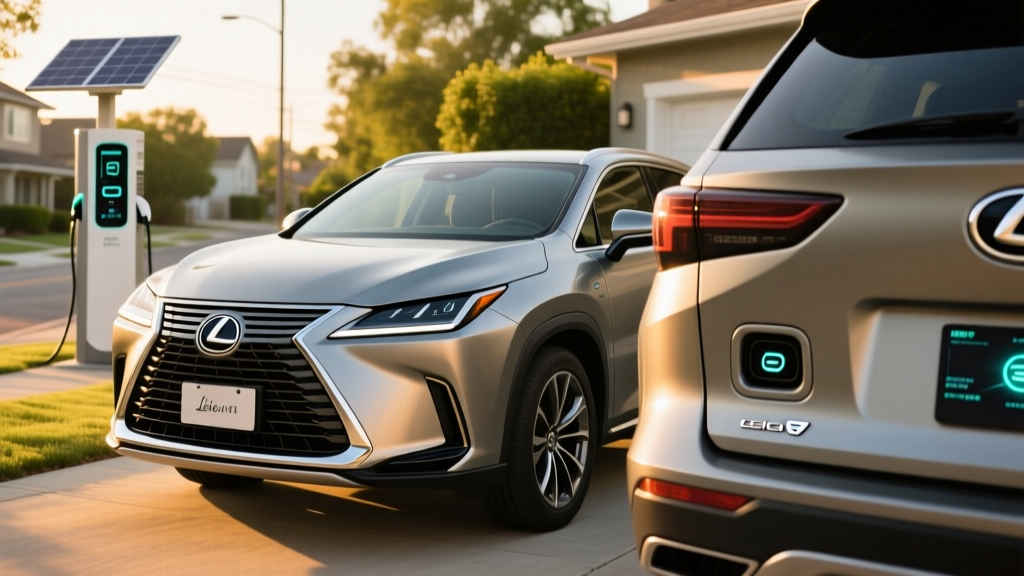
The three-row luxury SUV segment rarely rewards fuel efficiency, but the Lexus TX 350 hybrid — officially the TX 500h F SPORT Performance — attempts to thread the needle between family hauler and fuel sipper. For 2026, the TX lineup offers three distinct powertrains: the turbocharged TX 350 (gas-only), the TX 500h (conventional hybrid), and the TX 550h+ (plug-in hybrid). Buyers searching for a "Lexus TX 350 hybrid" are almost always cross-shopping the TX 500h against the gas model or considering whether the plug-in TX 550h+ justifies its premium.
This guide breaks down every electrified TX variant with exact EPA figures, real-world efficiency expectations, powertrain specs, and total ownership costs so you can match the right TX to your driving pattern.
Lexus TX Powertrain Lineup: Gas, HEV, and PHEV Explained
Before diving into MPG, it's critical to understand how Lexus structures the TX lineup, because the naming can mislead. There is no vehicle badged "TX 350 hybrid." Here's what actually exists for 2026:
| Model | Type | Needs Plugging In? | Powertrain | Combined HP |
|---|---|---|---|---|
| TX 350 | Gas-only (ICE) | No | 2.4L turbo I-4 | 275 hp |
| TX 500h | Conventional Hybrid (HEV) | No — self-charging via regen | 2.4L turbo I-4 + electric motors | 366 hp |
| TX 550h+ | Plug-in Hybrid (PHEV) | Yes — for EV range benefit | 3.5L V6 + electric motors | 406 hp |
A conventional hybrid (HEV) like the TX 500h captures energy from braking and deceleration to charge a small battery. You never plug it in — it operates like a gas car at the pump but uses electric assist to reduce fuel consumption. A plug-in hybrid (PHEV) like the TX 550h+ has a larger battery you charge from a wall outlet or public charger, giving you a meaningful electric-only driving range before the gas engine engages.
Fuel Economy: EPA Ratings and Real-World MPG
Here's where the hybrid advantage becomes concrete. The TX 500h delivers substantially better fuel economy than the gas-only TX 350, especially in city driving where regenerative braking and electric motor assist do the most work.
| Model | City MPG | Highway MPG | Combined MPG | Drivetrain |
|---|---|---|---|---|
| TX 350 (FWD) | 21 | 27 | 23 | FWD |
| TX 350 (AWD) | 20 | 26 | 22 | AWD |
| TX 500h (AWD) | 27 | 28 | 27 | AWD (DIRECT4) |
| TX 550h+ (AWD, hybrid mode) | 29 | 27 | 28 | AWD |
Source: EPA Fuel Economy Guide (fueleconomy.gov)
Real-World MPG Expectations
Hybrids typically exceed their EPA city ratings in stop-and-go traffic because that's where regenerative braking recaptures the most energy. In our experience with Toyota/Lexus turbo-hybrid powertrains, expect:
- City driving: TX 500h often achieves 28–30 MPG in moderate traffic
- Highway cruising (70+ mph): Expect 25–27 MPG — hybrids lose their advantage at sustained high speeds
- Cold weather (below 35°F): Subtract 2–4 MPG as the engine runs more often for cabin heat and battery conditioning
- Heavy cargo/towing: Subtract 3–5 MPG with a full load or roof box
The TX 550h+ achieves an EPA-estimated 33 miles of electric-only range. Once that battery is depleted, it operates as a conventional hybrid at roughly 28 MPG combined.
Powertrain Specs: What's Under the Hood
| Specification | TX 350 | TX 500h (HEV) | TX 550h+ (PHEV) |
|---|---|---|---|
| Engine | 2.4L turbo I-4 | 2.4L turbo I-4 + hybrid system | 3.5L V6 + hybrid system |
| Total System HP | 275 hp | 366 hp | 406 hp |
| Total Torque | 317 lb-ft | 406 lb-ft | 406+ lb-ft |
| 0–60 mph | ~7.0 sec | ~5.9 sec | ~5.5 sec |
| Transmission | 8-speed auto | 6-speed auto (hybrid-optimized) | e-CVT |
| Drivetrain | FWD or AWD | AWD (DIRECT4) | AWD (DIRECT4) |
| Towing Capacity | 5,000 lbs | 5,000 lbs | 5,000 lbs |
| Seating | 6 or 7 | 6 | 6 |
The TX 500h uses Lexus's DIRECT4 all-wheel-drive system, which employs a rear-mounted electric motor to continuously vary torque distribution between the front and rear axles. This isn't a traditional mechanical AWD — it can send up to 100% of rear torque instantly, improving both traction and cornering stability.
The TX 550h+ pairs a naturally aspirated 3.5-liter V6 with a more powerful electric motor setup and an 18.1 kWh (usable) lithium-ion battery pack. That battery provides the 33-mile electric-only range — enough for most school runs, grocery trips, and commutes under 30 miles.
TX 550h+ Plug-in Hybrid: Charging and Electric Range
If you're considering the PHEV variant, charging logistics matter. Here's the complete picture:
| Charging Method | Power | 0–100% Time | Notes |
|---|---|---|---|
| Level 1 (120V household outlet) | ~1.4 kW | ~12 hours | Overnight trickle; adds ~4 mi/hr |
| Level 2 (240V home charger) | ~6.6 kW | ~3 hours | Recommended for daily use |
| DC Fast Charging | Not supported | N/A | No DC fast-charge port |
The TX 550h+ does not support DC fast charging. This is common for PHEVs — the battery is small enough that Level 2 charging fully replenishes it overnight or during a workday. The 33-mile EV range means most daily driving can be done on electricity alone if you charge nightly.
The TX 500h (conventional hybrid) has no charging port at all. Its small hybrid battery is maintained entirely through regenerative braking and engine-driven generation. You fuel it like any gas car.
Pricing, Trims, and Tax Credit Eligibility
| Model / Trim | 2026 MSRP (est.) | Federal Tax Credit |
|---|---|---|
| TX 350 (Base) | $55,090 | None — gas vehicle |
| TX 350 Premium | $57,590 | None |
| TX 500h F SPORT Performance | $65,290 | None — conventional HEV |
| TX 550h+ Luxury (PHEV) | $73,490 | Up to $7,500 (§30D) — see rules below |
Source: Lexus TX model page
Federal Tax Credit Rules for the TX 550h+ (2026)
The TX 550h+ is the only variant that may qualify for the IRS §30D Clean Vehicle Credit. Eligibility depends on multiple factors that change annually:
- MSRP cap: SUVs must be under $80,000 — the TX 550h+ qualifies
- Buyer income cap: AGI must not exceed $150,000 (single), $225,000 (head of household), or $300,000 (joint)
- Battery sourcing: Critical minerals and battery components must meet phased-in domestic/free-trade sourcing thresholds — verify current-year compliance with your dealer
- Point-of-sale transfer: Eligible buyers can apply the credit as an immediate price reduction at the dealership rather than waiting for a tax refund
- Conventional hybrids (TX 500h) do NOT qualify for §30D — the credit applies only to plug-in vehicles with sufficient battery capacity
Always confirm eligibility with a tax professional and check the latest rules at IRS.gov before purchasing.
Hybrid Battery Warranty and Long-Term Reliability
Battery Warranty Coverage
| Coverage | Term |
|---|---|
| Hybrid Battery (TX 500h / TX 550h+) | 10 years / 150,000 miles |
| Hybrid System Components | 8 years / 100,000 miles |
| Basic Vehicle Warranty | 4 years / 50,000 miles |
| Powertrain Warranty | 6 years / 70,000 miles |
Lexus (and parent company Toyota) have the deepest track record in hybrid technology of any automaker, dating to the 2001 Prius. The TX 500h's hybrid battery is a sealed nickel-metal hydride (NiMH) pack designed for longevity — it's far smaller and less stressed than a full EV battery, cycling between roughly 40% and 80% state of charge to minimize degradation.
The TX 550h+ uses a lithium-ion pack, which carries slightly different degradation characteristics but benefits from the same 10-year/150,000-mile hybrid battery warranty. Under normal use, Toyota/Lexus hybrid batteries routinely last 150,000–200,000+ miles before meaningful capacity loss.
Battery replacement cost: If a hybrid battery does fail out of warranty, replacement typically runs $3,000–$5,000 for the TX 500h NiMH pack and $6,000–$9,000 for the TX 550h+ lithium-ion pack (parts and labor). Third-party reconditioned batteries are increasingly available at 40–50% lower cost. For context, the vast majority of Lexus hybrid owners never replace their battery during ownership.
Who Should Choose the TX 500h vs. the TX 550h+ vs. a Full EV?
Choose the TX 500h (HEV) If:
- You want better MPG without changing any habits — no plugs, no charging apps
- You don't have reliable home or workplace charging access
- You want the performance upgrade (366 hp) over the TX 350 with a 5 MPG combined improvement
- You drive more highway miles than city miles (where the hybrid advantage narrows)
- Budget is a priority — it's ~$8,000 less than the PHEV
Choose the TX 550h+ (PHEV) If:
- You have Level 2 charging at home and a commute under 33 miles
- You want to drive most weekdays on electricity with weekend gas flexibility
- You qualify for the $7,500 federal credit, narrowing the price gap significantly
- You want the smoothest, quietest around-town driving (EV mode)
- You plan to keep the vehicle 8+ years and want maximum fuel cost savings
Consider a Full EV (e.g., Tesla Model X, Rivian R1S) Instead If:
- You have reliable home Level 2 charging and your daily driving is under 250 miles
- You want zero tailpipe emissions and minimal maintenance (no oil changes, no engine)
- You want access to HOV lanes in states that grant them only to BEVs
- Your total mileage is high enough that electricity cost savings offset the higher purchase price
Pros and Cons at a Glance
TX 500h Pros
- 27 MPG combined in a 5,000-lb three-row SUV is exceptional
- 366 hp with DIRECT4 AWD — genuinely quick for its class
- No charging infrastructure needed — works like a gas car
- Toyota/Lexus hybrid reliability track record is unmatched
- 10-year/150k-mile hybrid battery warranty
TX 500h Cons
- $65,000+ starting price is steep for a hybrid SUV
- No federal tax credit for conventional hybrids
- Third-row space is tight for adults on long trips
- Highway MPG advantage over TX 350 is modest (~2 MPG)
- F SPORT Performance trim only — no base hybrid option
Frequently Asked Questions
How many MPG does the Lexus TX 350 hybrid get?
There is no "TX 350 hybrid" badge. The conventional hybrid in the TX lineup is the TX 500h, which achieves an EPA-estimated 27 MPG combined (27 city / 28 highway). The gas-only TX 350 gets 22–23 MPG combined depending on drivetrain. In real-world city driving, the TX 500h frequently exceeds its EPA rating, delivering 28–30 MPG.
How far can the TX 550h+ go on electric only?
The TX 550h+ plug-in hybrid has an EPA-estimated 33 miles of electric-only range. This covers most daily commutes and errands. Once the battery is depleted, the vehicle seamlessly switches to hybrid mode and continues as a conventional hybrid at approximately 28 MPG combined with no range limitation beyond the fuel tank.
Does the Lexus TX hybrid qualify for a tax credit?
The conventional hybrid TX 500h does not qualify for the federal §30D Clean Vehicle Credit — that credit is reserved for plug-in vehicles. The plug-in hybrid TX 550h+ may qualify for up to $7,500, subject to buyer income limits (under $150K single / $300K joint), MSRP caps (under $80K for SUVs — it qualifies), and battery component/critical mineral sourcing requirements that change annually. Check current rules at IRS.gov.
Is the Lexus TX hybrid reliable? What about battery replacement cost?
Lexus and Toyota have built hybrids continuously since 1997, and their hybrid systems are among the most proven in the industry. The hybrid battery is warrantied for 10 years / 150,000 miles. Real-world data shows Toyota/Lexus hybrid batteries routinely lasting 150,000–200,000+ miles. Out-of-warranty replacement costs approximately $3,000–$5,000 for the TX 500h and $6,000–$9,000 for the TX 550h+. Most owners never face this expense.
Should I get the TX 500h hybrid or a full electric SUV?
Choose the TX 500h if you lack reliable home charging, frequently drive over 300 miles between stops, or live in an area with sparse public charging infrastructure. Choose a full EV like the Rivian R1S or Tesla Model X if you have home Level 2 charging, your daily driving stays under 250 miles, and you want to eliminate gasoline costs and engine maintenance entirely. The TX 550h+ PHEV splits the difference — electric for weekdays, gas for weekends.
Does the TX 500h need to be plugged in?
No. The TX 500h is a conventional (self-charging) hybrid. Its small battery is recharged entirely by the gasoline engine and regenerative braking. You only ever visit a gas station, just like a conventional vehicle. Only the TX 550h+ plug-in hybrid benefits from being plugged in.