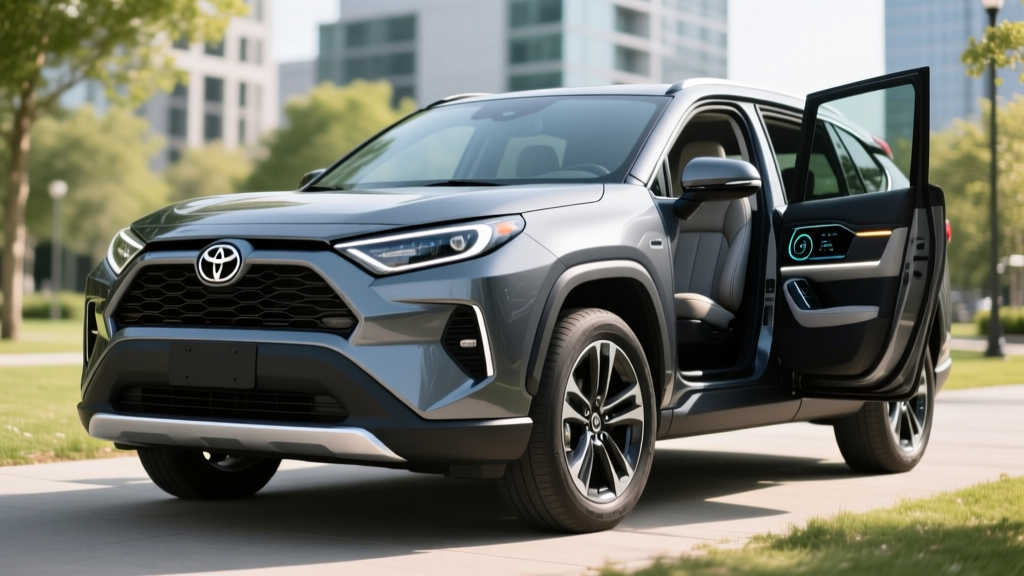
The Toyota RAV4 Hybrid remains the best-selling hybrid SUV in America for a reason: it delivers genuine fuel savings without requiring you to change a single driving habit. No plugs, no range anxiety, no charging apps — just a 39 MPG combined EPA rating and Toyota's reputation for long-term reliability. For 2025, the RAV4 Hybrid continues with the proven fourth-generation hybrid powertrain across a wide trim lineup, making it one of the most accessible entry points into electrified driving.
But how does the RAV4 Hybrid stack up against its plug-in sibling (the RAV4 Prime), and does it still make sense if you're also considering a full battery-electric vehicle? We break down every number that matters — from real-world fuel economy to battery replacement costs — so you can decide with confidence.
HEV vs. PHEV: Which RAV4 Is Right for You?
Toyota sells two electrified RAV4 variants, and confusing them is the most common buyer mistake. Here's the fundamental difference:
RAV4 Hybrid (HEV)
- No plug required. The 1.6 kWh battery recharges through regenerative braking and the gas engine.
- 39 MPG combined (EPA) across all trims with AWD.
- 219 combined horsepower from a 2.5L 4-cylinder + dual electric motors.
- Starts at ~$33,000 MSRP — no federal tax credit, but lower upfront cost.
- Best for: drivers without home charging access, or those who want simplicity.
RAV4 Prime (PHEV)
- Plugs in to a 120V or 240V outlet. 18.1 kWh battery pack.
- 42 miles electric-only (EPA), then operates as a 38 MPG hybrid.
- 302 combined horsepower — the quickest RAV4 Toyota makes.
- Starts at ~$44,500 MSRP — may qualify for federal/state incentives.
- Best for: drivers with home charging who commute under 40 miles daily.
If you can install a Level 2 charger at home and your daily driving stays under 42 miles, the RAV4 Prime effectively becomes an EV for your commute while retaining gas-engine flexibility for road trips. If you lack home charging or want a lower purchase price, the standard RAV4 Hybrid delivers outstanding efficiency with zero infrastructure requirements.
Fuel Economy: EPA Ratings and Real-World MPG
The 2025 RAV4 Hybrid comes exclusively with electronic all-wheel drive (AWD), meaning an independent rear electric motor powers the back axle — there's no mechanical driveshaft. This setup is standard across every trim, so fuel economy figures don't vary by trim level.
| Driving Condition | EPA Rating | Real-World Expectation |
|---|---|---|
| City | 41 MPG | 42–46 MPG (hybrids excel in stop-and-go) |
| Highway | 38 MPG | 34–37 MPG (aerodynamic drag at 70+ mph) |
| Combined | 39 MPG | 37–41 MPG (depends on driving mix) |
Why real-world city MPG often beats the EPA sticker: Hybrids recapture energy through regenerative braking every time you slow down. In dense urban traffic with frequent stops, the electric motors do more of the work and the gas engine shuts off more often. Owners who drive predominantly in the city regularly report 43–46 MPG on forums and fueleconomy.gov user submissions.
Highway reality check: At sustained speeds above 70 mph, the gas engine does nearly all the work and aerodynamic drag increases significantly. Expect 34–37 MPG on long interstate trips. Cold weather (below 30°F) can reduce fuel economy by 5–10% due to longer engine warm-up times and increased battery internal resistance.
For comparison, the non-hybrid gas-only 2025 RAV4 AWD achieves 30 MPG combined — meaning the hybrid saves roughly 3.3 gallons per 100 miles driven. At $3.40/gallon and 12,000 miles/year, that's approximately $1,346 in annual fuel savings over the gas model.
Powertrain Specs: What's Under the Hood
| Specification | 2025 RAV4 Hybrid |
|---|---|
| Engine | 2.5L DOHC 4-cylinder (176 hp, 163 lb-ft) |
| Front Electric Motor | 88 kW (118 hp) |
| Rear Electric Motor (AWD) | 40 kW (54 hp) |
| Net Combined Horsepower | 219 hp |
| Hybrid Battery | 1.6 kWh (sealed NiMH, self-charging) |
| Transmission | eCVT (planetary gearset, no belts) |
| 0–60 mph | 7.4 seconds |
| Drivetrain | Electronic AWD (eAWD) — standard |
| Towing Capacity | 1,750 lbs |
| Fuel Tank | 14.5 gallons |
| Total Driving Range | ~565 miles (EPA combined) |
The RAV4 Hybrid uses Toyota's fourth-generation hybrid system. Unlike a traditional CVT with a steel belt and pulleys, the eCVT is a planetary gearset that blends power from the engine and two motor-generators with no friction components to wear out. This is a major reason Toyota hybrids have such strong long-term reliability records.
The 1.6 kWh nickel-metal hydride (NiMH) battery is small by EV standards — it's not designed to drive the vehicle on electric power alone for any meaningful distance. Instead, it acts as a buffer, storing recaptured braking energy and providing torque-fill during acceleration. The battery is managed conservatively by the hybrid control system, never charging above ~80% or discharging below ~40% state of charge, which significantly extends its lifespan.
Pricing, Trims, and Tax Credit Eligibility
The 2025 RAV4 Hybrid is offered in six trims, all with AWD:
| Trim | MSRP (approx.) | Key Features |
|---|---|---|
| LE | $33,145 | Toyota Safety Sense 2.5, 8" touchscreen, wireless CarPlay/Android Auto |
| XLE | $34,635 | Blind-spot monitor, dual-zone climate, smart key, alloy wheels |
| XLE Premium | $36,560 | SofTex seats, moonroof, power liftgate |
| SE | $37,145 | Sport-tuned suspension, 19" wheels, paddle shifters |
| XSE | $38,045 | Two-tone paint, sport seats, ambient lighting |
| Limited | $40,760 | Leather, 12.3" digital cluster, premium audio, heated/ventilated front seats |
Federal tax credit: The standard RAV4 Hybrid (HEV) does not qualify for the IRS §30D Clean Vehicle Credit. That credit applies only to plug-in electric vehicles (BEVs and PHEVs) with sufficient battery capacity. Conventional hybrids that cannot be plugged in are excluded by statute.
What about the RAV4 Prime PHEV? The Prime has historically qualified for up to $7,500 under §30D, but eligibility depends on current-year battery sourcing, critical minerals, MSRP caps (≤$80,000 for SUVs), and buyer income limits ($150K single / $300K joint). Always verify current eligibility on fueleconomy.gov before purchasing, as supply-chain rules change periodically.
State incentives: Some states offer rebates for conventional hybrids, though these are less common than BEV/PHEV incentives. Check your state energy office or department of environmental quality for current programs.
Battery Longevity, Warranty, and Replacement Costs
Toyota Hybrid Battery Warranty
Coverage: 10 years / 150,000 miles (whichever comes first) on the hybrid battery and all hybrid-system components, including the inverter, motor-generators, and control ECU.
Applies to: All 2020+ model-year Toyota hybrids, including the 2025 RAV4 Hybrid. This warranty is transferable to subsequent owners.
How long do Toyota hybrid batteries actually last? Toyota's hybrid battery data, accumulated over 25+ years since the original Prius, shows that the vast majority of hybrid batteries outlast their warranty period. Taxi fleets running Toyota hybrids routinely report 200,000–300,000+ miles on original batteries. The conservative state-of-charge window (never fully charged or fully depleted) is the key engineering factor.
Replacement cost if out of warranty: A new OEM hybrid battery for the RAV4 Hybrid runs approximately $3,000–$4,500 including labor at a Toyota dealer. Refurbished/reconditioned batteries from third-party suppliers are available for $1,500–$2,500. Individual battery modules can sometimes be replaced for $500–$1,200 if only a few cells have degraded.
For context, the average RAV4 Hybrid owner will spend roughly $1,350/year less on fuel compared to the gas-only RAV4. Over a 10-year ownership period, that's $13,500 in fuel savings — more than enough to cover a battery replacement if one were ever needed (which statistically, it won't be for most owners).
RAV4 Hybrid vs. Prime vs. Full EV: The Decision Framework
Choose the RAV4 Hybrid (HEV) if:
- You don't have access to home or workplace charging (apartment, street parking, no garage).
- You want the lowest purchase price and simplest ownership experience.
- Your daily mileage varies widely — some days 10 miles, some days 400.
- You tow occasionally (1,750 lb capacity).
- You want proven, 20+ year hybrid reliability data.
Choose the RAV4 Prime (PHEV) if:
- You can install a Level 2 (240V) charger at home.
- Your daily commute is under 42 miles round-trip — you'd almost never use gas on weekdays.
- You want the quickest RAV4 (302 hp, 5.7-second 0–60).
- You want to reduce fuel consumption to near-zero on most days while keeping road-trip flexibility.
- You may qualify for the §30D federal tax credit and/or state PHEV incentives.
Choose a full BEV (e.g., Tesla Model Y, Hyundai Ioniq 5) if:
- You have reliable home Level 2 charging.
- You want the lowest per-mile energy cost (electricity is ~$0.04–0.06/mile vs. ~$0.09–0.12/mile for the hybrid on gas).
- You're comfortable planning around DC fast-charging on road trips.
- You want zero tailpipe emissions and minimal drivetrain maintenance (no oil changes, no spark plugs).
- Your household has a second gas or hybrid vehicle for long trips if needed.
RAV4 Prime PHEV: Electric-Only Range and Charging Details
For readers seriously considering the plug-in variant, here are the critical PHEV-specific numbers:
| Specification | 2025 RAV4 Prime |
|---|---|
| Battery Capacity | 18.1 kWh (lithium-ion) |
| Electric-Only Range (EPA) | 42 miles |
| Total Range (EV + Gas) | ~600 miles |
| MPGe (Electric Mode) | 94 MPGe combined |
| MPG (Hybrid Mode, Battery Depleted) | 38 MPG combined |
| Level 1 Charging (120V) | ~12 hours (0–100%) |
| Level 2 Charging (240V, 3.3 kW onboard) | ~4.5 hours (0–100%) |
| DC Fast Charging | Not supported |
| Combined Horsepower | 302 hp |
| 0–60 mph | 5.7 seconds |
| Base MSRP | ~$44,500 |
Important charging note: The RAV4 Prime does not support DC fast charging. Its onboard charger maxes out at 3.3 kW (some model years offered an optional 6.6 kW charger on higher trims — verify for the specific model year). This means a full charge from empty takes about 4.5 hours on a 240V Level 2 home charger, or roughly 12 hours on a standard 120V household outlet. For most PHEV owners who plug in nightly, this is perfectly adequate — you're only replenishing 42 miles of range, not 300.
In real-world use, expect 35–40 miles of electric range in moderate temperatures, dropping to 30–33 miles in cold weather (below 30°F) when cabin heating draws additional energy from the battery. Highway-speed electric-only driving (70+ mph) also reduces range to approximately 32–35 miles.
Reliability, Safety, and Ownership Costs
Toyota's hybrid powertrain is among the most thoroughly validated in the automotive industry. The eCVT planetary gearset has no belts, chains, or clutch packs to wear. The brake pads typically last 80,000–100,000 miles because regenerative braking handles most deceleration. There's no traditional starter motor or alternator to fail — the hybrid motor-generators handle those functions.
The 2025 RAV4 Hybrid includes Toyota Safety Sense 2.5 as standard equipment on every trim: adaptive cruise control, lane-tracing assist, automatic emergency braking with pedestrian detection, lane departure alert, and automatic high beams. These are SAE Level 1–2 driver-assist features — the driver must remain fully engaged at all times.
The RAV4 consistently earns top marks from the IIHS and NHTSA. Toyota's hybrid battery and hybrid-system warranty (10 years/150,000 miles) is one of the longest in the industry, reflecting the company's confidence in the technology.
Pros
- 41 MPG city — real-world owners often exceed this in stop-and-go driving
- No plug required — zero charging infrastructure needed
- Standard AWD on every trim with no fuel-economy penalty
- 10-year/150,000-mile hybrid battery warranty
- Strong resale value — RAV4 Hybrid holds value better than most competitors
- Proven reliability with 25+ years of Toyota hybrid data
- Spacious cargo area (37.5 cu ft behind rear seats)
Cons
- No DC fast charging (HEV doesn't need it; Prime lacks it)
- 1,750-lb towing capacity is modest for an SUV
- eCVT drone under hard acceleration (common to all Toyota hybrids)
- Infotainment system is functional but not class-leading
- No federal tax credit for the HEV (only the PHEV Prime qualifies)
- Rear seat legroom is adequate but not generous vs. some competitors
Frequently Asked Questions
How many MPG does the 2025 Toyota RAV4 Hybrid actually get?
The EPA rates it at 41 city / 38 highway / 39 combined. In real-world driving, city-heavy commuters regularly see 42–46 MPG thanks to regenerative braking, while sustained highway driving at 75 mph typically returns 34–37 MPG. Cold weather reduces these figures by roughly 5–10%.
Does the RAV4 Hybrid need to be plugged in?
No. The RAV4 Hybrid (HEV) is a self-charging conventional hybrid. Its small 1.6 kWh battery recharges through regenerative braking and the gasoline engine. You never plug it in. Only the RAV4 Prime (PHEV) requires plugging in to access its 42-mile electric-only range.
How far can the RAV4 Prime go on electric power alone?
The EPA rates the RAV4 Prime at 42 miles of electric-only range. Real-world results vary: expect 35–40 miles in mild weather with mixed driving, and 30–33 miles in cold weather or at sustained highway speeds. Once the battery depletes, it seamlessly transitions to hybrid mode at 38 MPG combined.
Is the RAV4 Hybrid reliable? What does a battery replacement cost?
Toyota's hybrid system has over 25 years of proven reliability. The hybrid battery is warranted for 10 years/150,000 miles, and most batteries outlast this coverage. If replacement is needed out of warranty, expect $3,000–$4,500 for a new OEM battery or $1,500–$2,500 for a refurbished unit. The eCVT transmission has no wear-prone belts or clutches.
Does the 2025 RAV4 Hybrid qualify for a federal tax credit?
No. The standard RAV4 Hybrid (HEV) does not qualify for the IRS §30D Clean Vehicle Credit because it cannot be plugged in and lacks sufficient battery capacity. The RAV4 Prime (PHEV) may qualify for up to $7,500, subject to current-year battery-sourcing requirements, MSRP caps, and buyer income limits. Always verify eligibility on fueleconomy.gov and consult a tax professional.
Hybrid vs. PHEV vs. full EV — which should I choose?
Choose the RAV4 Hybrid (HEV) if you want maximum simplicity, no charging infrastructure, and the lowest purchase price. Choose the RAV4 Prime (PHEV) if you can charge at home and commute under 42 miles daily — you'll use almost no gas on weekdays. Choose a full EV if you have home charging, want the lowest per-mile energy cost, and are comfortable with DC fast-charging on road trips.
How does the RAV4 Hybrid compare to competing hybrid SUVs?
The Honda CR-V Hybrid (40 MPG combined) is its closest rival, offering slightly more rear-seat room but a less proven hybrid track record. The Hyundai Tucson Hybrid (38 MPG combined) provides more standard features but trails on fuel economy. The RAV4 Hybrid's combination of 39 MPG, standard AWD, strong resale value, and Toyota's hybrid reliability record keeps it at the top of the segment.