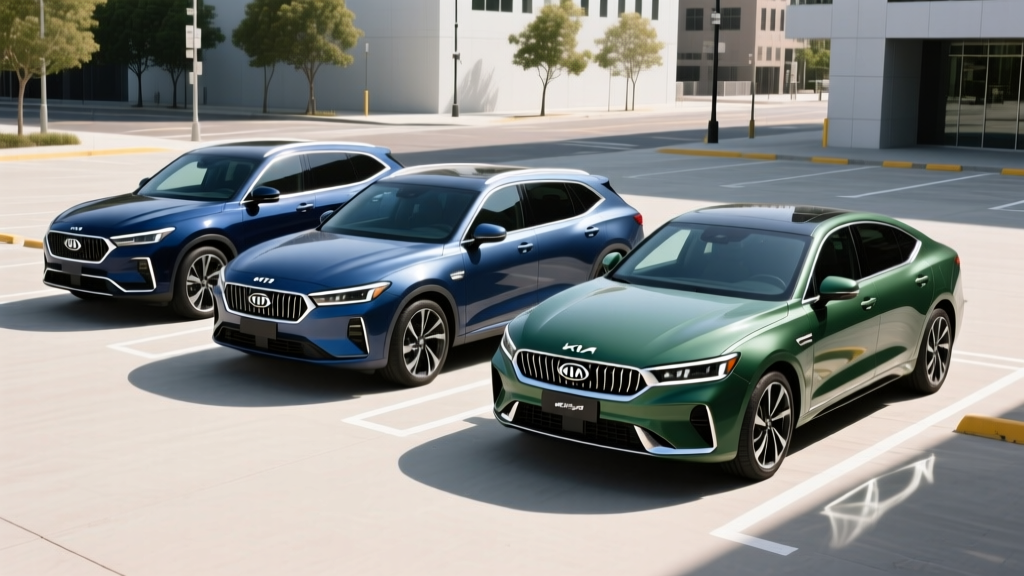
Kia's hybrid lineup has matured into one of the most comprehensive in the mainstream market. For 2026, the brand offers three core model families — the Niro, Sportage, and Sorento — each available as either a conventional hybrid (HEV) or a plug-in hybrid (PHEV). That gives buyers six distinct configurations to evaluate, spanning a compact crossover to a three-row midsize SUV, with prices ranging from the low $30,000s to the mid-$50,000s before incentives.
This guide breaks down every 2026 Kia hybrid model with exact EPA fuel economy figures, electric-only range for PHEVs, powertrain output, battery specifications, warranty coverage, and current federal tax credit eligibility. We'll also address the decision that matters most: whether an HEV, a PHEV, or a full battery-electric vehicle (BEV) is the right fit for your driving pattern.
HEV vs. PHEV: How Kia's Two Hybrid Types Actually Work
Before comparing individual models, it's essential to understand the mechanical distinction between Kia's HEV and PHEV powertrains — because the ownership experience differs substantially.
Conventional Hybrid (HEV)
A Kia HEV uses a small lithium-ion battery (typically 1.5–2.0 kWh) paired with a gasoline engine and electric motor. The battery recharges exclusively through regenerative braking and the engine — you never plug it in. The electric motor assists during acceleration and enables brief low-speed electric driving, but the engine remains the primary power source. The payoff is improved fuel economy, particularly in stop-and-go city traffic where regenerative braking recaptures energy that a gas-only car wastes as heat.
Plug-In Hybrid (PHEV)
A Kia PHEV carries a much larger battery (11.2–13.8 kWh usable) and a more powerful electric motor. You plug it in to a Level 1 (120V) or Level 2 (240V) charger to fill the battery, which delivers 28–33 miles of electric-only driving before the gasoline engine engages. Once the battery depletes, the vehicle operates as a conventional hybrid. The PHEV rewards owners who can charge at home and whose daily commutes fall within the electric-only range — effectively functioning as an EV on weekdays and a hybrid on road trips.
2026 Kia Niro Hybrid and Niro Plug-In Hybrid
The Niro is Kia's smallest hybrid offering — a compact crossover that prioritizes efficiency above all else. Redesigned for the current generation, it rides on a dedicated hybrid platform that maximizes interior packaging despite its modest footprint.
Niro HEV: The Efficiency Leader
The Niro HEV pairs a 1.6-liter four-cylinder engine with a 43-hp electric motor and a 1.56 kWh lithium-ion battery, routed through a six-speed dual-clutch automatic transmission. Combined output is 139 horsepower.
| Trim | City MPG | Highway MPG | Combined MPG |
|---|---|---|---|
| LX / EX | 53 | 54 | 53 |
| SX Touring | 49 | 52 | 50 |
Source: fueleconomy.gov
Real-world observation: The Niro HEV is one of those rare vehicles that can actually exceed its EPA city rating in moderate climates with light-footed driving — regenerative braking is highly effective at urban speeds. On sustained highway trips at 75+ mph, expect figures closer to 45–48 MPG as aerodynamic drag dominates and the engine carries more load.
Niro PHEV: 33 Miles Electric, Then Hybrid Mode
The Niro PHEV upgrades to an 84-hp electric motor and an 11.1 kWh usable battery pack (total pack capacity is larger, with a buffer to protect longevity). Combined system output rises to 180 horsepower.
| Specification | Value |
|---|---|
| Electric-only range (EPA) | 33 miles |
| Total range (electric + gas) | ~430 miles |
| Combined MPGe (electric mode) | 108 MPGe |
| Hybrid-mode MPG (after depletion) | 48 combined |
| Battery capacity (usable) | 11.1 kWh |
| Level 2 charge time (0–100%) | ~2 hours 45 min at 3.3 kW |
| DC fast charging | Not available |
| Combined horsepower | 180 hp |
Charging is limited to Level 1 (standard 120V outlet, ~9 hours to full) and Level 2 (240V, under 3 hours). There is no DC fast-charge capability — this is typical for PHEVs in this class, since the small battery doesn't warrant the added cost and weight of fast-charge hardware.
Starting MSRP for the Niro HEV is approximately $32,090; the Niro PHEV starts around $35,590 (source: Kia.com).
2026 Kia Sportage Hybrid and Sportage Plug-In Hybrid
The Sportage occupies the high-volume compact-SUV segment and offers the most powertrain variety in Kia's lineup. The hybrid and PHEV variants share the turbocharged 1.6-liter four-cylinder engine but differ significantly in electric motor output and battery size.
Sportage HEV: Practical Efficiency for a Family SUV
The Sportage HEV delivers a combined 226 horsepower — a substantial upgrade over the gas-only Sportage's 187 hp — thanks to a 59-hp electric motor integrated into the six-speed automatic transmission. A 1.49 kWh battery supports electric assist and low-speed EV mode.
| Drivetrain | City MPG | Highway MPG | Combined MPG |
|---|---|---|---|
| FWD | 42 | 44 | 43 |
| AWD | 38 | 38 | 38 |
The FWD-to-AWD efficiency gap is notable — all-wheel drive adds mechanical drag and weight, costing roughly 5 MPG combined. If you don't need AWD, the FWD Sportage HEV is meaningfully more efficient.
Sportage PHEV: 34 Miles Electric with AWD Standard
The Sportage PHEV is the performance-oriented plug-in option. It pairs the 1.6L turbo with a 97-hp electric motor and a 13.8 kWh usable battery. Combined output is 261 horsepower, and all-wheel drive is standard on every PHEV trim.
| Specification | Value |
|---|---|
| Electric-only range (EPA) | 34 miles |
| Total combined range | ~430 miles |
| Combined MPGe (electric mode) | 84 MPGe |
| Hybrid-mode MPG (after depletion) | 35 combined |
| Battery capacity (usable) | 13.8 kWh |
| Level 2 charge time (0–100%) | ~3 hours 15 min at 7.2 kW onboard charger |
| DC fast charging | Not available |
| Combined horsepower | 261 hp |
The Sportage PHEV's 7.2 kW onboard charger is a standout — it charges roughly twice as fast on Level 2 as most competing PHEVs, which typically max out at 3.3–3.7 kW. A full charge in just over 3 hours means you can easily top up during the workday if your workplace offers Level 2 stations.
MSRP for the Sportage HEV starts near $33,590 (FWD LX); the Sportage PHEV begins around $40,590 (source: Kia.com).
2026 Kia Sorento Hybrid and Sorento Plug-In Hybrid
The Sorento is the only three-row vehicle in Kia's hybrid lineup, making it the default choice for families who need six-passenger seating without stepping up to the full-size Telluride (which remains gas-only).
Sorento HEV: Three-Row Hybrid Efficiency
Like the Sportage, the Sorento HEV uses the 1.6L turbo-four and six-speed automatic with an integrated electric motor, producing 226 combined horsepower. The larger vehicle mass reduces fuel economy compared to the Sportage, but the figures remain strong for a three-row SUV.
| Drivetrain | City MPG | Highway MPG | Combined MPG |
|---|---|---|---|
| FWD | 36 | 35 | 36 |
| AWD | 34 | 34 | 34 |
Sorento PHEV: Electric Commuting with Third-Row Utility
The Sorento PHEV shares the Sportage PHEV's powertrain — 261 hp, 13.8 kWh battery, 7.2 kW onboard charger — but the additional weight and drag of the larger body trim electric-only range slightly.
| Specification | Value |
|---|---|
| Electric-only range (EPA) | 30 miles |
| Total combined range | ~420 miles |
| Combined MPGe (electric mode) | 79 MPGe |
| Hybrid-mode MPG (after depletion) | 33 combined |
| Battery capacity (usable) | 13.8 kWh |
| Level 2 charge time (0–100%) | ~3 hours 15 min at 7.2 kW |
| DC fast charging | Not available |
| Combined horsepower | 261 hp |
The Sorento HEV starts around $39,590; the Sorento PHEV starts near $52,090, reflecting its positioning as a near-premium family hauler.
Battery Warranty, Reliability, and Replacement Costs
Kia Hybrid & PHEV Battery Warranty
All 2026 Kia hybrid and plug-in hybrid models carry a 10-year / 100,000-mile hybrid battery warranty, alongside the standard 10-year/100,000-mile powertrain warranty. This is among the longest hybrid battery warranties in the industry — Toyota and Hyundai match it, while most competitors offer 8 years/100,000 miles.
The warranty covers battery capacity loss that causes the pack to fall below a defined performance threshold (typically 60–70% of original capacity, depending on the specific terms). It is transferable to subsequent owners only under the original 5-year/60,000-mile basic warranty period.
On reliability: Kia's hybrid powertrains have proven durable over the current generation's lifecycle. The six-speed automatic transmission used in the HEV and PHEV systems is a conventional torque-converter or dual-clutch design — not a CVT — which tends to draw fewer long-term reliability complaints than the CVTs found in some competing hybrids.
If a hybrid battery does require out-of-warranty replacement, expect costs between $2,500 and $5,000 depending on the model (Niro batteries are smaller and cheaper; Sorento PHEV packs cost more). Refurbished or reconditioned packs are increasingly available at the lower end of that range. For most owners, the 10-year warranty window will cover the vehicle's primary ownership period entirely.
Federal Tax Credits: What Qualifies in 2026?
Federal tax credit eligibility for Kia's hybrid lineup depends entirely on whether you're buying an HEV or a PHEV — and the rules differ substantially.
Conventional Hybrids (HEV): No Federal Tax Credit
The IRS §30D Clean Vehicle Credit applies only to plug-in vehicles with a minimum battery capacity of 7 kWh. None of Kia's HEV models qualify. There is currently no federal tax credit for conventional hybrids.
Plug-In Hybrids (PHEV): Up to $7,500 — With Caveats
Kia's PHEV models (Niro, Sportage, Sorento) may qualify for up to $7,500 under §30D, but eligibility hinges on three requirements that must all be met:
- MSRP cap: SUVs (Niro, Sportage, Sorento all qualify as SUVs under IRS classification) must have an MSRP at or below $80,000. All Kia PHEVs clear this threshold.
- Buyer income cap: Modified adjusted gross income must not exceed $150,000 (single), $225,000 (head of household), or $300,000 (joint filing).
- Battery sourcing requirements: The vehicle must meet critical minerals and battery component sourcing thresholds that phase up annually. As of 2026, these requirements are stringent, and Kia's PHEV battery supply chains may only partially qualify — meaning some vehicles may receive $3,750 (half credit) or the full $7,500 depending on the specific build date and battery lot.
Beginning in 2024, the credit can be transferred to the dealer at point of sale, reducing your purchase price directly rather than waiting for a tax refund. Always verify the specific vehicle's eligibility via the IRS's official seller reporting tool at irs.gov before signing a purchase agreement.
Hybrid vs. PHEV vs. Full EV: Which Kia Is Right for You?
Choose a Kia HEV if:
- You cannot charge at home (apartment, street parking, no garage access)
- You want a simple ownership experience with zero behavioral change — just fill up with gas as usual
- Your budget is tighter and you don't want the PHEV price premium ($3,000–$7,000 more)
- You drive a mix of city and highway and want consistently strong fuel economy without plugging in
Choose a Kia PHEV if:
- You can install or already have Level 2 charging at home
- Your daily commute is under 30 miles round-trip (the electric-only range covers most errands and commutes)
- You take road trips regularly and don't want to plan around DC fast-charger availability
- You want to reduce gasoline consumption significantly without committing to a full EV
Choose a Full EV (e.g., Kia EV6 or EV9) if:
- You have reliable home charging and your typical trips fall within 200–280 miles
- You want to eliminate gasoline costs and engine maintenance entirely
- You qualify for the full $7,500 federal credit and your state offers additional EV incentives
- You're comfortable with public DC fast charging for longer road trips
Complete 2026 Kia Hybrid Lineup at a Glance
| Model | Type | Combined HP | EPA MPG / MPGe | EV Range (PHEV) | Starting MSRP | Federal Credit |
|---|---|---|---|---|---|---|
| Niro HEV | HEV | 139 | 53 combined (LX) | N/A | $32,090 | None |
| Niro PHEV | PHEV | 180 | 108 MPGe / 48 MPG | 33 mi | $35,590 | Up to $7,500* |
| Sportage HEV (FWD) | HEV | 226 | 43 combined | N/A | $33,590 | None |
| Sportage PHEV (AWD) | PHEV | 261 | 84 MPGe / 35 MPG | 34 mi | $40,590 | Up to $7,500* |
| Sorento HEV (FWD) | HEV | 226 | 36 combined | N/A | $39,590 | None |
| Sorento PHEV (AWD) | PHEV | 261 | 79 MPGe / 33 MPG | 30 mi | $52,090 | Up to $7,500* |
*Federal credit subject to §30D eligibility requirements including buyer income limits, battery sourcing compliance, and point-of-sale dealer registration. Verify at irs.gov before purchase.
Frequently Asked Questions
How many MPG do Kia hybrid models get?
It varies by model and drivetrain. The Niro HEV leads at 53 MPG combined (LX/EX trims). The Sportage HEV FWD achieves 43 combined, and the Sorento HEV FWD delivers 36 combined. AWD reduces efficiency by 2–5 MPG across all models. PHEV models achieve 33–48 MPG in hybrid mode after the electric range is depleted, plus 79–108 MPGe when operating on battery power.
How far can Kia PHEVs drive on electric power alone?
The 2026 Niro PHEV delivers 33 miles of EPA-rated electric-only range, the Sportage PHEV achieves 34 miles, and the Sorento PHEV provides 30 miles. Real-world electric range depends on temperature (expect 15–25% reduction in freezing weather), driving style, and use of climate control. In mild conditions with moderate speeds, some owners report matching or slightly exceeding EPA figures.
Do Kia hybrids need to be plugged in?
No — Kia's conventional HEV models (Niro HEV, Sportage HEV, Sorento HEV) never need to be plugged in. The battery charges through regenerative braking and the gasoline engine. Only the PHEV models require plugging in to access their electric-only driving range. If you never plug in a PHEV, it will still function as a conventional hybrid, but you'll miss the efficiency benefit and the investment in the larger battery.
Are Kia hybrids reliable, and what does battery replacement cost?
Kia's current-generation hybrid powertrains have demonstrated solid reliability, backed by a 10-year/100,000-mile hybrid battery and powertrain warranty — one of the longest in the industry. Out-of-warranty battery replacement typically costs $2,500–$5,000 depending on the model, though refurbished options can reduce that figure. Most hybrid batteries are designed to last the life of the vehicle under normal use.
Does any Kia hybrid qualify for a federal tax credit?
Kia's conventional HEV models do not qualify for any federal tax credit. The three PHEV models (Niro, Sportage, Sorento) may qualify for up to $7,500 under the IRS §30D Clean Vehicle Credit, subject to buyer income limits ($150K single / $300K joint), MSRP caps ($80K for SUVs — all Kia PHEVs qualify), and battery component/critical mineral sourcing requirements that change annually. The credit can be applied at the point of sale as a direct price reduction. Always confirm eligibility for the specific vehicle VIN at irs.gov.
Can Kia PHEVs use DC fast chargers?
No. None of Kia's current PHEV models support DC fast charging. They are limited to Level 1 (120V, approximately 9–12 hours for a full charge) and Level 2 (240V). The Sportage and Sorento PHEV feature a 7.2 kW onboard charger, which is notably faster than the 3.3 kW chargers in the Niro PHEV and many competing PHEVs. Given battery sizes of 11–14 kWh, DC fast charging would add cost and weight without meaningful benefit for most PHEV owners who charge overnight at home.