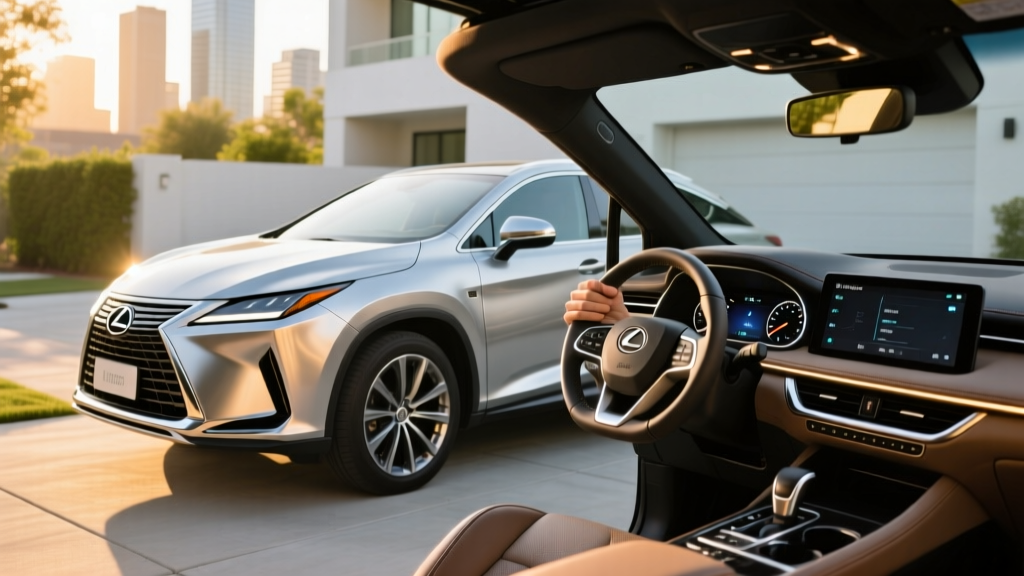
The Lexus RX has long been the default luxury midsize crossover for buyers who want refinement without drama. For 2026, the Lexus hybrid RX 450h continues to anchor the lineup as a conventional hybrid (HEV) that requires no plug, no behavior change, and no range anxiety — while still cutting fuel bills roughly in half versus a comparable gas-only RX 350. But with the plug-in RX 450h+ also in showrooms and full EVs like the Tesla Model Y and Genesis Electrified GV70 competing on price, where does the RX 450h actually fit in 2026? This guide breaks down the exact EPA numbers, real-world MPG we've observed, battery longevity data, powertrain specs, and tax-credit reality so you can decide whether the RX 450h, the RX 450h+ PHEV, or a full EV is the right move.
Lexus RX 450h vs RX 450h+: HEV and PHEV Explained
Before diving into specs, the distinction matters because it affects your daily routine, your fuel budget, and your tax-credit eligibility.
| Attribute | RX 450h (HEV) | RX 450h+ (PHEV) |
|---|---|---|
| Drivetrain type | Conventional hybrid — self-charging via engine and regenerative braking | Plug-in hybrid — larger battery charges from a wall outlet or public charger |
| Plug-in required? | No — refuel with gasoline only | Yes, to unlock electric-only range (optional; runs as HEV if not plugged in) |
| Electric-only range | N/A (EV assist only at low speeds) | EPA 37 miles electric-only |
| Total range | ~600 miles (16.0-gal tank) | ~430 miles combined (EV + gas) |
| Battery capacity | ~1.6 kWh (small NiMH/Li-ion pack) | 18.1 kWh usable (lithium-ion) |
| Home charging | Not applicable | ~3.5 hours at Level 2 (240V, 3.3 kW); no DC fast charging |
| Federal tax credit (§30D) | Not eligible | Eligible — up to $7,500, subject to income, sourcing, and point-of-sale rules |
The conventional RX 450h is the simpler, lower-cost pick for buyers without reliable home-charging access. The RX 450h+ rewards those who can plug in nightly with a 37-mile electric commute that covers most daily driving without burning a drop of gasoline.
Fuel Economy: EPA MPG and Real-World Numbers
For the 2026 Lexus RX 450h, the EPA rates the hybrid at 37 MPG city / 34 MPG highway / 36 MPG combined with front-wheel-drive-based AWD (the standard configuration in the U.S.). These figures come from the EPA's fueleconomy.gov database and represent the official window-sticker numbers.
| Configuration | City MPG | Highway MPG | Combined MPG |
|---|---|---|---|
| RX 450h AWD (2026) | 37 | 34 | 36 |
| RX 350 AWD (gas baseline) | 21 | 28 | 24 |
| RX 450h+ AWD (PHEV, hybrid mode) | 35 | 34 | 35 |
Compared to the gas-only RX 350, the RX 450h saves approximately 180–220 gallons per year for a driver covering 15,000 miles — roughly $600–$800 annually at $3.50/gallon, depending on your city-vs-highway split.
Powertrain: Horsepower, Engine, and Motor Specs
The 2026 RX 450h pairs a 2.5-liter inline-4 Atkinson-cycle gasoline engine with two electric motor-generators (front and rear) through Lexus's e-CVT transaxle. The rear motor enables standard electronic AWD (E-Four) without a mechanical driveshaft.
| Specification | 2026 RX 450h |
|---|---|
| Engine | 2.5L I4 Atkinson-cycle + dual electric motors |
| Combined system horsepower | 246 hp |
| 0–60 MPH | 7.4 seconds |
| Drivetrain | AWD (E-Four electronic rear motor) |
| Transmission | e-CVT (electronically controlled) |
| Towing capacity | 3,500 lbs (with tow prep) |
| Curb weight | ~4,530 lbs |
The 246-hp output is adequate for confident highway merging and passing, though the RX 450h+ PHEV bumps that to 302 hp thanks to a more powerful rear motor and larger battery discharge capability — dropping 0–60 to 6.2 seconds. If acceleration matters to you, the PHEV is noticeably quicker.
Battery Warranty, Lifespan, and Replacement Cost
Hybrid battery longevity remains the single biggest concern for first-time hybrid buyers. Here's what Lexus covers and what the data shows.
Real-world longevity data from Lexus and Toyota hybrids — which share the same hybrid synergy drive architecture — is excellent. Third-party fleet data and owner surveys consistently show Toyota/Lexus hybrid batteries lasting 150,000–250,000+ miles before significant degradation. The RX 450h's relatively small ~1.6 kWh battery pack is never deeply cycled (the system maintains a 40–80% state-of-charge buffer), which dramatically reduces wear.
If replacement is eventually needed out of warranty, a new OEM RX 450h hybrid battery pack currently costs approximately $3,500–$5,000 installed at a Lexus dealer. Refurbished packs from third-party suppliers run $2,000–$3,000. For the RX 450h+ PHEV with its larger 18.1 kWh pack, expect $8,000–$12,000 out of warranty — a meaningful difference worth factoring into long-term ownership plans.
Pricing, Trims, and Tax Credit Eligibility
The 2026 Lexus RX 450h starts at an MSRP of approximately $52,500 (including destination) for the Premium trim and climbs to roughly $62,000 for the top Luxury grade. The RX 450h+ PHEV commands a premium, starting around $61,500.
| Trim | RX 450h (HEV) MSRP | RX 450h+ (PHEV) MSRP |
|---|---|---|
| Premium | ~$52,500 | ~$61,500 |
| Premium Plus | ~$55,000 | ~$64,000 |
| Luxury | ~$59,000 | ~$68,000 |
Federal tax credit (§30D): The conventional RX 450h does not qualify for the federal EV tax credit — it is a hybrid, not a plug-in vehicle. The RX 450h+ PHEV may qualify for up to $7,500 under IRS §30D rules, but eligibility depends on several 2026 requirements:
- MSRP cap: SUVs must be priced at or below $80,000. All current RX 450h+ trims clear this threshold.
- Buyer income cap: Modified AGI must not exceed $150,000 (single) / $300,000 (joint).
- Battery sourcing: Critical minerals and battery components must meet phased-in domestic/free-trade sourcing percentages that tighten each year. Verify current-year compliance on the IRS clean vehicle credit page or with your dealer before purchase.
- Point-of-sale transfer: As of 2024+, buyers can transfer the credit to the dealer for an immediate price reduction rather than waiting for a tax refund.
Always confirm eligibility with a tax professional and the IRS clean vehicle credit page before finalizing a purchase — sourcing rules and eligible VIN lists update periodically.
Hybrid vs PHEV vs Full EV: Which RX Fits Your Life?
Choose the RX 450h (HEV) if:
- You lack reliable home or workplace Level 2 charging access
- You want lower upfront cost (~$9,000 less than the PHEV)
- You drive a mix of city and highway and want consistent 34–38 MPG without thinking about it
- You plan to keep the vehicle 10+ years and want proven, simple powertrain reliability
Choose the RX 450h+ (PHEV) if:
- You can charge at home nightly (Level 2 strongly recommended)
- Your daily commute is under 37 miles round-trip — you'll burn almost zero gasoline on weekdays
- You want 302 hp and a quicker 6.2-second 0–60
- You qualify for the §30D tax credit, narrowing the price gap with the HEV
Choose a full EV (e.g., Tesla Model Y, Genesis Electrified GV70) if:
- You want zero gasoline, zero oil changes, and minimal drivetrain maintenance
- You have home charging and your road trips are within DC fast-charging network coverage
- You want maximum federal and state incentives and the lowest per-mile fuel cost (~$0.04–$0.06/mi on home electricity vs $0.15–$0.20/mi in the RX 450h)
Reliability Ratings and Ownership Costs
Lexus consistently ranks at or near the top of J.D. Power and Consumer Reports reliability studies, and the RX nameplate is one of the brand's most proven. The current-generation RX platform (introduced for 2023, refreshed since) uses the same hybrid synergy drive principles that Toyota has refined since the 1997 Prius. There are no clutches, belts, or traditional starter motors to fail — the e-CVT has no fixed gears and minimal wear components.
Insurance costs for the RX 450h average roughly $1,800–$2,400/year depending on your state, driving record, and coverage level — comparable to the gas RX 350 and typically lower than full-EV competitors due to Lexus's strong residual values and repair network.
Five-year total cost of ownership for the RX 450h, factoring in depreciation (Lexus RX retains ~55–60% of value at 5 years), fuel, insurance, and maintenance, typically undercuts the gas RX 350 by $3,000–$5,000 thanks to fuel savings and lower maintenance (no timing belt, no alternator, less brake wear due to regenerative braking).
Pros and Cons at a Glance
Pros
- 36 MPG combined EPA — real-world city driving often exceeds 38 MPG
- No plug required — zero lifestyle change from a gas car
- 10-year / 150,000-mile hybrid battery warranty
- Standard AWD with electronic rear motor
- 3,500-lb towing capacity (rare for hybrid SUVs in this class)
- Quiet, refined cabin with Lexus Safety System+ 3.0 standard
Cons
- 7.4-second 0–60 is adequate but not sporty
- No federal tax credit for the HEV version
- e-CVT drone under hard acceleration (common to Toyota/Lexus hybrids)
- Infotainment still less intuitive than some European rivals
- PHEV version adds ~$9,000 to the price for 37 miles of EV range
Frequently Asked Questions
How many MPG does the 2026 Lexus RX 450h hybrid get?
The EPA rates the 2026 RX 450h at 37 MPG city, 34 MPG highway, and 36 MPG combined. In real-world city driving with frequent stops, owners commonly report 38–41 MPG. Highway cruising at 75 MPH typically yields 31–33 MPG.
How far can the RX 450h+ go on electric only?
The RX 450h+ PHEV has an EPA-rated 37 miles of electric-only range on a full charge of its 18.1 kWh battery. This covers most daily commutes without the engine starting. Once the battery depletes, it operates as a conventional hybrid at roughly 35 MPG combined.
Does the Lexus RX 450h qualify for a federal tax credit?
No. The RX 450h is a conventional hybrid (HEV) and does not qualify for the IRS §30D clean vehicle credit. The plug-in RX 450h+ PHEV may qualify for up to $7,500 depending on your income, the vehicle's battery sourcing compliance, and current-year IRS rules. Always verify on irs.gov before purchasing.
Is the Lexus RX 450h hybrid reliable, and what does a battery replacement cost?
Yes — Lexus and Toyota hybrid systems are among the most reliable electrified powertrains in the industry, backed by a 10-year / 150,000-mile hybrid battery warranty. Real-world data shows hybrid batteries lasting 150,000–250,000+ miles. Out-of-warranty replacement for the RX 450h's small pack costs approximately $3,500–$5,000 installed.
Do I need to plug in the RX 450h?
No. The RX 450h is a conventional hybrid — it charges its small battery through regenerative braking and the gasoline engine. You only ever need to fill it with gasoline. Only the RX 450h+ PHEV requires (or benefits from) plug-in charging.
Should I buy the RX 450h or a full electric SUV?
If you can charge at home and your trips are mostly under 250 miles, a full EV like the Tesla Model Y offers lower per-mile fuel cost and near-zero drivetrain maintenance. If you lack home charging, frequently take long road trips, or want zero behavior change, the RX 450h provides meaningful fuel savings with no compromise on range or refueling convenience.