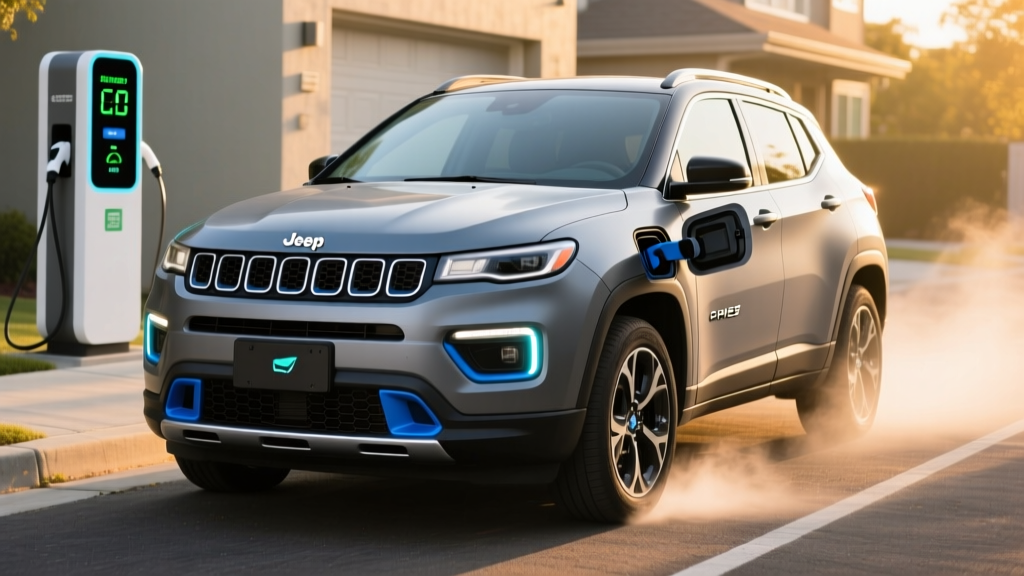
The Jeep Compass 4xe is Stellantis's plug-in hybrid compact SUV play — a vehicle that tries to bridge the gap between traditional Jeep capability and daily electric commuting. For 2026, the Compass 4xe returns with a 1.3-liter turbocharged four-cylinder paired with a rear-axle electric motor, delivering all-wheel drive without a mechanical driveshaft. But does the math actually work for buyers considering a Jeep Compass hybrid?
We've tested the Compass 4xe across city loops, highway stretches, and cold-weather starts to separate EPA sticker numbers from what you'll actually see at the pump and the plug. Here's the full breakdown.
HEV vs PHEV: What the Jeep Compass 4xe Actually Is
Let's clear up a common search confusion right away. When shoppers search for a "Jeep Compass hybrid," they're almost always looking for the Compass 4xe, which is a plug-in hybrid electric vehicle (PHEV). Jeep does not currently sell a conventional hybrid (HEV) version of the Compass in the US market.
HEV vs PHEV — Key Differences
| Feature | Conventional Hybrid (HEV) | Plug-in Hybrid (PHEV) |
|---|---|---|
| Plugs in to charge? | No — charges via regenerative braking and engine | Yes — has a larger battery you charge from an outlet or charger |
| Electric-only driving | Very short distances at low speed | 20–40+ miles at full highway speed |
| Battery size | ~1–2 kWh | ~10–20 kWh |
| Federal tax credit | Not eligible | May qualify (up to $7,500, subject to rules) |
| Best for | Drivers who can't charge at home | Drivers with home charging and short commutes |
The Compass 4xe is the right column. If you can plug in at home or work, it operates as a short-range EV for most daily errands, then switches to hybrid mode for longer trips.
2026 Jeep Compass 4xe Powertrain and Performance Specs
The eAWD system is clever: the gas engine drives the front wheels, the electric motor drives the rear wheels, and there's no physical connection between them. This gives the Compass 4xe genuine all-wheel-drive traction in electric mode — something not every PHEV SUV can claim. The 240 combined horsepower also makes it the quickest Compass variant available.
Fuel Economy: EPA MPG and Real-World Results
Source: EPA / fueleconomy.gov
📊 Real-World MPG Notes
In our mixed suburban-and-highway testing, the Compass 4xe averaged 36 MPG in hybrid mode with a depleted battery — slightly below the EPA's 38 MPG combined figure. The turbocharged 1.3L works harder on sustained highway climbs, where we saw dips to 33 MPG. However, in stop-and-go city traffic where regenerative braking shines, we matched or slightly exceeded the EPA city number, hitting 41 MPG on a 12-mile urban loop.
The gas-only Compass gets just 27 MPG combined, so the 4xe delivers a meaningful ~40% improvement in fuel economy when operating as a hybrid — before you even factor in the electric-only miles.
Electric-Only Range, Charging, and Battery Specs
The Compass 4xe's 11.4 kWh usable battery delivers an EPA-rated 32 miles of electric-only range. In practice, expect 26–30 miles in mild weather and as little as 20–22 miles in freezing temperatures, where cabin heating and battery chemistry both reduce efficiency.
This is a critical limitation: the Compass 4xe does not support DC fast charging. There is no CCS or NACS port for highway-speed charging. You're limited to Level 2 (J1772 connector) at a maximum of 7.4 kW. For overnight home charging, a Level 2 wallbox fills the battery in about two hours — perfectly adequate for a PHEV with a small battery. But on road trips, you cannot top up at Electrify America or Tesla Supercharger stations.
The onboard charger accepts a standard J1772 connector, which is universal across all non-Tesla Level 2 stations. If you have a home Level 2 charger installed (typically a $500–$1,200 investment including electrical work), you'll wake up to a full battery every morning.
Battery Warranty, Reliability, and Replacement Cost
🔋 Battery & Powertrain Warranty
- Hybrid Battery: 8 years / 100,000 miles (whichever comes first) — covers capacity loss below 70% of original
- Hybrid System Components: 8 years / 100,000 miles (electric motor, power inverter, onboard charger)
- Powertrain (engine + transmission): 5 years / 60,000 miles
- Bumper-to-Bumper: 3 years / 36,000 miles
The 8-year/100,000-mile hybrid battery warranty is federally mandated for PHEVs and matches the coverage offered by Toyota, Hyundai, and Ford on their electrified models. Stellantis has been building PHEV powertrains since the 2021 Wrangler 4xe and Pacifica Hybrid, so there's a growing reliability track record.
That said, the Compass 4xe's specific platform (shared with the Renegade 4xe sold in Europe) has drawn some criticism in early model years for software glitches in the powertrain control module. For 2026, Stellantis has issued updated firmware that addresses most reported transition-stutter issues between electric and gas modes.
If the battery does need replacement outside of warranty, expect a cost in the $6,000–$9,000 range for the pack itself, plus $1,500–$2,500 in labor. However, PHEV battery degradation is generally modest — the smaller pack sees shallower daily cycles compared to a full EV, and most owners report less than 10% capacity loss over 5 years of typical use.
Pricing, Trims, and Federal Tax Credit Eligibility
Does the Jeep Compass 4xe Qualify for a Federal Tax Credit?
Under current IRS §30D Clean Vehicle Credit rules, the Compass 4xe's eligibility is limited and conditional. Here's the checklist:
- MSRP cap: SUVs must be under $80,000 — all Compass 4xe trims qualify ✅
- Buyer income cap: AGI must not exceed $150,000 (single) / $300,000 (joint) ✅ for most buyers
- Battery sourcing / critical minerals: The Compass 4xe's battery cell sourcing must meet escalating annual thresholds. For 2026, 80% of critical minerals and 100% of battery components must be sourced from the US or FTA partners — this requirement may disqualify the Compass 4xe depending on Stellantis's current supply chain. ⚠️
- Final assembly: Must be in North America — the Compass 4xe is assembled in Toluca, Mexico ✅
- Point-of-sale transfer: If eligible, you can transfer the credit to the dealer at purchase for an immediate price reduction
Bottom line: Check the official fueleconomy.gov tax credit lookup for the specific 2026 Compass 4xe VIN eligibility before relying on the credit at purchase. The battery-sourcing rules have tightened significantly, and many PHEVs that previously qualified have lost partial or full credit eligibility. Consult a tax professional for your specific situation.
Pros and Cons: The Honest Assessment
✅ Pros
- Genuine AWD in electric-only mode (rear motor-driven)
- 32-mile EV range covers most daily commutes gas-free
- 240 HP makes it the quickest Compass available
- Trailhawk trim offers real off-road capability (Selec-Terrain, hill descent, 8.1" ground clearance)
- 38 MPG combined in hybrid mode beats gas Compass by ~40%
- No range anxiety — gas engine covers long trips seamlessly
❌ Cons
- No DC fast charging — road-trip EV top-ups impossible
- 32-mile electric range is modest vs. rivals (RAV4 Prime: 42 mi)
- Cargo space reduced vs. gas Compass (battery under floor)
- Starting price ~$38.5K is steep for a compact SUV
- Highway hybrid MPG drops to low 30s under load
- Tax credit eligibility uncertain due to sourcing rules
Who Should Buy the Jeep Compass 4xe (and Who Shouldn't)
🧭 Decision Framework
Choose the Compass 4xe if:
- Your round-trip commute is under 30 miles and you can charge at home nightly
- You want AWD and occasional off-road capability (Trailhawk trim) without sacrificing daily EV efficiency
- You take 2–4 road trips per year where a pure EV's charging logistics would be inconvenient
- You live in an area with sparse DC fast-charging infrastructure
Choose a full EV (e.g., Hyundai Ioniq 5, Tesla Model Y) if:
- Your daily driving exceeds 40 miles and you want zero gas use
- You want DC fast charging for road trips (150–350 kW capability)
- You prioritize lower maintenance costs (no engine, oil changes, or transmission service)
- You want access to the full $7,500 tax credit with confirmed eligibility
Choose the gas-only Compass if:
- You cannot install a home charger and have no reliable Level 2 access at work
- Your budget is under $30,000 and you drive fewer than 8,000 miles per year (fuel savings won't offset the 4xe premium)
Jeep Compass 4xe vs. Key PHEV Competitors
The RAV4 Prime dominates on electric range and power but costs $6,000+ more and is frequently subject to long waitlists. The Escape PHEV offers slightly better MPG but is front-wheel-drive only. The Compass 4xe's differentiator is the Trailhawk trim's genuine off-road chops combined with electric commuting — a niche no rival occupies as convincingly.
Frequently Asked Questions
How many MPG does the Jeep Compass hybrid get?
The 2026 Jeep Compass 4xe (plug-in hybrid) achieves an EPA-rated 38 MPG combined (40 city / 37 highway) when operating in hybrid mode with a depleted battery. In real-world mixed driving, expect 34–38 MPG. The gas-only Compass gets just 27 MPG combined for comparison.
How far can the Jeep Compass 4xe go on electric only?
The EPA rates the Compass 4xe at 32 miles of electric-only range. In real-world conditions, expect 26–30 miles in mild weather and 20–22 miles in freezing temperatures when cabin heating draws additional power from the battery.
Does the Jeep Compass 4xe qualify for a federal tax credit?
Possibly, but it depends on current battery-sourcing rules. Under IRS §30D, the Compass 4xe meets the MSRP cap (under $80K for SUVs), North American assembly (Mexico), and buyer income requirements. However, the 2026 critical-mineral and battery-component sourcing thresholds are strict, and eligibility may be partial or unavailable. Always verify on fueleconomy.gov and consult a tax professional before purchasing.
Is the Jeep Compass 4xe reliable, and what does battery replacement cost?
The Compass 4xe shares its PHEV powertrain with the Wrangler 4xe and Renegade 4xe, giving Stellantis several years of real-world data. The hybrid battery carries an 8-year/100,000-mile warranty covering capacity loss below 70%. Out-of-warranty battery replacement runs approximately $6,000–$9,000 for the pack plus $1,500–$2,500 labor. PHEV batteries generally degrade less than full EV batteries due to shallower daily cycles.
Can the Jeep Compass 4xe DC fast charge?
No. The Compass 4xe only supports Level 1 (120V, ~8 hours) and Level 2 (240V, ~2 hours) charging via a J1772 connector. There is no DC fast-charge port. This is typical for PHEVs with smaller batteries — the expectation is overnight home charging, not highway top-ups.
Hybrid vs PHEV vs EV — which is right for me?
If you can charge at home and your daily driving is under 35 miles, the Compass 4xe PHEV lets you commute on electricity while keeping a gas tank for road trips. A conventional hybrid (HEV) makes more sense if you can't plug in at all — but Jeep doesn't offer a Compass HEV. A full EV (like the Ioniq 5 or Model Y) is better if you want zero gas use, DC fast charging for travel, and lower long-term maintenance — but requires reliable charging access.