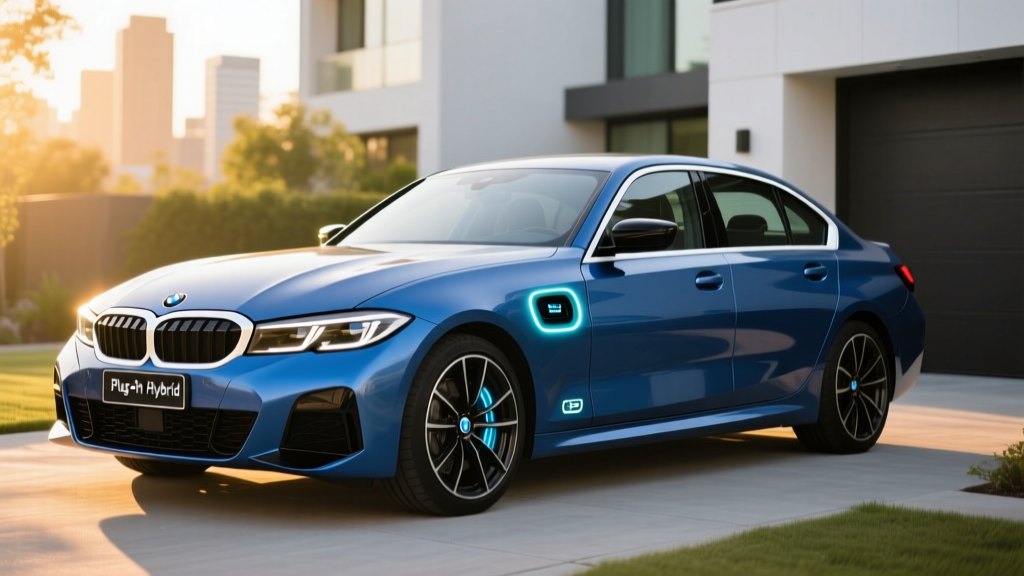
The BMW 330e has occupied a specific niche since its debut: a sport sedan that lets you commute on electricity while keeping a gas engine for road trips. The 2026 BMW 330e plug-in sedan continues that formula with a turbocharged four-cylinder paired with an electric motor integrated into the transmission, a modest battery pack for short zero-emission drives, and the driving dynamics BMW is known for. But with full EVs now routinely exceeding 300 miles of range and conventional hybrids achieving 50+ MPG, where does a plug-in hybrid like the 330e actually fit in 2026?
This guide breaks down every number that matters — EPA MPG and MPGe, electric-only range, battery capacity, charging times, powertrain output, pricing, tax credit eligibility, and real-world ownership considerations — so you can decide whether the 330e is the right electrified sedan for your garage.
BMW 330e at a Glance: Key Specs
| Spec | Value |
|---|---|
| Powertrain | 2.0L turbo I4 + electric motor (PHEV) |
| Combined System Output | 288 hp / 310 lb-ft torque |
| Battery (Gross / Usable) | 19.5 kWh / ~16.3 kWh usable (NMC lithium-ion) |
| EPA Electric-Only Range | 22 miles (up to 24 mi in ideal conditions) |
| EPA Combined MPGe (EV mode) | 75 MPGe |
| EPA MPG (Hybrid/Charge-Sustaining) | 28 city / 34 highway / 30 combined |
| Total Combined Range | ~370 miles (electric + gas) |
| 0–60 mph | 5.6 seconds (xDrive AWD) |
| Max AC Charging (Level 2) | 3.7 kW (J1772 connector) |
| DC Fast Charging | Not available |
| Level 2 Charge Time (0–100%) | ~4.5 hours at 3.7 kW |
| Level 1 Charge Time (120V) | ~12–14 hours |
| Drivetrain | xDrive AWD (standard) |
| Cargo Volume | 13.2 cu ft (battery reduces trunk space) |
| Base MSRP (330e xDrive) | $46,895 (before destination) |
| Battery & Powertrain Warranty | 8 years / 80,000 miles (hybrid components) |
| Basic / Powertrain Warranty | 4 yr / 50,000 mi basic; 4 yr / 50,000 mi powertrain |
HEV vs. PHEV vs. Full EV: Where the 330e Fits
Before diving deeper, it's worth clarifying the three electrified vehicle categories, because buyers often confuse them:
| Feature | HEV (e.g., Toyota Prius) | PHEV (e.g., BMW 330e) | BEV (e.g., Tesla Model 3) |
|---|---|---|---|
| Plug in to charge? | No — charges via regen & engine | Yes — but can also run on gas alone | Yes — required |
| Electric-only range | 0–2 miles at low speed | 20–40 miles typical | 250–400+ miles |
| Gas engine? | Yes (primary propulsion) | Yes (backup + highway) | No |
| Tailpipe emissions | Low | Low when charged; moderate on gas | Zero at tailpipe |
| Federal tax credit (§30D) | No | Up to $3,750 (if eligible) | Up to $7,500 (if eligible) |
| Home charging needed? | No | Recommended for daily EV commuting | Essential |
The 2026 BMW 330e is a plug-in hybrid (PHEV). It has both a gas tank and a battery you charge by plugging in. If you forget to charge it, the car still drives perfectly fine as a conventional hybrid — the engine and regenerative braking manage the battery automatically. This is the core advantage over a full EV: zero range anxiety on road trips. The trade-off is that the electric-only range (22 miles EPA) is quite short compared to a BEV, and the battery is small enough that DC fast charging isn't offered.
Electric-Only Range and MPGe: The Daily Commute Question
The EPA rates the 2026 BMW 330e at 22 miles of electric-only range. In practice, this number shifts based on conditions:
EPA Electric Range: 22 miles
Real-World Expectations:
- Mild weather, city driving (under 45 mph): 23–26 miles possible
- Highway driving (70+ mph): 16–18 miles before engine kicks in
- Cold weather (below 32°F): 14–17 miles (battery efficiency drops ~20–30%)
Key insight: The 330e's electric range is best suited for short commutes and errands. If your round-trip commute exceeds 20 miles, the engine will activate on the return leg unless you charge at work.
When running on electricity alone, the 330e achieves 75 MPGe (miles per gallon equivalent), a measure the EPA uses to compare electric and gas energy consumption. For context, a full EV like the Tesla Model 3 Long Range achieves 132 MPGe — the 330e's lower figure reflects the weight and complexity of carrying both a gas powertrain and an electric system.
Once the battery depletes, the car switches to charge-sustaining hybrid mode. Here, the EPA rates it at 30 MPG combined (28 city / 34 highway). These are respectable numbers for a 4,000+ lb luxury AWD sedan, but they trail conventional hybrids like the Toyota Prius (57 MPG combined) by a wide margin. The 330e's hybrid efficiency is limited by its weight and performance-oriented tuning.
| Mode | City | Highway | Combined |
|---|---|---|---|
| Electric Only (MPGe) | — | — | 75 MPGe |
| Hybrid (Charge-Sustaining) MPG | 28 | 34 | 30 |
Real-world note: In city driving with a charged battery, many owners report effectively achieving 50–80+ MPG equivalent over short trips because the electric motor handles most of the work. On long highway trips where the battery depletes within the first 20 miles, expect the 28–34 MPG hybrid figures to dominate.
Powertrain and Performance: 288 HP of Electrified Sport Sedan
The 330e pairs a 2.0-liter turbocharged inline-four (producing 181 hp on its own) with an electric motor integrated into the 8-speed automatic transmission. Combined system output is 288 horsepower and 310 lb-ft of torque. BMW's xDrive all-wheel-drive system is standard.
The result is a 0–60 mph time of 5.6 seconds — quick for a luxury sedan and noticeably faster than the gas-only 330i (5.8 seconds). The electric motor provides instant torque at low RPMs, making the 330e feel punchy around town. In Sport mode with a charged battery, the XtraBoost function temporarily adds the motor's full output for overtaking.
Driving modes include:
- Hybrid (default): The car automatically balances electric and gas power for efficiency.
- Electric: Forces pure EV mode until the battery depletes or you floor the throttle.
- Sport: Aggressive throttle mapping, firmer steering, and maximum combined power.
- Battery Control: Runs the engine to maintain or recharge the battery — useful if you want to save EV range for a city zone later in your trip.
The powertrain is smooth and well-integrated. Transitions between electric and gas power are nearly imperceptible — a hallmark of BMW's PHEV engineering. The 8-speed automatic shifts crisply, and the regenerative braking is progressive rather than grabby.
Charging the 330e: What You Need to Know
Charging the BMW 330e is straightforward but limited compared to full EVs:
| Level | Power | Connector | 0–100% Time | Practical Use |
|---|---|---|---|---|
| Level 1 (120V household) | ~1.4 kW | J1772 | 12–14 hours | Overnight trickle; not ideal daily |
| Level 2 (240V home/work) | 3.7 kW | J1772 | ~4.5 hours | Best daily option; full charge overnight |
| DC Fast Charging | N/A | N/A | N/A | Not supported on the 330e |
The 330e's onboard charger maxes out at 3.7 kW. Even if you plug into a 7.2 kW or 11.5 kW Level 2 station, the car will only draw 3.7 kW. This means a full charge takes about 4.5 hours — fine for overnight home charging but impractical for mid-day top-ups.
DC fast charging is not available on the 330e. BMW has not equipped the PHEV 3 Series with DC capability, which is common across most PHEVs (the Toyota RAV4 Prime and Chrysler Pacifica PHEV also lack DC charging). Given the small 19.5 kWh battery, the use case simply doesn't demand it — you're topping up overnight, not on a road trip.
Home charging setup: A standard Level 2 home charger (such as a ChargePoint Home Flex or BMW's own Wallbox) on a 240V circuit will fully replenish the battery each night. Installation typically costs $500–$1,500 depending on your electrical panel's capacity and the run length from panel to garage. For the 330e's 3.7 kW draw, even a basic 16-amp Level 2 circuit is sufficient — you don't need to upgrade to a 48-amp charger.
The charge port is located on the driver-side front fender and uses the J1772 connector standard on all non-Tesla PHEVs and EVs in North America. An adapter is not needed for public Level 2 stations (ChargePoint, EVgo, etc.).
Pricing, Trims, and Tax Credit Eligibility
The 2026 BMW 330e xDrive starts at $46,895 (plus $1,175 destination), placing it roughly $4,000 above the gas-only 330i xDrive. Key standard equipment includes:
- BMW Curved Display with iDrive 8.5
- Sport seats with SensaTec upholstery
- 18-inch alloy wheels
- Adaptive LED headlights
- BMW Driving Assistant (forward collision warning, lane departure, blind-spot)
- Wireless Apple CarPlay and Android Auto
Popular option packages can push the price into the $55,000–$60,000 range:
- Premium Package (~$3,200): Heated steering wheel, heated front seats, head-up display
- Executive Package (~$3,800): Parking Assistant Plus, surround-view camera, gesture control
- M Sport Package (~$4,200): Sport suspension, M steering wheel, aerodynamic kit, 19-inch wheels
- Individual options: Harman Kardon audio ($875), Vernasca leather ($1,450), adaptive suspension ($1,000)
Federal Tax Credit: Does the 330e Qualify?
Under the IRS §30D clean vehicle credit, the BMW 330e may qualify for a partial federal tax credit of up to $3,750 — not the full $7,500. Here's why:
- Battery sourcing requirement: The 330e's battery is manufactured by CATL (China) and assembled in Europe. As of 2026, the critical minerals and battery component sourcing requirements under §30D mean many BMW PHEVs qualify for only the $3,750 battery-component half of the credit — or potentially none, depending on the specific model year's supply chain.
- MSRP cap: Sedans must be under $55,000 MSRP. The 330e base price ($46,895) qualifies, but heavily optioned examples exceeding $55,000 do not.
- Buyer income cap: AGI must not exceed $150,000 (single), $225,000 (head of household), or $300,000 (joint).
- Point-of-sale transfer: If eligible, you can transfer the credit to the dealer at purchase for an immediate price reduction — you don't need to wait until tax filing.
- Verify before buying: Ask the dealer for the vehicle's IRS credit eligibility code and cross-reference with the fueleconomy.gov tax credit lookup. Rules change frequently.
Bottom line: Expect $0–$3,750 in federal credit depending on your income, the vehicle's option level, and the current sourcing rules. Do not assume the full $7,500. Consult a tax professional for your specific situation.
Real-World Ownership: Reliability, Battery Warranty, and Costs
BMW Hybrid Battery & Component Warranty:
- Coverage: 8 years / 80,000 miles (whichever comes first)
- What's covered: High-voltage battery, electric motor, power electronics, onboard charger
- Capacity threshold: BMW warrants the battery against defects and excessive degradation — typically defined as dropping below ~70% of original capacity within the warranty period
- Out-of-warranty replacement cost: $8,000–$12,000 for the high-voltage battery pack (based on dealer estimates and third-party shops)
Reliability: BMW's PHEV powertrain has proven reasonably robust. The B48 2.0L turbo engine is one of BMW's most reliable modern mills, and the electric motor/transmission integration has few reported failure points. The main long-term concern is the high-voltage battery, which uses NMC (nickel manganese cobalt) chemistry. NMC batteries degrade faster than LFP (lithium iron phosphate) but offer higher energy density in a smaller package — a necessary trade-off in a sedan with limited battery space.
Based on owner reports and industry data from sources like Consumer Reports, BMW 330e models from 2021–2025 have shown average-to-above-average reliability. Common issues are minor — software glitches, 12V battery drain (the auxiliary battery, not the traction battery), and occasional charging-port door malfunctions.
Ownership cost comparison (5-year estimate):
| Category | 330e xDrive (PHEV) | 330i xDrive (Gas) |
|---|---|---|
| MSRP (base) | $46,895 | $42,895 |
| Federal tax credit (est.) | −$3,750 | $0 |
| Effective purchase price | $43,145 | $42,895 |
| Fuel/electricity (5 yr, 15k mi/yr) | $4,800–$6,200* | $9,500–$11,000 |
| Maintenance (5 yr) | $2,800–$3,500 | $3,200–$4,000 |
| Insurance (5 yr avg) | $9,000–$11,000 | $8,500–$10,500 |
| Estimated 5-yr total cost | $59,745–$63,845 | $64,095–$68,395 |
*Fuel cost for the 330e varies dramatically based on how often you charge. If you charge nightly and commute under 22 miles, most driving is electric, pushing costs toward the low end. If you rarely charge, you're burning gas at 30 MPG — closer to the high end.
The 330e can save roughly $3,000–$5,000 over five years compared to the gas 330i, primarily through reduced fuel consumption — but only if you charge regularly. Without home charging access, the PHEV premium over the 330i becomes harder to justify.
Who Should Buy the BMW 330e — And Who Shouldn't
Pros
- Seamless transitions between EV and gas — no range anxiety on road trips
- 288 hp with instant electric torque feels sportier than the 330i
- Short commutes (under 22 mi round-trip) can be done entirely on electricity
- BMW driving dynamics, build quality, and interior refinement
- No need to rely on public charging infrastructure
- Partial federal tax credit may reduce effective price
Cons
- 22-mile electric range is short — most commutes will use some gas
- No DC fast charging limits mid-day top-ups
- Trunk space reduced to 13.2 cu ft (battery intrusion)
- 30 MPG hybrid mode trails conventional hybrids significantly
- Premium over 330i only pays off with regular charging
- Full tax credit unlikely due to battery sourcing rules
Decision Framework: Is the 330e Right for You?
Choose the BMW 330e if:
- Your daily commute is under 25 miles round-trip and you can charge at home nightly
- You want a luxury sport sedan but take road trips where EV charging infrastructure is sparse
- You're not ready to commit to a full EV but want to reduce gas consumption
- You value BMW's driving dynamics and want more power than the 330i
Choose a full EV (like the BMW i4 or Tesla Model 3) if:
- Your daily driving is under 250 miles and you have reliable home charging
- You want zero tailpipe emissions and maximum fuel savings
- You want access to DC fast charging for road trips
- You want the full $7,500 federal tax credit (subject to eligibility)
Choose the gas 330i if:
- You cannot install a home charger (apartment, no garage)
- Your commute is long (60+ miles daily) where the PHEV premium won't pay off
- Trunk space is a priority (330i offers 17 cu ft vs. 330e's 13.2)
Frequently Asked Questions
How many MPG does the BMW 330e get?
The EPA rates the 2026 BMW 330e at 28 city / 34 highway / 30 combined MPG when running in hybrid (charge-sustaining) mode. When the battery is charged and you're driving on electricity, efficiency is rated at 75 MPGe. Real-world MPG depends heavily on how often you charge — owners who plug in nightly and commute short distances report effectively using very little gasoline on a day-to-day basis.
How far can the BMW 330e go on electric only?
The EPA electric-only range is 22 miles. In mild weather with city driving, you may see 24–26 miles. Highway speeds and cold weather reduce this to 14–18 miles. Once the battery depletes, the gas engine takes over seamlessly.
Does the BMW 330e qualify for a federal tax credit?
The 330e may qualify for a partial federal tax credit of up to $3,750 under IRS §30D, depending on battery sourcing compliance, buyer income limits, and the vehicle's MSRP (must stay under $55,000 for sedans). The full $7,500 credit is unlikely due to critical-mineral and battery-component sourcing requirements. Always verify eligibility on fueleconomy.gov and consult a tax professional before purchasing.
Is the BMW 330e reliable, and what does battery replacement cost?
The 330e's B48 turbo engine and electric motor integration have shown average-to-good reliability in owner surveys. The high-voltage battery is covered by an 8-year/80,000-mile warranty. Out-of-warranty replacement is estimated at $8,000–$12,000, though most PHEV batteries from this era are lasting well beyond 100,000 miles with normal use.
Can the BMW 330e use DC fast chargers?
No. The 330e only supports Level 1 (120V) and Level 2 (240V) AC charging via a J1772 connector. The maximum charge rate is 3.7 kW, meaning a full charge takes about 4.5 hours on Level 2. DC fast charging (CCS, NACS, CHAdeMO) is not supported — this is standard for most PHEVs with small battery packs.
How does the 330e compare to the BMW i4?
The BMW i4 is a fully electric sedan with 227–307 miles of EPA range, DC fast charging up to 205 kW, and eligibility for the full $7,500 tax credit (subject to sourcing rules). The i4 eDrive40 starts around $52,200. If you have home charging and don't regularly drive more than 250 miles in a day, the i4 offers lower running costs and a smoother all-electric experience. The 330e makes more sense only if you frequently take long road trips where charging infrastructure is a concern.
Do I need to charge the 330e every night?
You don't need to — the car functions perfectly as a hybrid without plugging in. But to get the fuel savings and electric-driving experience you paid the PHEV premium for, nightly charging is strongly recommended. A Level 2 home charger is the most practical setup; Level 1 (standard outlet) works but takes 12+ hours for a full charge.
Sources: EPA Fuel Economy — BMW 330e, IRS §30D Clean Vehicle Credit, BMW Group PressClub USA.