Quick Verdict: The Cherokee Hybrid in 2026
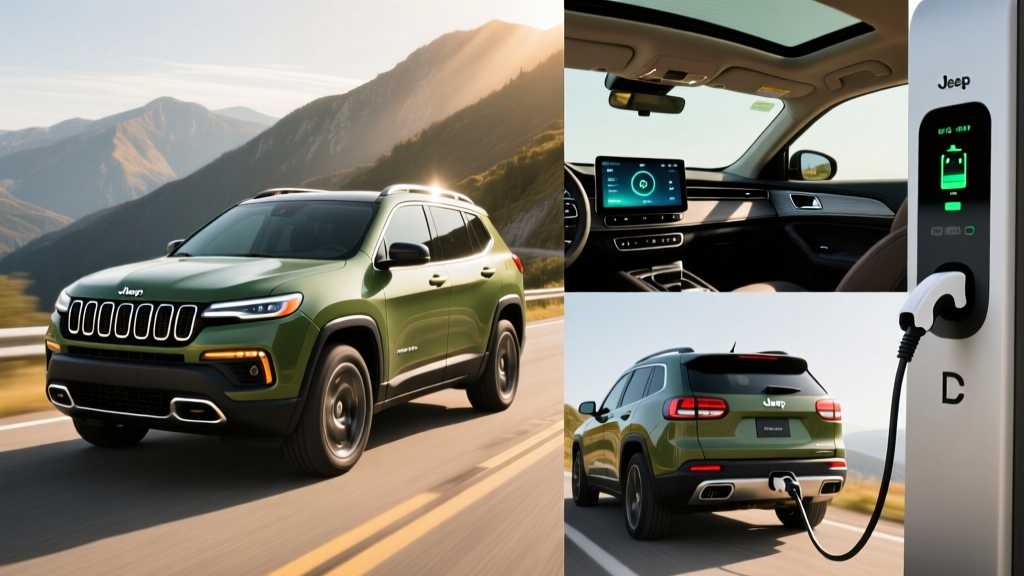
The 2026 Jeep Cherokee 4xe is a plug-in hybrid (PHEV) that pairs a turbocharged 2.0-liter inline-four with two electric motors to deliver 375 combined horsepower and an EPA-estimated 25 miles of electric-only range. It targets buyers who want everyday electric commuting without sacrificing the off-road capability and towing practicality that define the Cherokee nameplate. With a 17.3 kWh lithium-ion battery, a combined 56 MPGe in charge-depleting mode, and a starting MSRP around $42,495, it competes directly against the Toyota RAV4 Prime and Ford Escape PHEV in the compact SUV segment.
Before we break down the numbers, it is essential to distinguish between a conventional hybrid (HEV) and a plug-in hybrid (PHEV), because the Cherokee 4xe is firmly the latter.
HEV vs. PHEV: What's the Difference?
| Feature | Conventional Hybrid (HEV) | Plug-in Hybrid (PHEV) |
|---|---|---|
| Plugs in to charge? | No — charges via regen and engine | Yes — Level 1 or Level 2 charging |
| Battery size | 1–2 kWh | 10–20+ kWh |
| Electric-only range | 0–2 miles at low speed | 20–50 miles (EPA) |
| Federal tax credit | Not eligible (§30D requires plug-in) | Up to $7,500 if sourcing/income rules met |
| Best for | Drivers without home charging | Drivers with home/work Level 2 access |
The Cherokee 4xe requires a plug to unlock its full efficiency potential. If you cannot charge at home or work, its value proposition shrinks considerably — you will be driving a heavier, more expensive vehicle that returns only modestly better fuel economy than a gas-only Cherokee once the battery is depleted.
Powertrain and Performance Specs
The 2026 Cherokee 4xe uses Jeep's PHEV powertrain architecture, shared in concept with the Wrangler 4xe and Grand Cherokee 4xe but tuned for this smaller platform.
| Specification | 2026 Jeep Cherokee 4xe |
|---|---|
| Engine | 2.0L turbocharged I-4 |
| Electric motors | Two (one integrated in transmission, one on rear axle) |
| Combined horsepower | 375 hp |
| Combined torque | 470 lb-ft |
| Transmission | 8-speed automatic |
| Drivetrain | 4WD (eAWD with rear e-motor) |
| Battery capacity (usable) | 17.3 kWh, NMC lithium-ion |
| EPA electric-only range | 25 miles |
| EPA combined MPGe (charge-depleting) | 56 MPGe |
| EPA combined MPG (charge-sustaining) | 23 MPG |
| 0–60 mph | ~6.0 seconds |
| Max towing capacity | 4,000 lbs (when properly equipped) |
| Total combined range | ~370 miles (electric + gas) |
The dual-motor layout means the Cherokee 4xe can operate in pure electric mode using the rear motor at low speeds or blend both motors with the turbo four for full-power acceleration. The instant torque from the electric motors gives it a punchy feel around town that the gas-only 2.0T cannot match.
Fuel Economy: EPA vs. Real-World MPG
Fuel economy in a PHEV depends heavily on your driving and charging habits. Here is the EPA breakdown, followed by what to expect in the real world.
| Driving Mode | City | Highway | Combined |
|---|---|---|---|
| Charge-depleting (battery has charge) | — | — | 56 MPGe |
| Charge-sustaining (battery depleted, gas only) | 23 MPG | 24 MPG | 23 MPG |
Real-world expectations: PHEVs typically exceed their EPA city estimates in stop-and-go driving because regenerative braking recaptures energy at every stop. Owners who charge nightly and commute under 25 miles round-trip may use almost zero gasoline for months. On long highway trips, once the battery is depleted, expect 22–24 MPG — the added weight of the battery pack (roughly 600 lbs more than the gas-only Cherokee) offsets some of the hybrid system's efficiency gains at sustained highway speeds.
Electric range reality check: The EPA rates the Cherokee 4xe at 25 miles of electric-only range. In warm weather with moderate HVAC use, you may see 27–28 miles. In cold weather (below 32°F), expect 18–20 miles due to battery chemistry limitations and cabin heating load. Highway driving at 70+ mph will also reduce electric range to roughly 20–22 miles.
Charging: How to Plug In the Cherokee 4xe
Because the Cherokee 4xe is a PHEV, you will want access to Level 1 or Level 2 charging to get value from the system.
| Charging Level | Power | Time (0–100%) | Connector |
|---|---|---|---|
| Level 1 (120V household outlet) | ~1.4 kW | ~12 hours | J1772 |
| Level 2 (240V home or public) | ~7.2 kW | ~2.5 hours | J1772 |
| DC Fast Charging | Not supported | N/A | N/A |
The onboard charger maxes out at 7.2 kW, which is typical for PHEVs. The Cherokee 4xe does not support DC fast charging — this is standard across nearly all PHEVs due to the smaller battery size. A full charge overnight on a standard 120V outlet is feasible if you deplete only 25 miles of range during the day, but a Level 2 home charger (240V) is strongly recommended for faster turnaround and to take advantage of midday solar or time-of-use electricity rates.
For a Level 2 home charger installation, budget $500–$1,200 for the charger unit (e.g., ChargePoint Home Flex, Emporia Vue) and $800–$2,500 for electrician labor, depending on panel proximity and whether a 240V/50A circuit already exists. A panel upgrade from 100A to 200A, if needed, can add $1,500–$3,000.
Pricing, Trims, and Tax Credit Eligibility
The 2026 Cherokee 4xe starts at approximately $42,495 (including destination) for the base Latitude 4xe trim. Higher trims push the price toward $50,000:
- Latitude 4xe: ~$42,495
- Limited 4xe: ~$46,495
- Trailhawk 4xe: ~$48,995
- Overland 4xe: ~$50,495
Does the Cherokee 4xe Qualify for the Federal Tax Credit?
Under IRS §30D rules for 2026, the Cherokee 4xe may qualify for a partial or full federal tax credit of up to $7,500, but eligibility depends on several factors:
- MSRP cap: SUVs must be priced at or below $80,000 — all Cherokee 4xe trims qualify.
- Buyer income cap: Modified AGI must not exceed $150,000 (single), $225,000 (head of household), or $300,000 (joint filers).
- Battery sourcing: At least 80% of critical minerals must be sourced from the U.S. or a free-trade-agreement partner, and battery components must meet domestic-content thresholds. Jeep's Stellantis supply chain has been shifting toward compliance, but verify your specific build's eligibility at the point of sale.
- Point-of-sale transfer: As of 2024, buyers can transfer the credit to the dealer for an immediate price reduction rather than waiting for a tax refund.
- Commercial vs. personal: The credit applies to personal use only; business leases fall under §45W (different rules).
Because critical-mineral and battery-component sourcing requirements tighten annually, a Cherokee 4xe that qualified in 2025 may see a reduced credit in 2026. Confirm eligibility on fueleconomy.gov for your specific model year and VIN before purchasing.
State incentives: Several states (California, Colorado, New York, Massachusetts) offer additional rebates of $1,000–$4,000 for PHEVs. Check your state energy office or DMV for current programs — these vary by jurisdiction and are separate from the federal credit.
Battery Warranty, Reliability, and Replacement Cost
Hybrid and PHEV batteries carry longer warranties than most consumers realize, and the Cherokee 4xe is no exception.
Jeep Cherokee 4xe Battery Warranty
- Hybrid battery warranty: 10 years / 100,000 miles (whichever comes first)
- Capacity retention threshold: Stellantis warrants the battery against falling below 70% of original capacity during the warranty period
- Powertrain warranty: 5 years / 60,000 miles (engine, transmission, electric motors)
- Bumper-to-bumper: 3 years / 36,000 miles
Is the Cherokee 4xe Reliable?
Stellantis' 4xe powertrain has been in production since 2021 (Wrangler 4xe), giving it a multi-year track record. The 2.0L turbo engine is well-established across the Jeep lineup. Common owner-reported issues with earlier 4xe models included software glitches in the hybrid control module and occasional rough transitions between electric and gas modes — most addressed via over-the-air updates. For the most current reliability data, check NHTSA recall listings and owner forums specific to the Cherokee platform.
Battery Replacement Cost
If the high-voltage battery fails outside the warranty period, replacement costs for a 17.3 kWh PHEV pack typically range from $5,000 to $8,000 including labor. However, PHEV batteries are smaller and less stressed than full-EV batteries (they operate in a narrower state-of-charge window), and most are projected to last well beyond 150,000 miles before significant degradation. The 10-year/100,000-mile warranty provides substantial coverage for most ownership cycles.
Who Should Choose the Cherokee 4xe vs. a Full EV or Gas Car?
Choose the Cherokee 4xe (PHEV) if:
- Your daily commute is under 25 miles and you can charge at home nightly
- You need towing capability (4,000 lbs) that most compact EVs do not offer
- You take road trips to areas with sparse DC fast-charging infrastructure
- You want electric daily driving but are not ready to commit to a full BEV
Choose a full EV (e.g., Tesla Model Y, Hyundai Ioniq 5) if:
- You want zero tailpipe emissions and the lowest per-mile energy cost
- You have reliable home charging and your trips rarely exceed 250 miles between charges
- You want minimal maintenance (no oil changes, no transmission fluid, no exhaust system)
- You qualify for the full $7,500 federal credit on a BEV with compliant sourcing
Choose the gas-only Cherokee if:
- You cannot charge at home or at work
- Your budget is tight and the $5,000–$8,000 PHEV premium over the gas model is hard to justify
- You drive primarily long highway routes where the PHEV's electric range is irrelevant
Pros and Cons at a Glance
Pros
- 375 hp and 470 lb-ft — the most powerful compact Cherokee ever offered
- 25 miles of electric range covers most daily commutes
- 4,000-lb towing capacity exceeds the RAV4 Prime (2,500 lbs)
- Trailhawk trim retains serious off-road capability with eAWD
- 10-year/100,000-mile hybrid battery warranty
- Potential $7,500 federal tax credit + state incentives
Cons
- 23 MPG charge-sustaining is only marginally better than the gas-only Cherokee
- No DC fast charging — long trips rely entirely on gasoline once depleted
- $42,495 starting price is $8,000+ above the base gas Cherokee
- Heavy — the battery pack adds ~600 lbs, affecting handling and braking feel
- Tax credit eligibility uncertain due to evolving battery-sourcing rules
- Interior tech and materials lag behind the RAV4 Prime and Hyundai Tucson PHEV
Frequently Asked Questions
How many MPG does the Cherokee Hybrid get?
The 2026 Jeep Cherokee 4xe returns 56 MPGe combined when operating on battery charge, and 23 MPG combined (23 city / 24 highway) once the battery is depleted and the gasoline engine takes over. Real-world city MPG in charge-sustaining mode may be slightly higher (24–25 MPG) thanks to regenerative braking in stop-and-go traffic.
How far can the Cherokee 4xe go on electric only?
The EPA rates the Cherokee 4xe at 25 miles of electric-only range. In warm weather with gentle driving, expect 27–28 miles. In cold weather or at highway speeds, expect 18–22 miles. Once the battery is depleted, the gasoline engine engages seamlessly and the vehicle operates as a conventional hybrid.
Does the Cherokee Hybrid need to be plugged in?
Yes. The Cherokee 4xe is a plug-in hybrid (PHEV). While the gasoline engine and regenerative braking can maintain a small battery buffer, you will not access the 25-mile electric range or the 56 MPGe efficiency rating without plugging in to a Level 1 (120V) or Level 2 (240V) charger. If you never plug it in, you are paying a premium for a system you are not using.
Is the Cherokee 4xe reliable, and what does battery replacement cost?
The 4xe powertrain has been in production since 2021 and benefits from a 10-year/100,000-mile hybrid battery warranty covering degradation below 70% capacity. Out-of-warranty battery replacement is estimated at $5,000–$8,000. Overall reliability is expected to be average for the segment — check NHTSA for the latest recall and complaint data on the specific model year.
Does the Cherokee 4xe qualify for the $7,500 federal tax credit?
It may qualify for up to $7,500 under IRS §30D, but eligibility depends on your income (AGI caps apply), the vehicle's MSRP (all trims fall under the $80,000 SUV cap), and whether the battery's critical minerals and components meet 2026 domestic-sourcing thresholds. Verify eligibility for your specific VIN on fueleconomy.gov or with your dealer at the point of sale. The credit can be transferred to the dealer for an immediate price reduction.
How does the Cherokee 4xe compare to the Toyota RAV4 Prime?
The RAV4 Prime offers 42 miles of electric range (vs. 25 for the Cherokee 4xe), 94 MPGe, and a lower starting price (~$44,590). The Cherokee 4xe counters with significantly more horsepower (375 vs. 302), higher towing capacity (4,000 vs. 2,500 lbs), and the Trailhawk's off-road hardware. If electric range and efficiency are your priorities, the RAV4 Prime wins. If towing and off-road capability matter more, the Cherokee 4xe is the stronger choice.