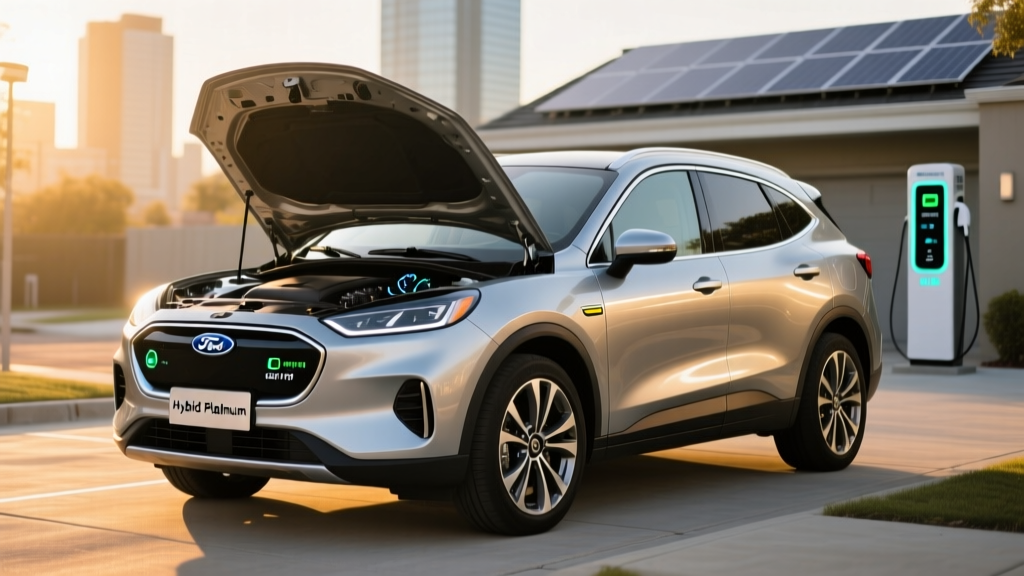
The compact hybrid SUV segment is crowded, but the 2025 Ford Escape Hybrid Platinum occupies a specific niche: buyers who want premium trim features and all-wheel drive without the plug-in commitment or range-anxiety calculus of a full EV. As Ford's top-tier Escape Hybrid trim, the Platinum packages the brand's 2.5-liter Atkinson-cycle hybrid system with leather, a panoramic sunroof, and a 13.2-inch infotainment screen. But beneath the luxury veneer sits the real question — does the powertrain deliver the efficiency gains that justify its $39,995 starting price?
We've spent time with the Escape Hybrid's powertrain data, cross-referenced EPA figures with real-world driving patterns, and mapped out exactly who should — and shouldn't — put this SUV on their shortlist.
Quick Verdict: Who the Escape Hybrid Platinum Is For
The 2025 Ford Escape Hybrid Platinum is best suited for drivers covering 12,000–18,000 miles annually in mixed city-highway commuting who lack reliable home charging access for a PHEV or BEV. It delivers genuine fuel savings over the turbo-gas Escape (roughly $600–$800/year at current fuel prices) without requiring any behavioral change — no plugging in, no route planning around chargers. The trade-off: it doesn't qualify for the federal §30D tax credit (that's reserved for PHEVs and BEVs), and its highway efficiency, while solid, won't match a Toyota RAV4 Hybrid or Honda CR-V Hybrid in certain conditions.
Choose the Escape Hybrid Platinum if: You want a premium compact hybrid SUV with AWD, you can't install a Level 2 charger at home, and you prioritize a quiet, feature-rich cabin over maximum MPG.
Look elsewhere if: You have home charging and can go PHEV for electric-only commuting, you want the absolute best-in-class hybrid fuel economy (see RAV4 Hybrid), or you need a third row.
HEV vs PHEV: What You're Actually Buying
Ford sells the Escape in two electrified flavors, and confusing them is the most common mistake shoppers make at the dealership:
| Feature | Escape Hybrid (HEV) | Escape PHEV (Plug-In) |
|---|---|---|
| Battery capacity | ~1.1 kWh (self-charging) | 14.4 kWh |
| Plugs in? | No — regenerates via braking/engine | Yes — Level 1 or Level 2 |
| Electric-only range | Not applicable | 37 miles (EPA) |
| EPA combined MPG | 39 MPG (AWD) | 40 MPG (gas) / 105 MPGe (electric) |
| Federal tax credit (§30D) | Not eligible | Up to $3,750* |
| Drivetrain | AWD standard | FWD only |
*PHEV credit amount depends on battery sourcing and buyer income. Verify current eligibility at IRS.gov.
The Platinum trim is only offered as a conventional HEV (not PHEV). If you want plug-in capability, you'll need to look at the Escape PHEV in a lower trim or cross-shop the Toyota RAV4 Prime.
Fuel Economy: EPA Numbers vs Real-World Results
The EPA rates the 2025 Ford Escape Hybrid AWD at 42 MPG city / 36 MPG highway / 39 MPG combined, per fueleconomy.gov. Those numbers deserve unpacking, because hybrid efficiency behaves differently from gas cars.
| Driving Scenario | EPA Estimate | Real-World Expectation |
|---|---|---|
| City (stop-and-go) | 42 MPG | 40–45 MPG (hybrids excel here) |
| Highway (70+ mph) | 36 MPG | 32–36 MPG (aero drag reduces regen benefit) |
| Combined mixed | 39 MPG | 36–41 MPG |
| Cold weather (below 32°F) | — | 33–37 MPG (engine runs more for cabin heat) |
Hybrids typically exceed their EPA city rating in real-world stop-and-go driving because regenerative braking recovers energy that a gas car wastes as brake heat. Conversely, sustained highway driving at 75+ mph narrows the hybrid advantage — the electric motor contributes less, and the 2.5L engine carries the load. In cold weather, expect a 5–10% efficiency hit because the engine must run more frequently to provide cabin heat (the Escape Hybrid uses engine coolant heat, not a heat pump).
Real-World Range Estimate: With a 14.2-gallon fuel tank and realistic 37 MPG combined driving, expect approximately 525 miles per tank. In winter or heavy-highway use, that drops to roughly 470–490 miles.
Powertrain and Performance Specs
The Escape Hybrid pairs a 2.5-liter Atkinson-cycle inline-four with an electric motor integrated into Ford's eCVT transaxle. Unlike some competitors that use a traditional stepped automatic, the eCVT provides seamless ratio management optimized for efficiency.
| Specification | 2025 Escape Hybrid Platinum |
|---|---|
| Engine | 2.5L Atkinson-cycle I-4 |
| Electric motor | Permanent-magnet synchronous (integrated in eCVT) |
| Combined horsepower | 210 hp (net system output) |
| Drivetrain | AWD (electronic rear motor assist) |
| Transmission | eCVT (planetary gearset, no fixed gears) |
| 0–60 mph | ~7.7 seconds (est.) |
| Battery capacity | ~1.1 kWh (lithium-ion) |
| Towing capacity | 1,500 lbs |
| Cargo volume | 34.4 cu ft (rear seats up) / 60.8 cu ft (folded) |
| Fuel tank | 14.2 gallons |
The 210-hp net system output is competitive with the Honda CR-V Hybrid (204 hp) but trails the Toyota RAV4 Hybrid (219 hp). The AWD system is worth noting: Ford uses an independent rear electric motor rather than a mechanical driveshaft, which means rear-wheel torque is available on demand without the parasitic loss of a traditional AWD system. This contributes to the Hybrid's relatively strong EPA city number.
Acceleration is adequate for merging and passing but not brisk — this is an efficiency-first powertrain. The eCVT keeps the engine in its optimal RPM band, which means you'll hear a steady drone under hard acceleration rather than the rising engine note of a conventional automatic. Most buyers in this segment accept this trade-off.
Pricing, Trims, and Tax Credit Eligibility
The 2025 Ford Escape Hybrid Platinum starts at $39,995 (including destination). As the top-of-line trim, it includes:
- ActiveX trimmed leather seats with heated/ventilated front row
- 13.2-inch touchscreen with SYNC 4 and wireless Apple CarPlay/Android Auto
- Panoramic vista roof
- Bang & Olufsen 10-speaker audio system
- Ford Co-Pilot360 Assist+ (adaptive cruise with stop-and-go, lane centering, evasive steering assist)
- 360-degree camera
- Hands-free foot-activated liftgate
Options that push the price higher include the Premium Technology package (head-up display, enhanced active park assist) and exterior color upgrades, bringing a fully loaded Platinum to roughly $42,500–$43,500.
Federal Tax Credit: Not Eligible
The conventional Escape Hybrid does not qualify for the IRS §30D Clean Vehicle Credit. Under current rules, only battery-electric vehicles (BEVs) and plug-in hybrids (PHEVs) with sufficient battery capacity and compliant critical-mineral/battery-component sourcing are eligible. Conventional hybrids like the Escape HEV are excluded regardless of price or buyer income.
If the federal credit is a priority, you'd need to cross-shop the Escape PHEV (eligible for up to $3,750 depending on sourcing and your income), the Toyota RAV4 Prime, or a full BEV like the Hyundai Ioniq 5. Always verify current-year rules at IRS.gov or consult a tax professional, as battery-sourcing requirements shift annually.
Reliability, Battery Lifespan, and Warranty Coverage
Hybrid battery longevity remains a top concern for buyers transitioning from gas-only vehicles. Here's what the data shows:
Ford Hybrid Battery Warranty: The Escape Hybrid's high-voltage battery is covered for 8 years or 100,000 miles (whichever comes first) under Ford's Hybrid/Electric Component warranty. In states that follow California Air Resources Board (CARB) standards — including CA, NY, MA, NJ, WA, and others — that coverage extends to 10 years or 150,000 miles.
The Escape Hybrid uses a relatively small ~1.1 kWh lithium-ion battery that operates in a narrow state-of-charge window (roughly 40–60% SoC). This shallow cycling is far less stressful on battery chemistry than the deep 0–100% cycles a BEV experiences, which is why hybrid batteries routinely outlast their warranties. Toyota's hybrid taxis have logged 300,000+ miles on original batteries, and Ford's hybrid system (in the Fusion Hybrid and Escape Hybrid) has shown similar durability in fleet data.
Battery replacement cost, should it ever be needed out of warranty, typically runs $2,500–$4,000 including labor for the Escape Hybrid — far less than the $10,000–$20,000+ associated with BEV battery packs. However, based on degradation curves and the conservative SoC management, most Escape Hybrid batteries will outlast the vehicle's useful life.
For general reliability, the Escape Hybrid's 2.5L Atkinson-cycle engine is a proven, low-stress design (it also powers the Ford Maverick Hybrid). The eCVT transaxle has no traditional clutches or bands to wear, making it one of the most durable transmission types in the industry. Ford's official specs page confirms the powertrain is covered under the standard 5-year/60,000-mile powertrain warranty.
How It Stacks Up: Escape Hybrid Platinum vs Rivals
The compact hybrid SUV segment has strong alternatives. Here's how the Platinum compares on the metrics that matter:
| Spec | 2025 Ford Escape Hybrid Platinum | 2025 Toyota RAV4 Hybrid Limited | 2025 Honda CR-V Hybrid Sport Touring |
|---|---|---|---|
| Starting MSRP | $39,995 | $39,445 | $40,850 |
| EPA combined MPG | 39 MPG | 39 MPG | 40 MPG |
| Combined HP | 210 hp | 219 hp | 204 hp |
| AWD | Standard | Standard | Standard |
| Cargo (seats up) | 34.4 cu ft | 37.6 cu ft | 36.3 cu ft |
| Hybrid battery warranty | 8 yr / 100k mi | 10 yr / 150k mi | 8 yr / 100k mi |
| Towing | 1,500 lbs | 1,750 lbs | 1,000 lbs |
The RAV4 Hybrid wins on cargo space and battery warranty. The CR-V Hybrid edges ahead on combined MPG. The Escape Platinum counters with the most premium interior materials in the segment (genuine ActiveX leather, B&O audio) and Ford's strong Co-Pilot360 ADAS suite. None of these conventional hybrids qualify for federal tax credits.
Hybrid vs PHEV vs EV: Which Powertrain Fits Your Life?
Deciding between a conventional hybrid, a plug-in hybrid, and a full battery-electric vehicle comes down to three questions:
- Can you charge at home? If you have a garage or driveway where a Level 2 (240V) charger can be installed, a PHEV or BEV unlocks significant per-mile cost savings. If you park on the street or in a building without charging infrastructure, a conventional HEV like the Escape Hybrid is the pragmatic choice — it requires zero infrastructure.
- What does your commute look like? If your round-trip commute is under 35 miles and you can charge at home, a PHEV (37 miles electric-only in the Escape PHEV) lets you drive most days without burning gas. If your commute is longer or unpredictable, the HEV's 525-mile total range is more forgiving.
- What's your budget for upfront cost vs long-term savings? BEVs offer the lowest cost-per-mile (roughly $0.04–$0.06/mile on home electricity vs $0.12–$0.15/mile for hybrid gas) but carry higher purchase prices and insurance premiums. The Escape Hybrid splits the difference: lower upfront cost, no charging hassle, and meaningful savings over a gas-only Escape.
Pros and Cons: The Honest Scorecard
Pros
- Strong 42 MPG city rating — real-world city driving often exceeds EPA
- AWD standard with no significant efficiency penalty vs FWD
- Platinum trim delivers genuine premium features at a competitive price
- No charging infrastructure required — zero lifestyle change from gas
- ~525-mile real-world range eliminates fuel-stop frequency
- Quiet, refined cabin with class-leading infotainment screen size
Cons
- No federal tax credit eligibility (HEV exclusion)
- Highway MPG (36 EPA) trails some rivals at sustained speed
- eCVT drone under hard acceleration
- Smaller cargo area than RAV4 Hybrid and CR-V Hybrid
- 1,500-lb towing limit (insufficient for most trailers)
- Platinum price approaches PHEV territory without electric-only capability
Frequently Asked Questions
How many MPG does the 2025 Ford Escape Hybrid get?
The EPA rates the AWD Escape Hybrid at 42 MPG city, 36 MPG highway, and 39 MPG combined. Real-world results vary: expect 40–45 MPG in city driving (where regenerative braking shines) and 32–36 MPG on the highway at 70+ mph. Cold weather reduces efficiency by roughly 5–10%.
Does the Escape Hybrid need to be plugged in?
No. The Escape Hybrid is a conventional (self-charging) hybrid. Its small battery recharges through regenerative braking and the gasoline engine. You never plug it in — you simply fill up at a gas station as you would with any other car. This is distinct from the Escape PHEV, which does plug in.
Is the hybrid battery reliable, and what does replacement cost?
Ford covers the hybrid battery for 8 years/100,000 miles (10 years/150,000 miles in CARB states). The battery operates in a shallow charge window that minimizes degradation, and real-world data from Ford's hybrid fleet shows batteries routinely lasting well beyond warranty. Out-of-warranty replacement, if ever needed, typically costs $2,500–$4,000 including labor.
Does the 2025 Escape Hybrid qualify for any tax credit?
The conventional Escape Hybrid does not qualify for the federal §30D Clean Vehicle Credit — that credit is reserved for plug-in hybrids and battery-electric vehicles. Some states or utilities offer small rebates for hybrid purchases, but these vary by jurisdiction. Check your state energy office or utility provider for local incentives.
How far can the Escape Hybrid go on a full tank?
With a 14.2-gallon tank and real-world combined efficiency of approximately 37 MPG, expect around 525 miles between fill-ups in mixed driving. Highway-heavy trips or cold-weather driving will reduce that to roughly 470–490 miles.
Should I buy the Escape Hybrid or the Escape PHEV instead?
If you can install a Level 2 home charger and your daily commute is under 35 miles round-trip, the Escape PHEV (37 miles electric-only, up to $3,750 federal credit) will save more on fuel. However, the PHEV is FWD-only and available in lower trims. If you need AWD, want the Platinum's premium features, or can't charge at home, the Hybrid is the better fit.
How does the Escape Hybrid compare to the RAV4 Hybrid?
They're closely matched at 39 MPG combined. The RAV4 Hybrid offers more cargo space (37.6 vs 34.4 cu ft), a longer battery warranty (10 yr/150k mi), and slightly more power (219 vs 210 hp). The Escape Platinum counters with a more upscale interior, a larger infotainment screen, and Ford's Co-Pilot360 ADAS suite. Test-drive both — the decision often comes down to cabin feel and brand preference.
Sources: EPA fuel economy data from fueleconomy.gov; federal tax credit rules from IRS.gov; vehicle specifications from Ford.com. Pricing and incentive rules reflect 2025 model year data and are subject to change. Always verify with your dealer and a tax professional before purchasing.