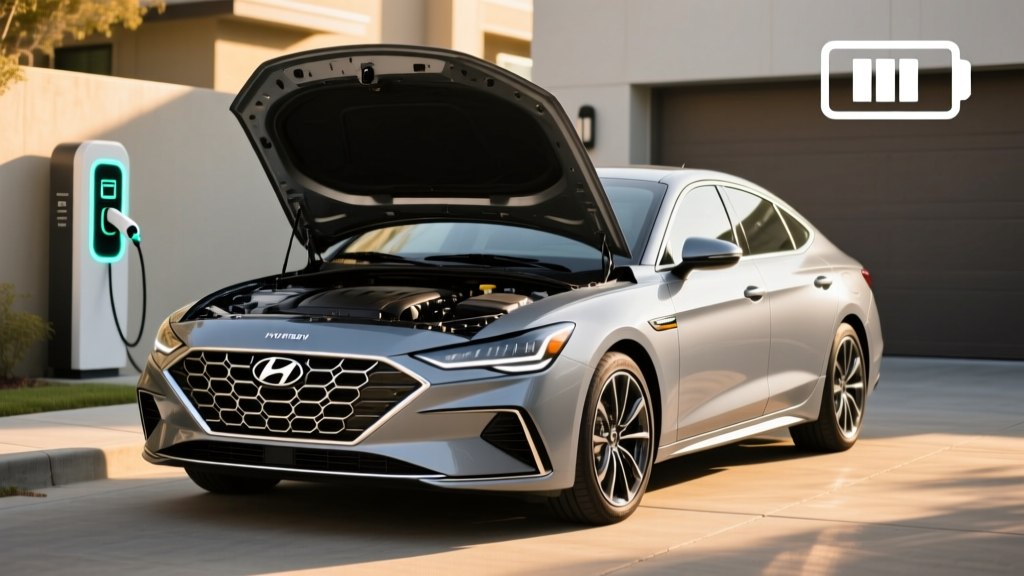
The midsize sedan segment has thinned considerably, but the Hyundai Sonata Hybrid remains a standout for buyers who want serious fuel efficiency without plugging in. With an EPA-estimated 47 MPG combined and a starting MSRP around $31,000, it occupies a specific niche: maximum miles-per-dollar for commuters who can't (or won't) deal with charging infrastructure. This guide breaks down the true Hyundai Sonata Hybrid cost of ownership — purchase price, fuel spend, warranty protection, and how it stacks up against plug-in alternatives and full EVs.
HEV vs PHEV: What the Sonata Hybrid Actually Is
Let's clear up a common confusion right away. The current Sonata Hybrid sold in the United States is a conventional hybrid electric vehicle (HEV), not a plug-in hybrid. Hyundai discontinued the Sonata Plug-in Hybrid (PHEV) after the 2019 model year and has not reintroduced it for 2025 or 2026.
HEV vs PHEV — Key Differences
| Feature | Conventional Hybrid (HEV) | Plug-in Hybrid (PHEV) |
|---|---|---|
| Plug-in Charging | No — self-charges via engine & regen | Yes — charges via outlet or station |
| Electric-Only Range | ~1 mile at low speeds | 25–45 miles typical |
| Battery Size | ~1.6 kWh | 13–30+ kWh |
| Federal Tax Credit (§30D) | Not eligible | Up to $7,500 (if eligible) |
| Example | Sonata Hybrid | Toyota RAV4 Prime, Hyundai Tucson PHEV |
This distinction matters for the cost equation. The Sonata Hybrid's lower sticker price and zero charging hassle come at the trade-off of never driving on electricity alone for meaningful distances. If your goal is electric-only commuting, you'll need to look at a PHEV (like the Tucson PHEV) or a full BEV (like the Ioniq 6). If your goal is simply burning the least gasoline possible with no lifestyle changes, the Sonata HEV delivers.
Hyundai Sonata Hybrid Fuel Economy: EPA and Real-World MPG
The 2025–2026 Sonata Hybrid pairs a 2.0-liter four-cylinder engine with an electric motor integrated into the six-speed automatic transmission. The result is a combined system output of 192 horsepower and EPA ratings that put it at the top of the midsize hybrid sedan class.
| Driving Cycle | EPA Estimate | Real-World Expectation |
|---|---|---|
| City | 50 MPG | 48–55 MPG (hybrids often beat EPA in stop-and-go) |
| Highway | 45 MPG | 40–44 MPG (aerodynamic drag and sustained speed reduce regen advantage) |
| Combined | 47 MPG | 44–50 MPG depending on driving mix |
Why real-world can exceed EPA in the city: Conventional hybrids recapture kinetic energy during braking and use it to power the electric motor at low speeds. Stop-and-go traffic is where the Sonata Hybrid shines — the engine shuts off frequently, and the electric motor handles launches. On sustained highway climbs or in extreme cold (below 20°F), expect the lower end of the range as the engine runs more often to maintain cabin heat and battery charge.
According to fueleconomy.gov, the Sonata Hybrid's 47 MPG combined ranks it among the most efficient non-plug-in midsize sedans available, trailing only the Toyota Prius (which is a compact liftback, not a direct competitor in size).
Hyundai Sonata Hybrid Cost: MSRP, Trim Pricing, and What You'll Actually Pay
Hyundai offers the Sonata Hybrid in three trims for the 2025–2026 model year. Pricing below reflects base MSRP before destination charges:
| Trim | MSRP (approx.) | Key Features |
|---|---|---|
| SEL | $31,000 | 17" alloys, 12.3" digital cluster, wireless CarPlay/Android Auto, SmartSense safety suite |
| N Line | $34,500 | Sport-tuned suspension, 19" wheels, N Line styling, panoramic sunroof |
| Limited | $37,500 | Leather seats, ventilated front seats, head-up display, Digital Key, surround-view monitor |
Destination charges add approximately $1,150. Dealer markups vary by market but have largely normalized since the supply-chain disruptions of 2021–2023.
Federal and State Incentives
Because the Sonata Hybrid is a conventional HEV (not a PHEV or BEV), it does not qualify for the federal §30D Clean Vehicle Credit. That credit — up to $7,500 — applies only to plug-in vehicles meeting battery-sourcing, MSRP, and buyer-income requirements per IRS guidelines.
Some states offer modest rebates or HOV-lane access for conventional hybrids, but these programs are increasingly rare and typically favor plug-in vehicles. Check your state's energy office or DMV for current programs. A few utility companies also offer time-of-use rate discounts for hybrid owners, though these are more common for EV charging.
Five-Year Fuel Cost: Sonata Hybrid vs Gas-Only vs Full EV
The strongest argument for the Sonata Hybrid is fuel savings. Here's a five-year cost projection assuming 15,000 miles/year, $3.50/gallon regular unleaded, and $0.15/kWh for home EV charging:
| Vehicle Type | MPG / MPGe | Annual Fuel Cost | 5-Year Fuel Cost |
|---|---|---|---|
| Sonata Hybrid (HEV) | 47 MPG combined | ~$1,117 | ~$5,585 |
| Sonata 2.5L Gas | 28 MPG combined | ~$1,875 | ~$9,375 |
| Hyundai Ioniq 6 (BEV) | 140 MPGe combined | ~$525 (home charging) | ~$2,625 |
The math: Over five years, the Sonata Hybrid saves approximately $3,790 in fuel compared to the gas-only Sonata. That nearly covers the hybrid powertrain premium. Against a full EV like the Ioniq 6, the hybrid costs about $2,960 more in fuel over five years — but the Ioniq 6 starts around $42,000 (before potential tax credits), meaning the Sonata Hybrid still wins on total out-of-pocket cost for buyers who don't qualify for or can't access the full federal credit.
Battery Warranty and Replacement Cost
Hyundai covers the Sonata Hybrid's 1.6 kWh lithium-ion battery with a 10-year / 100,000-mile warranty (in states following California emissions standards; 8-year/80,000-mile in some other states — confirm with your dealer). This is one of the longest hybrid battery warranties in the industry.
Replacement cost if out of warranty: Hybrid battery packs for the Sonata typically run $2,000–$3,500 for the part, plus $500–$800 in labor. However, hybrid battery failure before 150,000 miles is statistically uncommon based on long-term fleet data from similar Hyundai/Kia hybrid systems. Most degradation manifests as a slight MPG reduction (1–3 MPG) rather than a total failure.
Powertrain, Performance, and Driving Impressions
The Sonata Hybrid's powertrain uses Hyundai's Transmission-Mounted Electric Device (TMED), which places a 39 kW (52 hp) electric motor directly in the six-speed automatic transmission housing rather than using a CVT or power-split device like Toyota's system. The result is a more natural driving feel with distinct gear shifts.
- Engine: 2.0L inline-4, 150 hp / 139 lb-ft torque
- Electric Motor: 39 kW (52 hp) / 151 lb-ft torque
- Combined System Output: 192 hp
- Transmission: 6-speed automatic with TMED
- 0–60 mph: ~7.8 seconds
- Drivetrain: Front-wheel drive
The 0–60 time is adequate for merging and passing but won't feel quick. The trade-off for 47 MPG is acceptable for most buyers in this segment. Regenerative braking is moderate — you can adjust it via steering-wheel paddles, but the Sonata Hybrid does not offer true one-pedal driving like a full EV or some PHEVs.
Who Should Choose the Sonata Hybrid (and Who Shouldn't)
Choose the Sonata Hybrid If:
- You rent or live somewhere without access to a garage or dedicated parking spot for a charger
- You want 500+ miles of total range between fill-ups with zero behavioral changes
- Your commute is mixed city/highway and you want strong MPG in both conditions
- You prefer a traditional midsize sedan with a large trunk (16.0 cu ft) over a crossover
- Your budget is $31K–$38K and you don't qualify for EV tax credits due to income or tax liability
Choose a PHEV or Full EV Instead If:
- You have home charging and want electric-only commuting (consider the Tucson PHEV or Ioniq 5)
- You qualify for the full $7,500 federal credit, which makes a BEV's effective price competitive
- You want to minimize tailpipe emissions in daily driving (a PHEV covers most commutes on electricity)
- You're willing to spend more upfront for lower per-mile operating costs long-term
Reliability and Long-Term Ownership
Hyundai's hybrid systems have proven durable over multiple generations. The Sonata Hybrid's 2.0L engine is naturally aspirated (no turbocharger to maintain), and the TMED design avoids the belt-driven accessories found in some competing systems. The six-speed automatic is a conventional planetary-gear transmission — proven technology with known service intervals.
From a maintenance perspective, the Sonata Hybrid requires the same service as a gas car (oil changes, brake fluid, tire rotations) but with some advantages: regenerative braking extends pad and rotor life significantly, with many owners reporting original brake pads lasting 80,000+ miles. There is no transmission fluid to change on the recommended schedule under normal driving conditions.
For safety ratings, the Sonata has historically earned top marks from IIHS, and Hyundai's SmartSense suite includes forward collision-avoidance assist, lane-keeping assist, blind-spot monitoring, and adaptive cruise control as standard equipment across all trims.
Frequently Asked Questions
How many MPG does the Hyundai Sonata Hybrid get?
The EPA rates the 2025–2026 Sonata Hybrid at 50 MPG city, 45 MPG highway, and 47 MPG combined. In real-world city driving with frequent stops, many owners report exceeding the EPA city estimate, reaching 50–55 MPG. Highway-only driving at sustained speeds typically yields 40–44 MPG.
Does the Hyundai Sonata Hybrid need to be plugged in?
No. The Sonata Hybrid is a conventional HEV that charges its small 1.6 kWh battery through regenerative braking and the gasoline engine. You simply fill it with regular unleaded gasoline like any other car. Hyundai does not currently sell a plug-in version of the Sonata in the US market.
Does the Sonata Hybrid qualify for any tax credit?
Not at the federal level. The IRS §30D Clean Vehicle Credit applies only to plug-in electric vehicles (PHEVs and BEVs) meeting specific battery-sourcing, MSRP, and buyer-income requirements. Conventional hybrids like the Sonata Hybrid are excluded. Check your state's energy office for any local incentive programs.
How long will the Sonata Hybrid battery last, and what does replacement cost?
Hyundai warranties the hybrid battery for 10 years / 100,000 miles (in California-emissions states; 8/80,000 elsewhere). Real-world data from Hyundai/Kia hybrid fleets suggests these batteries commonly last 150,000+ miles before significant degradation. If replacement is needed out of warranty, expect $2,500–$4,300 including labor.
Is the Sonata Hybrid better than a full EV like the Ioniq 6?
It depends on your situation. The Sonata Hybrid costs less upfront ($31K vs ~$42K), doesn't require charging access, and delivers 500+ miles of range per tank. The Ioniq 6 is far cheaper to "fuel" (~$525/year on home electricity vs ~$1,117/year on gas) and may qualify for up to $7,500 in federal credits. If you have reliable home charging and qualify for incentives, the EV often wins on total cost. If you lack charging access or drive long highway routes frequently, the hybrid is the more practical choice.
What is the total driving range of the Sonata Hybrid?
With a 13.2-gallon fuel tank and 47 MPG combined, the Sonata Hybrid delivers approximately 620 miles of total range per fill-up under mixed driving. Highway-heavy driving reduces this to around 540–580 miles; city-heavy driving can push it above 650 miles.
Pros
- Class-leading 47 MPG combined for a midsize sedan
- No plug-in required — zero infrastructure dependency
- 10-year / 100,000-mile hybrid battery warranty (CARB states)
- Competitive starting MSRP of ~$31,000
- Strong standard safety suite (SmartSense)
- Spacious trunk (16.0 cu ft) and rear seat
Cons
- No federal tax credit eligibility
- No electric-only driving range to speak of
- Modest 192 hp — not a performance-oriented sedan
- AWD not available (FWD only)
- PHEV variant discontinued — no plug-in Sonata option in the US