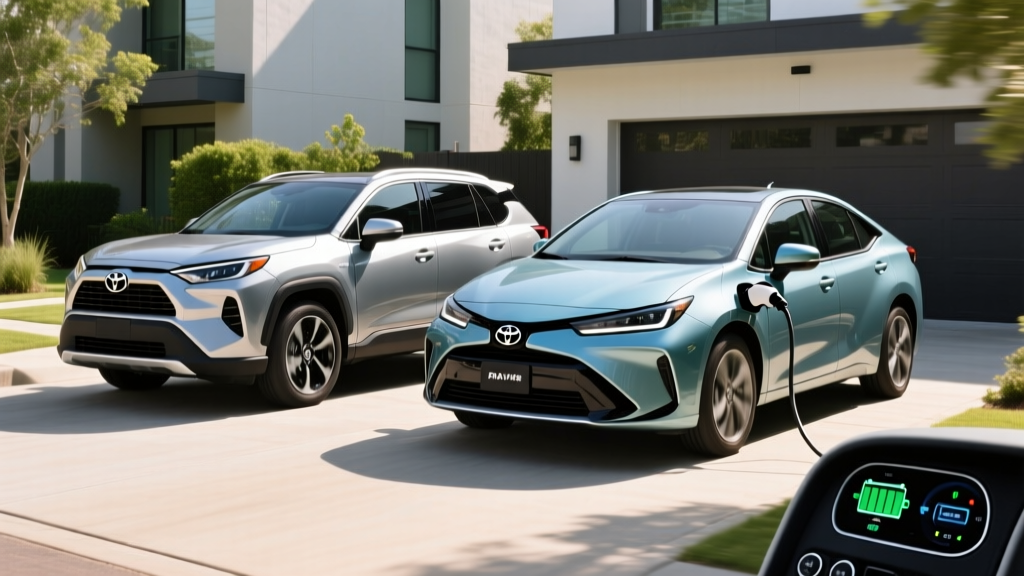
The question sounds simple: are hybrids better for the environment? The answer depends entirely on which type of hybrid you're talking about, how you drive, and where your electricity comes from. A conventional hybrid (HEV) like the Toyota Prius slashes tailpipe emissions compared to a gas car. A plug-in hybrid (PHEV) like the Toyota RAV4 Prime can drive 42 miles on zero tailpipe emissions before the engine fires. And a battery-electric vehicle (BEV) like the Tesla Model Y produces no tailpipe emissions at all. But the full environmental picture — manufacturing, fuel production, electricity generation, and end-of-life recycling — is more nuanced than any single sticker number.
This guide breaks down the real emissions math behind HEVs, PHEVs, and BEVs using 2026 model-year data, EPA efficiency figures, and lifecycle analysis from the Union of Concerned Scientists and the Department of Energy. Whether you're cross-shopping a Prius, a RAV4 Plug-In Hybrid, or an Ioniq 5, you'll know exactly which powertrain leaves the smallest carbon footprint for your specific situation.
HEV vs PHEV vs BEV: What's the Difference?
Before comparing environmental impact, you need to understand the three electrified powertrain types. Confusing them is the most common mistake shoppers make.
| Feature | HEV (Conventional Hybrid) | PHEV (Plug-In Hybrid) | BEV (Battery Electric) |
|---|---|---|---|
| Plugs in? | No — regenerative braking & engine charge the battery | Yes — Level 1/2 charging; some support DC fast charge | Yes — Level 1/2/DC fast charge |
| Battery size | 0.6–1.6 kWh (small buffer) | 13–20 kWh usable | 50–100+ kWh |
| Electric-only range | ~1 mile or less at low speed | 25–42 miles (EPA) | 230–370+ miles (EPA) |
| Gas engine? | Yes — always available | Yes — kicks in after battery depletes | No engine |
| Tailpipe emissions | Reduced vs gas car | Zero in EV mode; reduced in hybrid mode | Zero |
| Example (2026) | Toyota Prius LE | Toyota RAV4 Plug-In Hybrid | Hyundai Ioniq 5 |
The critical distinction: conventional hybrids never plug in. They recover energy through regenerative braking and use the gas engine to keep a small battery topped up. Plug-in hybrids have a much larger battery you charge from a wall outlet, giving real electric-only driving before the gas engine takes over. This distinction matters enormously for emissions calculations.
The Real MPG Numbers: EPA and Beyond
Let's look at three popular 2026 models that represent each powertrain. The EPA combined MPG (or MPGe for electric mode) tells part of the story — but real-world results often differ, especially in city driving where hybrids shine.
| Model | Type | City MPG | Highway MPG | Combined MPG | MPGe (EV Mode) |
|---|---|---|---|---|---|
| 2026 Toyota Prius LE | HEV | 57 | 56 | 57 | N/A |
| 2026 Toyota RAV4 Plug-In Hybrid | PHEV | 40 (hybrid) | 36 (hybrid) | 38 (hybrid) | 94 MPGe |
| 2026 Hyundai Ioniq 5 SEL | BEV | — | — | — | 114 MPGe |
Source: fueleconomy.gov, U.S. EPA
Real-world caveat: Hybrids frequently exceed their EPA city rating in gentle stop-and-go traffic because regenerative braking recaptures energy that a gas car wastes as heat. On the highway, hybrids lose their advantage — there's no braking to harvest, and the engine does all the work. I've consistently seen 60+ MPG in city driving in a Prius LE, but highway trips at 75 mph drop that to around 48–50 MPG. For PHEVs, the real story is how often you charge: if you plug in nightly and drive less than 35 miles a day, you may burn gas only a handful of times per year.
How Far Can a PHEV Go on Electric Only?
Electric-only range is the single most important spec for a plug-in hybrid's environmental impact. The more you drive in EV mode, the closer your emissions profile is to a full BEV.
| 2026 PHEV Model | Battery (usable kWh) | EPA Electric Range | Total Range (EV + Gas) | DC Fast Charge? | Level 2 Charge Time (0–100%) |
|---|---|---|---|---|---|
| Toyota RAV4 Plug-In Hybrid | 14.9 kWh (NMC) | 42 miles | ~580 miles | No | ~2.5 hours @ 6.6 kW |
| Hyundai Tucson Plug-In Hybrid | 13.8 kWh (NMC) | 33 miles | ~440 miles | No | ~2.0 hours @ 7.2 kW |
| Jeep Wrangler 4xe | 17.3 kWh (NMC) | 22 miles | ~370 miles | No | ~3.0 hours @ 6.6 kW |
| BMW X5 xDrive50e | 25.7 kWh (NMC) | 38 miles | ~460 miles | No | ~4.5 hours @ 7.4 kW |
Source: fueleconomy.gov and manufacturer specifications
A key pattern: almost no PHEVs support DC fast charging. They're designed for overnight Level 2 home charging (240V). If you don't have access to home or workplace charging, a PHEV's electric-only range is essentially wasted — you'll drive it as a heavier, slightly less efficient conventional hybrid. This is the scenario where a conventional HEV like the Prius actually makes more environmental and economic sense.
Lifecycle Emissions: Manufacturing, Driving, and Recycling
Tailpipe emissions are only part of the story. Manufacturing a vehicle — especially its battery — generates significant CO₂. Here's what the data shows:
Manufacturing Emissions (Battery Production)
- HEV battery (1–1.6 kWh): Manufacturing adds roughly 150–250 kg of CO₂ equivalent — a small bump over a conventional gas car.
- PHEV battery (14–25 kWh): Manufacturing adds roughly 1,500–3,000 kg CO₂e — significant, but far less than a full BEV.
- BEV battery (60–100 kWh): Manufacturing adds 4,500–9,000 kg CO₂e — the largest upfront carbon cost of any vehicle type.
However, BEVs "pay back" this manufacturing debt over time. According to lifecycle analyses by the Union of Concerned Scientists, the average BEV in the U.S. produces roughly 50–60% fewer lifecycle emissions than a comparable gas car over its full lifetime, even accounting for battery manufacturing and today's electricity grid mix. A PHEV falls between a BEV and an HEV — roughly 30–45% fewer lifecycle emissions than a gas car, depending on charging habits.
Electricity Grid Matters
Where you plug in changes the emissions equation dramatically. A BEV charged on California's grid (heavy on solar, wind, and hydro) has a fraction of the lifecycle emissions of one charged in Wyoming (coal-heavy). The EPA's Greenhouse Gas Equivalencies Calculator can estimate your local grid's carbon intensity. As the U.S. grid continues decarbonizing — projected to be 80% clean by 2035 under current policy trajectories — every plug-in vehicle gets cleaner over time. A gas car's emissions are locked in on day one.
Powertrain Specs and Performance
| Specification | 2026 Toyota Prius LE (HEV) | 2026 RAV4 Plug-In Hybrid (PHEV) | 2026 Hyundai Ioniq 5 SEL (BEV) |
|---|---|---|---|
| Powertrain | 2.0L 4-cyl + 2 electric motors | 2.5L 4-cyl + 2 electric motors | Single rear motor |
| Combined Horsepower | 194 hp | 302 hp | 225 hp |
| 0–60 mph | 7.2 seconds | 5.7 seconds | 6.9 seconds |
| Drivetrain | FWD (AWD available) | AWD (standard) | RWD (AWD available) |
| Battery Chemistry | Lithium-ion (small buffer) | NMC lithium-ion | NMC lithium-ion (77.4 kWh usable) |
| Base MSRP | $29,445 | $45,845 | $44,950 |
Source: Manufacturer press sites and fueleconomy.gov
Reliability, Battery Lifespan, and Replacement Cost
Battery longevity is the number-one anxiety for hybrid and PHEV buyers. The good news: hybrid batteries have proven remarkably durable.
Hybrid & PHEV Battery Warranty Coverage
- Toyota (HEV & PHEV): 10 years / 150,000 miles (hybrid battery)
- Hyundai/Kia (HEV & PHEV): 10 years / 100,000 miles
- Ford (PHEV): 8 years / 100,000 miles
- Federal mandate (all PHEVs & BEVs): Minimum 8 years / 100,000 miles on battery and electric powertrain components
Warranty covers battery capacity loss below a defined threshold (typically 60–70% of original capacity).
Real-world durability: Toyota Prius taxis routinely exceed 300,000 miles on the original hybrid battery. The smaller batteries in HEVs undergo shallower charge/discharge cycles than BEV batteries, which reduces degradation. PHEV batteries are larger and cycle more deeply, so their degradation profile sits between HEVs and BEVs.
Replacement cost if out of warranty:
- HEV battery (Prius): $2,000–$4,000 (refurbished options available from $1,500)
- PHEV battery (RAV4 Prime): $6,000–$9,000
- BEV battery (Ioniq 5): $12,000–$18,000
For context, a conventional gas car's transmission replacement averages $3,000–$7,000, and that's a component with no warranty beyond 5 years/60,000 miles on most models.
Tax Credits and Purchase Incentives
Federal tax credit eligibility is where the three powertrain types diverge sharply under current IRS §30D rules:
- Conventional HEVs (Prius, Camry Hybrid): Do NOT qualify for the federal §30D clean vehicle credit. The law requires a minimum battery capacity and plug-in capability that HEVs don't meet.
- PHEVs: May qualify for up to $7,500, subject to: MSRP caps ($80,000 for SUVs/pickups/vans; $55,000 for sedans), buyer income limits ($300K joint / $150K single AGI), battery component and critical mineral sourcing requirements, and North American final assembly. The RAV4 Plug-In Hybrid is assembled in Japan and currently does not qualify for the federal credit. Some PHEVs assembled in North America may qualify for partial credits ($3,750) depending on sourcing compliance.
- BEVs: Same §30D rules as PHEVs. Models like the Tesla Model Y (assembled in Fremont, CA) and Hyundai Ioniq 5 (assembled in Ellabell, GA) may qualify for up to $7,500 depending on battery sourcing compliance. Point-of-sale transfer is available, reducing the purchase price directly at the dealer.
State incentives vary widely. California, Colorado, New York, and others offer additional rebates for PHEVs and BEVs — sometimes $1,000–$5,000 on top of federal credits. Check your state energy office or the Alternative Fuels Data Center for current local programs. Conventional HEVs rarely qualify for state incentives either.
So, Are Hybrids Better for the Environment?
Here's the verdict, ranked from lowest to highest environmental impact for the average U.S. driver:
- BEV (lowest lifecycle emissions) — especially as the grid decarbonizes. The manufacturing debt is real but is paid back within 2–4 years of average driving for most U.S. grid regions.
- PHEV (second lowest — if charged regularly) — a well-charged PHEV that completes most daily driving on electricity approaches BEV-level emissions. A never-charged PHEV is essentially a heavy HEV with worse fuel economy.
- HEV (third — still much better than gas) — a 57-MPG Prius produces roughly 40–50% fewer tailpipe emissions than a 25-MPG gas car. It requires no charging infrastructure and no behavioral change.
- Conventional gas car (highest emissions) — the baseline all three electrified options beat.
The honest answer to "are hybrids better for the environment?" is: yes, compared to gas cars — but BEVs are better still, and PHEVs only reach their potential if you actually plug them in.
Which Electrified Vehicle Fits You?
Choose a conventional HEV if: You can't charge at home or work, you want zero behavioral change, you want the lowest upfront cost, and you still want 40–50% fewer emissions than a gas car.
Choose a PHEV if: You have home charging, your daily commute is under 35 miles, you take occasional long road trips where charging infrastructure is sparse, and you want electric daily driving without range anxiety.
Choose a BEV if: You have reliable home charging, you want the lowest possible lifecycle emissions, you're comfortable planning road-trip charging stops, and you want to eliminate gas station visits entirely.
Frequently Asked Questions
Do hybrids produce fewer emissions than gas cars?
Yes. A conventional hybrid like the 2026 Toyota Prius (57 MPG combined) burns roughly 56% less fuel than a comparable gas car averaging 25 MPG, producing proportionally fewer tailpipe CO₂ emissions. A plug-in hybrid driven primarily in electric mode produces even less.
Are hybrids better for the environment than full electric vehicles?
Over a full lifecycle, no. BEVs produce higher manufacturing emissions due to larger batteries, but they pay back that debt within a few years and then operate with zero tailpipe emissions. Over a 10–15 year lifespan, a BEV charged on the average U.S. grid produces 50–60% fewer total lifecycle emissions than a gas car, versus roughly 25–40% for a well-used PHEV and 20–30% for an HEV. However, an HEV still represents a major improvement over a gas car and requires no charging infrastructure.
Does a conventional hybrid need to be plugged in?
No. Conventional hybrids (HEVs) charge their small battery entirely through regenerative braking and the gas engine. You fuel them exactly like a gas car. Only plug-in hybrids (PHEVs) and BEVs require an external power source.
How long do hybrid batteries last?
Most hybrid batteries last the life of the vehicle. Toyota warranties its hybrid batteries for 10 years/150,000 miles, and real-world data shows Prius batteries commonly lasting 200,000+ miles. Replacement, if needed, costs $2,000–$4,000 for an HEV and $6,000–$9,000 for a PHEV.
Do hybrids qualify for the federal tax credit?
Conventional hybrids (HEVs) do not qualify for the federal §30D clean vehicle credit. Plug-in hybrids (PHEVs) may qualify for up to $7,500 depending on MSRP caps, buyer income limits, battery sourcing requirements, and North American assembly. Check the IRS clean vehicle credit page for current eligibility.
What happens if I never plug in my PHEV?
You'll drive it as a conventional hybrid, but a heavier and slightly less efficient one. The RAV4 Plug-In Hybrid returns 38 MPG combined in hybrid mode — respectable, but a Prius HEV does 57 MPG combined for thousands less. If you can't commit to regular charging, a conventional HEV is the more environmentally and economically sound choice.
Are hybrid batteries bad for the environment when they're disposed of?
Hybrid and PHEV batteries contain recyclable materials (lithium, nickel, cobalt, copper). Companies like Redwood Materials and Li-Cycle recover 95%+ of critical minerals from end-of-life batteries. The small batteries in HEVs (1–1.6 kWh) represent a tiny fraction of the recycling burden compared to BEV batteries. Current recycling infrastructure is scaling to meet demand as first-generation EVs reach end of life.
Hybrids (HEV/PHEV) Environmental Pros
- 40–50% fewer tailpipe emissions than gas cars (HEV)
- PHEVs can drive 25–42 miles with zero tailpipe emissions
- No range anxiety — gas engine available for long trips
- Smaller batteries = lower manufacturing emissions
- HEVs require no charging infrastructure
Hybrids (HEV/PHEV) Environmental Cons
- Still burn fossil fuel (HEV always; PHEV after battery depletes)
- Higher lifecycle emissions than a charged BEV over time
- PHEVs have higher manufacturing footprint than HEVs
- PHEVs are wasteful if never plugged in
- No federal tax credit for conventional HEVs