Quick Verdict: A Practical Hybrid SUV With a Redesigned Cabin
The 2025 Subaru Forester Hybrid arrives as part of the model's full sixth-generation redesign, pairing a newly upgraded interior with a proven series-parallel hybrid powertrain. For buyers searching for the 2025 Subaru Forester Hybrid interior layout, cargo capacity, and tech integration, this is the most refined Forester cabin Subaru has built — and it's backed by a hybrid system that returns an EPA-estimated 35 MPG combined without ever needing a plug.
This is a conventional hybrid (HEV), not a plug-in hybrid (PHEV). That distinction matters: there's no electric-only driving range to manage, no charging cable to deal with, and no eligibility for the federal §30D EV tax credit. What you get instead is straightforward fuel savings, standard all-wheel drive, and Subaru's latest EyeSight driver-assistance suite.
| Spec | 2025 Subaru Forester Hybrid |
|---|---|
| Powertrain | 2.5L flat-4 + electric motor (series-parallel HEV) |
| Combined Horsepower | 194 hp |
| Drivetrain | Standard Symmetrical AWD |
| EPA MPG (City / Hwy / Combined) | 35 / 33 / 35 (est.) |
| Hybrid Battery | ~1.1 kWh lithium-ion (self-charging, no plug) |
| 0-60 mph | ~8.5 seconds (est.) |
| Cargo Volume (behind rear seats) | ~28.9 cu ft |
| Starting MSRP | ~$36,595 (est., Hybrid Premium trim) |
| Hybrid Battery Warranty | 8 years / 100,000 miles |
Inside the 2025 Forester Hybrid: Interior Layout and Technology
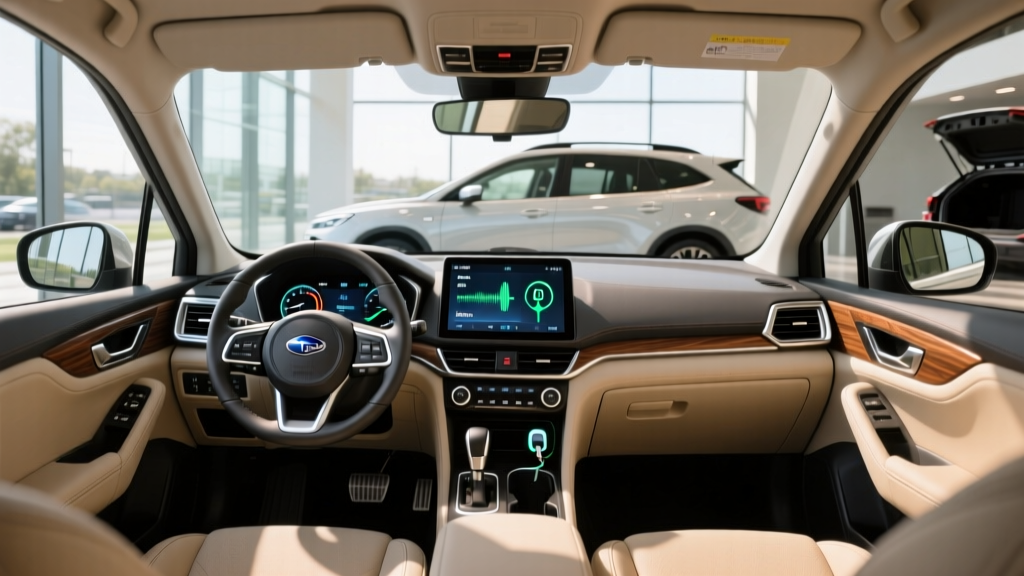
The sixth-generation Forester rides on an updated Subaru Global Platform, and the interior reflects a meaningful step up in materials, noise isolation, and screen real estate. The hybrid variant shares its cabin architecture with the gas-only Forester but adds hybrid-specific instrument cluster displays showing energy flow, regenerative braking status, and battery state of charge.
Infotainment and Displays
The centerpiece is an 11.6-inch vertical touchscreen running Subaru's latest Starlink infotainment system with wireless Apple CarPlay and Android Auto. Higher trims add built-in navigation and a 12.3-inch digital driver display that can toggle between a traditional speedometer layout and a hybrid energy-monitor view. The vertical orientation keeps climate controls accessible below the screen — a practical choice that avoids the touchscreen-only climate menus some competitors have adopted.
Seating and Cargo
The Forester Hybrid seats five with a 60/40 split-folding rear bench. Subaru has reshaped the rear seat cushion for better thigh support on longer drives. Cargo volume behind the second row sits at approximately 28.9 cubic feet — essentially unchanged from the gas model because the compact hybrid battery is packaged under the rear seat area rather than intruding into the load floor. Fold the rear seats flat and you're looking at roughly 68 cubic feet of total space, competitive with the Toyota RAV4 Hybrid.
Materials and Noise
Soft-touch materials cover the dashboard top and door uppers on Hybrid Premium and above. Subaru has added additional sound-deadening insulation in the floor and firewall for the 2025 generation, which matters in a hybrid where the engine cycles on and off more frequently than in a gas-only car. At idle with the engine off, the cabin is near-silent; under hard acceleration, the 2.5L flat-4 is audible but less droning than the previous generation's CVT tuning.
Hybrid Powertrain: 194 HP and Standard AWD
The 2025 Forester Hybrid uses a series-parallel hybrid system built around Subaru's 2.5-liter naturally aspirated Boxer engine paired with an electric motor integrated into the transmission housing. Combined output is 194 horsepower — a meaningful bump over the gas-only Forester's 180 hp. Power reaches all four wheels through Subaru's Symmetrical All-Wheel Drive system, which is standard across every Forester trim, hybrid or not.
The hybrid battery pack is a compact lithium-ion unit rated at approximately 1.1 kWh of usable capacity. This is a self-charging system: regenerative braking and the gasoline engine replenish the battery during normal driving. There is no plug, no charging port, and no electric-only driving mode designed for sustained zero-emission travel. The electric motor assists during acceleration and enables brief low-speed electric-only movement (such as creeping through a parking lot), but this is not a PHEV with a measurable electric-only range.
How the Hybrid System Drives
The electric motor fills in the torque gap that naturally aspirated engines typically have at low RPM, giving the Forester Hybrid a more responsive feel from a stop than the gas-only model. The continuously variable transmission (CVT) has been recalibrated for the hybrid to reduce the "rubber-band" effect under acceleration. In practice, the powertrain is smooth and unobtrusive during city driving — exactly where a conventional hybrid delivers its biggest efficiency advantage.
Fuel Economy: EPA Estimates and Real-World MPG
Fuel economy is the primary reason buyers cross-shop the Forester Hybrid against the gas-only version. Here's how the numbers break down:
| Driving Condition | EPA Estimate | Real-World Expectation |
|---|---|---|
| City | 35 MPG | 34–38 MPG (hybrids often exceed EPA in stop-and-go) |
| Highway | 33 MPG | 30–33 MPG (aerodynamic drag and CVT tuning reduce gains) |
| Combined | 35 MPG | 32–36 MPG depending on driving mix |
Conventional hybrids like the Forester tend to deliver their best real-world results in city and suburban driving, where regenerative braking recovers energy at every stop and the electric motor handles low-speed propulsion. On sustained highway runs above 70 mph, the advantage over the gas-only Forester (EPA 29 combined) narrows but remains meaningful — roughly 6 MPG combined in typical mixed driving.
For context, the EPA's fueleconomy.gov database lists official ratings once the vehicle is certified. Cold weather will reduce fuel economy by roughly 5–10% in winter conditions, as the engine runs more frequently to maintain cabin heat and the battery operates less efficiently at low temperatures. This is true of all hybrids and is less severe than the 20–30% range loss a full EV experiences in freezing weather.
HEV vs. PHEV vs. EV: Which Forester Buyer Are You?
The Forester Hybrid is a conventional HEV. Subaru does not currently offer a Forester plug-in hybrid (PHEV) in the U.S. market. Understanding the difference is essential before you compare it to competitors or consider a full EV.
| Factor | HEV (Forester Hybrid) | PHEV (e.g., Toyota RAV4 Prime) | BEV (e.g., Hyundai Ioniq 5) |
|---|---|---|---|
| Needs to plug in? | No — self-charging | Yes, for full benefit | Yes — required |
| Electric-only range | Minimal (low-speed only) | 35–42 miles typical | 250–320+ miles |
| Fuel cost reduction | ~20–25% vs. gas equivalent | ~50–70% if charged daily | ~60–80% (varies by electricity rate) |
| Federal tax credit (§30D) | Not eligible | Eligible (up to $7,500, subject to sourcing/income rules) | Eligible (up to $7,500, subject to sourcing/income rules) |
| Home charging required? | No | Recommended (120V works, 240V ideal) | Yes (Level 2 strongly recommended) |
| Upfront cost premium vs. gas | ~$1,500–$2,500 | ~$5,000–$8,000 (before credit) | ~$5,000–$15,000 (before credit) |
Choose the Forester Hybrid (HEV) if: You want better fuel economy without changing your refueling habits, you lack access to home or workplace charging, or you want standard AWD with minimal upfront cost premium.
Choose a PHEV if: You have a garage or driveway for a Level 2 charger, your daily commute is under 40 miles, and you want to drive mostly electric on weekdays while keeping gas flexibility for road trips.
Choose a full EV if: You have reliable home charging, you want maximum fuel-cost savings, you're eligible for the full federal tax credit, and you're comfortable with public DC fast charging for longer trips.
Pricing, Trims, and Tax Credit Eligibility
The 2025 Forester Hybrid is expected to start around $36,595 (including destination) in the Hybrid Premium trim, with a fully loaded Hybrid Touring approaching $42,000. This positions it competitively against the Toyota RAV4 Hybrid (starting ~$33,500) and the Honda CR-V Hybrid (starting ~$35,500), though the Forester's standard AWD across all trims narrows the effective price gap.
Federal Tax Credit Status
Because the Forester Hybrid is a conventional HEV — not a plug-in vehicle — it does not qualify for the IRS §30D Clean Vehicle Credit. That credit (up to $7,500 for new vehicles) applies only to battery electric vehicles (BEVs) and plug-in hybrids (PHEVs) that meet battery-sourcing, critical-mineral, MSRP, and buyer-income requirements. See the IRS Clean Vehicle Credit page for current eligibility rules.
Some states offer rebates or reduced registration fees for conventional hybrids, but these vary by jurisdiction. Check your state's energy or environmental agency website for current programs.
Reliability, Battery Warranty, and Replacement Cost
Hybrid Battery Warranty: Subaru covers the Forester Hybrid's lithium-ion battery pack for 8 years or 100,000 miles (whichever comes first). In states that follow California Air Resources Board (CARB) emissions standards — including California, New York, Massachusetts, and several others — the hybrid battery warranty extends to 10 years or 150,000 miles.
Long-Term Reliability
Subaru's hybrid system in the Forester is a mature design that shares architecture with hybrid components used in other Subaru models globally. The 2.5L Boxer engine is a well-established powerplant. Conventional hybrid batteries in modern vehicles from major manufacturers typically last well beyond their warranty periods — real-world data from Toyota's hybrid fleet (which uses similar nickel-metal-hydride and lithium-ion packs) shows many packs exceeding 150,000 miles with minimal capacity degradation.
Battery Replacement Cost
If the hybrid battery does require replacement outside of warranty, expect a cost in the range of $2,000 to $4,000 for the battery pack itself, plus labor. This is significantly less than a full EV battery replacement ($10,000–$20,000+) because the HEV pack is small (~1.1 kWh vs. 60–100 kWh in a BEV). Independent hybrid-battery refurbishment shops also offer reconditioned packs at lower cost, though availability varies by region.
The broader vehicle carries Subaru's standard 3-year/36,000-mile bumper-to-bumper and 5-year/60,000-mile powertrain warranties. Subaru's reliability ratings from sources like Consumer Reports and J.D. Power have been mixed in recent model years, largely due to infotainment complaints rather than powertrain issues — the hybrid system itself is not a reliability concern.
How It Compares: Forester Hybrid vs. Key Rivals
The compact hybrid SUV segment is competitive. Here's how the Forester Hybrid stacks up on the specs that matter:
| Spec | 2025 Subaru Forester Hybrid | 2025 Toyota RAV4 Hybrid | 2025 Honda CR-V Hybrid |
|---|---|---|---|
| Combined HP | 194 hp | 219 hp | 204 hp |
| EPA Combined MPG | 35 (est.) | 39 | 37 |
| AWD | Standard | Standard (AWD) | Available (FWD standard) |
| Cargo (rear seats up) | ~28.9 cu ft | 37.6 cu ft | 36.3 cu ft |
| Starting MSRP | ~$36,595 | ~$33,500 | ~$35,500 |
| Hybrid Battery Warranty | 8 yr / 100k mi | 10 yr / 150k mi | 8 yr / 100k mi |
The RAV4 Hybrid leads on fuel economy and cargo space. The CR-V Hybrid is close on efficiency and offers a slightly more upscale interior. The Forester Hybrid's advantages are its standard AWD on every trim, excellent outward visibility (a Subaru hallmark), and the EyeSight 4.0 driver-assistance system, which now includes a wide-angle camera for improved pedestrian and cyclist detection.
Pros
- Standard AWD on every trim — no FWD base model to avoid
- Redesigned interior with 11.6-inch vertical touchscreen
- Strong city MPG from hybrid system, especially in stop-and-go traffic
- Competent 194 hp output with responsive low-speed electric assist
- Excellent outward visibility and practical cargo layout
- EyeSight 4.0 with expanded sensor coverage
Cons
- Lower combined MPG than RAV4 Hybrid (35 vs. 39)
- Less cargo space than key rivals
- No PHEV variant available for electric-only commuting
- Higher starting price than base RAV4 Hybrid
- Hybrid battery warranty shorter than Toyota's 10-year coverage
- No federal tax credit eligibility (HEV, not PHEV/BEV)
Frequently Asked Questions
How many MPG does the 2025 Subaru Forester Hybrid get?
The Forester Hybrid is estimated to achieve 35 MPG city, 33 MPG highway, and 35 MPG combined. In real-world city driving with frequent stops, owners often see 36–38 MPG thanks to regenerative braking. Highway-only driving at sustained speeds above 70 mph typically yields 30–33 MPG.
Does the Forester Hybrid need to be plugged in?
No. The Forester Hybrid is a conventional hybrid (HEV). The battery recharges through regenerative braking and the gasoline engine. There is no charging port and no plug-in capability.
Does the 2025 Forester Hybrid qualify for a federal tax credit?
No. The IRS §30D Clean Vehicle Credit applies only to plug-in vehicles (BEVs and PHEVs). As a conventional HEV, the Forester Hybrid is not eligible. Some state-level hybrid incentives may apply — check your state's energy agency for current programs.
Is the Forester Hybrid reliable? What about battery replacement?
The hybrid system is based on proven, mature technology. Subaru covers the hybrid battery for 8 years/100,000 miles (10 years/150,000 miles in CARB states). If replacement is ever needed outside warranty, expect $2,000–$4,000 — far less than an EV battery replacement thanks to the small ~1.1 kWh pack.
How does the Forester Hybrid compare to a full EV like the Subaru Solterra?
The Solterra is a battery electric SUV with an EPA-estimated range of roughly 222–228 miles, DC fast charging capability, and eligibility for the federal tax credit (subject to current IRS rules). It costs significantly more upfront (~$45,000+) and requires home charging access. The Forester Hybrid is the better choice for buyers who want fuel savings without changing their refueling routine or who lack reliable charging access.
What's the difference between the Forester Hybrid and the RAV4 Prime?
The Toyota RAV4 Prime is a plug-in hybrid (PHEV) with 42 miles of electric-only range, 302 combined horsepower, and eligibility for the federal tax credit. It starts at roughly $44,500. The Forester Hybrid is a conventional HEV with no plug, lower cost, and simpler ownership — but less total fuel savings potential if you can charge a PHEV daily.
Specifications and pricing are based on manufacturer data and EPA estimates available at time of publication. Confirm final specs and current incentive eligibility with your local Subaru dealer and the EPA fueleconomy.gov database. Tax credit rules are subject to change — consult a tax professional or the IRS for personalized guidance.