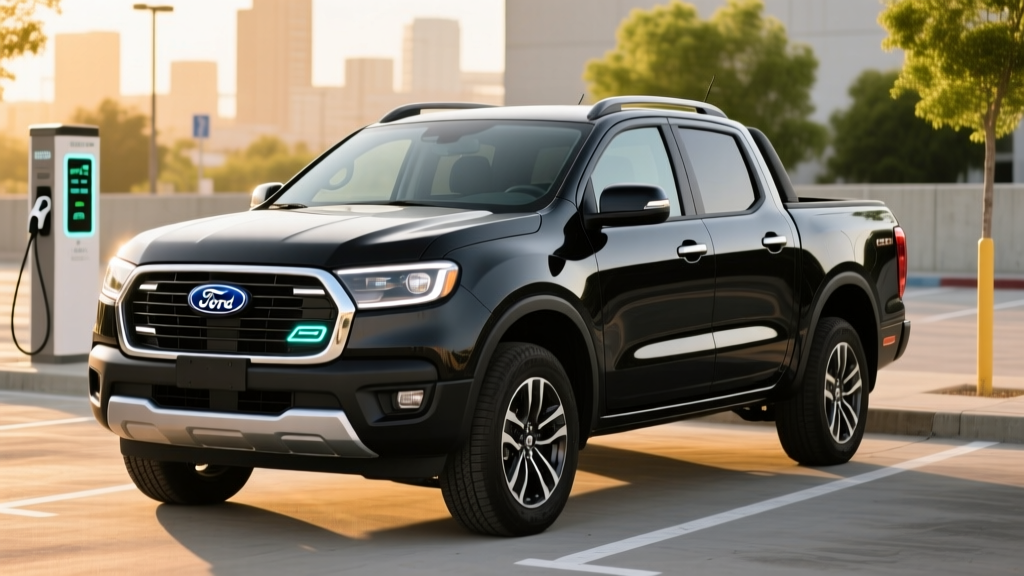
The search for a capable hybrid small truck essentially begins and ends with one nameplate: the Ford Maverick Hybrid. In a segment where mid-size trucks have ballooned in price and footprint, the Maverick's standard hybrid powertrain offers a rare combination — genuine truck utility wrapped around compact-car fuel economy. For 2026, the Maverick Hybrid remains the only conventional hybrid (HEV) in the compact truck class, making it a default pick for buyers who want a bed, want to save at the pump, and don't want to plug in.
But does the real-world fuel economy match the EPA sticker? Can it actually tow? And should you hold out for a plug-in hybrid or full EV truck instead? Let's put the numbers on the table.
2026 Ford Maverick Hybrid: Quick Spec Overview
| Specification | 2026 Maverick Hybrid (FWD) |
|---|---|
| Powertrain | 2.5L Atkinson-cycle I4 + electric motor |
| Combined Horsepower | 191 hp |
| Transmission | eCVT (power-split device) |
| Drivetrain | Front-wheel drive (AWD available) |
| EPA Fuel Economy (FWD) | 42 city / 33 highway / 37 combined MPG |
| EPA Fuel Economy (AWD) | 40 city / 32 highway / 36 combined MPG |
| Fuel Tank | 16.5 gallons |
| Max Range (estimated) | ~610 miles (FWD combined) |
| 0–60 mph | ~7.8 seconds |
| Max Payload | 1,500 lbs |
| Max Towing | 2,000 lbs (4,000 lbs w/ 4K Tow Pkg — gas only) |
| Bed Length | 4.5 feet (54.4 cu ft volume) |
| Base MSRP (XL Hybrid) | ~$28,500 |
| Battery Warranty | 8 years / 100,000 miles |
Fuel Economy: EPA Numbers vs. Real-World MPG
The Maverick Hybrid's headline number — 42 MPG city — is the kind of figure that makes sedan owners jealous, let alone truck buyers. But the city/highway split is where the hybrid advantage really shows. Like all power-split hybrids, the Maverick thrives in stop-and-go driving where regenerative braking recaptures energy and the electric motor handles low-speed propulsion. Highway driving, where the gas engine does most of the work, drops efficiency noticeably.
| Driving Scenario | FWD Hybrid | AWD Hybrid |
|---|---|---|
| EPA City | 42 MPG | 40 MPG |
| EPA Highway | 33 MPG | 32 MPG |
| EPA Combined | 37 MPG | 36 MPG |
| Real-World City (owner-reported) | 40–46 MPG | 38–43 MPG |
| Real-World Highway (70–80 mph) | 29–33 MPG | 28–31 MPG |
| Real-World Combined (mixed) | 34–39 MPG | 33–37 MPG |
According to aggregated owner data on fueleconomy.gov, many Maverick Hybrid owners report exceeding the EPA city estimate in moderate climates, with some logging 44–46 MPG on suburban commutes. Highway numbers tend to land slightly below the EPA sticker at sustained speeds above 75 mph — a common pattern for hybrids with relatively small displacement engines that must work harder at high velocity.
HEV vs. PHEV vs. EV: Which Truck Powertrain Fits You?
The Maverick Hybrid is a conventional hybrid (HEV) — it never plugs in. Its small lithium-ion battery (approximately 1.1 kWh usable) charges exclusively through regenerative braking and the gasoline engine. This is a critical distinction from plug-in hybrids (PHEVs) like the upcoming Toyota Tacoma PHEV or full battery-electric trucks like the Ford F-150 Lightning.
| Factor | HEV (Maverick Hybrid) | PHEV (e.g., Tacoma i-FORCE MAX PHEV) | BEV (e.g., F-150 Lightning) |
|---|---|---|---|
| Plugs in? | No | Yes | Yes |
| Electric-only range | N/A (EV assist only) | ~30–40 mi (est.) | 230–320 mi |
| Total range | ~540–610 mi | ~500+ mi combined | 230–320 mi |
| Home charging needed? | No | Recommended (Level 2) | Essential (Level 2) |
| Federal tax credit | None (§30D requires plug-in) | Potentially up to $7,500* | Up to $7,500* |
| Best for | No plug-in access, city-heavy driving | Home charging + short daily commute | Home charging, daily driving under 250 mi |
| Upfront cost premium | Lowest | Mid-range | Highest |
*Federal §30D tax credit eligibility depends on MSRP caps ($80,000 for trucks/vans/SUVs), buyer income limits ($300K joint / $150K single AGI), battery critical-mineral sourcing, and North American final assembly. Check current rules at irs.gov. The Maverick Hybrid does NOT qualify — it's an HEV, not a plug-in vehicle.
- You lack access to home or workplace charging
- Your commute is city/suburban-heavy (the hybrid sweet spot)
- You want truck capability at the lowest entry price
- You don't want to think about charging — ever
- You can install a Level 2 charger at home
- Your daily driving is under 40 miles (PHEV covers it on electricity alone)
- You want to qualify for the federal tax credit
- You want zero-emission daily driving with gas backup (PHEV) or full electrification (BEV)
Powertrain and Performance: What 191 HP Feels Like in a Small Truck
The Maverick Hybrid pairs a 2.5-liter Atkinson-cycle four-cylinder engine with a permanent-magnet electric motor, routed through Ford's eCVT — technically a planetary gearset power-split device, not a belt-driven CVT. Combined output is 191 horsepower, which is modest by modern truck standards but adequate for the Maverick's ~3,600-pound curb weight.
Acceleration to 60 mph takes approximately 7.8 seconds — perfectly acceptable for merging and passing, though the engine drones noticeably under hard acceleration as the eCVT holds it at peak RPM. The electric motor fills in torque at low speeds, giving the Maverick Hybrid a surprisingly responsive feel around town — exactly where this powertrain shines.
The AWD Hybrid variant, introduced for the 2025 model year and continuing into 2026, adds a rear-mounted electric motor that provides torque to the rear axle when slip is detected or under hard acceleration. This is not a mechanical AWD system — there's no driveshaft — but it's effective in rain, light snow, and gravel. The trade-off is a 1 MPG drop across the board and a modest price premium (~$1,500).
Towing, Payload, and the Hybrid's Real Limitations
Here's where the hybrid small truck conversation demands honesty. The Maverick Hybrid is rated for 2,000 pounds of towing across all hybrid trims — no 4K Tow Package is available for the hybrid (that's exclusive to the 2.0L EcoBoost gas model, which bumps capacity to 4,000 lbs). Payload tops out at 1,500 lbs for the hybrid.
For context, 2,000 lbs covers a small utility trailer, a couple of dirt bikes, or a lightweight pop-up camper. It does not cover a loaded horse trailer, a 5,000-lb boat, or a construction equipment haul. If towing is a primary use case, the EcoBoost gas Maverick with the 4K Tow Package — or stepping up to a mid-size truck — is the pragmatic choice.
Payload is less of a compromise. The Maverick's 4.5-foot bed with its 1,500-lb rating handles landscaping materials, furniture-store runs, and weekend project hauling without issue. The bed's clever features — standard tie-downs, available 12V and 120V power outlets, built-in ruler and cup holders in the tailgate — punch well above the truck's size class.
Battery Longevity, Warranty, and Replacement Costs
The Maverick Hybrid uses a relatively small lithium-ion battery pack (~1.1 kWh usable capacity) that operates within a narrow state-of-charge window — typically between 40% and 80%. This shallow cycling strategy dramatically reduces degradation compared to the deep discharge cycles a full EV battery endures. Toyota's hybrid battery packs (similar chemistry and strategy) routinely exceed 200,000 miles with minimal capacity loss, and Ford's hybrid system follows the same engineering philosophy.
If replacement is needed outside warranty, expect a hybrid battery pack cost in the $2,000–$3,500 range (parts and labor) based on current Ford hybrid service pricing — a fraction of full EV battery replacement costs. Independent hybrid specialists and refurbished pack options can bring this below $2,000. For perspective, a single transmission replacement on a conventional gas truck often costs more.
Pricing, Trims, and the Tax-Credit Question
The 2026 Maverick Hybrid starts at approximately $28,500 for the XL trim with FWD, making it one of the most affordable new trucks on the US market — hybrid or otherwise. Key trim pricing:
- XL Hybrid (FWD): ~$28,500
- XLT Hybrid (FWD): ~$30,500
- Lariat Hybrid (FWD): ~$34,000
- AWD Hybrid (any trim): add ~$1,500
Does the Maverick Hybrid qualify for a federal tax credit? No. The IRS §30D New Clean Vehicle Credit applies exclusively to plug-in electric vehicles (BEVs and PHEVs) with a minimum 7 kWh battery capacity. As a conventional hybrid with a ~1.1 kWh pack and no plug, the Maverick Hybrid is ineligible. Some states and utilities offer small rebates for conventional hybrids, but these vary widely — check your state energy office or local utility for current programs.
That said, the Maverick Hybrid's low base price means many buyers pay less out of pocket than they would for a BEV or PHEV truck even after applying the $7,500 federal credit. The fuel savings versus a comparable gas-only compact truck (roughly 25 MPG combined) add up to approximately $600–$900 per year for a driver covering 15,000 miles annually at $3.50/gallon — meaning the hybrid premium over the gas Maverick (if any, since the hybrid is standard on many trims) pays for itself within the first year or two.
Reliability and Ownership: What Owners Actually Report
Ford's hybrid powertrain technology is mature — the company has been refining its power-split hybrid system since the 2005 Escape Hybrid, making it one of the longest-running hybrid platforms from an American automaker. The Maverick Hybrid has earned strong reliability marks from owner surveys, with the hybrid system itself generating very few complaints relative to the conventional gas powertrain.
The Maverick earned an IIHS Top Safety Pick designation for the most recent tested model year, with Good ratings in major crash-test categories. Standard driver-assistance features include Ford Co-Pilot360 with automatic emergency braking, lane-keeping assist, and a rearview camera. Available adaptive cruise control and lane-centering provide Level 2 driver assistance on highway stretches — but as with all Level 2 systems, the driver must remain attentive and hands-on at all times.
- 42 MPG city — best-in-class for any truck
- Lowest starting price in the truck segment (~$28,500)
- No plug-in required — works for apartment dwellers
- Clever, usable 4.5-ft bed with smart features
- Strong real-world reliability track record
- AWD now available on hybrid trims
- Towing limited to 2,000 lbs (no 4K Tow option)
- Highway MPG drops significantly (29–33 real-world)
- No federal tax credit eligibility (HEV, not PHEV)
- Engine drone under hard acceleration (eCVT behavior)
- Bed is short (4.5 ft) — won't fit full sheets of plywood flat
- Modest 191 hp — not a performance truck
Frequently Asked Questions
How many MPG does the Ford Maverick Hybrid actually get?
The EPA rates the FWD Maverick Hybrid at 42 city / 33 highway / 37 combined MPG. Real-world owner reports cluster between 34 and 39 MPG combined, with city-heavy drivers often exceeding 40 MPG and highway-heavy drivers seeing 29–33 MPG at sustained speeds above 75 mph.
Does the Maverick Hybrid need to be plugged in?
No. The Maverick Hybrid is a conventional hybrid (HEV). Its small battery recharges through regenerative braking and the gas engine. You fuel it like any other vehicle — no charging cable, no home charger installation, no public charging dependency.
Is the Maverick Hybrid reliable, and what does a battery replacement cost?
Ford's hybrid system has over two decades of engineering refinement behind it. The hybrid battery is warranted for 8 years/100,000 miles (10 years/150,000 miles in CARB states). Out-of-warranty replacement runs approximately $2,000–$3,500, though real-world data suggests these packs routinely last well beyond 150,000 miles with the shallow-cycle strategy Ford employs.
Does the Maverick Hybrid qualify for any tax credit?
The federal §30D New Clean Vehicle Credit does not apply — it requires a plug-in vehicle with at least 7 kWh of battery capacity. The Maverick Hybrid has ~1.1 kWh and no plug. Some states and utilities may offer small hybrid rebates, but these vary by jurisdiction. Check your state energy office for current programs.
Can the Maverick Hybrid tow a trailer?
Yes, but with limits. The hybrid is rated for 2,000 lbs of towing — enough for a small utility trailer, lightweight camper, or a pair of personal watercraft. The 4,000-lb 4K Tow Package is only available on the 2.0L EcoBoost gas model, not the hybrid.
Hybrid vs. PHEV vs. EV truck — which should I choose?
Choose the Maverick Hybrid if you can't charge at home, want the lowest price, and drive mostly in the city. A PHEV truck (like the upcoming Tacoma PHEV) makes sense if you have home charging and a short commute you'd like to cover on electricity. A BEV truck (F-150 Lightning, Chevy Silverado EV) is best if you have reliable Level 2 home charging, drive under 250 miles daily, and want to eliminate gasoline entirely while qualifying for the federal tax credit.
Is AWD worth it on the Maverick Hybrid?
If you regularly deal with snow, rain, or unpaved roads, the AWD Hybrid's $1,500 premium and 1 MPG penalty are worthwhile. The rear electric motor engages automatically when slip is detected. For dry-climate, pavement-only drivers, FWD saves money and fuel.
Sources: fueleconomy.gov (EPA), Ford Motor Company, IRS §30D Tax Credit. Pricing and specifications reflect 2026 model year data available at time of publication. Tax credit eligibility rules are subject to change — consult a tax professional for your specific situation.