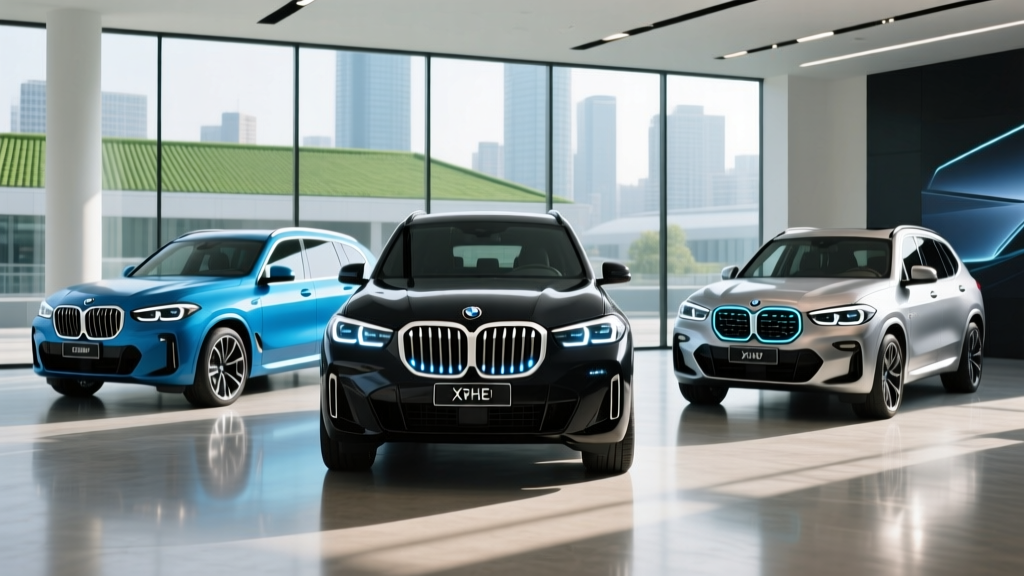
BMW has committed heavily to plug-in hybrid powertrains across its SUV lineup, offering buyers a bridge between gas-only convenience and full-electric driving. If you're researching a hybrid BMW SUV, the 2026 lineup centers on three distinct models: the midsize X5 xDrive50e, the high-performance XM, and the compact X3 xDrive30e. All three are plug-in hybrids (PHEVs), meaning they pair a gasoline engine with a larger battery and electric motor that delivers genuine electric-only range before the engine kicks in.
This guide breaks down each model's EPA fuel economy, electric range, battery specifications, charging behavior, powertrain output, pricing, and federal tax credit eligibility — with real-world caveats that spec sheets often omit.
HEV vs PHEV: Why Every Hybrid BMW SUV Is a Plug-In
Conventional Hybrid (HEV): A small battery recharges through regenerative braking and the engine. No plug. Electric-only driving is limited to brief low-speed moments. Think Toyota RAV4 Hybrid.
Plug-In Hybrid (PHEV): A significantly larger battery (typically 15–30 kWh) that charges via a plug. Delivers 20–50 miles of electric-only range at full highway speeds. Once depleted, operates as a conventional hybrid. Every current hybrid BMW SUV falls into this category.
BMW phased out conventional (non-plug-in) hybrid SUVs in the U.S. market. The practical implication: to extract maximum value from a hybrid BMW SUV, you need access to charging — ideally a Level 2 home charger. Without regular plug-in charging, a PHEV operates as a heavier, less efficient conventional hybrid, and you're carrying battery weight you never use.
2026 BMW X5 xDrive50e: The Mainstream Hybrid BMW SUV
The X5 xDrive50e is BMW's volume PHEV — a midsize luxury SUV that balances electric commuting with road-trip flexibility. For 2026, it carries over the powertrain introduced with the G05-generation refresh.
| Specification | X5 xDrive50e |
|---|---|
| Powertrain | 3.0L turbocharged inline-6 + electric motor |
| Combined Horsepower | 483 hp |
| Combined Torque | 516 lb-ft |
| 0-60 mph | 4.6 seconds |
| Battery (usable) | 25.7 kWh (NMC lithium-ion) |
| EPA Electric Range | 38 miles |
| EPA MPG (gas, charge-depleted) | 22 city / 24 hwy / 22 combined |
| MPGe (electric + gas) | 50 MPGe combined |
| Level 2 Charge Rate | 7.4 kW (AC only, no DC fast charge) |
| Level 2 Charge Time (0-100%) | ~4.0 hours |
| Base MSRP | $72,575 |
| Battery Warranty | 8 years / 80,000 miles |
Real-World Range Note: The EPA 38-mile electric rating assumes moderate temperatures and mixed driving. Expect 30–34 miles of electric range in cold weather (below 40°F) or sustained highway speeds above 70 mph. In mild city driving with regen braking, some owners report 40+ miles.
How Many MPG Does the X5 xDrive50e Get?
| Condition | City | Highway | Combined |
|---|---|---|---|
| EPA (charge-depleted, gas only) | 22 | 24 | 22 |
| Real-world observed (gas only) | 20–23 | 25–27 | 22–24 |
| With daily Level 2 charging | Most commutes use zero gasoline (under 38 mi) | ||
Like most PHEVs, the X5's gas-only MPG is modest — it's a 5,300-pound luxury SUV. The efficiency advantage comes from electric-only commuting. If your round-trip commute is under 35 miles and you charge nightly, you may use gasoline only on weekend road trips.
2026 BMW XM: The Performance PHEV
The XM is BMW M's first standalone model since the M1, and it uses a PHEV powertrain to deliver supercar-rivaling output. It's the most powerful hybrid BMW SUV in the lineup.
| Specification | XM | XM Label (Red) |
|---|---|---|
| Powertrain | 4.4L twin-turbo V8 + electric motor | 4.4L twin-turbo V8 + electric motor |
| Combined Horsepower | 644 hp | 738 hp |
| Combined Torque | 590 lb-ft | 738 lb-ft |
| 0-60 mph | 4.1 seconds | 3.7 seconds |
| Battery (usable) | 25.7 kWh (NMC) | 25.7 kWh (NMC) |
| EPA Electric Range | 31 miles | 30 miles |
| EPA MPG (gas only) | 12 city / 17 hwy / 14 combined | 12 city / 17 hwy / 14 combined |
| Level 2 Charge Rate | 7.4 kW (AC only) | 7.4 kW (AC only) |
| Base MSRP | $159,995 | $185,000 |
The XM's gas-only fuel economy is brutal — 14 MPG combined is thirstier than many non-hybrid V8 SUVs. The electric motor exists primarily for torque-fill performance, not efficiency. Buyers choosing the XM prioritize acceleration and exclusivity over operating cost.
2026 BMW X3 xDrive30e: The Compact PHEV Option
The redesigned X3 xDrive30e brings plug-in hybrid capability to BMW's compact SUV, competing with the Volvo XC60 Recharge and Lexus NX 450h+.
| Specification | X3 xDrive30e |
|---|---|
| Powertrain | 2.0L turbocharged inline-4 + electric motor |
| Combined Horsepower | 292 hp |
| Combined Torque | 332 lb-ft |
| 0-60 mph | 5.9 seconds |
| Battery (usable) | 22.0 kWh (NMC) |
| EPA Electric Range | 35 miles |
| EPA MPG (gas only) | 28 city / 29 hwy / 28 combined |
| MPGe (electric + gas) | 65 MPGe combined |
| Level 2 Charge Rate | 7.4 kW (AC only) |
| Base MSRP | $53,575 |
The X3 PHEV is the most fuel-efficient hybrid BMW SUV once the battery depletes, thanks to its smaller engine and lighter curb weight. For buyers who want BMW's plug-in technology at a lower entry price, this is the most accessible option.
Charging Every Hybrid BMW SUV: What to Expect
A critical limitation across the 2026 BMW PHEV lineup: none support DC fast charging. All three models accept AC charging only, capped at 7.4 kW via a Level 2 connection.
| Charge Level | Power (kW) | Approx. Miles Added/Hour | 0-100% Time |
|---|---|---|---|
| Level 1 (120V household) | ~1.4 kW | ~4–5 miles/hr | 16–20 hours |
| Level 2 (240V home/public) | 7.4 kW | ~22–25 miles/hr | 3.5–4.0 hours |
| DC Fast Charge | Not supported on any 2026 BMW PHEV | ||
This means highway road-trip charging isn't practical — you won't pull into a DC fast-charging station and add 100 miles of electric range in 15 minutes. The PHEV strategy here is charge-at-home, drive-electric-daily, burn-gas-on-road-trips.
Home charging setup: A 240V / 40A circuit (NEMA 14-50 or hardwired Level 2 EVSE) will fully recharge any BMW PHEV overnight. Installation costs typically range from $500–$2,500 depending on electrical panel proximity and local permit requirements. Always have a licensed electrician assess your panel capacity before installation.
Tax Credits and Incentives for BMW Plug-In Hybrids
Under current IRS §30D clean vehicle rules, the federal EV tax credit of up to $7,500 applies to qualifying PHEVs — but eligibility is constrained by multiple requirements:
- MSRP Cap: SUVs must have an MSRP at or below $80,000. This eliminates the XM entirely and most well-optioned X5 xDrive50e builds.
- Battery Capacity: Must be ≥7 kWh (all BMW PHEVs qualify).
- Income Limits: Adjusted gross income ≤$300,000 (joint), $225,000 (head of household), $150,000 (single).
- Battery Component Sourcing: Increasingly strict critical-mineral and battery-component requirements from IRS Notice 2023-14 may disqualify vehicles with certain foreign-sourced components. BMW's supply chain sourcing varies by model year.
- Point-of-Sale Transfer: Eligible buyers can transfer the credit to the dealer at purchase, reducing the purchase price directly rather than waiting for a tax refund.
Bottom line for 2026: The X3 xDrive30e (MSRP ~$53,575) is the most likely candidate to qualify for the full $7,500 credit, bringing effective pricing near $46,000. The X5 xDrive50e's $72,575 base MSRP falls under the $80,000 SUV cap, but options can push it over. Always verify current eligibility on fueleconomy.gov before purchasing, as sourcing rules tighten annually.
Reliability and Battery Warranty
BMW PHEV High-Voltage Battery Warranty: 8 years or 80,000 miles (whichever comes first), covering defects and capacity loss below 70% of original capacity. This is mandated by CARB-emissions-state requirements and applies nationwide for BMW.
Is a Hybrid BMW SUV Reliable?
BMW's PHEV powertrains have proven reasonably robust since the 2019-generation systems. The inline-6 (B58) in the X5 is widely regarded as one of BMW's most reliable modern engines. The electric motor adds complexity but has fewer wear components than a traditional transmission.
Battery replacement cost: Out-of-warranty high-voltage battery replacement for a BMW PHEV currently ranges from $12,000 to $18,000 including labor, depending on the model. However, NMC batteries in PHEV applications tend to degrade more slowly than in full BEVs because the usable window is smaller — the system rarely allows full 0% or 100% SoC at the cell level, which extends cycle life.
Real-world data from owner communities suggests BMW PHEV batteries lose roughly 8–12% capacity over the first 5 years / 60,000 miles — well within the 70% warranty threshold. Battery replacement before 150,000 miles is uncommon based on current degradation curves.
Hybrid BMW SUV vs Full EV vs Gas: Which Fits You?
Choose a hybrid BMW SUV (PHEV) if:
- Your daily commute is under 35 miles round-trip and you can charge at home
- You take regular road trips exceeding 200 miles and don't want to plan around DC fast-charging infrastructure
- You want electric daily driving but live in a region with extreme cold or limited public charging
- You're not ready to commit to a full BEV but want to reduce gasoline consumption significantly
Choose a full EV (like the BMW iX) if:
- You have reliable home Level 2 charging and your daily driving is under 250 miles
- You want zero gasoline expenses and minimal maintenance (no oil changes, no engine)
- You qualify for the full $7,500 federal credit and your state offers additional EV incentives
Choose a gas-only SUV if:
- You cannot charge at home or work (apartment, street parking, no outlet access)
- Your budget doesn't accommodate the PHEV price premium (~$8,000–$12,000 over a gas X5)
- You drive primarily long highway routes where PHEV electric range provides minimal benefit
Pros and Cons of the Hybrid BMW SUV Lineup
Pros
- 30–38 miles of electric-only range covers most daily commutes without gasoline
- No range anxiety — gas engine provides 350+ miles of total combined range
- Strong acceleration from combined electric + gas powertrain (especially X5 and XM)
- X3 xDrive30e likely qualifies for $7,500 federal tax credit
- 8-year/80,000-mile battery warranty provides long-term peace of mind
- Regenerative braking reduces brake wear significantly
Cons
- No DC fast charging on any model — highway electric top-ups are impractical
- Gas-only MPG is mediocre (14–28 combined depending on model) once battery depletes
- PHEV premium over gas-only BMW SUVs is $8,000–$15,000
- XM's fuel economy is worse than many non-hybrid V8 competitors
- X5 MSRP can exceed $80,000 cap when optioned, eliminating tax credit
- Requires home charging access to realize efficiency benefits
Frequently Asked Questions
How many MPG does a hybrid BMW SUV get?
It depends on the model and whether the battery is charged. The X3 xDrive30e achieves 28 MPG combined on gas alone and 65 MPGe when factoring in electric driving. The X5 xDrive50e gets 22 MPG combined on gas and 50 MPGe blended. The XM achieves just 14 MPG combined on gas. With daily charging and short commutes, all three can operate primarily on electricity, using gasoline rarely.
How far can a hybrid BMW SUV go on electric only?
The X5 xDrive50e delivers an EPA-rated 38 miles of electric-only range. The X3 xDrive30e provides 35 miles. The XM manages 30–31 miles. Real-world electric range drops to 25–32 miles in cold weather or sustained highway driving. Total combined range (electric + full gas tank) exceeds 350 miles in the X5 and X3.
Does a hybrid BMW SUV qualify for a tax credit?
Possibly. Under IRS §30D rules, the X3 xDrive30e (MSRP ~$53,575) is the strongest candidate for the up-to-$7,500 federal credit, subject to income caps and battery-sourcing requirements. The X5 xDrive50e qualifies at its $72,575 base MSRP (under the $80,000 SUV cap) but may exceed it with options. The XM does not qualify due to its $159,995+ MSRP. Always check fueleconomy.gov for the latest eligibility before purchasing.
Is a hybrid BMW SUV reliable, and what does battery replacement cost?
BMW's PHEV powertrains — especially the B58 inline-6 — have strong reliability reputations. The high-voltage battery is warrantied for 8 years/80,000 miles against capacity loss below 70%. Out-of-warranty battery replacement runs $12,000–$18,000, but real-world degradation data suggests most PHEV batteries retain 88–92% capacity at the 5-year mark, making premature replacement unlikely.
Can I charge a hybrid BMW SUV at a DC fast-charging station?
No. None of BMW's 2026 PHEV SUVs support DC fast charging. They accept AC charging only, up to 7.4 kW on Level 2. This means a full charge takes approximately 3.5–4 hours. The PHEV is designed for overnight home charging, not highway fast-charging stops.
Hybrid vs PHEV vs EV — which BMW SUV should I buy?
If you can charge at home and your commute is under 35 miles, a BMW PHEV (X3 xDrive30e or X5 xDrive50e) offers the best of both worlds: electric daily driving with gas-engine freedom for road trips. If you drive more than 250 miles daily or want zero gasoline costs, consider the BMW iX full EV. If you cannot charge at home, a conventional gas-only BMW SUV will be simpler and less expensive upfront — though you'll miss the electric-commuting advantage entirely.