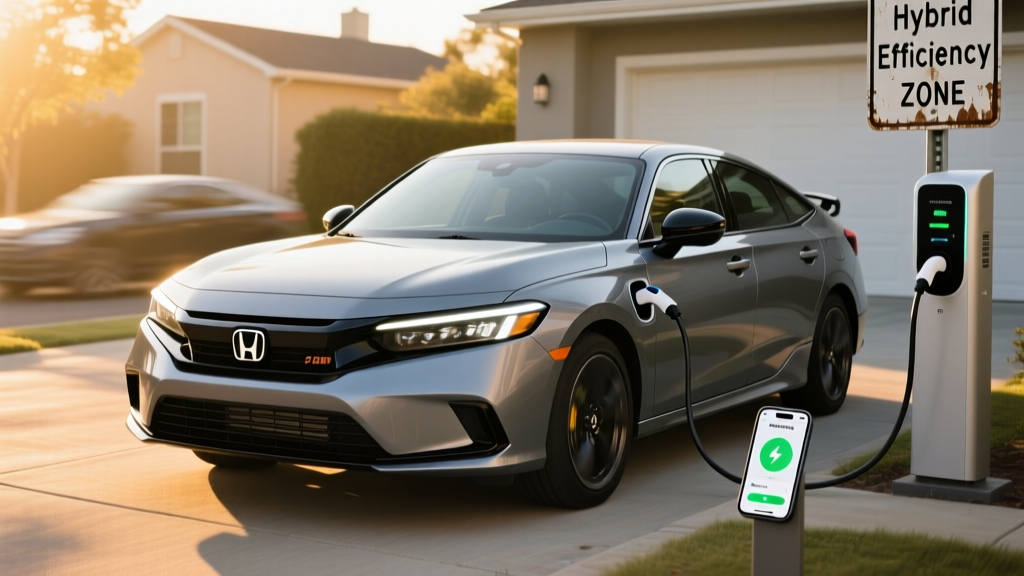
The 2026 Honda Civic Sport Hybrid occupies a specific niche that's increasingly hard to find: a conventional hybrid (HEV) that doesn't try to be an electric car. It doesn't plug in. It doesn't have an electric-only mode you need to manage. You just drive it, and it sips fuel at a rate that makes gas stations a monthly afterthought rather than a weekly obligation.
For buyers weighing the Civic Sport Hybrid against plug-in hybrids (PHEVs) or full battery-electric vehicles (BEVs), the decision hinges on your daily routine, home charging access, and whether you want the simplicity of a gas tank or the savings of electrons. This guide breaks down exactly what the 2026 Civic Sport Hybrid delivers — and where it falls short.
HEV vs PHEV vs EV: Where the Civic Sport Hybrid Fits
Before diving into specs, it's critical to understand what the Civic Sport Hybrid is not. It is a conventional hybrid (HEV), meaning it cannot plug in and has no meaningful electric-only range. The small lithium-ion battery (roughly 1.1 kWh usable) is recharged entirely by the gasoline engine and regenerative braking.
| Feature | Civic Sport Hybrid (HEV) | Typical PHEV (e.g., Toyota Prius Prime) | Full EV (e.g., Chevy Bolt EV) |
|---|---|---|---|
| Plugs in? | No | Yes (Level 1/2) | Yes (Level 1/2/DC) |
| Electric-only range | None (motor assists only) | 25–44 miles | 200–300+ miles |
| Total range | ~480 miles (12.4-gal tank) | ~600 miles (electric + gas) | 200–300 miles (battery only) |
| Fueling/charging time | 3 min at gas station | 4 hrs Level 2 / 3 min gas | 30 min DC / 8 hrs Level 2 |
| Federal tax credit (§30D) | Not eligible | Up to $7,500 (if eligible) | Up to $7,500 (if eligible) |
| Best for | No home charging, long trips | Short commutes + road trips | Home charging, daily driving |
The Civic Sport Hybrid's advantage is zero lifestyle change. If you live in an apartment without charging access, regularly drive 400+ miles between stops, or simply don't want to think about charging logistics, the HEV approach eliminates range anxiety entirely. The trade-off: you'll never drive on cheap electricity, and you won't qualify for the federal §30D tax credit that makes PHEVs and BEVs more affordable for eligible buyers.
Fuel Economy: EPA Ratings and Real-World MPG
The 2026 Honda Civic Sport Hybrid carries an EPA-estimated 50 MPG city / 47 MPG highway / 49 MPG combined, according to fueleconomy.gov. These numbers place it among the most efficient non-plug-in compact sedans available, trailing only the Toyota Prius (57 MPG combined) and Hyundai Elantra Hybrid Blue (54 MPG combined).
| Driving Condition | EPA Estimate | Real-World Expectation |
|---|---|---|
| City (stop-and-go) | 50 MPG | 50–55 MPG (hybrids excel here) |
| Highway (70+ mph) | 47 MPG | 42–46 MPG (aero drag, less regen) |
| Combined (mixed) | 49 MPG | 46–52 MPG |
| Cold weather (below 32°F) | N/A | 40–45 MPG (engine runs more for heat) |
Like most hybrids, the Civic Sport Hybrid often exceeds its EPA city rating in real-world stop-and-go driving. Regenerative braking recaptures energy that would otherwise be lost as heat, and the engine shuts off at stops. On a 15-mile urban commute with frequent lights, owners regularly report 52–55 MPG.
Highway driving tells a different story. At sustained 75–80 mph, the hybrid system's advantages diminish — the engine runs continuously, and aerodynamic drag dominates. Expect 42–46 MPG on long interstate trips. Cold weather further reduces efficiency because the engine must run to provide cabin heat (the Civic Sport Hybrid lacks the heat pump found in some BEVs).
Powertrain: 200 Horsepower from Honda's Two-Motor System
The 2026 Civic Sport Hybrid uses Honda's fourth-generation two-motor hybrid system, pairing a 2.0-liter Atkinson-cycle four-cylinder engine with two electric motors integrated into the transmission housing.
| Specification | 2026 Civic Sport Hybrid |
|---|---|
| Engine | 2.0L DOHC Atkinson-cycle I-4 |
| Engine power | 143 hp @ 6,000 rpm / 134 lb-ft @ 4,500 rpm |
| Electric motors | Dual motor (propulsion + generator) |
| Propulsion motor output | 181 hp / 232 lb-ft |
| Combined system output | 200 hp / 232 lb-ft |
| Transmission | e-CVT (single-speed direct drive) |
| 0–60 mph | ~6.8 seconds |
| Drivetrain | Front-wheel drive |
| Battery (usable) | ~1.1 kWh lithium-ion |
| Fuel tank | 12.4 gallons |
| Total range | ~480–600 miles (depending on driving) |
The system operates primarily as a series hybrid at low speeds: the engine drives a generator, which powers the propulsion motor or charges the battery. At highway speeds (typically above 45 mph), a lockup clutch engages, allowing the engine to drive the wheels directly for better efficiency. The result is seamless power delivery without the rubber-band feel of older CVTs.
With 200 combined horsepower and 232 lb-ft of instant electric torque, the Civic Sport Hybrid accelerates with authority. The 6.8-second 0–60 time is quick enough for confident highway merging and passes. Sport mode sharpens throttle response and holds higher RPMs, though at a fuel-economy penalty.
Pricing, Trims, and Tax Credit Reality
The 2026 Honda Civic Sport Hybrid is available in two body styles — sedan and hatchback — with pricing starting at $30,450 MSRP (including destination) for the Sport Hybrid sedan. The Sport Touring Hybrid, which adds leather, a premium audio system, and Honda's full suite of driver-assist features, starts at $33,850.
| Trim | Body Style | MSRP (incl. destination) |
|---|---|---|
| Sport Hybrid | Sedan | $30,450 |
| Sport Touring Hybrid | Sedan | $33,850 |
| Sport Hybrid | Hatchback | $31,450 |
| Sport Touring Hybrid | Hatchback | $34,850 |
Federal Tax Credit: Not Eligible
The Honda Civic Sport Hybrid does not qualify for the IRS §30D Clean Vehicle Credit. That credit is reserved for plug-in hybrids (PHEVs) and battery-electric vehicles (BEVs) with battery capacities of at least 7 kWh. The Civic's 1.1 kWh hybrid battery falls well below that threshold.
Some states offer separate incentives for conventional hybrids, but these are increasingly rare as policy shifts toward plug-in vehicles. Check your state's energy office or AFDC incentive database for local programs.
For buyers who do have home charging access and want tax-credit eligibility, the plug-in alternative is worth considering — though Honda does not currently offer a Civic PHEV in the U.S. The closest competitors are the Toyota Prius Prime (44 miles electric, up to $7,500 credit) and Hyundai Ioniq PHEV (29 miles electric).
Battery Longevity, Warranty, and Replacement Cost
Hybrid battery anxiety is real, but the data shows it's largely unfounded for modern systems. Honda covers the Civic Sport Hybrid's lithium-ion battery with an 8-year/100,000-mile warranty (extended to 10 years/150,000 miles in California Air Resources Board states, including CA, NY, MA, and others adopting CARB rules).
The warranty guarantees the battery will retain sufficient capacity to function as designed. Unlike BEV batteries, which degrade in range, the Civic's small 1.1 kWh pack is cycled shallowly — typically between 40% and 80% state of charge — which dramatically extends cycle life. Honda's hybrid batteries in the Accord and Insight have demonstrated 150,000–200,000+ mile lifespans in fleet and owner data, with replacements being the exception, not the rule.
Battery Replacement Cost (Out of Warranty)
If the hybrid battery fails outside the warranty period, replacement costs typically range from $2,000 to $4,000 (parts and labor at a Honda dealer). Third-party hybrid specialists and refurbished battery options can reduce this to $1,200–$2,000. Given the shallow cycling and robust thermal management, most Civic Hybrids will never need a battery replacement during typical ownership.
The broader powertrain — engine, motors, and e-CVT — is covered by Honda's standard 5-year/60,000-mile powertrain warranty. The e-CVT has no belts, bands, or fluid under high pressure like a traditional automatic, contributing to its reliability record.
Real-World Ownership: Who Should Buy This Hybrid?
The 2026 Civic Sport Hybrid is the right choice for a specific buyer profile. It's not the right choice for everyone — and that's fine. Here's the decision framework:
Choose the Civic Sport Hybrid if:
- You lack reliable home or workplace charging (apartment, street parking)
- You regularly drive 300+ miles between fuel stops (road trips, rural areas)
- You want maximum fuel savings without changing your fueling habits
- Your daily commute is under 50 miles with stop-and-go traffic
- You prioritize low upfront cost over long-term fuel savings
Choose a PHEV or BEV instead if:
- You have Level 2 charging at home or work
- Your daily driving is under 40 miles (PHEV covers it on electric)
- You want to qualify for the $7,500 federal tax credit (income/MSRP limits apply)
- You want to eliminate tailpipe emissions during daily driving
- Electricity rates in your area are low (under $0.15/kWh)
For a buyer with a 20-mile round-trip commute and a garage with a 240V outlet, a PHEV like the Prius Prime would cover daily driving on electricity (saving $800–$1,200/year in fuel vs. the Civic Hybrid) while still offering a gas engine for road trips. But for the apartment dweller who drives 400 miles to visit family twice a year, the Civic Sport Hybrid's simplicity and 480+ mile range are decisive advantages.
Reliability and Safety Ratings
Honda's hybrid system has a strong reliability track record across the Accord, CR-V, and Civic lineups. The two-motor design has fewer moving parts than a traditional automatic transmission, and the Atkinson-cycle engine operates under lower thermal stress than a conventional Otto-cycle engine.
The 2026 Civic (non-hybrid and hybrid share the same platform) earned a 5-Star Overall Safety Rating from NHTSA and a Top Safety Pick+ designation from IIHS, the organization's highest honor. Standard Honda Sensing includes adaptive cruise control, lane-keeping assist, automatic emergency braking, and traffic-sign recognition.
Frequently Asked Questions
How many MPG does the 2026 Honda Civic Sport Hybrid get?
The EPA estimates 50 MPG city / 47 MPG highway / 49 MPG combined. Real-world city driving often exceeds 50 MPG due to regenerative braking, while sustained highway driving at 75+ mph typically yields 42–46 MPG.
Does the Civic Sport Hybrid plug in?
No. The Civic Sport Hybrid is a conventional hybrid (HEV), not a plug-in hybrid (PHEV). The battery is charged entirely by the gasoline engine and regenerative braking. You never plug it in.
How far can the Civic Hybrid go on electric only?
The Civic Sport Hybrid has no meaningful electric-only range. The electric motor assists the gasoline engine and can propel the car at very low speeds for short distances (under 1 mile at parking-lot speeds), but it cannot drive on electricity alone for any practical distance.
Is the hybrid battery reliable, and what does replacement cost?
Honda's hybrid batteries have demonstrated 150,000–200,000+ mile lifespans. The battery is covered by an 8-year/100,000-mile warranty (10 years/150,000 miles in CARB states). Out-of-warranty replacement costs $2,000–$4,000 at a dealer, or $1,200–$2,000 from third-party specialists.
Does the 2026 Civic Sport Hybrid qualify for a federal tax credit?
No. The IRS §30D Clean Vehicle Credit requires a battery capacity of at least 7 kWh and plug-in capability. The Civic Hybrid's 1.1 kWh battery does not qualify. Only plug-in hybrids (PHEVs) and battery-electric vehicles (BEVs) are eligible, subject to MSRP, income, and battery-sourcing requirements.
Hybrid vs PHEV vs EV — which should I choose?
Choose the Civic Hybrid (HEV) if you lack home charging or drive long distances regularly. Choose a PHEV if you have home charging and a short daily commute (under 40 miles). Choose a BEV if you have reliable charging, want maximum fuel savings, and your daily driving is under 250 miles.