Quick Verdict: A Three-Row Hybrid That Prioritizes Efficiency Over Electrification
The Toyota Highlander Hybrid occupies a specific niche: families who want three-row SUV practicality with dramatically lower fuel costs, but who aren't ready — or able — to plug in. For the 2026 model year, the Highlander Hybrid returns with its proven 2.5-liter four-cylinder hybrid powertrain, refined interior materials on upper trims, and an EPA-estimated 35 MPG combined. It is a conventional hybrid (HEV), meaning it never needs to be plugged in — the gasoline engine and regenerative braking handle all battery charging.
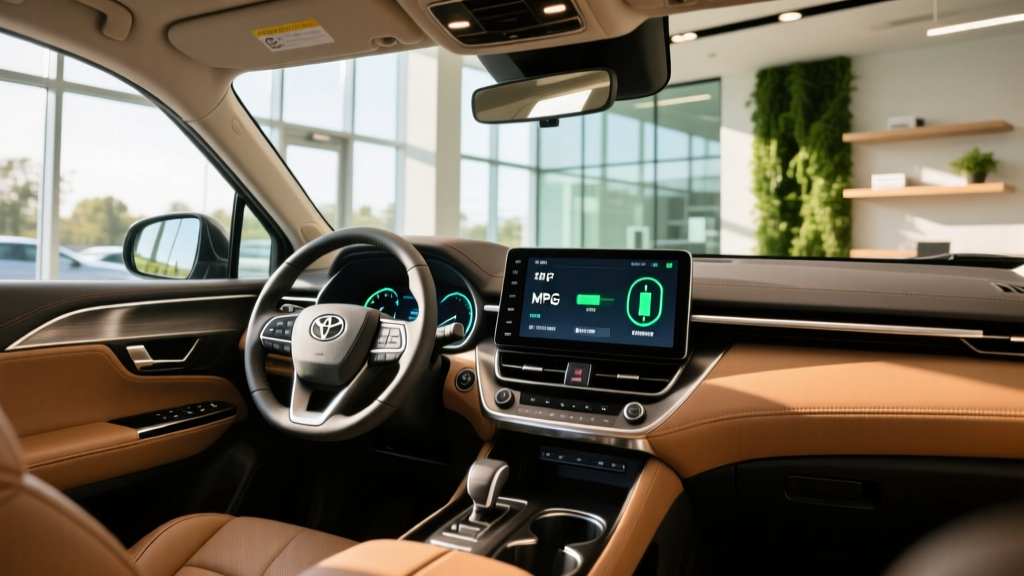
If you've searched for the Toyota Highlander Hybrid interior hoping for a tech-forward cockpit with massive screens, you'll find a more conservative approach. Toyota prioritizes durability, intuitive controls, and material quality over flashy displays. The result is a cabin that ages well and serves families effectively, even if it doesn't grab headlines at auto shows.
HEV vs. PHEV: Where the Highlander Hybrid Fits
Before diving into specs, it's essential to understand what the Highlander Hybrid is — and isn't.
| Feature | Highlander Hybrid (HEV) | Plug-In Hybrid (PHEV) Example: RAV4 Prime | Battery Electric (BEV) |
|---|---|---|---|
| Plug-in charging required? | No | Yes (optional but recommended) | Yes (mandatory) |
| Electric-only range | ~1 mile at low speed | 42 miles (RAV4 Prime) | 250–400+ miles |
| Battery size | 1.6 kWh (NiMH) | 18.1 kWh (Li-ion) | 75–100+ kWh |
| Federal tax credit (§30D) | Not eligible | Up to $7,500 (if eligible) | Up to $7,500 (if eligible) |
| Home charging install needed | No | Recommended (Level 2) | Required (Level 2) |
The Highlander Hybrid is a conventional hybrid (HEV). Its small 1.6 kWh nickel-metal hydride (NiMH) battery is charged exclusively by the gasoline engine and regenerative braking. You cannot plug it in. This is fundamentally different from a plug-in hybrid (PHEV) like the Toyota RAV4 Prime, which offers 42 miles of electric-only driving and qualifies for federal tax credits.
Toyota does not currently offer a Highlander PHEV in the United States. If plug-in capability is a priority, you'd need to look at competitors like the Kia Sorento PHEV or the Mazda CX-90 PHEV — though neither matches the Highlander's interior volume.
Powertrain Specs: 243 HP from a Four-Cylinder Hybrid
| Specification | 2026 Toyota Highlander Hybrid |
|---|---|
| Engine | 2.5L inline-4 (186 hp, 179 lb-ft) |
| Electric motors | Front: 134 hp / Rear: 40 hp (eAWD models) |
| Combined system output | 243 hp |
| Transmission | eCVT (electronically controlled continuously variable) |
| Drivetrain | FWD or eAWD (electronic all-wheel drive) |
| Battery type / capacity | NiMH / 1.6 kWh (usable) |
| 0–60 mph | ~7.8 seconds |
| Towing capacity | 3,500 lbs |
The Highlander Hybrid pairs a naturally aspirated 2.5-liter four-cylinder with two electric motor-generators in the front transaxle. eAWD models add a third, independent rear motor that engages automatically for traction. Unlike mechanical AWD systems, there's no driveshaft — the rear motor activates only when needed, minimizing efficiency losses.
The eCVT transmission isn't a traditional belt-and-pulley CVT. Toyota's Hybrid Synergy Drive uses a planetary gearset to seamlessly blend engine and motor power. The result is smooth, linear acceleration without the rubber-band feel some CVTs produce. However, under hard acceleration, the engine does drone at high RPM — a common hybrid trait that the Highlander's sound insulation only partially masks.
Fuel Economy: EPA Estimates and Real-World MPG
| Drivetrain | City | Highway | Combined |
|---|---|---|---|
| FWD (LE, XLE) | 36 MPG | 35 MPG | 36 MPG |
| eAWD (all trims) | 35 MPG | 35 MPG | 35 MPG |
Source: EPA Fuel Economy
These numbers are remarkable for a 4,500-pound, three-row SUV. For context, the non-hybrid V6 Highlander (discontinued after 2022) returned just 24 MPG combined. The hybrid nearly doubles that in city driving.
Real-World MPG: What Owners Actually See
Toyota's hybrid system excels in stop-and-go traffic, where the electric motors handle low-speed propulsion and regenerative braking recaptures energy. In real-world testing:
- City / suburban driving: 33–38 MPG — many owners report exceeding the EPA city estimate in moderate traffic because regen braking works hardest in these conditions.
- Highway cruising (70–75 mph): 28–32 MPG — hybrids lose their advantage at sustained high speeds where the gasoline engine does most of the work and aerodynamic drag dominates.
- Cold weather (below 30°F): 27–30 MPG combined — the engine runs more frequently to provide cabin heat and maintain battery temperature, reducing electric-motor utilization.
- Mountainous terrain: 25–29 MPG on sustained climbs, though regenerative braking on descents partially recovers the deficit.
With a 17.1-gallon fuel tank, expect a real-world range of 510–610 miles depending on driving conditions — enough for most families to visit a gas station just once or twice a month.
Toyota Highlander Hybrid Interior: Cabin Quality, Space, and Technology
The Highlander Hybrid's interior is where Toyota's conservative philosophy shows most clearly. This is a cabin designed for long-term durability and family functionality rather than wow factor.
Materials and Build Quality
Lower trims (LE, XLE) use a mix of soft-touch surfaces on the dashboard and door uppers with harder plastics on lower panels — typical for the segment. The XLE upgrades to SofTex synthetic leather seating that resists spills and holds up well to child seats. Limited and Platinum trims add genuine leather, wood-grain interior trim, and a panoramic moonroof that floods all three rows with natural light.
Panel gaps are tight, and Toyota's assembly quality remains a benchmark. Buttons and knobs operate with precise, damped action — the kind of detail that matters after 100,000 miles of daily use.
Seating and Cargo
The Highlander Hybrid seats up to eight passengers (seven with optional second-row captain's chairs on XLE and above). Key interior dimensions:
- Cargo behind third row: 16.1 cu ft — enough for a week's groceries or two carry-on suitcases, but tight for a full family road trip with the third row deployed.
- Cargo behind second row (third row folded): 48.4 cu ft — competitive with midsize rivals.
- Maximum cargo (all rear seats folded): 84.3 cu ft — nearly flat load floor.
Third-row space is adequate for children or shorter adults on trips under an hour. For regular adult third-row use, the larger Toyota Grand Highlander Hybrid (which adds 5.5 inches of length and significantly more third-row legroom) is worth considering.
Infotainment and Technology
The 2026 Highlander Hybrid features Toyota's latest Audio Multimedia system:
- LE / XLE: 8.0-inch touchscreen
- Limited / Platinum: 12.3-inch touchscreen with enhanced resolution
- Standard: Wireless Apple CarPlay and Android Auto, 6-speaker audio
- Available: JBL 11-speaker premium audio, navigation, Wi-Fi hotspot
The system is responsive and logically organized, with physical knobs for volume and tuning — a practical choice that many families prefer over all-touch interfaces. A 7-inch multi-information display in the instrument cluster provides hybrid energy-flow data, battery state of charge, and instant fuel economy readouts.
Pricing, Trims, and Tax Credit Eligibility
| Trim | MSRP (FWD) | MSRP (eAWD) |
|---|---|---|
| LE | $40,720 | $41,770 |
| XLE | $44,170 | $45,220 |
| Limited | $49,075 | $50,125 |
| Platinum | $52,475 | $53,525 |
Prices include destination charge. Source: Toyota Motor Sales
Federal Tax Credit: Not Eligible
§30D Federal Tax Credit Status: The Toyota Highlander Hybrid does not qualify for the federal §30D Clean Vehicle Credit. Under current IRS rules, only plug-in electric vehicles (BEVs and PHEVs) with a battery capacity of at least 7 kWh are eligible. As a conventional HEV with a 1.6 kWh battery, the Highlander Hybrid falls outside the credit's scope.
Some states and local utilities offer rebates for conventional hybrids, though these are increasingly rare as incentive programs shift toward plug-in vehicles. Check your state energy office or utility provider for current programs.
Battery Warranty, Reliability, and Replacement Cost
Hybrid Battery Warranty: 10 years / 150,000 miles (whichever comes first), covering defects and capacity loss below a specified threshold. This applies to all 50 states.
Powertrain Warranty: 5 years / 60,000 miles.
Basic Warranty: 3 years / 36,000 miles.
How Long Do Toyota Hybrid Batteries Last?
Toyota's NiMH hybrid batteries have an exceptional longevity track record. Data from fleet operators and long-term owners shows:
- Typical lifespan: 150,000–200,000+ miles before significant degradation.
- Degradation pattern: NiMH cells lose capacity gradually rather than failing suddenly. Most owners notice a slight fuel-economy decrease (1–3 MPG) after 150,000 miles as the battery holds less charge.
- Failure rate: Well under 5% within the warranty period, based on industry repair data.
Battery Replacement Cost
If replacement is needed out of warranty:
- New OEM battery (Toyota dealer): $3,000–$4,500 installed
- Refurbished / reconditioned battery: $1,500–$2,500 installed
- Individual cell replacement: $500–$1,200 (specialist hybrid shops can replace degraded cells rather than the entire pack)
For context, the smaller NiMH pack in a Highlander Hybrid is far less expensive to replace than the large lithium-ion packs in BEVs or PHEVs. This is one reason conventional hybrids carry lower long-term ownership risk than many buyers assume.
Overall Reliability
Toyota's hybrid system is among the most proven in the automotive industry, with over 25 years of continuous refinement since the original Prius. The Highlander Hybrid consistently earns above-average reliability ratings. The eCVT transmission has no friction bands or clutch packs to wear out, and the electric motors have no brushes — making them essentially maintenance-free. According to IIHS, the Highlander also earns top safety marks, giving families confidence beyond just powertrain durability.
Highlander Hybrid vs. PHEV vs. EV: Which Three-Row SUV Fits You?
Choose the Highlander Hybrid (HEV) If:
- You cannot charge at home (apartment, street parking, no garage)
- You want a proven, low-risk powertrain with 200k+ mile longevity
- You regularly drive long distances and don't want to plan around charging
- You want three rows and 35+ MPG without a plug-in premium
- You tow up to 3,500 lbs and need AWD
Choose a PHEV (e.g., Kia Sorento PHEV) If:
- You have home charging and a commute under 30 miles
- You want electric-only daily driving with gas-engine backup
- You want to qualify for the $7,500 federal tax credit
- You're willing to pay a higher MSRP for plug-in capability
Quick Decision Framework
Can you install a Level 2 home charger?
- No → Highlander Hybrid is the clear winner. No plug-in vehicle makes sense without reliable home charging.
- Yes → Do you regularly take road trips over 300 miles? Yes → Highlander Hybrid or a PHEV. No → Consider a three-row EV like the Kia EV9 for even lower operating costs.
Is the $7,500 tax credit important to your budget?
- Yes → Look at PHEVs or BEVs. The Highlander Hybrid offers no federal credit.
- No → The Highlander Hybrid's lower MSRP and no-charger-install cost may still make it the most economical choice over 5 years.
Frequently Asked Questions
How many MPG does the Toyota Highlander Hybrid get?
The EPA rates the 2026 Highlander Hybrid at 36 MPG combined (FWD) or 35 MPG combined (eAWD), with 36/35 city and 35/35 highway. Real-world results typically range from 28–38 MPG depending on driving conditions, with city driving often exceeding the EPA estimate and highway cruising falling slightly below.
Does the Toyota Highlander Hybrid need to be plugged in?
No. The Highlander Hybrid is a conventional hybrid (HEV). Its battery charges automatically through the gasoline engine and regenerative braking. There is no plug, no charging port, and no need for any home charging infrastructure.
Is there a plug-in hybrid (PHEV) version of the Highlander?
Toyota does not currently offer a Highlander PHEV in the US market. The larger Grand Highlander Hybrid is also a conventional HEV only. If you want a three-row Toyota-adjacent PHEV, no option currently exists. Competitors like the Kia Sorento PHEV (32 miles electric-only) or Mazda CX-90 PHEV (26 miles) are the closest alternatives.
How far can the Highlander Hybrid drive on electric power alone?
Less than 1 mile at very low speeds (under 25 mph). The Highlander Hybrid uses its electric motors primarily to assist the gasoline engine during acceleration and to enable engine-off coasting — not for sustained electric-only driving. This is normal for conventional hybrids with small battery packs.
Is the hybrid battery reliable, and what does replacement cost?
Toyota's NiMH hybrid batteries are among the most reliable in the industry, typically lasting 150,000–200,000+ miles. The battery is covered by a 10-year/150,000-mile warranty. Out-of-warranty replacement runs $3,000–$4,500 for a new OEM pack, or $1,500–$2,500 for a refurbished unit. Individual cell repair can cost as little as $500–$1,200 at a hybrid specialist.
Does the Highlander Hybrid qualify for any federal tax credit?
No. Under current IRS §30D rules, only plug-in vehicles (BEVs and PHEVs) with at least 7 kWh of battery capacity qualify for the federal Clean Vehicle Credit. The Highlander Hybrid's 1.6 kWh NiMH battery does not meet this threshold. Check your state and local utility for possible hybrid rebates, though these are uncommon.
How does the Highlander Hybrid compare to the Grand Highlander Hybrid?
The Grand Highlander Hybrid uses the same 243 hp powertrain but adds 5.5 inches of overall length, resulting in significantly more third-row legroom (33.5 vs. 27.7 inches) and cargo space behind the third row (20.6 vs. 16.1 cu ft). Fuel economy drops slightly to 34 MPG combined. If third-row usability is a priority, the Grand Highlander is the better choice — but it starts approximately $4,000 higher.